'%3E%3Cpath d='M16.3574 35.6519H12.9537L15.0491 18.8873L16.3574 35.6519ZM30.4229 54.0093L22.309 0.994385H7.91795L0 54.0093H10.6634L11.5802 46.3855H17.4014L17.9914 54.0093H30.4229Z' fill='%23971B20'/%3E%3Cpath d='M48.2073 41.8813C48.2073 43.4049 47.4892 44.0011 46.1144 44.0011H43.7595V11.0687H46.1144C47.4892 11.0687 48.2073 11.6636 48.2073 13.1885V41.8813ZM59.5273 43.6695V11.3326C59.5273 3.71323 53.5729 0.994385 47.8157 0.994385H31.7213V54.0093H47.8157C53.5729 54.0093 59.5273 51.29 59.5273 43.6695Z' fill='%23971B20'/%3E%3Cpath d='M90.183 0.994385H78.6039L75.0711 30.6157L71.9955 0.994385H59.4346L69.2474 54.0093H80.373L90.183 0.994385Z' fill='%23971B20'/%3E%3Cpath d='M107.063 42.3448C107.063 43.7359 105.951 44.5974 104.643 44.5974C103.269 44.5974 102.157 43.7359 102.157 42.3448V12.658C102.157 11.2676 103.269 10.4058 104.643 10.4058C105.951 10.4058 107.063 11.2676 107.063 12.658V42.3448ZM119.233 43.2723V11.7312C119.233 6.36384 112.952 -3.8147e-06 104.643 -3.8147e-06C96.2667 -3.8147e-06 89.9867 6.36384 89.9867 11.7312V43.2723C89.9867 48.6393 96.2667 55 104.643 55C112.952 55 119.233 48.6393 119.233 43.2723Z' fill='%23971B20'/%3E%3Cpath d='M150.976 43.9349V33.7309H139.069V42.3448C139.069 43.7359 137.957 44.5974 136.582 44.5974C135.076 44.5974 133.964 43.7359 133.964 42.3448V12.658C133.964 11.2676 135.076 10.4058 136.582 10.4058C137.957 10.4058 139.069 11.2676 139.069 12.658V21.2723H150.976V11.0687C150.976 5.70107 145.283 -3.8147e-06 136.582 -3.8147e-06C127.75 -3.8147e-06 121.796 5.70107 121.796 11.0687V43.9349C121.796 49.3022 127.75 55 136.582 55C145.283 55 150.976 49.3022 150.976 43.9349Z' fill='%23971B20'/%3E%3Cpath d='M167.478 35.6519H164.076L166.17 18.8873L167.478 35.6519ZM181.544 54.0093L173.432 0.994385H159.037L151.123 54.0093H161.785L162.704 46.3855H168.523L169.114 54.0093H181.544Z' fill='%23971B20'/%3E%3Cpath d='M205.412 10.4058V0.994385H177.081V10.4058H185.392V54.0093H197.428V10.4058H205.412Z' fill='%23971B20'/%3E%3Cpath d='M230.002 54.0093V43.9349H218.914V31.8746H226.635V21.8028H218.914V10.4058H230.002V0.994385H206.875V54.0093H230.002Z' fill='%23971B20'/%3E%3C/g%3E%3Cdefs%3E%3CclipPath id='clip0_260_7080'%3E%3Crect width='230' height='55' fill='white'/%3E%3C/clipPath%3E%3C/defs%3E%3C/svg%3E)
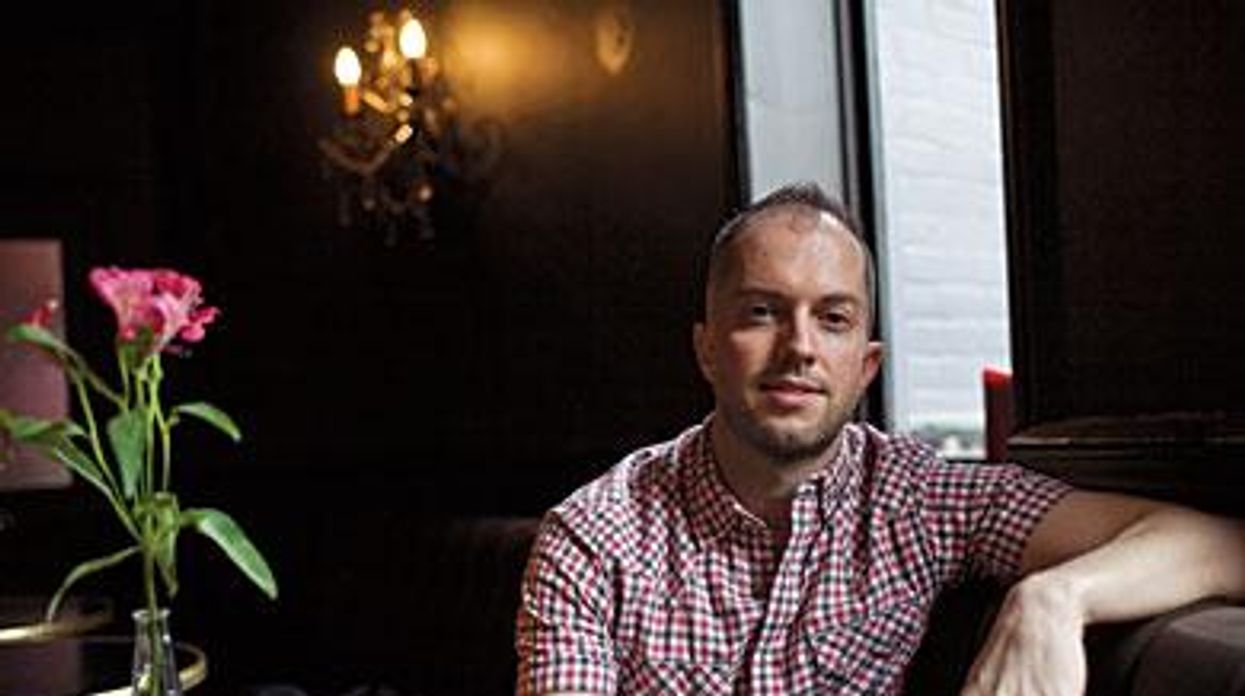

Lake Overturn has all the ingredients to be the next Great American Novel, including a dozen characters (these from mid-1980s Idaho) observed by an omniscient narrator who has humor, righteousness, and that rare ability to both dazzle and touch while remaining steadily entertaining. For all those reasons and more, it's the kind of story reviewers rhapsodize over. But to find the author of this Great American Novel -- the exotically named Vestal McIntyre -- one must fly to England and then negotiate a maze of subways and trains before emerging in Greenwich, the distant London borough where time begins and ends.
McIntyre gives the appearance of being an unassuming exchange student from middle America, here to study the ships on the Thames. In fact, he moved to England from New York City last July to live with his husband, Tristan le Masson Bangard. A disarmingly youthful 37, McIntyre has an air of delighted contentment that could have as much to do with domestic bliss as with anticipating the publication of his first novel.
In his writing McIntyre soars, but in person he speaks softly and steadily, making his voice heard over the clanging silverware and scraping chairs and tables at the picturesque cafe where he's chosen to meet for the interview.
Lake Overturn revolves around a group of people in Eula, Idaho, over the course of a year, spanning parts of 1986 and '87. At the center of the group are two seventh-grade boys -- Gene, an autistic youth, and Enrique, a misfit trying to reinvent himself -- who live in the same trailer park with their respective single mothers. The boys' romantic misadventures and an artfully arranged collection of friends and relatives round out the cast.
McIntyre takes characters who could easily be caricatures -- the rigidly religious, a young man attempting rape, a terminally ill mother -- and portrays them with empathy. "That's the best thing that books do," he says quietly over parsnip soup and English breakfast tea. "I wanted to write a big book with a broad perspective, like a good 19th-century novel. I love those Victorian novels with a lot of characters like Trollope and Dickens had."
Like his two main characters, McIntyre was in junior high in 1986, and there are similarities between the author and Enrique, especially as the teenage character explores his sexuality. "The most autobiographical part of Enrique is his effort in figuring out where he fits in at school," McIntyre says. I went to a Christian school until ninth grade, and I was kind of the school fag there. I hated it so much, I convinced my parents to let me go to public school."
McIntyre's favorite character in the book though is Connie, a dour middle-aged mother who questions God's will at every turn. "There is a lot of me in Connie," he says. "I was intensely Christian and concerned with how to live God's law perfectly." Then he pauses and adds, "But when you're writing a big book like this, you're not really thinking about yourself. I was just trying to write."
McIntyre's approach to writing is slightly unusual -- he's more of a binge writer than a daily one. Having living the past 13 years in New York, he says, "I'd spend all my time at my regular job so I could save up enough money to be able to take time off and go to [artists' residencies] like Yaddo, where I'd write huge sections of the book."
The key moment came in 2006, when he received a grant from the National Endowment for the Arts. "It was just enough money to take the summer off," he says. A family friend lent him a cabin in Maine. "It was just me, with no phone, no Internet, and just acres of land between me and the next person," he says wistfully. By the end of the summer he'd written a third of the novel. Certain scenes, especially the most powerful sections in the last 60 pages, he kept as treats until the end, when he was visiting Le Masson Bangard in London. "They were more bitter treats," he says today.
McIntyre's upbringing is far more interesting than most of the memoirs crowding the shelves of Waterstone's, the chain bookshop where he now works.
He grew up in Nampa, Idaho, a town not unlike the fictional Eula of Lake Overturn, and is the youngest of seven brothers and sisters. "We have kind of an interesting family," he says with an air of understatement. "There are four gay kids -- my brother and I are gay, and then two of my sisters are gay." Another brother is a Southern Baptist missionary based in Bangladesh.
"My parents wanted to live out in the country with sheep and horses, and they were very religious [Baptist] but weren't very rigid." His father, a pediatrician, cared for many patients who couldn't pay for his services and also took in boarders who couldn't afford to pay for a home of their own. "So we had these people in our house all the time, staying with us. There were wounded Afghan soldiers who had been invited to the U.S. by conservative groups but then didn't have a place to stay once they got there, foster brothers, exchange students, and people getting out of jail. It was kind of a zoo."
And what was it like for four siblings to come out to their religious parents? Did they all come out en masse?
"No," he says, laughing. "The other three came out before me. I had a girlfriend from 16 to 20, and she moved to Boston with me when I went to college. And when the whole thing ended, I came out. Actually, she told my parents! It was not cute."
As true Christians, his parents were very supportive. At one point, when the American Baptist Churches were debating the denomination's position on homosexuality, McIntyre says his mother stood up at the meeting and said, "I have four gay kids, and they grew up in this church. And if you don't vote to be affirming of them, they won't come here anymore. Is that what you want?"
I tell him that I remember Boston in the mid 1980s as a pretty homophobic place, and he looks askance. "In Idaho these rednecks would hang out outside the gay bar in Boise and throw beer bottles at people as they left," he says matter-of-factly. Tufts University, on the other hand, had a center where students could safely hang out: "Going to Boston made it possible for me to come out."
After earning his bachelor's degree, McIntyre moved to New York. He was accepted into the graduate creative writing program at Columbia University but decided to instead take a job as a waiter at Florent, the now shuttered Meatpacking District diner and then late-night home to drag queens, club kids, and the loudly fabulous. "Back then I didn't know my writing, and I would have been really influenced by other people," he says. "So I decided to do my own thing."
McIntyre had a few stories published in literary magazines, and in 2004 a collection of his work, You Are Not the One, was published by Carroll and Graf. "I didn't care how much it sold," he says, "but I really wanted a review in The New York Times." That came in February 2005, when the paper declared, "McIntyre's stories can be funny, but in a scary, manic Augusten Burroughs kind of way. And when they aren't -- when they focus on something as unexpected as a high school student who sets out to read Moby-Dick to a cousin with Down syndrome -- they're crushingly sweet." Today, McIntyre refers to You Are Not the One as a collection of experiments that helped him forge the voice that informs Lake Overturn.
It's also the book that led him to his husband. When the collection of stories was published in England in 2006, McIntyre flew over to promote it. One evening at a nightclub he bumped into a man named Tristan, leading to what McIntyre fondly recalls as "a tawdry introduction." Last year, after Florent closed, he and Le Masson Bangard were married in Palm Springs, Calif. A summer-long celebration ensued, then the couple moved to Le Masson Bangard's London home.
"I live here because federal law won't allow my husband to live in the U.S.," McIntyre says with a little bite. "In England we are treated like regular spouses, which is what we are. The way the U.K. sees it, this is a civil partnership. It is very civilized, and it just makes sense."
As for the glamour of their relationship -- those names alone -- McIntyre says, "It does sound pretty good. But in reality we're sitting there watching Battlestar Galactica in our underwear."
His life in England sounds pretty ideal too. "When I lived in New York, I'd have to go away to write, but here it's a lot quieter -- I live in a house with my husband instead of in a 300-square-foot apartment on the Lower East Side. I have a writing room that overlooks a garden and a 15th-century chapel right across the street." He smiles at the improbability of it all.
Even his job at the chain bookshop has its perks. His collection of short stories is available at the counter, and he enjoys his colleagues' company. "I work with these 18-year-olds, and they got me to read Twilight," he says, laughing. "I only enjoyed it to the point that I could talk with them about it like a high school girl would."
And is he ready for some degree of attention, or even literary fame? "I'm totally ready!" he declares. "I still don't quite believe that the book's finally getting out there. But I would be completely thrilled if it was a success, but I'm not crazy about working these day jobs."