When lesbian filmmaker Tanya Wexler heard about the treatment for female hysteria (i.e. orgasms) she says, "It made me laugh. I knew it was a story I had to tell." Her new film, Hysteria, which premiers today, is a romantic comedy wrapped around the amusing story of the first electro-mechanical vibrator, invented in 1880 by happenstance, at a time when Victorian prudishness coincided with the dawn of the electrical age.
Despite the fact that there are no out LGBT characters in the film, the sentiment of this charming, quirky film -- perhaps thanks to both the lead characters and director Tanya Wexler's acknowledged lesbian lens -- makes it feel like it belongs in squarely the lesbian cinema cannon.
Hugh Dancy is Dr. Mortimer Granville, a well-meaning doctor who is too earnest and caring to stay employed for long in the rather staid world of medicine. In an early scene, he's arguing with a senior physician over whether a woman needs her blackened and filthy bandages replaced (he's arguing for it) and has to explain that "germs" could get in and infect her leg, leading to gangrene or death. The stodgy doc doesn't believe in this newfangled thing called "germs" (which has thus far only been reported in obscure medical journals) and fires Dr. Granville on the spot. We get it, he's a different sort of man, and a different sort of doctor.
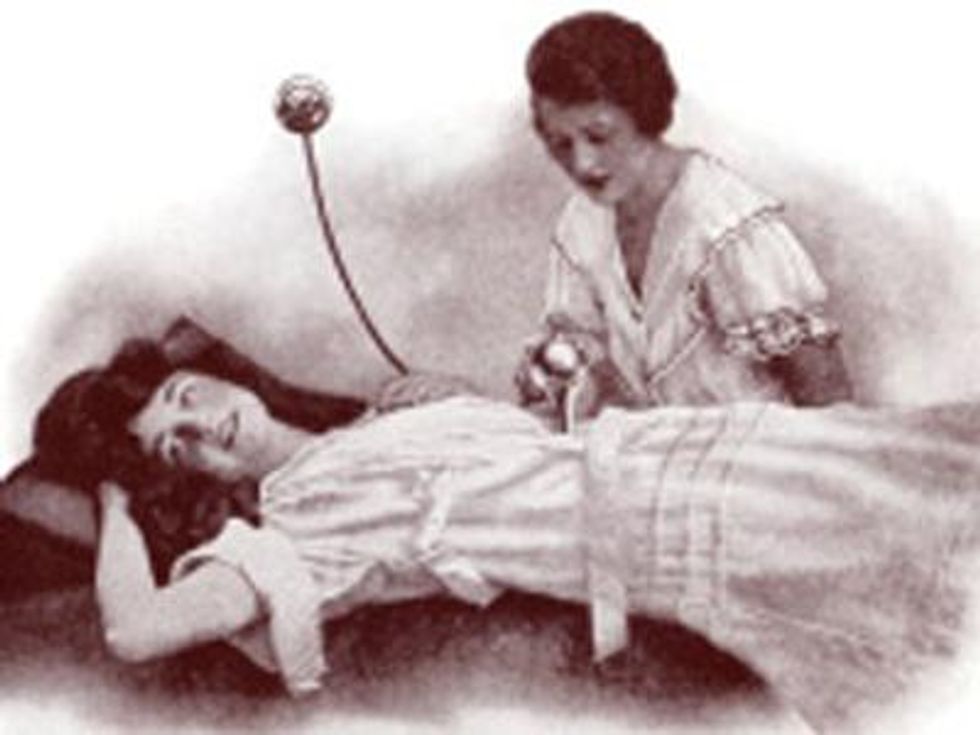
What does this have to do with vibrators or Maggie Gyllenhal or lesbians? A lot, actually. After a series of deflating job interviews, Granville ends up a fancy clinic with a older physician renown for treating female hysteria, which was --as you may know from your gender studies classes -- once a widely-diagnosed condition in the 19th century for women who suffered from everything from insomnia to eating disorders, shortness of breath, fainting, and general troublemaking. The treatment, as Dr. Granville learns, is a manual massage of the nether regions that leads the patient to "hysterical paroxysm." (The latter was a fancy word for orgasm, though the doctors at the time believed women couldn't orgasm and that these hysterical paroxysms were purely medical, not pleasurable.)
But Dr. Dalrymple, whose practice Granville ends up in, finds his waiting room always full of women seeking this treatment. Only his eldest daughter, Maggie Gyllenhall as Charlotte, believes that the women who see him aren't really ill but merely bored housewives, stuck at home with babies and husbands who can't pleasure (or listen) to them.
Not so for Charlotte. She's single and has a career her father finds unsuitable for a proper English lady: she works with the poor as a reformer and a sort of social worker running a center for the working poor and their kids where she serves food, teaches children in daycare, and helps people pay their bills and stay out of jail. (Read: lesbian.)
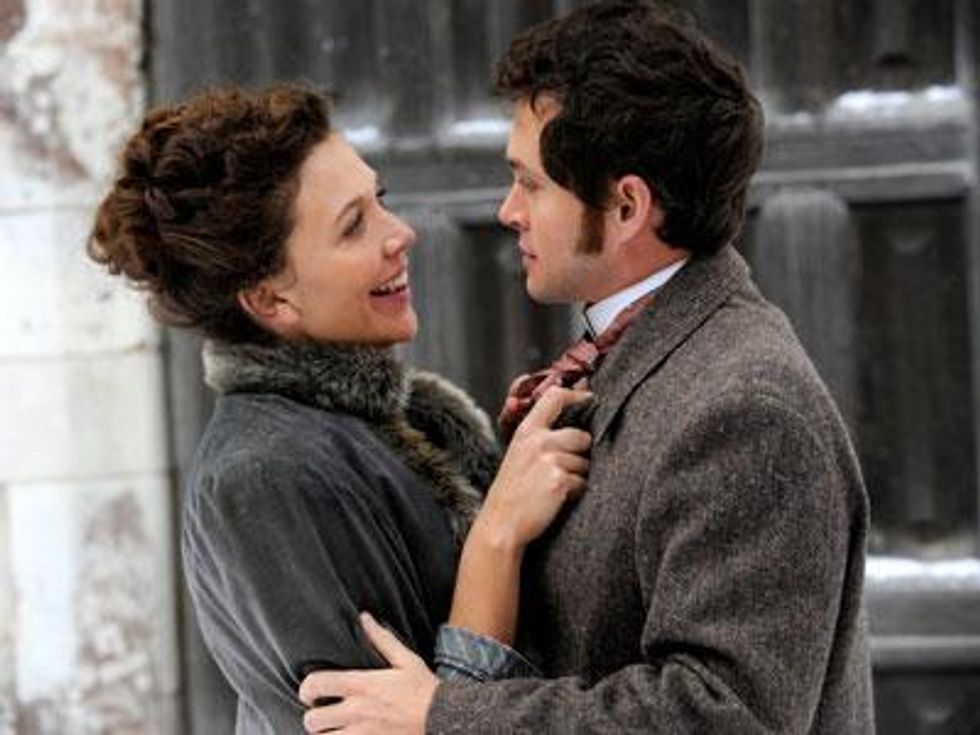
Much of the energy of the film is between Charlotte and Dr. Granville (who, I remind you, is a more sensitive modern man), and though it's between a man and woman, their relationship makes this feel in many ways like a classically queer feminist film. It's an outsider story, of one person who is boldly out, regardless of the costs, with a paramour who is struggling with whether or not to be true to oneself or to fit in and be who others want you to be. It's a perfect metaphor of same-sex relationships, for coming out, for women's liberation, for the fight we all have even today.
Charlotte has made her choice and even though she appears to fall for Granville, she never does so at the expense of her beliefs, her career, and her self. She's a firebrand and a women's rights advocate, and it's clear that she doesn't need to have someone else save her (or manually stimulate her -- she can stimulate herself, damn it).

It's no surprise that a lesbian made this film. Wexler, as a filmmaker, is a bit of a firebrand herself with an oeuvre that's small but impressive. Years ago she directed Ball in the House and the acclaimed film, Finding North (in which a woman gets fired, follows a random suicidal man to Texas, and discovers he's despondent over the death of his ex-boyfriend). Then she did something that Hollywood frowns on: she took 10 years off from filmmaking to help raise her kids with her partner of 17 years, actress Amy Zimmerman.
Zimmerman isn't the only name that Wexler could drop in Tinseltown circles. She's from a family of American legends: at one time her late father, Jerrold Wexler, owned many of New York City's top skyscrapers, including the World Trade Center; her uncle Haskell Wexler has been called one of film history's ten most influential cinematographers; and '80s film icon turned eco warrior Daryl Hannah is her half sister. She's even related, via an in-law, to Lou Adler, the music legend who owns The Roxy in Los Angeles. But from talking with her you'd know none of that.
Wexler, a disarmingly attractive brunette with a wicked grin and an even more devilish sense of wit, doesn't rely on that lofty familial pedigree; her talent speaks for itself. But, she admits that being a lesbian did help her understand the material in Hysteria. "I have been on both sides of table so to speak," she says. "So I know the situation from both the doctor and patients' point of view."
The hardest part was making sure that it was a "thoroughly British" film: "I was interested in the fact that in what can be a very proper -- some would say repressed --culture, such ideas and inventions [as the vibrator] were possible. I think that is where the comedy comes from, that contrast. So, in many ways, the more authentically British this movie felt, the funnier!"
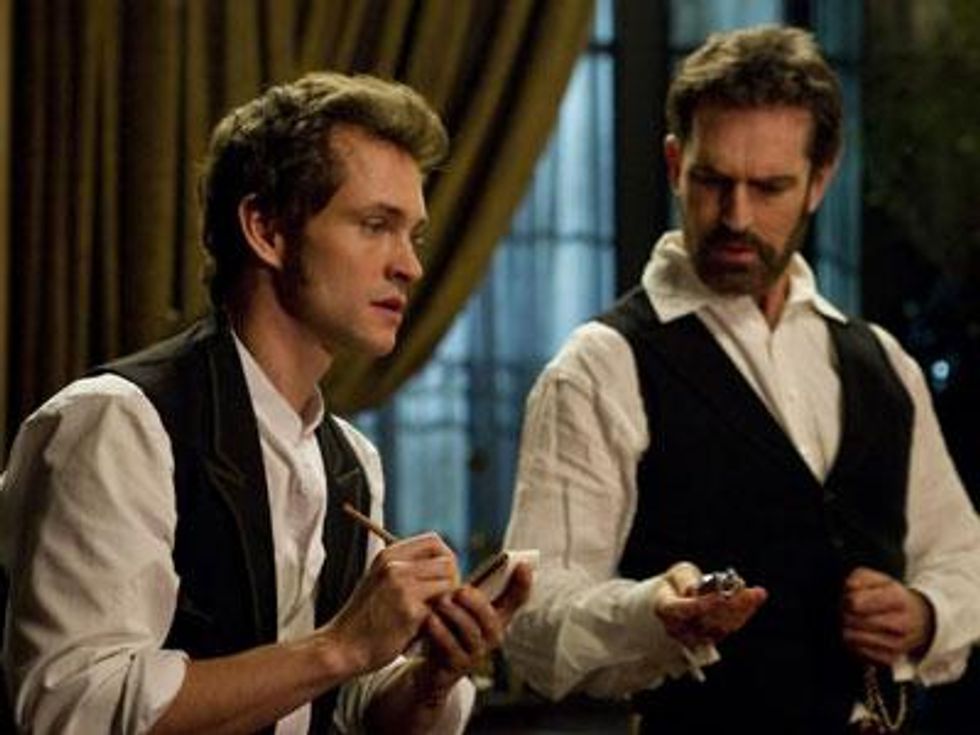
Wexler does right, too, by the often-miscast gay actor Rupert Everett, who adds whimsy to this film as the eccentric and wealthy Edmund St. John Smythe, who is so passionate about new technology that he has a telephone installed before Buckingham Palace does. As Smythe, Everett (below, right, with Dancy) is a brilliant and tenacious inventor, charming and aloof, curious about the way things work and how to make them better. Though he's clearly enamored of his friend Dr. Granville, the wealthy inventor is a bit detached from fellow man, a bit too flip and disorderly in his approach to others (is it affluence, brilliance, or Asperger Syndrome? Who knows?). He comes across as an aloof pre-Internet tech genius, the Victorian England version of Mark Zuckerburg.
In fact, Smythe is more than Granville's occasional benefactor; the doctor is Smythe's sounding board for inspiration. So when Granville comes home from work, tired from eight hours of "manually stimulating" lady parts, he tries out Smythe's latest invention, a mechanical feather duster thingy, on his hand. Immediately, Granville realizes that vibration might have a better purpose. And well, history is made on screen and off.
The vibrator, in fact, was one of the earliest patents. The San Francisco premier of Hysteria was held last week in conjunction with the grand opening of Good Vibrations' Antique Vibrator Museum. Showcasing collectibles from the 1800s and onward, the Vibrator Museum tells a fascinating story of history, health, and sexuality. Curator and staff sexologist Dr. Carol Queen said the new exhibit (see ad below) "contextualizes the vibrators' role in society and highlights how our attitudes around sex and female pleasure have evolved. It really gives us an appreciation for how far both society and technology have come, and it's fitting to house the exhibit in the original female-friendly adult retail store."
The turn-of-the-century vibes seen in Hysteria were a far cry from the modern technology but paved the way for today's pleasure, which is why Good Vibrations, the legendary queer-run sex toy company co-sponsored the San Francisco premiere of Hysteria. Still will all the hubub this spring over sex toys, one can't help but question whether the history of the vibrator is somehow yet to be discovered.
"Yes," says Wexler, thoughtfully. "Though I think after people see Hysteria they will know a whole lot more."
Though the American Psychiatric Association debunked the existence of hysteria as a disease in 1952, medical experts from the time of Hippocrates up to the 20th century believed that hysteria expressed the womb's revolt against sexual deprivation. In the film Hysteria, we see a sexual revolt of a different sort. Of course, Hysteria feels like a bit of a time capsule. Modern sexual mores aren't on display, and though Everett's Oscar Wildish character feels queer (and shows no interest in women, even a cute, flirty prostitute), his sexuality is never overtly named on screen. (Regardless, Evererett is in his element and this is clearly his best sidekick role since My Best Friend's Wedding.)
Still there's plenty of saucy sex talk in Hysteria, much of it at the expense of these rather clueless male doctors who somehow believe that women don't feel pleasure. In one scene, Charlotte teases Dr. Granville, saying, "It must be difficult pleasuring half the women in the city." He replies: "Pleasure has nothing to do with it, I can assure you." And Charlotte retorts, "I suppose that depends on whether you're over the table or on it."
Later, as Granville explains why his hands hurt, saying, "I must find a way to attend to these women properly," Smythe is quick to reply, "I believe the French had quite a bit of luck using their tongues."
These retorts are the ba-da-bing that makes up some great scenes, but it's Charlotte's spitfire intellectualism and activism that makes up much of Hysteria's joy.
The knowledge about women's sexuality and the use of sex toys has increased dramatically since the day Dr. Granville patented his vibrator (yes, Hysteria is a true story -- sort of). A new report in fact showed that there are more women in the U.S. who use vibrators (53%) than have husbands (51%). In fact, 45% of men also admit to using vibrators.
Debby Herbenick, associate director of the Center for Sexual Health Promotion, told Science Daily that research proves that women who use vibrators are healthier and happier than women who don't. "The study about women's vibrator use affirms what many doctors and therapists have known for decades," said Herbenick. "That vibrator use is common, it's linked to positive sexual function such as desire and ease of orgasm, and it's rarely associated with any side effects,"
Which is why stores that specialize in vibrators and other sex toys have grown exponentially in recent years and many of them are led by, owned by, or founded by lesbian or bisexual women: Babeland (which has three stores in New York and the flagship in Seattle); Good Vibrations (which has three stores in San Francisco, one each in Berkeley and Oakland, Calif., and Brookline, Mass.); Sugar in Baltimore; The Rubber Tree in Long Beach, Calif.; Smitten Kitten in Minneapolis; and that's just the tip of the iceberg if you consider online stores.
In fact, vibrators have become so ubiquitous that Jimmyjane, a luxury sex toy company, gave them out to celebrities attending the premiers of Hysteria in New York as did Good Vibes in San Francisco. One celebrity attendee, Angela Lansbury, got the vibrator and told amused onlookers it was her first. Very few women believed her.
So in our sexually diverse modern world, Hysteria might seem a bit like a throwback, perhaps anachronistic, a film about life as we once knew it. But, if an alarming number of women can't reach orgasm during sex (some surveys put it between 20% and 43%), have we really come that far from the era captured in Hysteria?
The auteur laughs. "Is that meant to be a pun?" Wexler teases. "Clearly we have progressed. I think it's undeniable. Maybe we can help that last 20% come along with the rest of us."