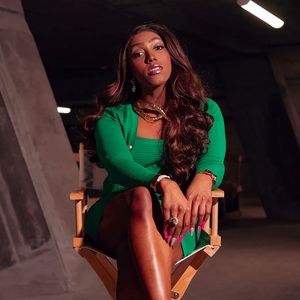


A breakout star from I Want to Work for Diddy, Laverne Cox returns in the unconventional makeover series Transform Me.
March 15 2010 2:35 PM EST
November 17 2015 5:28 AM EST
By continuing to use our site, you agree to our Private Policy and Terms of Use.
A breakout star from I Want to Work for Diddy, Laverne Cox returns in the unconventional makeover series Transform Me.
A breakout star from season 1 of the VH1 reality show I Want to Work for Diddy, Laverne Cox returns to the network in Transform Me, a makeover series based on an original concept she pitched with her production company, Complete World Domination. Transform Me, which premieres March 15, follows Cox and fellow transgender fashionistas Jamie Clayton and Nina Poon across the country as they offer their makeover subjects much more than meets the eye. Cox, who transcends the unattractive tribulations that have dogged trans actresses of color, explains why she's never tried to pass as anything but cute.
The Advocate: When it comes to giving makeovers, what advantages do trans women have over biological females?
Laverne Cox: Not all transgender women are into style and beauty, but the three of us -- Nina, Jamie, and I -- are all immersed in clothes and fashion. But it's really more about having a vision about who you are and projecting that vision outward. We always knew who we were on the inside, but as transgender women, that wasn't always reflected on the outside. I don't want to say that we have an edge, but because we've been so meticulous about making our outsides match our insides, we feel we do have a different perspective.
Each man on the Queer Eye makeover team brought his own individual expertise to the mix. As for your Transform Me costars, Jamie is a successful makeup artist and Nina is a fashion expert and model. What do you bring to the makeover table?
I deal with what's going on on the inside. It's always been my belief that if we let ourselves go or if we're stuck in a rut aesthetically, there's something psychological or emotional that's keeping us from making a change. If you don't deal with the root of the problem, changing somebody's hair and makeup doesn't make a difference. Much of my own transformation has been about more than the outside; it's been about letting go of the old, bad notions I had about myself.
Did you and the other two ladies get along or were there any catfights off-camera?
It's amazing how many people ask that! People always assume a cast of women is fighting -- and they're hoping for it. No, we all love each other and have known each other for years. We're so happy and grateful to have this opportunity to not only impact the lives of each woman we make over but also hopefully impact lives across the country.
Your makeover subjects don't know you're trans women until you show up at their doors. What's the reasoning behind that choice?
There aren't a lot of transgender people on television, so the reactions our makeover subjects might have to us might mirror the reactions that America might have to us. The makeover subjects may raise the same questions America has about transgender folks. We didn't tell them ahead of time because we wanted truthful reactions when they met us. All but one of the women had never met anyone transgender before.
Did the surprise revelation make any of the women uncomfortable?
You'll just have to watch and see how we handle it, but it gets juicy. The reality is that we're in the infancy stage in terms of transgender representation in the media. We've seen exploitative and stereotypical representation of transgender folks for years, but rarely do we have diverse, humanized representation, and I'm proud that our show is bringing that to the country.
In the premiere episode Nina comments that your makeover subject looks like she's thinking, "How dare these bitches look better than I do and they weren't born women!" Have you often gotten that attitude?
I have. I don't even know what to say to a woman who asks, "Why do you look better than me?" I think everyone's beautiful, so it's kind of ridiculous, but it's also part of the reason for this show. So many people have come up to me over the years and asked, "How do you do your makeup?" and "Can you help dress me?" So there must be something there, and hopefully people can learn from what we have to offer.
What would you do if some lady rang your doorbell and tried to make you over?
[Laughs] Well, I haven't asked to be made over. I'm not an advocate of ambush makeovers, because even if you think somebody looks crazy, they might be feeling really cute about themselves. It's all about living for yourself: If you're feeling cute, feel cute! All of these women have asked for makeovers because they're not feeling cute.
For your first makeover you returned to your hometown of Mobile, Ala. Was that strange, or have you gone back to Mobile often since your transition?
My mom still lives there, so I've been going back about once a year for the past five years. It is weird going back because I felt very isolated growing up in Mobile. I was a very feminine child, and that was rough for me because everyone thought I was a boy. I had to suppress all my feelings about being a girl, so I was desperate to get out of there as a kid. But now I feel grateful I had a place like Mobile to grow up because it really shaped me into who I am today, and I love myself.
Your childhood pictures are briefly displayed in Transform Me's opening sequence. The trans people that I know aren't exactly eager to discuss their pre-transition lives, let alone show photographic evidence of it to strangers. Was the decision to display one of your "boy" pictures difficult for you?
It was a hugely difficult decision. I've been acting for years, and people have often asked me for old photos, but I can't count how many times I've had to say, "Absolutely not." So when the network said, "We really need to see pictures of you from before," all three of us were like, "Um, we're not doing that." But because this is a makeover show where "before and afters" are important, we consented to do it. Under any other circumstances, we wouldn't have.
The idea of passing seems very different in the trans community than it is in the gay community, where the desire to pass as straight is often considered counterproductive or offensive. You're obviously openly transgender on your show, but how important is it for you to pass as a biologically born female in your everyday life?
Oh, wow, that's a great question. Whenever I heard "passing" when I started immersing myself in the transgender community, I immediately thought about my black history -- when black folks needed to pass back in the day. Some black people who could pass felt they needed to pass because they lived in a cultural context that was hostile to them because of their race; it wasn't about changing that cultural context. Any necessity an individual might feel to pass is a reaction to discrimination that needs to be eradicated, so I personally think passing is problematic. I've always been out as a trans woman. I've endured so much harassment and discrimination in my lifetime, so I respect those who just want to live their lives quietly, but politically I feel it's crucial that we're out as transgender people. People need to see that transgender people are diverse -- that we're doctors, lawyers, parents, sisters, brothers, and everything in between. The more we come out and put faces on the transgender community, the more perceptions will change.
Do you find it harder to gain acceptance as a trans woman within the African-American community?
I can't speak for everyone, but it has been harder for me, and some black girlfriends of mine feel the same way. I don't want to suggest that black folks are more transphobic than other groups, but I do know that a black transgender woman living in a black neighborhood gets harassed more than a white transgender woman would. Even a white transgender woman who might pass, black people don't care -- they're like, "Oh, that's a white thing." But they're disturbed when they see another black person who's transgender because they feel it's somehow an affront to the race. A lot of black folks need evolution, but a lot of white folks do too.
With your participation on I Want to Work for Diddy, you became the first African-American trans woman on a reality show. Are you comfortable being a role model for the trans community?
The term "role model" seems ridiculous to me, but I am aware that I've inspired some other transgender girls -- like Jaila Simms, who won Diddy's Making His Band. That's a big deal to me, so I take it seriously. I do feel a certain responsibility to my community, but I'm a human being, so I have flaws and I'm going to make mistakes, which has to be OK. So many black transgender women wrote to me when I was on I Want to Work for Diddy and said they'd never seen any black trans woman represented on television as professional and articulate. It's not usually so positive or uplifting when we see black trans women in the media.
You've played a number of transgender prostitutes, including your recent guest spots on Bored to Death and Law & Order. Is it frustrating that the few roles offered to trans women are so often hookers?
Well, that's why I started producing. I realized that people weren't writing complicated roles for transgender actresses, so I needed to start creating roles for myself. I'm happy to be in the reality realm, but there still aren't many acting roles written for us that go beyond prostitutes, particularly for transgender women of color. But as an artist, I try not to judge a character, like, "Oh, she's a prostitute, so I can't play that." That's ridiculous, because there are transgender women who are prostitutes, and that doesn't mean these characters aren't human beings. I try to bring humanity to whatever role I play. It can get frustrating, though. I remember one day I was so excited that I had three auditions, but in every single one I was playing a hooker. It's really sad that this is what the industry thinks of us, but I believe it can and will change. Baby steps.
You accepted the 2009 GLAAD Media Award for Outstanding Reality Series for I Want to Work for Diddy. What was your experience like at the San Francisco ceremony?
Diverse representation of transgender people in the media is so important to me that I've made it my life's work, so to be recognized by an organization with a similar purpose was so incredibly validating. I met Calpernia Addams for the first time -- we were cowinners because she also won for Transamerican Love Story -- and she's a delight. She's done so much amazing work for our community. I also met Dustin Lance Black, who I'm a huge fan of. There were a bunch of other amazing people there I didn't meet because I was too shy. I may not seem shy, but I can't go up to celebrities and be like, "I'm a huge fan!"
You're a writer, a contributing producer, and a subject of T, an upcoming documentary on trans women executive-produced by Janet Jackson. Have you met her?
I have not met her yet because she mostly communicates with one of my business partners through her managers, but she did invite us all to her concert a couple years ago. She's been so supportive of the transgender community. T has been a labor of love for our production company for a really long time because it's been difficult to get off the ground, but hopefully it'll be coming out soon.
Want more breaking equality news & trending entertainment stories?
Check out our NEW 24/7 streaming service: the Advocate Channel!
Download the Advocate Channel App for your mobile phone and your favorite streaming device!