'%3E%3Cpath d='M16.3574 35.6519H12.9537L15.0491 18.8873L16.3574 35.6519ZM30.4229 54.0093L22.309 0.994385H7.91795L0 54.0093H10.6634L11.5802 46.3855H17.4014L17.9914 54.0093H30.4229Z' fill='%23971B20'/%3E%3Cpath d='M48.2073 41.8813C48.2073 43.4049 47.4892 44.0011 46.1144 44.0011H43.7595V11.0687H46.1144C47.4892 11.0687 48.2073 11.6636 48.2073 13.1885V41.8813ZM59.5273 43.6695V11.3326C59.5273 3.71323 53.5729 0.994385 47.8157 0.994385H31.7213V54.0093H47.8157C53.5729 54.0093 59.5273 51.29 59.5273 43.6695Z' fill='%23971B20'/%3E%3Cpath d='M90.183 0.994385H78.6039L75.0711 30.6157L71.9955 0.994385H59.4346L69.2474 54.0093H80.373L90.183 0.994385Z' fill='%23971B20'/%3E%3Cpath d='M107.063 42.3448C107.063 43.7359 105.951 44.5974 104.643 44.5974C103.269 44.5974 102.157 43.7359 102.157 42.3448V12.658C102.157 11.2676 103.269 10.4058 104.643 10.4058C105.951 10.4058 107.063 11.2676 107.063 12.658V42.3448ZM119.233 43.2723V11.7312C119.233 6.36384 112.952 -3.8147e-06 104.643 -3.8147e-06C96.2667 -3.8147e-06 89.9867 6.36384 89.9867 11.7312V43.2723C89.9867 48.6393 96.2667 55 104.643 55C112.952 55 119.233 48.6393 119.233 43.2723Z' fill='%23971B20'/%3E%3Cpath d='M150.976 43.9349V33.7309H139.069V42.3448C139.069 43.7359 137.957 44.5974 136.582 44.5974C135.076 44.5974 133.964 43.7359 133.964 42.3448V12.658C133.964 11.2676 135.076 10.4058 136.582 10.4058C137.957 10.4058 139.069 11.2676 139.069 12.658V21.2723H150.976V11.0687C150.976 5.70107 145.283 -3.8147e-06 136.582 -3.8147e-06C127.75 -3.8147e-06 121.796 5.70107 121.796 11.0687V43.9349C121.796 49.3022 127.75 55 136.582 55C145.283 55 150.976 49.3022 150.976 43.9349Z' fill='%23971B20'/%3E%3Cpath d='M167.478 35.6519H164.076L166.17 18.8873L167.478 35.6519ZM181.544 54.0093L173.432 0.994385H159.037L151.123 54.0093H161.785L162.704 46.3855H168.523L169.114 54.0093H181.544Z' fill='%23971B20'/%3E%3Cpath d='M205.412 10.4058V0.994385H177.081V10.4058H185.392V54.0093H197.428V10.4058H205.412Z' fill='%23971B20'/%3E%3Cpath d='M230.002 54.0093V43.9349H218.914V31.8746H226.635V21.8028H218.914V10.4058H230.002V0.994385H206.875V54.0093H230.002Z' fill='%23971B20'/%3E%3C/g%3E%3Cdefs%3E%3CclipPath id='clip0_260_7080'%3E%3Crect width='230' height='55' fill='white'/%3E%3C/clipPath%3E%3C/defs%3E%3C/svg%3E)

This story originally appeared on Them.
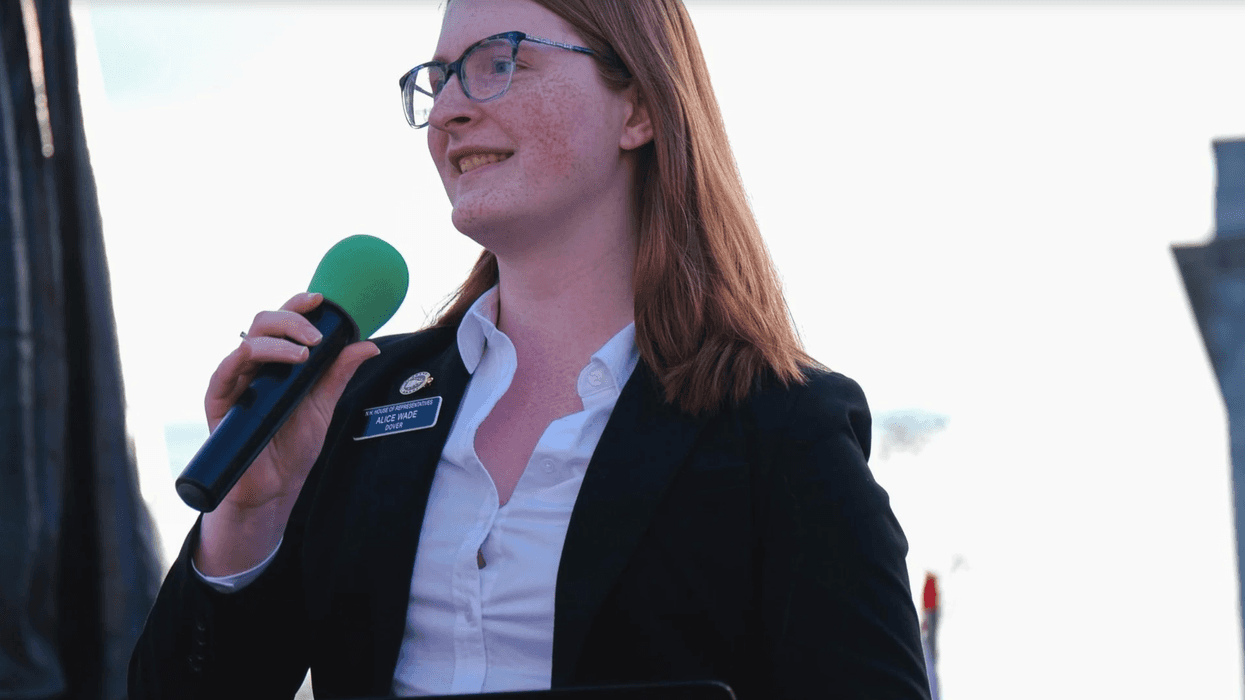
New Hampshire Democratic state representative Alice Wade has spent her brief time in office pushing forward progressive policy points, often fighting against anti-transgender legislation such as bathroom restrictions and gender-affirming care bans since being elected in 2024. As the 25-year-old’s nascent political career gained momentum in the spring of 2025, Wade tells Them that she considered an exploratory campaign for Congress in the state’s 1st Congressional District (CD-1), seeking the backing of other progressives.
That all came to a halt, she says, after Democratic Socialist U.S. House candidate and fellow progressive state representative Heath Howard pressured her to end her campaign, allegedly saying that because Wade is a trans woman, she would stand no chance of being elected. Instead, Wade said Howard told her to support his bid for CD-1.
“Last year, a fellow state representative and someone I considered a close friend called me repeatedly, telling me not to run for Congress,” she posted to Facebook on August 3. “He told me our friendship would be over if I stayed in the race. He questioned my integrity. He tried persuading me with promises of future political support if I stepped aside. And, most painfully, he told me that because I’m an openly transgender woman, I stood no chance of winning higher office in New Hampshire.”
In the fallout of the public statement, multiple other New Hampshire progressives such as state rep. Alissandra Murray, organizer Melody Knapp, and Brandon James Lemay, — the latter of whom ran for state representative in Hillsboro, New Hampshire in 2022 — have all come forward their own criticisms of Howard, describing a pattern of pressuring other progressive candidates, particularly women, to not run against him.
“I have personally witnessed attacks on progressive organizations, colleagues, and political opponents, including through burner accounts and campaign proxies used to spread attacks and misinformation,” Murray wrote on a post to Instagram and Facebook. “He has gone so far as to shout at individuals in public when they don’t submit to his pressure campaign, including myself. Too often, the targets have been women and members of marginalized communities.”
Though Wade says she prefers not to focus on interpersonal conflict in the context of politics, when she realized others had allegedly experienced similar problems with Howard, she said she felt compelled to speak out about her experience.
“What made me come forward is that, recently, I started hearing from others about how he's treating them the same way he did me,” Wade tells Them. “I realized this is a pattern of behavior and it’s hurting a lot of people and it needs to stop. If me coming forward can make all of those individuals who Heath has treated in a similar way realize that they are not alone, that it's not their fault, then I thought me coming forward would do more good.”
Them reached out to Howard for comment on Wade’s allegations. In response, Howard pointed to a 2025 exchange with fellow Democratic state representative Jonah Wheeler over an anti-trans bathroom bill, and his voting record at large.
“I am proud to be an ally for trans rights,” he wrote, adding, “I endorsed Alice in her 2024 contested primary, half of my campaign team is trans, and I am supporting trans candidates up and down the ballot this election cycle.”
On the subject of what Wade says he told her about her electoral viability, Howard wrote, “Words can be misconstrued. A lot of feelings have been hurt over this, and I am working hard to connect with voters about my voting record, and how we will always stand in lockstep with the LGBTQ+ community.”
A senate campaign strategy gone wrong
During the spring of 2025, Wade was feeling hopeful. She had quickly built working alliances and friendships with other progressives in the state house, such as Howard, sponsoring bills that would mandate employers protect workers from extreme temperatures, prevent vapes from being marketed to children, and protect the private data of medical patients.
When Howard told her he was considering running for Congress in March 2025, Wade says she expressed support. After her mentors encouraged her, given her successful first year, Wade said she too considered running an exploratory campaign to see if she would be a viable progressive candidate for CD-1. She tells Them that if another progressive candidate had turned out to be “better positioned,” she fully intended to end her campaign and support them.
This isn’t an unheard-of strategy in politics, much less among progressive candidates. During the mayoral elections in New York City the same year, now-Mayor Zohran Mamdani and Democratic U.S. House candidate Brad Lander ran their campaigns on similar platforms, cross-endorsing each other throughout the Democratic primary, eventually beating out establishment Democrat and former New York governor Andrew Cuomo. The strategy helped bolster progressive support for the left and eventually won Mamdani the election, but more crucially, put a Democratic Socialist in the the highest office of a major city.
That’s why when Wade told Howard, a long-term political ally and friend, about her intentions to run an exploratory campaign for Congress in May, to build a similar grassroots coalition, she says she felt surprised when their friendship “changed overnight” as a result. From May through the summer, Wade says their conversations shifted from legislation to Howard repeatedly asking her to drop out of the race, eventually culminating in him allegedly telling her he didn’t believe she could win because she is trans.
“I felt hurt when Heath called me multiple times and said that as a trans candidate, I couldn't win,” she tells Them. “I'm not blind to the fact that me being trans is something that I have to deal with because I deal with it every day. I'm already dealing with it as a trans legislator. Coming from somebody who had supported me against some of the anti-trans bills during floor fights, it felt very hurtful.”
But fellow progressives say that Howard’s alleged efforts to get Wade to drop out of the race extended beyond private conversations between the two. Several progressives say that Howard disparaged Wade behind her pack, in private conversations.
“Around May 2025, Heath called me to try and convince me that you were unelectable as a trans woman,” Brandon James Lemay, who ran for state rep. in Hillsboro, New Hampshire in 2022, wrote under Wade’s public statement. “He attempted this by feigning concern that other people wouldn't support or vote for you because you are trans. I'm sorry I failed to realize [the] severity of how far Heath would take this. Thanks for speaking up.”
Murray, a state rep. since 2022 who frequently organized with Howard and Wade, tells Them that the trio often worked together. But after Wade expressed her desire to run an exploratory congressional campaign for the same seat Howard is currently running for, Murray says they immediately noticed a change in his behavior.
“He started talking about how she was a trans woman and couldn’t win in this district because trans women can’t run in New Hampshire,” they tell Them. “He said that people would think that she supported the genocide in Gaza because she's an aerospace engineer — but she’s a conscientious objector and doesn’t do anything related to any contracts with the Department of War [...] Just all these different things to paint her out as not a real working-class person, not a progressive, not someone who was going to stand for a free Palestine, which were all against reality.”
In September 2025, Wade made the decision to drop out of the race, in part because of the financial toll, in part because of the difficulty of maintaining a full-time job while campaigning, and in large part, she says, because of the pressure from Howard.
A pattern of behavior splintering progressive power
Murray says this is not the first time they observed this behavior from Howard towards other progressives, which is what compelled them to speak out. In May 2025, when former journalist Hanna Trudo was considering a congressional run, Murray alleges Howard told Them Trudo needed to be “put in her place.”
In January 2026, WMUR released text messages between Howard and Democratic New Hampshire gubernatorial candidate Jon Kiper from spring of 2025 that showed the two discussing the state Democratic Party.
“Maybe it was just my experience, but I don't think the NHDP wants to support cis white men. [They] basically told me that,” Kiper wrote to Howard. "Women kind of run the party.”
“Yeah, but that’s why we keep losing,” Howard wrote.
Howard’s alleged behavior towards Wade, per Murray, made it difficult for progressives in the statehouse to organize.
“It's a huge problem because that is fracturing the power we can build as a progressive movement in order to actually actualize change in the state,” Murray tells Them. “Organizers on the ground need to be able to trust and work with the legislators who support the same issues they do and have the same goals that they have.”
But the trend of Democrats edging out trans candidates isn’t unique to this New Hampshire congressional race. Per a report by Hope Pisoni for Uncloseted Media, Jordan Goodman, a trans candidate, was reportedly edged out of a campaign for a seat in the state Governor’s Council by her Democratic opponent Ronald Iacobucci, even after securing endorsements from local Democrats.
In Michigan, Congressional candidate Joanna Whaley faced baseless accusations from her Democratic opponent Frank Liberati of violating campaign regulations for not running under her deadname. In its report, Uncloseted Media identified a growing trend of Democrats pressuring potential trans candidates out of local races.
Following Wade’s public statement, Howard initially told the NH Journal, “I did not say that.” But the following day, the state rep. told WMUR in an August 4 statement that the dispute was a misunderstanding.
“Intent and impact are different things,” he said. “It was never my intent to reduce Alice's candidacy to her identity, but I recognize that my words caused unintended harm, and I sincerely apologize.”
In the aftermath, Wade says she has received more support than she ever expected, in addition to others stepping forward to share their experiences with Howard. Ultimately, she hopes the ordeal can open the door for other marginalized candidates to run for office.
“I’m not the only one who's experienced this sort of dismissal in politics. It happens all the time. We talk about whether a woman is an electable candidate for president all this time, and pointing fingers at all these identities as the reason for these issues,” she tells Them. “That’s the case with jobs. That’s the case with people in public. They’re told, ‘Nobody’s done it before, so don’t even try.’ You’ll face these obstacles that you already know exist.”
She continues, “For me, the point is I don’t need to be told those obstacles exist. I need help breaking down those obstacles so that whoever the next person is doesn’t have to deal with the same issues that I have. Rather than having somebody try to convince you that you shouldn’t try that for whatever reason, let me give it a shot. Don’t make that decision for me.”
Get the best of what’s queer. Sign up for Them’s newsletters.