'%3E%3Cpath d='M16.3574 35.6519H12.9537L15.0491 18.8873L16.3574 35.6519ZM30.4229 54.0093L22.309 0.994385H7.91795L0 54.0093H10.6634L11.5802 46.3855H17.4014L17.9914 54.0093H30.4229Z' fill='%23971B20'/%3E%3Cpath d='M48.2073 41.8813C48.2073 43.4049 47.4892 44.0011 46.1144 44.0011H43.7595V11.0687H46.1144C47.4892 11.0687 48.2073 11.6636 48.2073 13.1885V41.8813ZM59.5273 43.6695V11.3326C59.5273 3.71323 53.5729 0.994385 47.8157 0.994385H31.7213V54.0093H47.8157C53.5729 54.0093 59.5273 51.29 59.5273 43.6695Z' fill='%23971B20'/%3E%3Cpath d='M90.183 0.994385H78.6039L75.0711 30.6157L71.9955 0.994385H59.4346L69.2474 54.0093H80.373L90.183 0.994385Z' fill='%23971B20'/%3E%3Cpath d='M107.063 42.3448C107.063 43.7359 105.951 44.5974 104.643 44.5974C103.269 44.5974 102.157 43.7359 102.157 42.3448V12.658C102.157 11.2676 103.269 10.4058 104.643 10.4058C105.951 10.4058 107.063 11.2676 107.063 12.658V42.3448ZM119.233 43.2723V11.7312C119.233 6.36384 112.952 -3.8147e-06 104.643 -3.8147e-06C96.2667 -3.8147e-06 89.9867 6.36384 89.9867 11.7312V43.2723C89.9867 48.6393 96.2667 55 104.643 55C112.952 55 119.233 48.6393 119.233 43.2723Z' fill='%23971B20'/%3E%3Cpath d='M150.976 43.9349V33.7309H139.069V42.3448C139.069 43.7359 137.957 44.5974 136.582 44.5974C135.076 44.5974 133.964 43.7359 133.964 42.3448V12.658C133.964 11.2676 135.076 10.4058 136.582 10.4058C137.957 10.4058 139.069 11.2676 139.069 12.658V21.2723H150.976V11.0687C150.976 5.70107 145.283 -3.8147e-06 136.582 -3.8147e-06C127.75 -3.8147e-06 121.796 5.70107 121.796 11.0687V43.9349C121.796 49.3022 127.75 55 136.582 55C145.283 55 150.976 49.3022 150.976 43.9349Z' fill='%23971B20'/%3E%3Cpath d='M167.478 35.6519H164.076L166.17 18.8873L167.478 35.6519ZM181.544 54.0093L173.432 0.994385H159.037L151.123 54.0093H161.785L162.704 46.3855H168.523L169.114 54.0093H181.544Z' fill='%23971B20'/%3E%3Cpath d='M205.412 10.4058V0.994385H177.081V10.4058H185.392V54.0093H197.428V10.4058H205.412Z' fill='%23971B20'/%3E%3Cpath d='M230.002 54.0093V43.9349H218.914V31.8746H226.635V21.8028H218.914V10.4058H230.002V0.994385H206.875V54.0093H230.002Z' fill='%23971B20'/%3E%3C/g%3E%3Cdefs%3E%3CclipPath id='clip0_260_7080'%3E%3Crect width='230' height='55' fill='white'/%3E%3C/clipPath%3E%3C/defs%3E%3C/svg%3E)


Only some of the Whitney Museum's galleries were hushed during the 2010 Biennial exhibition when I visited. On the third floor a collection of video pieces was exhibited in a maze of dark rooms, each with a soundtrack that mingles with the others. But for artist Rashaad Newsome's video piece, only laughter from the viewers filled the room. His pieces, Untitled and Untitled (New Way) were silent, focusing on animated portraits of single dancers performing a dance style called vogue.
In the gallery the teenage French tourist were likely giggling because of the dance's gender-bending. In Untitled one svelte male dancer is dressed in tight pants with a billowy, sequined blouse-like top, bleach-blond hair, and dandyish heeled boots, contorting his body in serpentine poses before breaking them down to a beat that isn't there, all while tossing out seemingly flippant feminine hand gestures. His movements are confident and seemingly instinctual, leaving only his baggy shirt to trail behind in question. Through this he stares unsympathetically at the viewer -- both seducing and repelling. When one video stops the teens scream for another.
When I met with Newsome at his Chelsea studio, he talked from behind an antique art deco desk stacked with both magazines and several blinking external hard drives. He was framed by a collection of several gigantic baroque gold frames leaning against the wall behind him. He tells me how he has been inspired by casual gestures and how body language is used as communication. Newsome is quite reserved and refreshingly laconic.
He considers his Whitney Biennial pieces to be an archive of sorts of vogue in its purest forms, but Newsome also records the more pedestrian street theater of urban female body language in an ongoing piece called Shade Compositions, which he has performed internationally. For this piece he choreographs women performers who act out body language typical of urban environments.
"My interest lies in cultural signifiers," says Newsome. "I'm fascinated by ghetto body language used by black and Latino women and how it is integrated into popular culture all around the world and how that transcends class levels. When does it become a part of contemporary global culture and when does it lose that lower-class stigma?"
Newsome casts women from the streets of cities like Paris, New York, and Atlanta and films them in screen tests acting out these gestures before he includes them in a group performance. In live stagings the performers stand together, with a few initiating the first moves and corresponding verbal sounds and then more following, each standing in place and repeating their move. Some snap their fingers and jerk their heads, and others thrust their hips out and call out expressions like "Girrrrrrl!" Newsome records all these sounds with a Nintendo Wii gaming machine that he hacked into, using the wand controller as a bespoke conductors' baton. He takes these live sounds, along with some that he prerecorded, and loops them back during the performance until they overlap, recycle, and crescendo in a rich remix.
"For Shade Compositions certain women would be hesitant to get into character or perform the gestures," Newsome says. "It proved that this body language has a stigma. They're kind of embarrassed that they do it."
Everywhere he travels he picks up on and records regional gestures, like the mutations of American hip-hop body language he found in Paris's North African baneuil neighborhoods. In this way Newsome acts as an anthropologist, scouting and observing the way urban women interact in globally connected but sometimes marginalized societies. And he has even slyly incorporated men into Shade Compositions.
"What people don't often know is that some of the sounds that are prerecorded and looped in are of a man's voice. In my research I found that what is considered to be stereotypical body language of a gay male is also the same as a black female," he says.
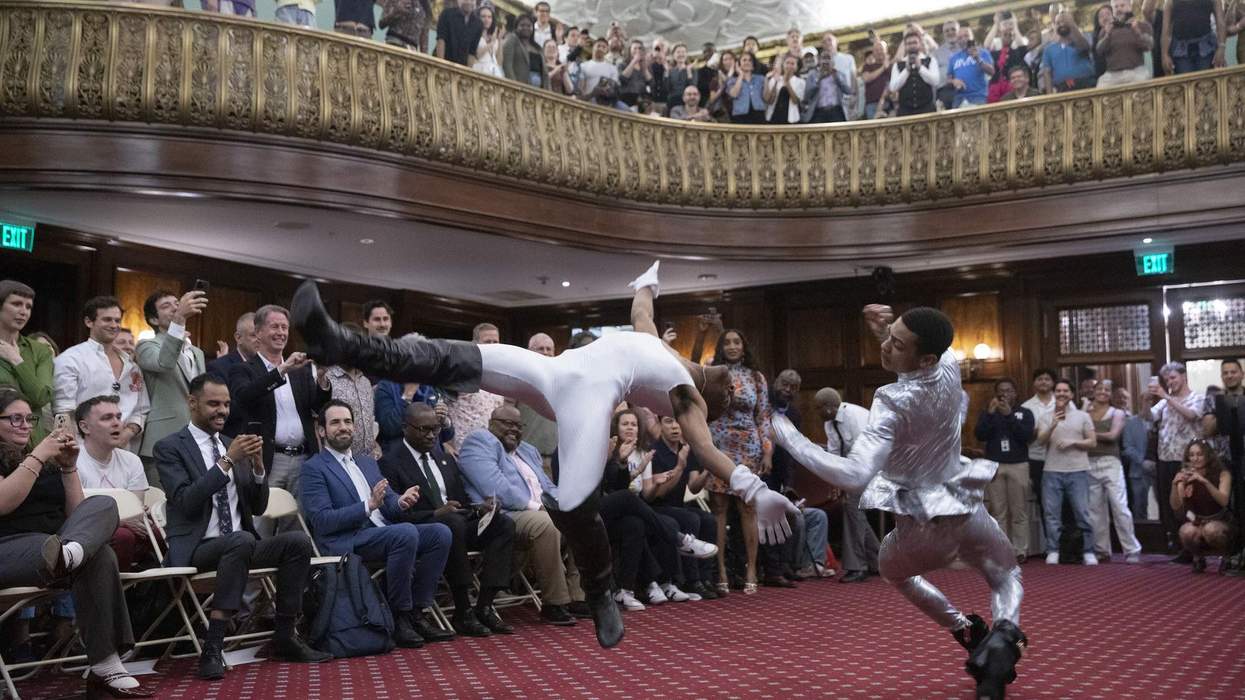
Tropes of gender confusion are also rife in his work with vogue dancing. Newsome has been attending the vogue dance ball competitions for years now in New York and in other cities. Here, mainly young black and Latino men and some women battle in varying styles of vogue as they walk a catwalk dressed in elaborate costumes with a minimalist house beat fueling the moves seen most notably in the 1990 documentary Paris Is Burning. Newsome's use of the subject evolves almost as rapidly as the style of dancing itself.
"Vogue is a dance form that has been totally bastardized by the dance community, but it's a huge part of the black gay diaspora," he says. "So I really wanted to archive it for the pieces in the Whitney. The dancing in Untitled is really the style called vogue femme, which is the newest style of vogue."
During the Biennial, Newsome also choreographed a live vogue dance performance called Five that packed the museum's ground floor. Five was based on the style of vogue femme and its five core elements. Newsome chose five dancers to personify the vogue femme gospel: hands, cat walk, floor work, spin-dips, and duck walking (a contested sixth element consists of hair, valued most by transgender vogue performers). Each dancer wore mostly black, punctuated with bright neon-colored bands at their wrists, ankles, and extremities. Although it's not the usual vogue fashion, these effects helped Newsome film the dancers' movements in a software program that he created to record the algorithms picked up by the bright colors.
As part of the performance, Newsome filmed the dancers and recorded their moves using the software on his computer and documented where their hands, feet and heads went in different colored lines -- based on the color that he selected. On a screen behind them, a visual, extended representation of the moves was shown. It looked like a human Spirograph, but much more erratic and mesmerizing.
"A lot of the vocabulary used to talk about dance revolves around line. And drawing historically is the starting point of any kind of piece, so it seemed very natural," Newsome says as he shows me a video of the performance.
Renowned Philadelphia vogue competition host and DJ Kevin Movado introduced each of the dancers onto the floor while live musical accompaniment from discreet instruments like violin, saxophone, drums, and guitar were layered onto Newsome's self-created house beat. And just as in Shade Compositions, an epic buildup of sound and movement terminated the evening.
It's not a surprise that Newsome used to be a DJ. His augmenting and collage of image and sound is so much a part of his works that he humorously refers to himself as a producer. His works are productions, and the process of his creation charges them just as much as the fleeting moves of the subjects he portrays. Ideas of sex, identity, and genre are not static -- they're just the next brilliant step on the march to something larger and more final.
"My work is like a rich language," he says. "What is interesting for me is how you learn the words of vogue and then put them together to make the language. What the kids do is so much akin to how I work."