'%3E%3Cpath d='M16.3574 35.6519H12.9537L15.0491 18.8873L16.3574 35.6519ZM30.4229 54.0093L22.309 0.994385H7.91795L0 54.0093H10.6634L11.5802 46.3855H17.4014L17.9914 54.0093H30.4229Z' fill='%23971B20'/%3E%3Cpath d='M48.2073 41.8813C48.2073 43.4049 47.4892 44.0011 46.1144 44.0011H43.7595V11.0687H46.1144C47.4892 11.0687 48.2073 11.6636 48.2073 13.1885V41.8813ZM59.5273 43.6695V11.3326C59.5273 3.71323 53.5729 0.994385 47.8157 0.994385H31.7213V54.0093H47.8157C53.5729 54.0093 59.5273 51.29 59.5273 43.6695Z' fill='%23971B20'/%3E%3Cpath d='M90.183 0.994385H78.6039L75.0711 30.6157L71.9955 0.994385H59.4346L69.2474 54.0093H80.373L90.183 0.994385Z' fill='%23971B20'/%3E%3Cpath d='M107.063 42.3448C107.063 43.7359 105.951 44.5974 104.643 44.5974C103.269 44.5974 102.157 43.7359 102.157 42.3448V12.658C102.157 11.2676 103.269 10.4058 104.643 10.4058C105.951 10.4058 107.063 11.2676 107.063 12.658V42.3448ZM119.233 43.2723V11.7312C119.233 6.36384 112.952 -3.8147e-06 104.643 -3.8147e-06C96.2667 -3.8147e-06 89.9867 6.36384 89.9867 11.7312V43.2723C89.9867 48.6393 96.2667 55 104.643 55C112.952 55 119.233 48.6393 119.233 43.2723Z' fill='%23971B20'/%3E%3Cpath d='M150.976 43.9349V33.7309H139.069V42.3448C139.069 43.7359 137.957 44.5974 136.582 44.5974C135.076 44.5974 133.964 43.7359 133.964 42.3448V12.658C133.964 11.2676 135.076 10.4058 136.582 10.4058C137.957 10.4058 139.069 11.2676 139.069 12.658V21.2723H150.976V11.0687C150.976 5.70107 145.283 -3.8147e-06 136.582 -3.8147e-06C127.75 -3.8147e-06 121.796 5.70107 121.796 11.0687V43.9349C121.796 49.3022 127.75 55 136.582 55C145.283 55 150.976 49.3022 150.976 43.9349Z' fill='%23971B20'/%3E%3Cpath d='M167.478 35.6519H164.076L166.17 18.8873L167.478 35.6519ZM181.544 54.0093L173.432 0.994385H159.037L151.123 54.0093H161.785L162.704 46.3855H168.523L169.114 54.0093H181.544Z' fill='%23971B20'/%3E%3Cpath d='M205.412 10.4058V0.994385H177.081V10.4058H185.392V54.0093H197.428V10.4058H205.412Z' fill='%23971B20'/%3E%3Cpath d='M230.002 54.0093V43.9349H218.914V31.8746H226.635V21.8028H218.914V10.4058H230.002V0.994385H206.875V54.0093H230.002Z' fill='%23971B20'/%3E%3C/g%3E%3Cdefs%3E%3CclipPath id='clip0_260_7080'%3E%3Crect width='230' height='55' fill='white'/%3E%3C/clipPath%3E%3C/defs%3E%3C/svg%3E)

The little American flags on the graves at Charles Evans Cemetery in Reading, Pennsylvania, look the same from a distance. A grid of red, white, and blue running between the headstones in the May light, the lilacs dried up on the south corner where the older immigrant families that built this nation are buried. From the parking lot of every American cemetery, it's all the same flag — the same country thanking the same dead.
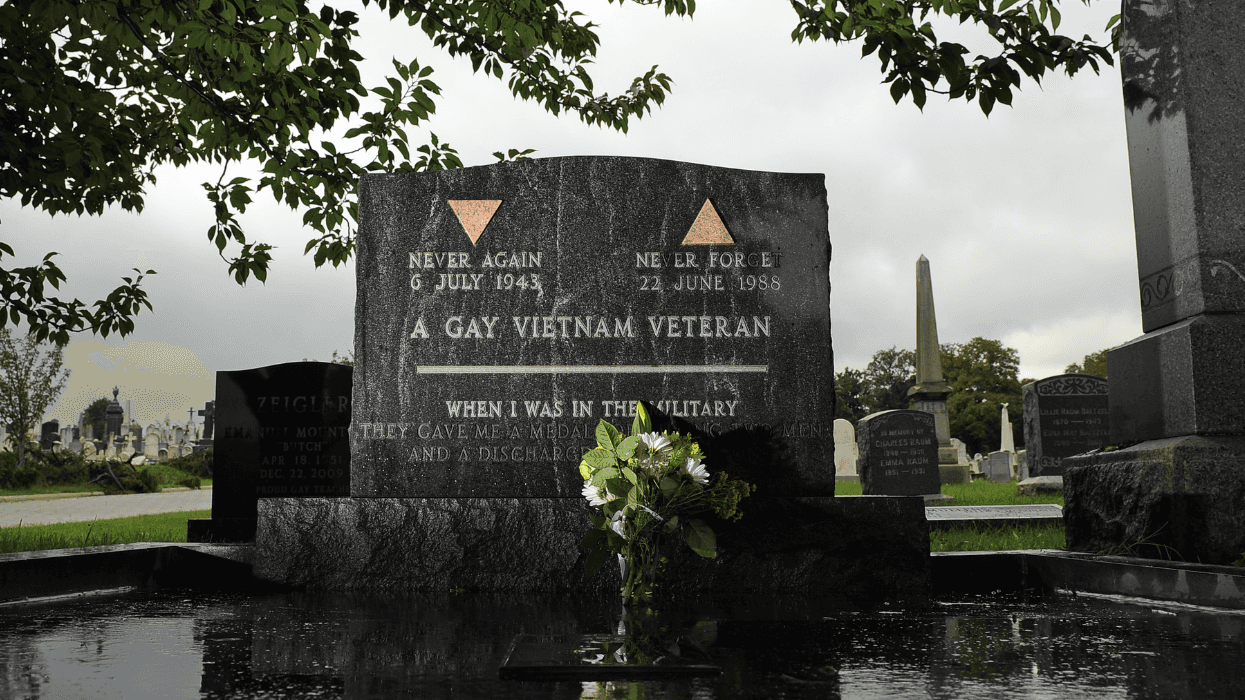
At Washington, D.C.’s Congressional Cemetery sits the grave of Air Force Technical Sergeant Leonard Matlovich, discharged in 1975 for the unspeakable crime of telling the truth. His headstone reads: “When I was in the military, they gave me a medal for killing two men and a discharge for loving one.”
That is what Memorial Day owes the queer soldier.
The American army has been queer-built from the start. At Valley Forge in the freezing winter of 1777, a Prussian general arrived who had been exiled from his country for his sexuality. Baron Friedrich Wilhelm von Steuben rode in with his Italian greyhound Azor walking by his side. Benjamin Franklin had recruited him in Paris. George Washington put the dying Continental Army in his hands. Within three months, Von Steuben turned it into a force that could beat the British. His training methods — the rank, the order, the Blue Book drill manual — are still embedded in how the United States military trains soldiers today.
A man widely believed to have been gay. The reason there is an American republic to celebrate at 250 years.
He stood in the mud with the soldiers. He did not hide. That is the greatest test of American masculinity — a willingness to be unafraid, and to risk it all.
Between Von Steuben and Matlovich, there are two centuries of queer Americans in uniform whose names, mostly, we will never know.
The men who marched with the Union and signed letters to each other that posterity has decided to call "intimate friendships." The lesbian women who served in nurses' corps in two world wars and came home to lives that could not hold what they had been to each other in the tents. The thousands who served through Don't Ask Don't Tell — except it was just Don't — and learned to write letters home with their pronouns crossed out twice.
There is the Lavender Scare — Truman and Eisenhower's federal purge that began in 1950 — when more than five thousand government employees, many of them decorated veterans, were fired for being suspected homosexuals. Some had just survived the Pacific. Some had crossed Europe on foot with fellow soldiers who cared less about their orientation and more about whether they had their back. They came home to a nation that fired them anyway — the country they had protected with their life.
There is Joseph Steffan, kicked out of the Naval Academy in 1987 weeks before graduation when he was forced to confirm what everyone already suspected. There are the men who died of AIDS in the 1980s and 1990s whose military service records were sealed because their identities had been classified more shameful than their deaths.
Memorial Day commemorates the fallen. But fallen does not just mean killed in action. Fallen also means erased. Fallen also means denied the dignity of being recorded as who you were.
I have not served. My closest brush with American military history is the Resilient Speaker training I completed last year with the Victims Resource Center of Pennsylvania, and the panels I have sat on for Governor Josh Shapiro's office twice. I am a civilian. I am also a queer American with Greek heritage on both sides — my mother's people and my father's people both rooted in Lesbos, the island where Sappho once wrote and where ferries still pull in carrying my family to America. The women I come from — yiayias, aunts, mother — honored my footwork like a soldier's from the beginning, as if they knew before I did what kind of war I would one day be asked to fight at home.
I came of age in Boston in the early 2000s, three years out from a still-smoking lower Manhattan. I moved to New York and built a life there. On the night of September 17, 2016, I walked my dog past 131 West 27th Street — just down the block from my apartment at 100 West 27th — hours before the FBI arrived to render safe an unexploded pressure cooker packed with ball bearings and steel nuts. The man who placed it intended to kill people on a Saturday night in Chelsea. The first of his two devices, on West 23rd Street, had already detonated and injured more than thirty. The second was found on my block by a civilian who saw what didn't belong and dialed 911.
Two pressure cookers. One city. In the name of destroying what we love.
I know what it costs to say something this country has trained you not to say. I cannot imagine what it costs to do it in uniform.
And yet they did. Two hundred and fifty years of them.
This Memorial Day comes during a year in which the United States is once again trying to push queer soldiers out of its army. The Department of Defense is being asked to pretend they were never there. The recruits learning Von Steuben's drill order in basic training this month are being taught the techniques of a queer Prussian whose name the Pentagon would prefer to leave at the door.
You cannot remove someone from history and then commemorate the history. The republic does not work that way.
So this Memorial Day, place the flag. Walk the cemetery. Stand at the parade. But know what we are honoring. The queer dead are part of the count. They always were.
At Valley Forge, the soldiers slept in log huts through a winter that should have killed them. Von Steuben did not just train them. He stood in the mud beside them. America, this Memorial Day, do the same for the queer soldiers — living and dead, named and unnamed, served and erased.
The republic owes them. The republic should pay their respects. It's our Memorial Day too.
Dimitrios Aletras, Jr. is a Greek-American novelist, essayist, and survivor advocate based in Reading, Pennsylvania. His debut literary novel, Abstract Faces, is currently with literary agents. He can be reached at dimitriosaletrasjr@gmail.com.
Opinion is dedicated to featuring a wide range of inspiring personal stories and impactful opinions from the LGBTQ+ community and its allies. Visit Advocate.com/submit to learn more about submission guidelines. We welcome your thoughts and feedback on any of our stories. Email us at voices@equalpride.com. Views expressed in Voices stories are those of the guest writers, columnists, and editors, and do not directly represent the views of The Advocate or our parent company, equalpride.