'%3E%3Cpath d='M16.3574 35.6519H12.9537L15.0491 18.8873L16.3574 35.6519ZM30.4229 54.0093L22.309 0.994385H7.91795L0 54.0093H10.6634L11.5802 46.3855H17.4014L17.9914 54.0093H30.4229Z' fill='%23971B20'/%3E%3Cpath d='M48.2073 41.8813C48.2073 43.4049 47.4892 44.0011 46.1144 44.0011H43.7595V11.0687H46.1144C47.4892 11.0687 48.2073 11.6636 48.2073 13.1885V41.8813ZM59.5273 43.6695V11.3326C59.5273 3.71323 53.5729 0.994385 47.8157 0.994385H31.7213V54.0093H47.8157C53.5729 54.0093 59.5273 51.29 59.5273 43.6695Z' fill='%23971B20'/%3E%3Cpath d='M90.183 0.994385H78.6039L75.0711 30.6157L71.9955 0.994385H59.4346L69.2474 54.0093H80.373L90.183 0.994385Z' fill='%23971B20'/%3E%3Cpath d='M107.063 42.3448C107.063 43.7359 105.951 44.5974 104.643 44.5974C103.269 44.5974 102.157 43.7359 102.157 42.3448V12.658C102.157 11.2676 103.269 10.4058 104.643 10.4058C105.951 10.4058 107.063 11.2676 107.063 12.658V42.3448ZM119.233 43.2723V11.7312C119.233 6.36384 112.952 -3.8147e-06 104.643 -3.8147e-06C96.2667 -3.8147e-06 89.9867 6.36384 89.9867 11.7312V43.2723C89.9867 48.6393 96.2667 55 104.643 55C112.952 55 119.233 48.6393 119.233 43.2723Z' fill='%23971B20'/%3E%3Cpath d='M150.976 43.9349V33.7309H139.069V42.3448C139.069 43.7359 137.957 44.5974 136.582 44.5974C135.076 44.5974 133.964 43.7359 133.964 42.3448V12.658C133.964 11.2676 135.076 10.4058 136.582 10.4058C137.957 10.4058 139.069 11.2676 139.069 12.658V21.2723H150.976V11.0687C150.976 5.70107 145.283 -3.8147e-06 136.582 -3.8147e-06C127.75 -3.8147e-06 121.796 5.70107 121.796 11.0687V43.9349C121.796 49.3022 127.75 55 136.582 55C145.283 55 150.976 49.3022 150.976 43.9349Z' fill='%23971B20'/%3E%3Cpath d='M167.478 35.6519H164.076L166.17 18.8873L167.478 35.6519ZM181.544 54.0093L173.432 0.994385H159.037L151.123 54.0093H161.785L162.704 46.3855H168.523L169.114 54.0093H181.544Z' fill='%23971B20'/%3E%3Cpath d='M205.412 10.4058V0.994385H177.081V10.4058H185.392V54.0093H197.428V10.4058H205.412Z' fill='%23971B20'/%3E%3Cpath d='M230.002 54.0093V43.9349H218.914V31.8746H226.635V21.8028H218.914V10.4058H230.002V0.994385H206.875V54.0093H230.002Z' fill='%23971B20'/%3E%3C/g%3E%3Cdefs%3E%3CclipPath id='clip0_260_7080'%3E%3Crect width='230' height='55' fill='white'/%3E%3C/clipPath%3E%3C/defs%3E%3C/svg%3E)

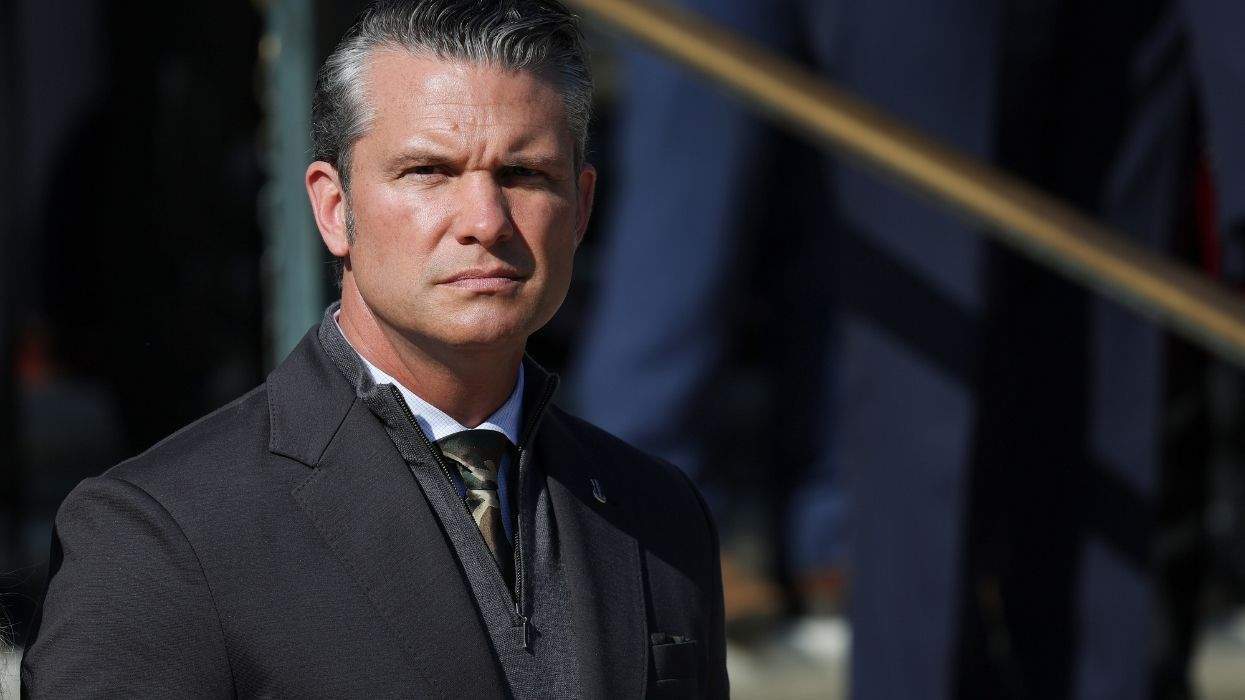
Defense Secretary Pete Hegseth is standing by his descriptions of transgender people as “weird” and his use of an anti-trans slur. The Trump administration, meanwhile, is asking a federal judge to prevent those statements from being used as evidence that its ban on transgender people’s military service is discriminatory.
The administration’s effort to keep Hegseth’s own words out of evidence is detailed in a series of court filings submitted Friday in Talbott v. Trump, a lawsuit brought by transgender troops fighting to remain in uniform. The plaintiffs are represented by a coalition of leading LGBTQ+ civil rights organizations and prominent litigation firms, including GLAD Law, the National Center for LGBTQ Rights, Wardenski P.C., Zalkind Duncan & Bernstein LLP, Kropf Moseley Schmitt PLLC and international law firm O’Melveny & Myers LLP.
In sworn written answers, Hegseth defended his language, reiterated his support for excluding trans troops and said he disagreed with nothing in President Donald Trump’s executive order restricting their service.
The Justice Department is also trying to exclude testimony from former Pentagon officials who dispute the administration’s military readiness claims. In another filing, government lawyers admit that the policy cuts short some military careers.
A hearing scheduled for Monday before Washington, D.C., U.S. District Judge Ana C. Reyes.
Hegseth stands by his words
Hegseth’s answers, signed October 28 under penalty of perjury, offer an account of how he views the people his department is trying to remove from military service.
Attorneys asked him about a passage from his 2024 book, The War on Warriors, in which he described transgender people as pretending to be members of another sex and called that “weird.”
“Men pretending to be women is ‘weird’ because men cannot be women and women cannot be men,” Hegseth wrote in the court filing.
Another question addressed his previous references to transgender people as “dudes in dresses” and using an anti-transgender slur. Hegseth repeated both expressions, saying people covered by the Pentagon’s restrictions on gender dysphoria should be excluded.
Asked which statements in Trump’s executive order he personally disagreed with, Hegseth answered, “None.”
He also defended his May 2025 declaration, “No More Trans @ DoD,” posted after the U.S. Supreme Court allowed the administration to enforce the ban while litigation continued.
“I, like many others, occasionally use the term ‘trans’ as shorthand for individuals with gender dysphoria,” Hegseth wrote.
Gender dysphoria refers to clinically significant distress that can arise when a person’s gender identity differs from their sex assigned at birth. Not all transgender people experience gender dysphoria, and being transgender is not a mental illness. Gender-affirming care is the treatment for that distress.
The government argues that its policy targets a medical diagnosis rather than transgender identity. The plaintiffs contend that the medical language is being used to remove transgender people regardless of their qualifications.
The judge already demanded answers
The written responses follow an October 14 hearing that The Advocate previously covered, when Reyes challenged government attorneys over efforts to shield Hegseth from questioning about his remarks.
“The government got up here and told me that when he tweeted transgender people are excluded from the military, he did not mean transgender people are excluded from the military,” Reyes said.
Plaintiffs sought a seven-hour deposition, which would have required Hegseth to answer attorneys’ questions under oath. Reyes declined to order that extensive questioning, instead requiring him to answer 10 written questions.
But she warned that inadequate responses could lead to a limited, one-hour deposition.
“I am very aware that he is the secretary of defense and has a lot of constraints on his time, but he has time to tweet, and he has time to put out videos, and he has time to speak to the generals,” Reyes said.
She also offered to supervise any deposition herself.
“If they give questions and the responses are a bunch of non-answers, totally fine, but then we’re going to get back into deposition world,” she warned.
Related: Trump administration tells federal judge to ignore Pete Hegseth’s anti-trans posts
The government says the slurs don’t prove discrimination
The Justice Department does not dispute that Hegseth made the statements. Instead, it argues that they should not be used to establish discriminatory intent.
Its motion specifically identifies his references to “trans lunacy,” “dudes in dresses” and the anti-transgender slur, arguing that they reflect concerns about medical fitness, military discipline and deployability rather than unconstitutional hostility.
A separate filing asks Reyes to determine whom the policy targets by examining its written rules rather than statements made by officials promoting it.
In March 2025, Reyes temporarily blocked the ban, calling it “soaked in animus and dripping with pretext,” and finding that the policy was likely driven by discrimination and supported by explanations that concealed its purpose.
Former Pentagon officials challenge the readiness claims
The administration is also trying to exclude testimony from former Pentagon leaders who oversaw military personnel policies when transgender troops served openly.
Shawn Skelly, a retired Navy commander and former senior readiness official, says no readiness or unit cohesion problems attributable to transgender service reached her office.
Former Army personnel official Yvette Bourcicot argues that the administration’s waiver requirements are effectively impossible for many troops who transitioned under previously approved military policies.
Ashish Vazirani, a former acting undersecretary of defense, wrote in a report that transition-related healthcare averaged $5.2 million annually over 10 fiscal years, less than 0.01 percent of the military health system’s approximately $60.2 billion fiscal 2024 budget.
Former Air Force personnel official Alex Wagner argues that the policy allows qualified troops to be discharged without individual evidence that their medical circumstances interfere with their duties.
The Justice Department disputes whether the former officials can reliably assess the current policy and argues that courts should defer to current military leadership.
The administration acknowledges careers are being cut short
In a motion seeking to exclude testimony from retired Army Maj. Gen. James Young, the Justice Department agreed that the ban ends some military careers prematurely.
“Defendants acknowledge as a factual matter that absent a waiver, some service members who fall within the policy do in fact have their careers curtailed,” government lawyers wrote.
Young argues that forced separation can cost troops future earnings, retirement benefits and veterans’ compensation. The government disputes his financial projections but acknowledges the underlying career disruption.
The administration also withdrew its notice that it intended to seek summary judgment Friday, abandoning its previously announced effort to have the case decided without trial.
Monday’s scheduled hearing has been moved online. In a Saturday order, Reyes directed the parties to appear by teleconference at 4 p.m. Eastern after they requested the proceeding to address a dispute over evidence gathering.
A two-week bench trial is scheduled to begin on January 4.