'%3E%3Cpath d='M16.3574 35.6519H12.9537L15.0491 18.8873L16.3574 35.6519ZM30.4229 54.0093L22.309 0.994385H7.91795L0 54.0093H10.6634L11.5802 46.3855H17.4014L17.9914 54.0093H30.4229Z' fill='%23971B20'/%3E%3Cpath d='M48.2073 41.8813C48.2073 43.4049 47.4892 44.0011 46.1144 44.0011H43.7595V11.0687H46.1144C47.4892 11.0687 48.2073 11.6636 48.2073 13.1885V41.8813ZM59.5273 43.6695V11.3326C59.5273 3.71323 53.5729 0.994385 47.8157 0.994385H31.7213V54.0093H47.8157C53.5729 54.0093 59.5273 51.29 59.5273 43.6695Z' fill='%23971B20'/%3E%3Cpath d='M90.183 0.994385H78.6039L75.0711 30.6157L71.9955 0.994385H59.4346L69.2474 54.0093H80.373L90.183 0.994385Z' fill='%23971B20'/%3E%3Cpath d='M107.063 42.3448C107.063 43.7359 105.951 44.5974 104.643 44.5974C103.269 44.5974 102.157 43.7359 102.157 42.3448V12.658C102.157 11.2676 103.269 10.4058 104.643 10.4058C105.951 10.4058 107.063 11.2676 107.063 12.658V42.3448ZM119.233 43.2723V11.7312C119.233 6.36384 112.952 -3.8147e-06 104.643 -3.8147e-06C96.2667 -3.8147e-06 89.9867 6.36384 89.9867 11.7312V43.2723C89.9867 48.6393 96.2667 55 104.643 55C112.952 55 119.233 48.6393 119.233 43.2723Z' fill='%23971B20'/%3E%3Cpath d='M150.976 43.9349V33.7309H139.069V42.3448C139.069 43.7359 137.957 44.5974 136.582 44.5974C135.076 44.5974 133.964 43.7359 133.964 42.3448V12.658C133.964 11.2676 135.076 10.4058 136.582 10.4058C137.957 10.4058 139.069 11.2676 139.069 12.658V21.2723H150.976V11.0687C150.976 5.70107 145.283 -3.8147e-06 136.582 -3.8147e-06C127.75 -3.8147e-06 121.796 5.70107 121.796 11.0687V43.9349C121.796 49.3022 127.75 55 136.582 55C145.283 55 150.976 49.3022 150.976 43.9349Z' fill='%23971B20'/%3E%3Cpath d='M167.478 35.6519H164.076L166.17 18.8873L167.478 35.6519ZM181.544 54.0093L173.432 0.994385H159.037L151.123 54.0093H161.785L162.704 46.3855H168.523L169.114 54.0093H181.544Z' fill='%23971B20'/%3E%3Cpath d='M205.412 10.4058V0.994385H177.081V10.4058H185.392V54.0093H197.428V10.4058H205.412Z' fill='%23971B20'/%3E%3Cpath d='M230.002 54.0093V43.9349H218.914V31.8746H226.635V21.8028H218.914V10.4058H230.002V0.994385H206.875V54.0093H230.002Z' fill='%23971B20'/%3E%3C/g%3E%3Cdefs%3E%3CclipPath id='clip0_260_7080'%3E%3Crect width='230' height='55' fill='white'/%3E%3C/clipPath%3E%3C/defs%3E%3C/svg%3E)
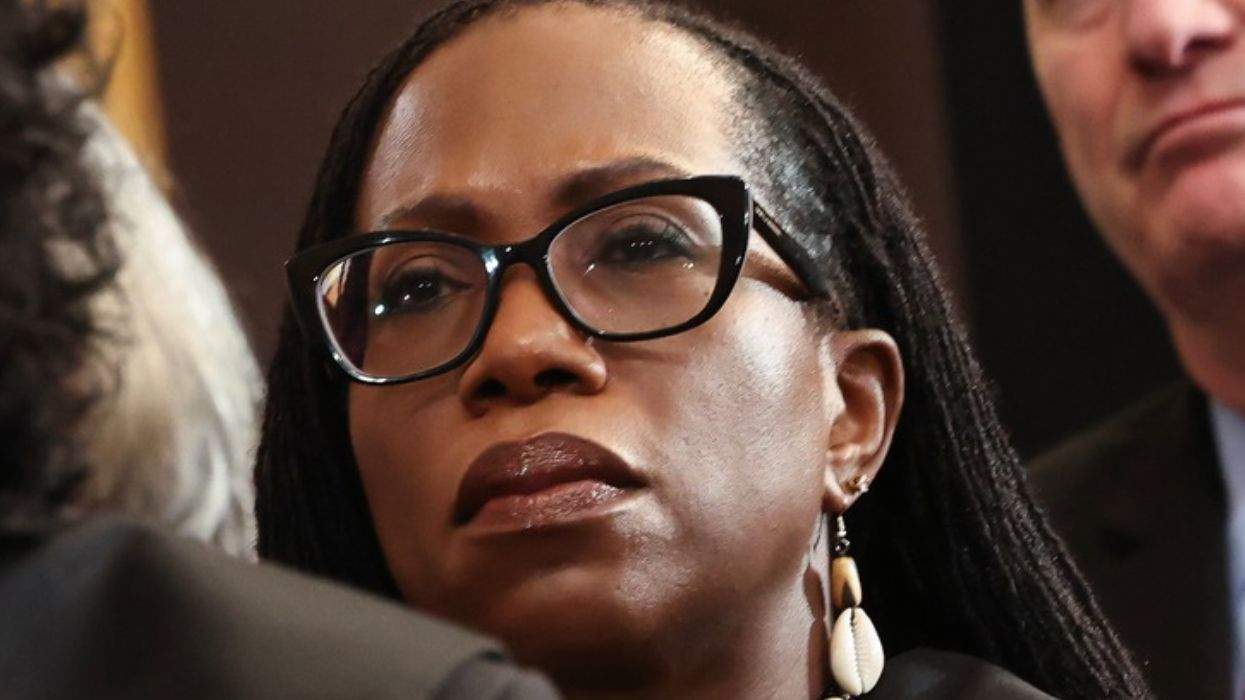
Justice Ketanji Brown Jackson accused the U.S. Supreme Court on Friday of disregarding the risk to eligible voters by allowing the Trump administration to revive an expanded federal citizenship-checking system weeks before the midterm elections.
In a dissent joined by Justices Sonia Sotomayor and Elena Kagan, Jackson said the court had made “questionable interim rulings” about federal laws it had never interpreted while considering only the harm the government claimed it would suffer if the system remained blocked. “The Court thus misuses its equitable powers,” she wrote.
The order pauses a June ruling that set aside changes to the Systematic Alien Verification for Entitlements program, known as SAVE, while the administration’s appeal proceeds. State and local officials can again use the expanded system. The Supreme Court has not issued a final ruling on whether the changes are lawful.
President Donald Trump directed the Department of Homeland Security in 2025 to expand SAVE for checking the citizenship of registered voters and people applying to vote. The changes let officials submit records in bulk and search using Social Security numbers. According to the court’s opinion, the system compares identifying information with Social Security Administration records. If it cannot confirm someone’s citizenship, the election agency must contact that person and seek additional proof.
Voting rights and privacy groups challenged the arrangement, arguing that it improperly disclosed protected Social Security records, bypassed federal privacy safeguards, and could wrongly identify citizens as noncitizens. U.S. District Judge Sparkle Sooknanan agreed and set aside the expanded program in June. A divided federal appeals court declined to suspend her ruling earlier this month.
The Supreme Court’s unsigned majority opinion concluded that a 1996 immigration law likely authorizes DHS to obtain citizenship information from other agencies despite the restrictions cited by the challengers. The majority said preventing the government from using the expanded system would hamper its ability to respond to election officials’ inquiries.
Jackson called that reading a “back-of-the-napkin assessment.” Congress permitted certain exchanges of citizenship information, she argued, but did not give the Social Security Administration permission to disclose records protected by other statutes. The provisions the majority relied upon “do not affirmatively grant any power,” she wrote.
Related: Federal judge baffled by Supreme Court order targeting trans Americans’ passports
The cost of an incorrect match
One Louisiana voter in the case is a naturalized citizen whose Social Security record does not accurately reflect her citizenship, the court’s opinion acknowledged. Jackson also cited a lower court finding that a Texas voter had their registration revoked without their knowledge, while two others had to provide proof of citizenship to remain registered.
Texas, which supported the administration in the case, has disputed claims that SAVE is unreliable. The Brennan Center for Justice warns that large-scale matching can produce errors when names or other details differ across records, and that Social Security data may not reflect a person’s naturalization.
Federal law generally requires states to finish programs that systematically remove ineligible voters from their rolls at least 90 days before a federal election, the majority noted. Individualized inquiries, can continue during that period. The court left a separate dispute over the reach of the 90-day rule for another case.
Jackson said that limit weakened the government’s claim that it urgently needed relief before November, especially because it could still use the earlier version of SAVE. The majority weighed “one side of the scale — the judicial equivalent of expecting a seesaw with weight applied on only one side to work properly,” she wrote.
Related: Kansas anti-trans law forced her license to say male. Then a cop questioned it and she was charged
What transgender voters face
The ruling comes as transgender Americans contend with restrictions on the documents they may need if an election office questions their registration or asks for proof of citizenship.
“SAVE checks a voter’s name against Social Security records, and a mismatch triggers a requirement to submit additional information to prove citizenship,” Shannon Minter, legal director of the National Center for LGBTQ Rights, told The Advocate. Minter cited a December warning from 12 secretaries of state that the expanded program risks misidentifying eligible voters as noncitizens, including people who have changed their names. Transgender voters who have done so face the same risk, Minter said.
“Even for those who have [legally changed their names], it is unclear what documentation states will require to prove the name change, and doing so will disclose a former name and, likely, the person’s transgender status, to a local election office,” Minter said.
A nationally representative KFF/The Washington Post survey conducted in 2022 found that 24 percent of transgender adults had legally changed their name on an identifying document. Measuring a different aspect of the problem, the 2022 U.S. Transgender Survey found that 48 percent of respondents with at least one identity document said none of their IDs carried the name they wanted.
In February, Kansas enacted a law invalidating driver’s licenses with gender markers updated to reflect their holders’ gender identities. The ACLU, which is challenging the law, said affected residents received notices that their licenses were no longer valid. Kansas requires photo identification to vote in person and accepts several forms, including a valid driver’s license or U.S. passport. Someone whose license was invalidated would need another accepted ID. Friday’s ruling did not address the Kansas law.
The State Department says it now issues passports only with an M or F marker matching a person’s sex at birth and no longer issues passports with an X marker. Previously issued passports remain valid unless they expire, are replaced, or are invalidated under federal regulations. Advocates for Trans Equality says U.S. Citizenship and Immigration Services has ended its former policy allowing transgender people to correct the sex designation on immigration documents, including naturalization certificates. The organization also says the Social Security Administration no longer permits changes to the sex designation in its records, though people can still update their names.
A September 2026 report from the Williams Institute at UCLA School of Law estimated that 323,700 eligible transgender voters in states with in-person voter ID laws lack an ID accurately reflecting their name or gender. Of those, an estimated 113,700 live in states with the strictest ID rules and lack a valid ID. The estimates concern voter ID requirements; they do not predict how many people SAVE might flag. The queries described in Friday’s opinion use a name, date of birth, or Social Security number. The opinion does not say that a gender-marker difference alone would trigger a flag.
“Taken together, these requirements are likely to present an unnecessary and undemocratic obstacle to voting for many transgender people,” Minter said.
Related: Here's how trans Americans can get accurate passports... for now.
Jackson’s warning about emergency rulings
Jackson’s dissent came the morning after she criticized the Supreme Court’s emergency docket during a lecture at the University of the District of Columbia School of Law. Speaking about the court’s practices generally, before Friday’s SAVE order, she warned that intervening in cases still moving through lower courts could give litigants swift relief without the ordinary review process. “Our modern methods are not serving the court or the country well,” she said.
The federal SAVE database at issue in Friday’s ruling is separate from the proposed SAVE Act, which would impose documentary proof-of-citizenship requirements for federal voter registration.
“The harm caused by burdening or disenfranchising even a few lawful voters outweighs the nonexistent harm that the Government experiences when it is prevented from taking an action that it likely lacks the authority to take,” Jackson wrote at the end of her dissent. “This imbalance, along with the Government’s improbable merits arguments, should have compelled the Court to deny the stay.”