'%3E%3Cpath d='M16.3574 35.6519H12.9537L15.0491 18.8873L16.3574 35.6519ZM30.4229 54.0093L22.309 0.994385H7.91795L0 54.0093H10.6634L11.5802 46.3855H17.4014L17.9914 54.0093H30.4229Z' fill='%23971B20'/%3E%3Cpath d='M48.2073 41.8813C48.2073 43.4049 47.4892 44.0011 46.1144 44.0011H43.7595V11.0687H46.1144C47.4892 11.0687 48.2073 11.6636 48.2073 13.1885V41.8813ZM59.5273 43.6695V11.3326C59.5273 3.71323 53.5729 0.994385 47.8157 0.994385H31.7213V54.0093H47.8157C53.5729 54.0093 59.5273 51.29 59.5273 43.6695Z' fill='%23971B20'/%3E%3Cpath d='M90.183 0.994385H78.6039L75.0711 30.6157L71.9955 0.994385H59.4346L69.2474 54.0093H80.373L90.183 0.994385Z' fill='%23971B20'/%3E%3Cpath d='M107.063 42.3448C107.063 43.7359 105.951 44.5974 104.643 44.5974C103.269 44.5974 102.157 43.7359 102.157 42.3448V12.658C102.157 11.2676 103.269 10.4058 104.643 10.4058C105.951 10.4058 107.063 11.2676 107.063 12.658V42.3448ZM119.233 43.2723V11.7312C119.233 6.36384 112.952 -3.8147e-06 104.643 -3.8147e-06C96.2667 -3.8147e-06 89.9867 6.36384 89.9867 11.7312V43.2723C89.9867 48.6393 96.2667 55 104.643 55C112.952 55 119.233 48.6393 119.233 43.2723Z' fill='%23971B20'/%3E%3Cpath d='M150.976 43.9349V33.7309H139.069V42.3448C139.069 43.7359 137.957 44.5974 136.582 44.5974C135.076 44.5974 133.964 43.7359 133.964 42.3448V12.658C133.964 11.2676 135.076 10.4058 136.582 10.4058C137.957 10.4058 139.069 11.2676 139.069 12.658V21.2723H150.976V11.0687C150.976 5.70107 145.283 -3.8147e-06 136.582 -3.8147e-06C127.75 -3.8147e-06 121.796 5.70107 121.796 11.0687V43.9349C121.796 49.3022 127.75 55 136.582 55C145.283 55 150.976 49.3022 150.976 43.9349Z' fill='%23971B20'/%3E%3Cpath d='M167.478 35.6519H164.076L166.17 18.8873L167.478 35.6519ZM181.544 54.0093L173.432 0.994385H159.037L151.123 54.0093H161.785L162.704 46.3855H168.523L169.114 54.0093H181.544Z' fill='%23971B20'/%3E%3Cpath d='M205.412 10.4058V0.994385H177.081V10.4058H185.392V54.0093H197.428V10.4058H205.412Z' fill='%23971B20'/%3E%3Cpath d='M230.002 54.0093V43.9349H218.914V31.8746H226.635V21.8028H218.914V10.4058H230.002V0.994385H206.875V54.0093H230.002Z' fill='%23971B20'/%3E%3C/g%3E%3Cdefs%3E%3CclipPath id='clip0_260_7080'%3E%3Crect width='230' height='55' fill='white'/%3E%3C/clipPath%3E%3C/defs%3E%3C/svg%3E)
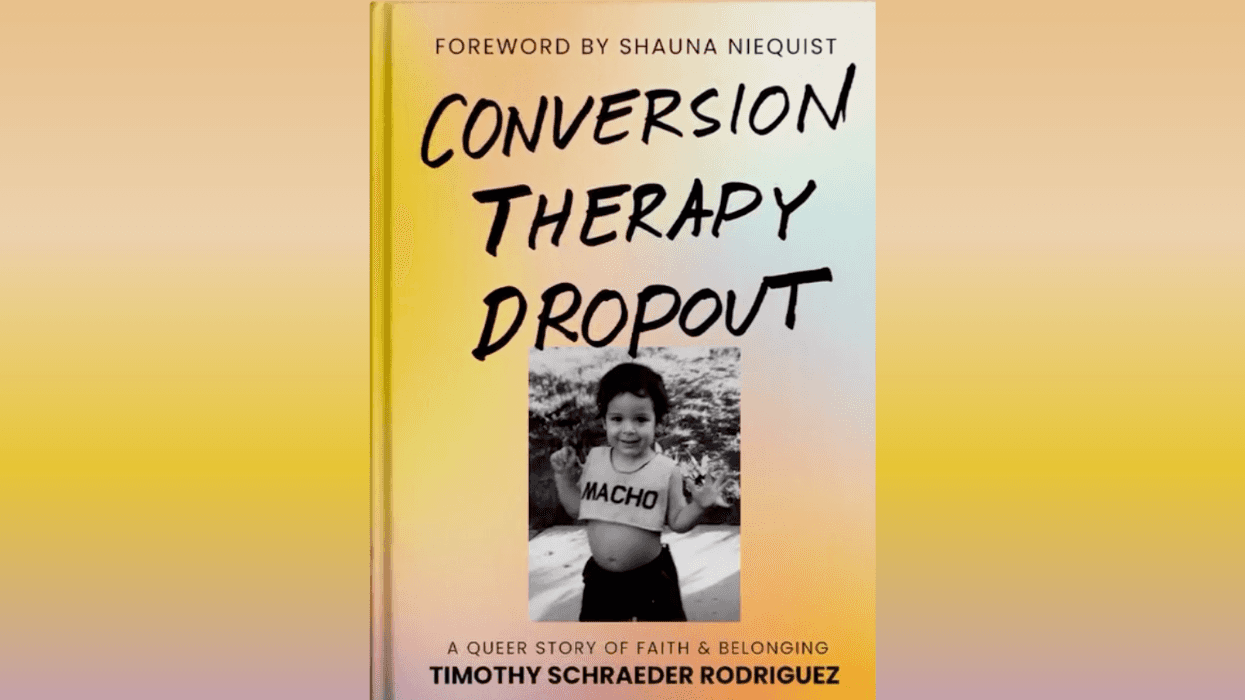

As a child in Peoria, Illinois, in the 1980s, Timothy Schraeder Rodriguez couldn't hide his disappointment when he unwrapped what he had hoped would be an Easy-Bake Oven – finding basketball equipment instead. Like many young queers in the making, he had yet to find words for his feelings. And with a family that belonged to the evangelical Assemblies of God church, it didn't take long for the inkling to turn to shame.
"The fear that I might be fundamentally unacceptable to God and that there was something in me that needed to be fixed would shape my relationship with faith for decades to come," writes Schraeder Rodriguez in his compelling new memoir: Conversion Therapy Dropout: A Queer Story of Faith and Belonging.
Fresh on the shelves, both heartfelt and heartbreaking, the account documents the author's foray into eight years of “conversion therapy" – the dangerous and discredited practice of trying to change a person’s sexual orientation or gender identity – and the decade of depression and substance abuse left in its wake.
The telling couldn't be more urgent. On March 31, 2026, a landmark ruling by the Supreme Court struck down Colorado’s ban on conversion therapy (Chiles v. Salazar), placing a therapist’s “professional speech” rights above the well-being of minors who are struggling with sexual and gender identity.
It's also an evergreen tale – one told for decades by those who made it out. Not everybody has.
Schraeder Rodriguez's journey kicks off as a teenager, when in a desperate search for transformation, he began pursuing “ever-grander” experiences, from revival services to worship concerts, searching for the spiritual formula that would rewire who he was at his core. He found purpose within church walls, eventually becoming the digital mastermind behind social media for some of the world’s largest megachurches.
Conversion Therapy Dropout exposes the darker side of these ministries that not only damaged individuals, but weaponized their testimonies of alleged personal healing to fight against broader antidiscrimination protections.
And yet, the allure of Christian youth subculture was irresistible.
What evangelical kid of the 1990s doesn't remember the youth groups, purity pledges, anthem worship music, and sense of belonging that comes from the shared experience of the prayer: "I commit my heart and life to your will and purpose."
When a career opportunity presents at his church after graduation, Schraeder Rodriguez jumps at the chance. Nine months later, he's confronted with material found on his computer. Pages of internet history. A secret exposed.
"You're broken. There's no place for people like you in ministry," he is told.
"I didn't understand yet that belonging shouldn't require sacrifice. That the arms open wide to receive me would eventually close like a trap."
Thus is the conundrum, the conflict, and the wrenching core of the matter: the insurmountable juggling act of accepting one's sexuality and oneself, with the requirement to walk the prescribed path.
Even as the author undertook the impossible task of trying to “fix” himself, he took on contract work, crafting messages of belonging for churches to entice new audiences into the fold.
“I was useful in the shadows, but unacceptable in the light. I worked for institutions that wouldn't accept someone like me, yet they eagerly embraced my talent for making them appear progressive and inclusive."
Conversion therapy has been widely condemned by major medical organizations, from the American Medical Association to the American Academy of Pediatrics. Lasting harms are irrefutable, and have historically included abusive physical and psychological techniques ranging from “laying on of hands” to electric shocks – and in the author's case, abandonment to a dingy hotel room where he spent days curled in a fetal position.
Schraeder Rodriguez exposes the cracks that had started to show in the 1990s with organizations like Exodus International, which he appropriately dubbed Conversion Therapy 101. He couldn't have known when he first called their number that the cofounder would eventually come forward with stories of crippling anxiety, depression, and suicidality.
It was one of many pit stops, which also included Living Hope forums, with its pseudo-psychology narrative (common to similar programs) that "sexual brokenness" could be overcome through discipline, behavior modification, and divine intervention.
Suggested cures for the homosexual ailment: form deep platonic relationships with members of the same sex ("What could possibly go wrong?"). Tips included avoiding brands like Calvin Klein. One straight-hopeful swore that joining a football league diminished his attraction to men. For young women, a Mary Kay makeover might do the trick.
The shared camaraderie of these straight-hopefuls gave the author a glimpse of what queer community could look like. His narrative is infused with humor, and the writing reveals an amiable, indeed, lovable character.
In one priceless scene, when an Exodus Youth program ends, a male attendee blasts Britney Spears. As Schraeder Rodriguez describes, as if possessed by the spirit of Britney herself, the attendee straddles a chair and launches into dance – only to be met by a pastor who discovers the gaiety, kicks the chair out from under, and screams: “Where is the fear of the Lord in this place?”
(Understandably, this becomes an inside joke for years. The telling is such a delectable morsel that no reader could be blamed for appropriating the phrase into their own vernacular.)
It took tens of thousands of dollars poured into Exodus conferences, retreats, therapy, courses, and support groups before Schraeder Rodriguez, at age 27, emerged from a breakdown to conversion therapy dropout status, free to begin navigating the gay world, ultimately finding kinship with others who found the courage to imagine a different future for themselves. People thriving in committed relationships and attending welcoming queer-affirming churches.
The realization that all along, he had been worthy.
His is a hero's journey that echoes a bit of Dorothy, who makes it through a Kansas tornado to Oz and back, only to discover the truth was always within her: "There's no place like home".
Schraeder Rodriguez closes his story with a benediction: "May you sense the presence of God, your Higher Power, the Universe —however you choose to name it — and may that presence steady you with peace, surround you with love, and remind you that you are never alone. May you know healing... may you run your race with joy... "
After all is said and done, perhaps God did have a perfect plan for a 16-year-old from Peoria who attended a revival in the sweltering Florida sun, deliverance on his mind.
Falling backward, slain in the spirit, from the touch of a preacher's hand and invocation – "Fire of God, consume him" – the boy collapsed to find a volunteer draping his sprawled body with a "modesty blanket."
"She knelt beside me, and prayed, 'Raise him up to be a mighty man after your own heart, Father God, someone who will help set others free.'”
It seems that God did exactly that.
Conversion Therapy Dropout: A Queer Story of Faith and Belonging, by Timothy Schraeder Rodriguez, is available now from Broadleaf Books.
Margaret Hetherman is a journalist whose work has appeared in NBC News, The Washington Post, Scientific American, Business Insider, Gothamist, and GO Magazine.