'%3E%3Cpath d='M16.3574 35.6519H12.9537L15.0491 18.8873L16.3574 35.6519ZM30.4229 54.0093L22.309 0.994385H7.91795L0 54.0093H10.6634L11.5802 46.3855H17.4014L17.9914 54.0093H30.4229Z' fill='%23971B20'/%3E%3Cpath d='M48.2073 41.8813C48.2073 43.4049 47.4892 44.0011 46.1144 44.0011H43.7595V11.0687H46.1144C47.4892 11.0687 48.2073 11.6636 48.2073 13.1885V41.8813ZM59.5273 43.6695V11.3326C59.5273 3.71323 53.5729 0.994385 47.8157 0.994385H31.7213V54.0093H47.8157C53.5729 54.0093 59.5273 51.29 59.5273 43.6695Z' fill='%23971B20'/%3E%3Cpath d='M90.183 0.994385H78.6039L75.0711 30.6157L71.9955 0.994385H59.4346L69.2474 54.0093H80.373L90.183 0.994385Z' fill='%23971B20'/%3E%3Cpath d='M107.063 42.3448C107.063 43.7359 105.951 44.5974 104.643 44.5974C103.269 44.5974 102.157 43.7359 102.157 42.3448V12.658C102.157 11.2676 103.269 10.4058 104.643 10.4058C105.951 10.4058 107.063 11.2676 107.063 12.658V42.3448ZM119.233 43.2723V11.7312C119.233 6.36384 112.952 -3.8147e-06 104.643 -3.8147e-06C96.2667 -3.8147e-06 89.9867 6.36384 89.9867 11.7312V43.2723C89.9867 48.6393 96.2667 55 104.643 55C112.952 55 119.233 48.6393 119.233 43.2723Z' fill='%23971B20'/%3E%3Cpath d='M150.976 43.9349V33.7309H139.069V42.3448C139.069 43.7359 137.957 44.5974 136.582 44.5974C135.076 44.5974 133.964 43.7359 133.964 42.3448V12.658C133.964 11.2676 135.076 10.4058 136.582 10.4058C137.957 10.4058 139.069 11.2676 139.069 12.658V21.2723H150.976V11.0687C150.976 5.70107 145.283 -3.8147e-06 136.582 -3.8147e-06C127.75 -3.8147e-06 121.796 5.70107 121.796 11.0687V43.9349C121.796 49.3022 127.75 55 136.582 55C145.283 55 150.976 49.3022 150.976 43.9349Z' fill='%23971B20'/%3E%3Cpath d='M167.478 35.6519H164.076L166.17 18.8873L167.478 35.6519ZM181.544 54.0093L173.432 0.994385H159.037L151.123 54.0093H161.785L162.704 46.3855H168.523L169.114 54.0093H181.544Z' fill='%23971B20'/%3E%3Cpath d='M205.412 10.4058V0.994385H177.081V10.4058H185.392V54.0093H197.428V10.4058H205.412Z' fill='%23971B20'/%3E%3Cpath d='M230.002 54.0093V43.9349H218.914V31.8746H226.635V21.8028H218.914V10.4058H230.002V0.994385H206.875V54.0093H230.002Z' fill='%23971B20'/%3E%3C/g%3E%3Cdefs%3E%3CclipPath id='clip0_260_7080'%3E%3Crect width='230' height='55' fill='white'/%3E%3C/clipPath%3E%3C/defs%3E%3C/svg%3E)

"U awake?"
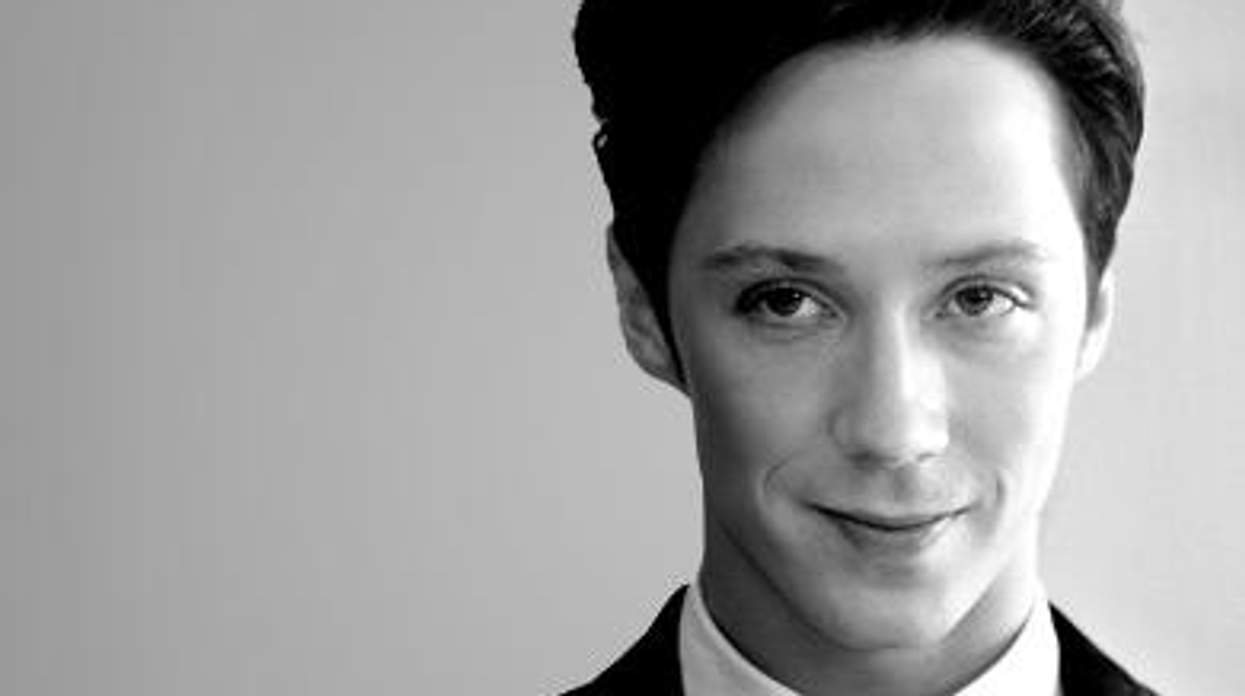
This text message came from Johnny Weir at 2:30 a.m. on March 4. I've grown accustomed to receiving middle-of-the-night missives from the figure skater, pretty much every time I try to schedule an interview, which has been five times in the past five years. And while I've enjoyed the electronic give-and-take, I have a pathetic track record -- 40% -- when it comes to actually landing the interview. (We've spoken twice on the record -- once for a Los Angeles Times piece about male figure skating costumes and a second time to get Weir's response for an Advocate.com story on the death threats he'd received as a result of the fur he'd used in his costumes prior to the Vancouver Olympics.)
Weir is, as you'd expect, hard to pin down when not under the thumb of coach Galina Zmievskaya, who from the looks of her demeanor on the Sundance Channel reality show Be Good Johnny Weir could have run a Soviet gulag had she been born a few decades earlier. But now Weir was away from Zmievskaya, in Los Angeles for Oscar weekend, and had promised me a post-Olympics chat for this magazine. But by 2:30 a.m. on March 4, I still didn't have an interview scheduled. I called. Repeatedly. And I even waited in his hotel lobby like a creep. Still, all I got in return were these texts. The content of his messages ranged from innocuous to playful to suggestive to downright overt -- the overall gist indicating what we all already know: Johnny Weir is ... not straight.
There are many people who see Weir as a hangnail to be picked at and ripped off. Their reasoning isn't easily teased apart: Weir's diva sensibility and annoying coyness about his sexuality are matched only by his exquisite narcissism. I'm continually impressed by how he infuriates detractors -- gay or straight, skating fan or foe -- on so many levels, though my current frustration with him doesn't quite match their rage. "What a disgusting, arrogant little twit," one comment on Advocate.com reads. "I don't hope he dies, but I do hope he loses." Weir draws the ire of people who just can't seem to ignore him. That elicits sympathy and a frenzied defense from his obsessed fans, which then incites his critics even more. When has an ice skater, other than Tonya Harding, attracted such hatred?
Weir did lose in Vancouver -- technically. On the most important night of his competitive career, he made the sign of the cross at the sideboards like his idol, Oksana Baiul, always did. He pursed his lips, took his starting position, and proceeded to land eight triple jumps. He also bizarrely flubbed a sit spin, however, and failed to measure up to the intricate programs -- however overdone -- of several of the skaters who finished above him. But where many of his competitors delivered community theater-rate artistic performances, Weir gave us La Scala. He always has, ever since he burst onto the amateur scene in 2001, winning the world junior championships in puffy white sleeves and a blue vest decorated with silver-and-gold embroidery. In Vancouver, Weir floated across the ice in equally elegant garb to "Nocturne," the stirring cello piece by Italian film composer Ennio Morricone. His face contorted with what appeared to be an overriding desire to create 4 1/2 minutes of indelible beauty. Evan Lysacek won the gold (well deserved, even if Johnny fanatics are repelled by his style), but it was Weir who crowned himself with roses, literally, by evening's end. Zmievskaya playfully tried to take the wreath off his head while waiting for the scores; Weir yanked it back and held his head high.
And for that, he has a bright future -- thus Weir's trip to Los Angeles over Oscar weekend, during which he worked as a correspondent for Access Hollywood, arrived at Elton John's Oscar party arm in arm with Kelly Osbourne (pictured), and played dress-up with celebrity stylist Rachel Zoe. (Lysacek, accompanied by Vera Wang that evening, received a fraction of the press.) Weir has finessed his comedic timing since the documentary Pop Star on Ice came out last year and is a natural on camera, something that will serve him well long after the latest media brouhaha dies down.
His skating career, however, is a different story. Olympic skaters often tour for years in exhibitions, and while Weir finished a mere sixth place in Vancouver, his three national championships and undeniable star power make him appear, at least on paper, a natural fit for the Stars on Ice tour (Weir has in the past performed with the now-defunct rival show, Champions on Ice, as has Rudy Galindo, who incredibly remains one of the few openly gay skaters in the sport). Weir has been passed over before by Stars on Ice, created by IMG and Scott Hamilton, the 1984 Olympic champion whose speed skater-like costumes were a rejection of the sequined aesthetic he seemed to disapprove of in his competitors. In March, Weir orchestrated a public spat with the tour, alleging Stars on Ice deemed him not "family-friendly" enough to participate. Though show officials vehemently denied the accusation, the Gay and Lesbian Alliance Against Defamation threw its full weight behind Weir.
"Stars on Ice applies a double standard because of perceived sexual orientation and gender expression," says GLAAD president Jarrett Barrios. "With someone of Weir's caliber, there's no other explanation." Though one Stars on Ice skater told me recently that "the guys on the tour have always been more on the manly side, so maybe [Weir] just doesn't fit," I can think of at least one alternative explanation: Weir's always been quick to trash other skaters in a harmless but bitchy manner -- he once referred to a fellow skater's program as a "vodka shot and snort of coke kind of thing" and recently summed up Lysacek's style in one word: "cold." If that's at all indicative of his on-tour professionalism, then perhaps there's more to Stars on Ice's snub than merely disapproving of an athlete's effeminate elan.
But GLAAD's support for Weir isn't off the mark, even if his Liberace-esque refusal to say those three little words duly aggravates many gay people. Weir's critics in the sport accuse him of hijacking ice skating and sucking out all the machismo -- a curious gripe, but a perennial charge that was leveled yet again during the Olympics. "They'll think all the boys who skate will end up like him," Canadian broadcaster Alain Goldberg said of young skaters watching Weir. "It sets a bad example." Goldberg and his colleague Claude Mailhot even joked on-air that Weir should be subjected to a gender test.
As Weir rightly pointed out in response, those barbs weren't directed solely at him, but also at the young boys who, inspired by Weir's "Fallen Angel" performance to Morricone, may have been moved to skate their own programs on concrete basement floors in white athletic socks. "There are so many kids like me, coming after me, whose parents might repress them just because they [heard] what these guys said about me, that their kids are going to turn out to be like me," Weir said on HLN's The Joy Behar Show. "And I think 'me' is pretty fabulous."
In an era when many effeminate boys still feel like they are anything but fabulous and that they have to turn themselves inside out in order to survive junior high school, Weir's gender nonconformity is one of figure skating's greatest gifts to popular culture. He may always be an outlier of his own making, and he may never have a place in Stars on Ice (which has always been too neutered for his performances anyway). But Weir has come out in a way far more potent than so many openly gay men who resist having friends or boyfriends who aren't sufficiently "straight-acting."
I'm sure I'll never get the "real" interview from Johnny. In so many staccato sound bites and fearless quips -- as well as the fierce black leggings and pink shoulder tassel that whips around his lithe frame as he completes a breathtaking triple axel -- I suppose he's already given it.