'%3E%3Cpath d='M16.3574 35.6519H12.9537L15.0491 18.8873L16.3574 35.6519ZM30.4229 54.0093L22.309 0.994385H7.91795L0 54.0093H10.6634L11.5802 46.3855H17.4014L17.9914 54.0093H30.4229Z' fill='%23971B20'/%3E%3Cpath d='M48.2073 41.8813C48.2073 43.4049 47.4892 44.0011 46.1144 44.0011H43.7595V11.0687H46.1144C47.4892 11.0687 48.2073 11.6636 48.2073 13.1885V41.8813ZM59.5273 43.6695V11.3326C59.5273 3.71323 53.5729 0.994385 47.8157 0.994385H31.7213V54.0093H47.8157C53.5729 54.0093 59.5273 51.29 59.5273 43.6695Z' fill='%23971B20'/%3E%3Cpath d='M90.183 0.994385H78.6039L75.0711 30.6157L71.9955 0.994385H59.4346L69.2474 54.0093H80.373L90.183 0.994385Z' fill='%23971B20'/%3E%3Cpath d='M107.063 42.3448C107.063 43.7359 105.951 44.5974 104.643 44.5974C103.269 44.5974 102.157 43.7359 102.157 42.3448V12.658C102.157 11.2676 103.269 10.4058 104.643 10.4058C105.951 10.4058 107.063 11.2676 107.063 12.658V42.3448ZM119.233 43.2723V11.7312C119.233 6.36384 112.952 -3.8147e-06 104.643 -3.8147e-06C96.2667 -3.8147e-06 89.9867 6.36384 89.9867 11.7312V43.2723C89.9867 48.6393 96.2667 55 104.643 55C112.952 55 119.233 48.6393 119.233 43.2723Z' fill='%23971B20'/%3E%3Cpath d='M150.976 43.9349V33.7309H139.069V42.3448C139.069 43.7359 137.957 44.5974 136.582 44.5974C135.076 44.5974 133.964 43.7359 133.964 42.3448V12.658C133.964 11.2676 135.076 10.4058 136.582 10.4058C137.957 10.4058 139.069 11.2676 139.069 12.658V21.2723H150.976V11.0687C150.976 5.70107 145.283 -3.8147e-06 136.582 -3.8147e-06C127.75 -3.8147e-06 121.796 5.70107 121.796 11.0687V43.9349C121.796 49.3022 127.75 55 136.582 55C145.283 55 150.976 49.3022 150.976 43.9349Z' fill='%23971B20'/%3E%3Cpath d='M167.478 35.6519H164.076L166.17 18.8873L167.478 35.6519ZM181.544 54.0093L173.432 0.994385H159.037L151.123 54.0093H161.785L162.704 46.3855H168.523L169.114 54.0093H181.544Z' fill='%23971B20'/%3E%3Cpath d='M205.412 10.4058V0.994385H177.081V10.4058H185.392V54.0093H197.428V10.4058H205.412Z' fill='%23971B20'/%3E%3Cpath d='M230.002 54.0093V43.9349H218.914V31.8746H226.635V21.8028H218.914V10.4058H230.002V0.994385H206.875V54.0093H230.002Z' fill='%23971B20'/%3E%3C/g%3E%3Cdefs%3E%3CclipPath id='clip0_260_7080'%3E%3Crect width='230' height='55' fill='white'/%3E%3C/clipPath%3E%3C/defs%3E%3C/svg%3E)


Within the first few moments of La Bola Negra, bullets disrupt a band lightly strumming their instruments in the Spanish countryside. Bombs drop on unsuspecting villagers, littering streets with bloodied bodies and thrusting Sebastián (Spanish singer Guitarricadelafuente, in his debut film role) away from his home. Fleeing the carnage, he gets swept into the fascist army. Being jolted by the gore and viscera of war was part of directorial duo Los Javis’s plan for the film: It’s not just a war movie, but an anti-war movie.
“I don’t think queer movies have to be kind or nice” Javier Calvo, half of Los Javis, says. “They can show the harshness of the world.” Such brutality comes from their own cinematic diet; underneath La Bola Negra’s triumphant peak is an iceberg of film knowledge, its sometimes bitter tone stemming from the oeuvre of Michael Haneke, Ivan’s Childhood by Andrei Tarkovsky, and Elem Klimov’s historical anti-war epic Come and See. The epic primogenitors populating its mood board include such decade-spanning productions as The English Patient, Titanic, and The Hours.
“We wanted to make a mix between the movies we love, the message, and create something new,” Javier Ambrossi, the other half of Los Javis, says. Calvo adds that they can use the “rules of traditional war movies, but make it with a queer perspective and a contemporary gaze.”
Throw it all together and you have the critically acclaimed La Bola Negra, which has elicited raves on the festival circuit, drumming up Oscar buzz and outlining the rules of an entirely new cinematic genre: the Epic Gay Drama. Yes, queer soldiers have been on screen before, but Los Javis seem to have cemented the hallmarks of what an EGD — an acronym Calvo and Ambrossi seem to have embraced — entails. In a year of large-scale, big-budget filmmaking that includes Christopher Nolan’s mythological The Odyssey and the starbound science fiction romp Project Hail Mary, La Bola Negra offers a true thesis for how queerness can nuance war movies and how epic films can embrace the intimacy of queerness.
“I wanted the intimacy to connect with a lot of people, but at the same time we wanted to make it big,” Ambrossi says. “The intimacy touches you because there’s a lot of things contrasting with it.”
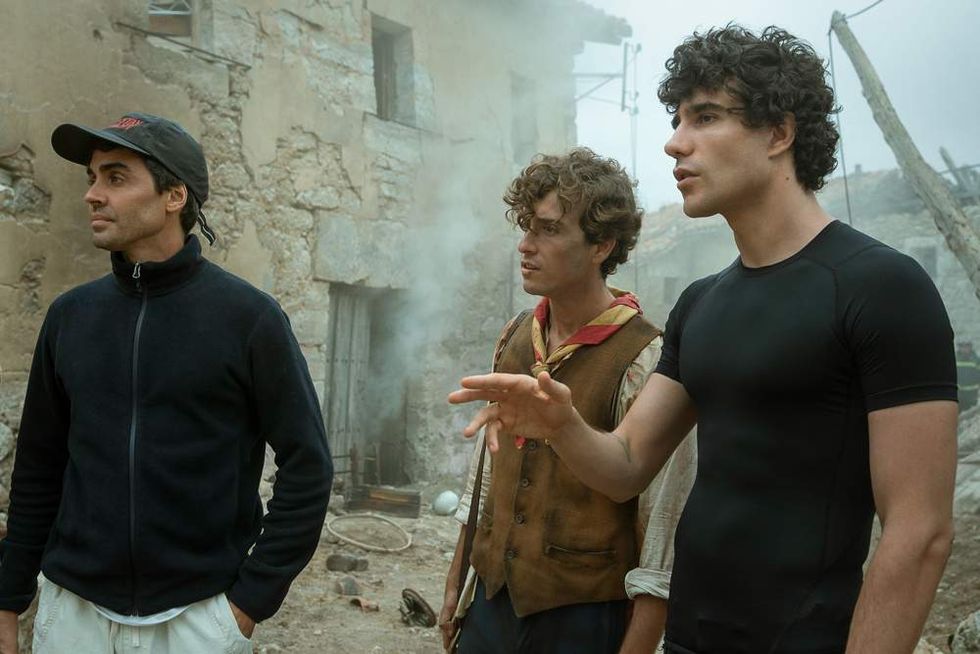 Los Javis on La Bola Negra's set with GuitarricadelafuenteNetflix
Queering the wartime epic also meant undercutting some of the genre’s conventions by finding funny moments in tragedy and drama in comedy. That, Calvo claims, echoes the work of queer auteurs such as Pedro Almodóvar and Gus Van Sant.
Close-up shots counterbalance the sweeping vistas, bombastic explosions, and clamoring crowds. During his time in the army, Sebastián meets and falls for Rafael Rodríguez Rapún (Miguel Bernardeau), a real person who fought in the Spanish army and was the partner of legendary Spanish poet Federico García Lorca, whose lost play gives the film its title.
“In the editing, it was a lot of eyes,” Calvo says. “It’s like Portrait of a Lady on Fire but make it Apocalypse Now.” He continues, “I love directors that show reality in a harsh way and we wanted to do that but have this tenderness in how Sebastian sees the world.”
With La Bola Negra, queerness is much more than just the characters’ sexualities; it is a shared history and lineage. While the stories are particular to LGBTQ+ people, the grand scale emphasizes the universality of its anti-war themes.
“We are writing and directing universal stories,” Ambrossi says. “In order to be universal, you don’t have to change the sexual orientation of the characters. I think that’s homophobic.”
For those new to Los Javis, the duo are known for a filmography that eschews the constraints of genre. Even from their first film, La Llamada, a musical with an indie spirit, Calvo, 35, and Ambrossi, 42, wanted to upend genre expectations. Their television series Paquitas Salas is a more “poetic,” in Ambrossi’s words, take on mockumentary comedy. And, with both their acclaimed TV show El Veneno and La Bola Negra, they document the way the past impedes on the present.
La Bola Negra, which alternates between 1932, 1937, and 2017, embraces a vision of time inspired by Lorca, who wrote in his poem “La leyenda del tiempo,” “El sueño va sobre el tiempo/ flotando como un velero,” which roughly translates, “The dream goes over time, floating like a sailboat.” They wanted viewers to get lost in time, sometimes even feeling unsure of how one scene and one era flows into one another.
“Some people,” Ambrossi says, “when they’re out of a screening, say at some point they just had to let go of themselves, just go with the flow.”
The film’s time jumps ultimately show a queerness that endures over time. When Alberto (Carlos González), a contemporary historian, is told his grandfather was a fascist, he searches for the truth and uncovers a deeper queer history, something Calvo says young LGBTQ+ people can wrestle with.
 Guitarricadelafuente and Miguel Bernardeau in 'La Bola Negra' Netflix
“It’s about understanding our sisters and knowing that they had no options,” Calvo says. He believes that the past is a “mystery that you have to crack,” to which Ambrossi adds that it’s a “mystery that connects” LGBTQ+ people over space and time.
“We are connected, and I don’t know if we are aware of that,” he says. “We’re part of the same rejection.”
Ultimately, Ambrossi and Calvo say, the film’s titular “black ball” is the shame engrained inside queer people since youth — and the film is a cry to remove it. It might seem like a tall order for a war movie to take on the long lineage of queer shame, but that is what La Bola Negra does beautifully, using its anti-war leanings as a call to reject killing one another’s bodies and spirits. Here, queerness is war’s antidote: hopeful, optimistic, and forward-looking.
“I think it’s important to make a movie that shows the horrors of war, the emptiness of it,” Calvo says. “It’s the opposite of possibility.”
This article is part of The Advocate’s Nov-Dec 2026 print issue, on newsstands November 3. Support queer media and subscribe — or download the issue through Apple News+, Zinio, Nook, or PressReader starting October 22.