'%3E%3Cpath d='M16.3574 35.6519H12.9537L15.0491 18.8873L16.3574 35.6519ZM30.4229 54.0093L22.309 0.994385H7.91795L0 54.0093H10.6634L11.5802 46.3855H17.4014L17.9914 54.0093H30.4229Z' fill='%23971B20'/%3E%3Cpath d='M48.2073 41.8813C48.2073 43.4049 47.4892 44.0011 46.1144 44.0011H43.7595V11.0687H46.1144C47.4892 11.0687 48.2073 11.6636 48.2073 13.1885V41.8813ZM59.5273 43.6695V11.3326C59.5273 3.71323 53.5729 0.994385 47.8157 0.994385H31.7213V54.0093H47.8157C53.5729 54.0093 59.5273 51.29 59.5273 43.6695Z' fill='%23971B20'/%3E%3Cpath d='M90.183 0.994385H78.6039L75.0711 30.6157L71.9955 0.994385H59.4346L69.2474 54.0093H80.373L90.183 0.994385Z' fill='%23971B20'/%3E%3Cpath d='M107.063 42.3448C107.063 43.7359 105.951 44.5974 104.643 44.5974C103.269 44.5974 102.157 43.7359 102.157 42.3448V12.658C102.157 11.2676 103.269 10.4058 104.643 10.4058C105.951 10.4058 107.063 11.2676 107.063 12.658V42.3448ZM119.233 43.2723V11.7312C119.233 6.36384 112.952 -3.8147e-06 104.643 -3.8147e-06C96.2667 -3.8147e-06 89.9867 6.36384 89.9867 11.7312V43.2723C89.9867 48.6393 96.2667 55 104.643 55C112.952 55 119.233 48.6393 119.233 43.2723Z' fill='%23971B20'/%3E%3Cpath d='M150.976 43.9349V33.7309H139.069V42.3448C139.069 43.7359 137.957 44.5974 136.582 44.5974C135.076 44.5974 133.964 43.7359 133.964 42.3448V12.658C133.964 11.2676 135.076 10.4058 136.582 10.4058C137.957 10.4058 139.069 11.2676 139.069 12.658V21.2723H150.976V11.0687C150.976 5.70107 145.283 -3.8147e-06 136.582 -3.8147e-06C127.75 -3.8147e-06 121.796 5.70107 121.796 11.0687V43.9349C121.796 49.3022 127.75 55 136.582 55C145.283 55 150.976 49.3022 150.976 43.9349Z' fill='%23971B20'/%3E%3Cpath d='M167.478 35.6519H164.076L166.17 18.8873L167.478 35.6519ZM181.544 54.0093L173.432 0.994385H159.037L151.123 54.0093H161.785L162.704 46.3855H168.523L169.114 54.0093H181.544Z' fill='%23971B20'/%3E%3Cpath d='M205.412 10.4058V0.994385H177.081V10.4058H185.392V54.0093H197.428V10.4058H205.412Z' fill='%23971B20'/%3E%3Cpath d='M230.002 54.0093V43.9349H218.914V31.8746H226.635V21.8028H218.914V10.4058H230.002V0.994385H206.875V54.0093H230.002Z' fill='%23971B20'/%3E%3C/g%3E%3Cdefs%3E%3CclipPath id='clip0_260_7080'%3E%3Crect width='230' height='55' fill='white'/%3E%3C/clipPath%3E%3C/defs%3E%3C/svg%3E)

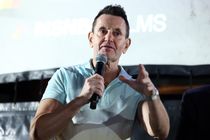
As Superman soars back into theaters this weekend, the new Clark Kent, David Corenswet, carries the legacy of not just a fictional hero but a real-life tale of resilience involving two men who understood the meaning of fight: Christopher Reeve, the actor-turned-activist paralyzed in 1995, who will forever be known as Superman, and Michael Manganiello, a trailblazing gay HIV survivor who helped Reeve channel his celebrity into groundbreaking advocacy
And in return, Reeve and his wife, Dana, helped Manganiello survive.
Keep up with the latest in LGBTQ+ news and politics. Sign up for The Advocate's email newsletter.
Manganiello now serves as president and CEO of Pyxis Partners in Washington, D.C., where he continues his work in advocacy, But his roots stretch far back. A former theater performer and restaurant owner in New York City's Hell’s Kitchen, Manganiello faced a devastating HIV diagnosis in 1988, when he was given just 18 months to live.
He became an early participant in National Institutes of Health clinical trials led by Dr. Anthony Fauci, helping pave the way for the life-saving “cocktail therapy” that revolutionized AIDS treatment.
This experience shaped his activism. Manganiello went on to become the first senior vice president of government relations for the Christopher and Dana Reeve Foundation, guiding landmark policies and raising more than $150 million for paralysis research. But his role with Reeve extended far beyond strategy and fundraising.
“I didn’t physically take care of him, and I wasn’t a nurse or anything like that,” Michael recalls. “But I definitely helped, certainly after the accident. I helped organize and sort of focus Chris on a different set of priorities than he probably had before his accident.”
“Before his paralysis, he was philanthropic, but not around medical research and health care access. He didn’t really know much about the NIH or clinical trials,” Manganiello says. “I helped him navigate the world of patient advocacy, federal funding, and health systems. How do we focus, and what are the priorities in terms of what we fund?”
Dana Reeve, Manganiello notes, was always a big part of everything. “I had known her years before I met Chris, so when I met Chris, he clearly wanted to get out of that chair, there’s no question about it,” Manganiello says. “But both of them recognized that people had to live with a disability or had been living with a disability for a long time. So I think we helped establish a great balance between cure and care. And I think it worked out great.”
Manganiello’s own survival became a symbol of hope for Chris and Dana. Diagnosed in the earliest days of the AIDS crisis, before protease inhibitors and the lifesaving drug cocktails, Manganiello once had a terrifying bout of Pneumocystis carinii pneumonia, a common opportunistic infection in men with AIDS.
“Chris and Dana picked me up at the hospital,” he says. “They understood everything. Chris’s first agent died of AIDS, so there was knowledge and compassion for what was taking place with me..”
His recovery was powerful for the Reeves. “They both would use me as an example, like ‘Michael was given 18 months. Look what happened to him, and he turned his life around.’ Sadly, I survived them both,” he remembers. “But I think I gave them hope. They were both given a bad prognosis, Dana with her cancer diagnosis, and they just didn’t survive it. But while they were alive, I think I was helpful there for sure.”
The two men also grew close professionally, especially as they moved their work to Washington, D.C. “That’s where you realize all the big changes happen, right? The big tectonic plate shift changes,” Manganiello points out. “Together, we secured the first $2 million in federal funding for what became the Christopher and Dana Reeve Paralysis Resource Center. That turned into a much bigger number by the time they both died and I left.”
One of their earliest priorities was eliminating lifetime insurance caps. “That was a huge issue for people with chronic long-term disabilities,” Manganiello says. “And for people with HIV.”
Later, they became fierce defenders of stem cell research, fighting conservative efforts to end federal support. Their coalition-building helped keep the doors open. Though the Reeves didn’t live to see it, one of President Obama’s first executive orders restored that funding. Later that year, Congress passed the Christopher and Dana Reeve Paralysis Act, something Christopher Reeve helped design but never saw signed into law.
In one particularly striking moment, Manganiello recalls organizing Reeve’s first visit to the NIH. “He didn’t know much about the NIH and I told him, ‘Chris, we’ve got to get down there. That’s where all the major research will be happening.’”
When Manganiello called the NIH the first time, they hesitated, saying there wasn’t much progress to show in spinal cord research, Michael had a ready reply. “I said, ‘I’m not bringing him down if you’re going to give him no hope.’ So they relented.”
Reeve and Manganiello flew down. “We were traveling like a moving ER, and we sat for lunch with then-HHS Secretary Donna Shalala. And we had a surprise guest with Dr. Fauci.”
“He had nothing to do with spinal cord injury,” Manganiello laughs. “But he’d been given an insurmountable problem and solved it. It gave Chris a lot of hope. He realized he had to use that model in central nervous system disorders. And he went on to do that.”
Manganiello’s own ties to NIH ran deep. He was participating in NIH clinical trials monthly, even as he worked with Reeve. “Nothing was working at the time, but because I was in those trials, I was one of the first people to get the call when Dr. Fauci was doing the cocktail. Lucky me, since I got it a year before everyone else. Here I am 30 years later.”
That longevity brought emotional complexity. “Helping Chris was a two-way street,” he reflects. “They were in the arts. A lot of their friends were impacted by HIV/AIDS. They were there to be supportive and kind. Then, when I was better and they had their bigger hurdles, I felt like I was there for them.”
Once, the Human Rights Campaign asked Manganiello to introduce Reeve at an event where some LGBTQ+ attendees were unsure why Reeve, a straight man, was being honored. “They said, ‘He’s a great guy and Superman and all, but what does he have to do with the HIV community?’ I was able to put him in context. I think it helped.”
As Superman movies return, like this week, it gives Manganiello a chance to look back. “We were all sort of inextricably interwoven,” he shares.