'%3E%3Cpath d='M16.3574 35.6519H12.9537L15.0491 18.8873L16.3574 35.6519ZM30.4229 54.0093L22.309 0.994385H7.91795L0 54.0093H10.6634L11.5802 46.3855H17.4014L17.9914 54.0093H30.4229Z' fill='%23971B20'/%3E%3Cpath d='M48.2073 41.8813C48.2073 43.4049 47.4892 44.0011 46.1144 44.0011H43.7595V11.0687H46.1144C47.4892 11.0687 48.2073 11.6636 48.2073 13.1885V41.8813ZM59.5273 43.6695V11.3326C59.5273 3.71323 53.5729 0.994385 47.8157 0.994385H31.7213V54.0093H47.8157C53.5729 54.0093 59.5273 51.29 59.5273 43.6695Z' fill='%23971B20'/%3E%3Cpath d='M90.183 0.994385H78.6039L75.0711 30.6157L71.9955 0.994385H59.4346L69.2474 54.0093H80.373L90.183 0.994385Z' fill='%23971B20'/%3E%3Cpath d='M107.063 42.3448C107.063 43.7359 105.951 44.5974 104.643 44.5974C103.269 44.5974 102.157 43.7359 102.157 42.3448V12.658C102.157 11.2676 103.269 10.4058 104.643 10.4058C105.951 10.4058 107.063 11.2676 107.063 12.658V42.3448ZM119.233 43.2723V11.7312C119.233 6.36384 112.952 -3.8147e-06 104.643 -3.8147e-06C96.2667 -3.8147e-06 89.9867 6.36384 89.9867 11.7312V43.2723C89.9867 48.6393 96.2667 55 104.643 55C112.952 55 119.233 48.6393 119.233 43.2723Z' fill='%23971B20'/%3E%3Cpath d='M150.976 43.9349V33.7309H139.069V42.3448C139.069 43.7359 137.957 44.5974 136.582 44.5974C135.076 44.5974 133.964 43.7359 133.964 42.3448V12.658C133.964 11.2676 135.076 10.4058 136.582 10.4058C137.957 10.4058 139.069 11.2676 139.069 12.658V21.2723H150.976V11.0687C150.976 5.70107 145.283 -3.8147e-06 136.582 -3.8147e-06C127.75 -3.8147e-06 121.796 5.70107 121.796 11.0687V43.9349C121.796 49.3022 127.75 55 136.582 55C145.283 55 150.976 49.3022 150.976 43.9349Z' fill='%23971B20'/%3E%3Cpath d='M167.478 35.6519H164.076L166.17 18.8873L167.478 35.6519ZM181.544 54.0093L173.432 0.994385H159.037L151.123 54.0093H161.785L162.704 46.3855H168.523L169.114 54.0093H181.544Z' fill='%23971B20'/%3E%3Cpath d='M205.412 10.4058V0.994385H177.081V10.4058H185.392V54.0093H197.428V10.4058H205.412Z' fill='%23971B20'/%3E%3Cpath d='M230.002 54.0093V43.9349H218.914V31.8746H226.635V21.8028H218.914V10.4058H230.002V0.994385H206.875V54.0093H230.002Z' fill='%23971B20'/%3E%3C/g%3E%3Cdefs%3E%3CclipPath id='clip0_260_7080'%3E%3Crect width='230' height='55' fill='white'/%3E%3C/clipPath%3E%3C/defs%3E%3C/svg%3E)
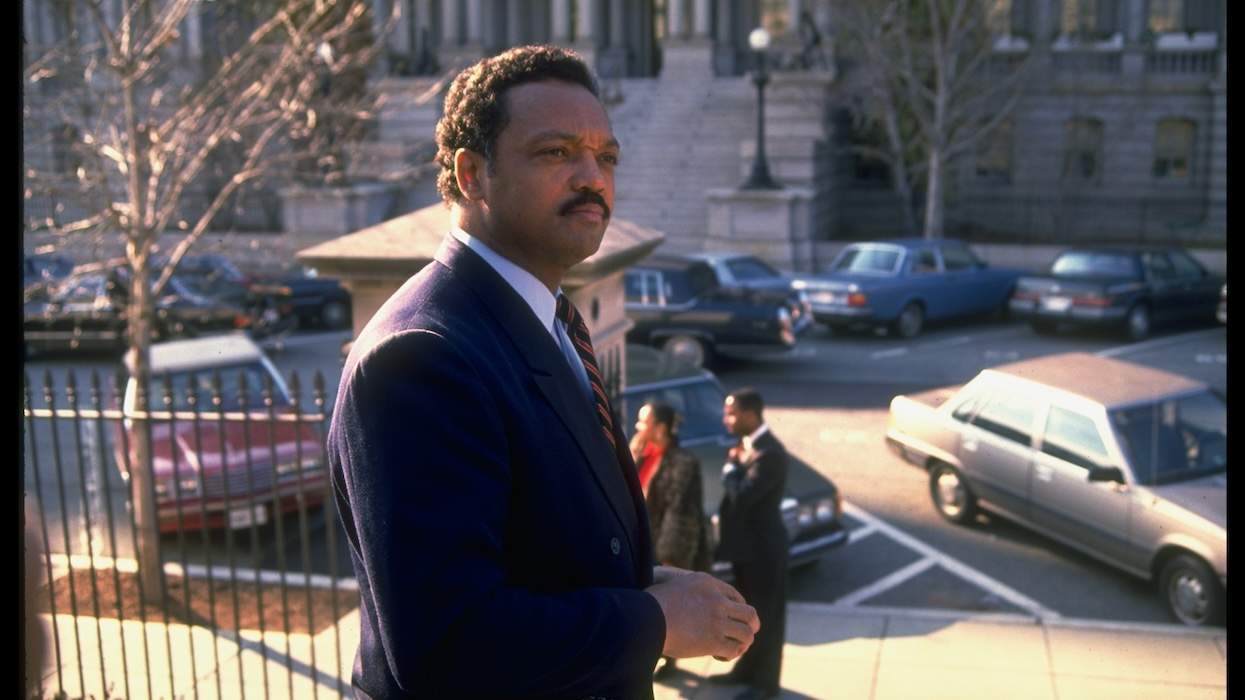

I met Jesse Jackson, who died Tuesday at 84, in 1988 when I worked on Capitol Hill. From what I recall, Jackson held a rally or gave a speech on the steps of the Capitol while he was running for president. I was lucky enough to be near the front, and I shook his hand. I remember him being tall, with a very firm grip.
As I did with any historic figure I’ve met during my life, I always kept up with him, reading books about him or paying attention when he made news headlines.
But I was quite aware of Jackson even before I met him. When he ran for president in 1984, he included LGBTQ+ rights as a central pillar of his political platform. He was the first major candidate to endorse LGBTQ+ rights, and I always appreciated that about Jackson. Trust me, in 1984, no one was proclaiming support for our community, at least in my recollection.
Related: Rev. Jesse Jackson, trailblazing civil rights icon and LGBTQ+ rights ally, dead at 84
This was all part of his famous “Rainbow Coalition,” where he included LGBTQ+ people alongside BIPOC communities, women, and others, advocating for their inclusion in the Democratic Party and the broader fight for equality.
I remember once having a conversation about Jackson and remarking that it wasn’t ironic that our Pride flag and his coalition shared a rainbow. Jackson was all about inclusion and always about including us.
For those of us who came of age in the 1980s, Jackson was not just a preacher or a civil rights advocate; he was always a valuable ally.
What made Jackson’s supportive stance toward our community even bolder back in the early and mid 1980s was that it coincided with the rise of discriminatory organizations like Jerry Falwell’s Moral Majority.
Falwell’s political group, which sanctimoniously preached Christianity, was restrictive in the way it weaponized scripture against us at the height of the AIDS crisis. It was during a time when gay men were dying, lesbians were organizing care networks because the government wouldn’t, and fear was overwhelming.
Related: 12 far-right groups with extreme anti-LGBTQ+ positions that threaten civil rights
Jackson did something that was neither safe nor politically convenient. He showed up, and that meant something. Frankly, it was beyond reproach at a time when most people shunned our community.
Jackson walked into hospices. He held hands with people suffering from AIDS, humanizing them. And in 1984, from the stage of the Democratic National Convention, he said the words “lesbians and gays” out loud and insisted we were part of the American family.
It’s so hard for people in this generation to understand how Jackson’s words and actions were like a thunderbolt. It didn’t seem real that someone actually acknowledged our existence. While I was still in college and closeted, I just remember the brief solace his speech provided. I felt, albeit briefly, legitimate.
At that time, I was so far removed from the AIDS crisis, but when reading about the devastation of the plague and reading about Jackson, I realized how much it mattered because we were being treated as a contagion, a curse, and a punch line. Trust me, AIDS jokes were prevalent and hauntingly offensive.
It mattered because too many leaders tried to calibrate their proximity to the community. People were sick and dying, families and communities were being torn apart, and politicians tried to find a way to be “sympathetic” without sounding like they were endorsing what was known at the time as the “homosexual lifestyle” or the “homosexual disease.”
But not Jackson. He had the empathy and foresight to include us. He understood something that still seems revolutionary in certain corners of American politics that providing dignity to one group does not take dignity from another.
At the end of the day, we are all simply human. Jackson understood that.
And I think part of that was Jackson’s understanding that life was fallible, that he made mistakes — which he apologized for — and he realized the frailty of being human. He was at Martin Luther King Jr.’s side when his mentor was assassinated on a hotel balcony in Memphis in 1968. Jackson knew that it was dangerous to speak out, but it was more dangerous to be quiet.
His Rainbow Coalition fused together Black, white, brown, poor, immigrant, and LGBTQ+. A coalition of the dismissed. A declaration that “we the people” doesn’t mean we live in silos.
In the wake of Jackson’s passing, the contrast is abrupt and distinct between the inclusive world he tried to build — one filled with rainbows — and the exclusionary one this administration is trying to impose on LGBTQ+ Americans
While Jackson spent his life stretching the definition of “we,” Donald Trump is shrinking it, methodically, aggressively, and unapologetically erasing it. Trump is about storm clouds the same way Jackson was about rainbows.
And that rainbow symbolism is coming under fire.
The recent removal of the Pride flag from the Stonewall National Monument was a slap at our history and Jackson’s rainbow legacy. Stonewall is not just a park. It is the birthplace of our modern liberation movement. The same holds true for rainbow crosswalks, rainbow flags on federal websites, rainbow flags on federal employees’ desks, and rainbow flags at U.S. embassies overseas.
To Jackson, the rainbow was all about hope. To Trump, it’s a threat.
Jackson’s Rainbow Coalition brought LGBTQ+ visibility into the national political mainstream. The Trump administration has framed the rainbow flag as a "divisive" emblem that conflicts with institutional neutrality.
In the end, what Jesse Jackson offered in the 1980s was not just rhetoric but sincerity. At a time when LGBTQ+ Americans were treated as trash and people with AIDS were abandoned by their government, he insisted on seeing us as human beings.
Jackson folded us into his Rainbow Coalition. The rainbow, on both sides, was never a gimmick. It was a reminder that inclusivity made us stronger, not weaker, with its many colors.
Jackson understood that when you stand with the most marginalized, with the dying, the shunned, the poor, the mocked, you are not clouding America; you are brightening it. And perhaps that’s the biggest lesson he leaves us with.