'%3E%3Cpath d='M16.3574 35.6519H12.9537L15.0491 18.8873L16.3574 35.6519ZM30.4229 54.0093L22.309 0.994385H7.91795L0 54.0093H10.6634L11.5802 46.3855H17.4014L17.9914 54.0093H30.4229Z' fill='%23971B20'/%3E%3Cpath d='M48.2073 41.8813C48.2073 43.4049 47.4892 44.0011 46.1144 44.0011H43.7595V11.0687H46.1144C47.4892 11.0687 48.2073 11.6636 48.2073 13.1885V41.8813ZM59.5273 43.6695V11.3326C59.5273 3.71323 53.5729 0.994385 47.8157 0.994385H31.7213V54.0093H47.8157C53.5729 54.0093 59.5273 51.29 59.5273 43.6695Z' fill='%23971B20'/%3E%3Cpath d='M90.183 0.994385H78.6039L75.0711 30.6157L71.9955 0.994385H59.4346L69.2474 54.0093H80.373L90.183 0.994385Z' fill='%23971B20'/%3E%3Cpath d='M107.063 42.3448C107.063 43.7359 105.951 44.5974 104.643 44.5974C103.269 44.5974 102.157 43.7359 102.157 42.3448V12.658C102.157 11.2676 103.269 10.4058 104.643 10.4058C105.951 10.4058 107.063 11.2676 107.063 12.658V42.3448ZM119.233 43.2723V11.7312C119.233 6.36384 112.952 -3.8147e-06 104.643 -3.8147e-06C96.2667 -3.8147e-06 89.9867 6.36384 89.9867 11.7312V43.2723C89.9867 48.6393 96.2667 55 104.643 55C112.952 55 119.233 48.6393 119.233 43.2723Z' fill='%23971B20'/%3E%3Cpath d='M150.976 43.9349V33.7309H139.069V42.3448C139.069 43.7359 137.957 44.5974 136.582 44.5974C135.076 44.5974 133.964 43.7359 133.964 42.3448V12.658C133.964 11.2676 135.076 10.4058 136.582 10.4058C137.957 10.4058 139.069 11.2676 139.069 12.658V21.2723H150.976V11.0687C150.976 5.70107 145.283 -3.8147e-06 136.582 -3.8147e-06C127.75 -3.8147e-06 121.796 5.70107 121.796 11.0687V43.9349C121.796 49.3022 127.75 55 136.582 55C145.283 55 150.976 49.3022 150.976 43.9349Z' fill='%23971B20'/%3E%3Cpath d='M167.478 35.6519H164.076L166.17 18.8873L167.478 35.6519ZM181.544 54.0093L173.432 0.994385H159.037L151.123 54.0093H161.785L162.704 46.3855H168.523L169.114 54.0093H181.544Z' fill='%23971B20'/%3E%3Cpath d='M205.412 10.4058V0.994385H177.081V10.4058H185.392V54.0093H197.428V10.4058H205.412Z' fill='%23971B20'/%3E%3Cpath d='M230.002 54.0093V43.9349H218.914V31.8746H226.635V21.8028H218.914V10.4058H230.002V0.994385H206.875V54.0093H230.002Z' fill='%23971B20'/%3E%3C/g%3E%3Cdefs%3E%3CclipPath id='clip0_260_7080'%3E%3Crect width='230' height='55' fill='white'/%3E%3C/clipPath%3E%3C/defs%3E%3C/svg%3E)

Two federal lawsuits filed this week have turned a single flagpole in New York City’s Greenwich Village into a referendum on how the United States tells its own story.
Keep up with the latest in LGBTQ+ news and politics. Sign up for The Advocate's email newsletter.
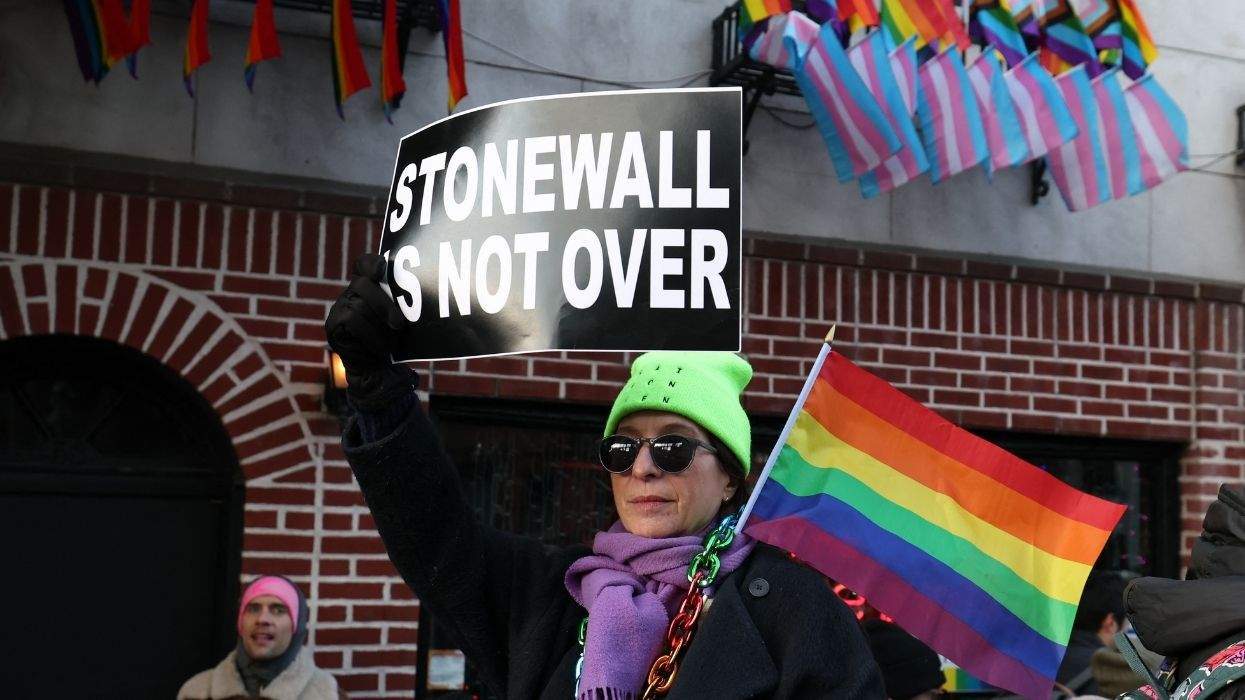
At issue is the Pride flag at the Stonewall National Monument, the first national monument dedicated to the LGBTQ+ rights movement. Earlier this month, the National Park Service removed the NPS-sanctioned Pride flag that had flown there since 2022, sparking protests in New York and a swift legal and political backlash. Now, one lawsuit filed by Lambda Legal in Manhattan seeks to force the government to restore the flag at Stonewall, while a second, broader case filed in Massachusetts challenges what plaintiffs describe as a coordinated effort by the Trump administration to scrub disfavored history and science from national parks across the country.
Together, the cases take on a dispute that is only partly about a piece of fabric. More fundamentally, they ask whether the federal government can selectively narrow the historical record presented in public spaces and whether Stonewall, of all places, can be stripped of a symbol that has become inseparable from its meaning.
The New York case was brought by the Gilbert Baker Foundation, Village Preservation, Equality New York, and other plaintiffs against the Department of the Interior and the National Park Service. The complaint argues that the agency acted unlawfully and arbitrarily when it removed the official Pride flag from the monument on February 9. The flag, installed after years of advocacy, was the first Pride flag flown permanently on federal land and bore the Park Service’s own insignia—an explicit signal, the plaintiffs say, that the government recognized the flag as part of the site’s historical interpretation.
The suit contends that the Park Service misread its own policies, ignored the Stonewall monument’s founding documents, and failed to follow required procedures under the National Historic Preservation Act, including consulting the public before making changes to a historic site. The removal, the plaintiffs argue, violates the Administrative Procedure Act because it rests on a justification that “on its face” does not require the flag to come down.
Stonewall is not an ordinary park unit. Established by President Barack Obama in 2016, the 7.7-acre monument encompasses Christopher Park, the Stonewall Inn, and surrounding streets where, in 1969, patrons and neighbors resisted a police raid. The uprising is widely seen as a catalytic moment in the modern LGBTQ+ rights movement. The National Park Service’s own foundation document describes the site’s purpose as preserving and interpreting that history and its continuing significance, placing Stonewall within the broader story of American civil rights.
The Pride flag’s defenders argue that the symbol is not decorative but interpretive: a visual shorthand for the movement that Stonewall helped ignite. Its removal, they say, represents not bureaucratic housekeeping but a narrowing of the story the federal government is willing to tell.
The second lawsuit, filed in federal court in Massachusetts by a coalition that includes the National Parks Conservation Association, the Union of Concerned Scientists, and several history and park-ranger groups, widens the lens. That case challenges a series of actions taken by the Interior Department and the Park Service following a 2025 executive order directing agencies to promote what the administration calls a more “patriotic” account of American history.
According to the complaint, the government has removed or altered exhibits and signage addressing slavery, climate change, Indigenous history, and civil rights at parks around the country, often with little explanation and no meaningful public process. The plaintiffs argue that this campaign violates federal law, including statutes that require the Park Service to reflect current scholarship and to serve as an educational resource for a diverse public. They are seeking court orders to halt the removals and restore materials that have already been taken down.
Related: New York City Council advances resolution opposing Stonewall Pride flag removal
Related: For New Yorkers, Stonewall’s new Pride flag is only step one
Related: They can take down the flag, but they can’t take down the history of Stonewall
In January, the Park Service circulated new internal guidance on the display of non-agency flags, which the administration has cited to justify taking down the Pride flag. The guidance says that, in most cases, only the U.S. flag, Department of the Interior flags, and the POW/MIA flag should be flown on NPS-controlled flagpoles, though it also allows exceptions for flags that provide historical context.
The Stonewall plaintiffs argue that the Pride flag falls squarely within that exception and that the government’s insistence otherwise reveals not a neutral application of policy but a selective, ideologically driven choice.
In a statement to The Advocate, Skye Perryman, the president and CEO of Democracy Forward, which is representing plaintiffs in the broader parks lawsuit, cast the litigation as a defense of the national parks’ civic purpose.
“America’s national parks are a living classroom, telling the stories of sacrifice, perseverance, and hope so that every visitor can learn our history and the world around us,” Perryman said. “You cannot tell the story of America without recognizing both the beauty and the tragedy of our history. You cannot truly love America without understanding our country’s true history and what it teaches about the country we must work together to build and the country that we can be. The president’s effort to erase history and science in our national parks violates federal law, and is a disgrace that neither honors our country’s legacy nor its future.”
Related: After trans people, Trump now erases bisexual people from Stonewall National Monument
Related: Gay former FBI official sues Kash Patel & Pam Bondi for Pride flag firing
The legal fight is unfolding alongside a political one. This week, Senate Minority Leader Chuck Schumer and Rep. Daniel Goldman, both New York Democrats, announced plans to introduce legislation that would make the Rainbow Flag permanent at Stonewall, a move applauded by the Gilbert Baker Foundation, which was founded to preserve the legacy of the flag’s creator.
“Whenever trouble strikes, and someone tries to ban our flag, the Gilbert Baker Foundation has been there. Through our Save The Rainbow Flag initiative, we have gone toe to toe with bullies and bigots from California to New Jersey, from Florida to Michigan. From the smallest town to Stonewall, we have shown up and fought the fight,” Charles Beal, President of the Gilbert Baker Foundation, said.