'%3E%3Cpath d='M16.3574 35.6519H12.9537L15.0491 18.8873L16.3574 35.6519ZM30.4229 54.0093L22.309 0.994385H7.91795L0 54.0093H10.6634L11.5802 46.3855H17.4014L17.9914 54.0093H30.4229Z' fill='%23971B20'/%3E%3Cpath d='M48.2073 41.8813C48.2073 43.4049 47.4892 44.0011 46.1144 44.0011H43.7595V11.0687H46.1144C47.4892 11.0687 48.2073 11.6636 48.2073 13.1885V41.8813ZM59.5273 43.6695V11.3326C59.5273 3.71323 53.5729 0.994385 47.8157 0.994385H31.7213V54.0093H47.8157C53.5729 54.0093 59.5273 51.29 59.5273 43.6695Z' fill='%23971B20'/%3E%3Cpath d='M90.183 0.994385H78.6039L75.0711 30.6157L71.9955 0.994385H59.4346L69.2474 54.0093H80.373L90.183 0.994385Z' fill='%23971B20'/%3E%3Cpath d='M107.063 42.3448C107.063 43.7359 105.951 44.5974 104.643 44.5974C103.269 44.5974 102.157 43.7359 102.157 42.3448V12.658C102.157 11.2676 103.269 10.4058 104.643 10.4058C105.951 10.4058 107.063 11.2676 107.063 12.658V42.3448ZM119.233 43.2723V11.7312C119.233 6.36384 112.952 -3.8147e-06 104.643 -3.8147e-06C96.2667 -3.8147e-06 89.9867 6.36384 89.9867 11.7312V43.2723C89.9867 48.6393 96.2667 55 104.643 55C112.952 55 119.233 48.6393 119.233 43.2723Z' fill='%23971B20'/%3E%3Cpath d='M150.976 43.9349V33.7309H139.069V42.3448C139.069 43.7359 137.957 44.5974 136.582 44.5974C135.076 44.5974 133.964 43.7359 133.964 42.3448V12.658C133.964 11.2676 135.076 10.4058 136.582 10.4058C137.957 10.4058 139.069 11.2676 139.069 12.658V21.2723H150.976V11.0687C150.976 5.70107 145.283 -3.8147e-06 136.582 -3.8147e-06C127.75 -3.8147e-06 121.796 5.70107 121.796 11.0687V43.9349C121.796 49.3022 127.75 55 136.582 55C145.283 55 150.976 49.3022 150.976 43.9349Z' fill='%23971B20'/%3E%3Cpath d='M167.478 35.6519H164.076L166.17 18.8873L167.478 35.6519ZM181.544 54.0093L173.432 0.994385H159.037L151.123 54.0093H161.785L162.704 46.3855H168.523L169.114 54.0093H181.544Z' fill='%23971B20'/%3E%3Cpath d='M205.412 10.4058V0.994385H177.081V10.4058H185.392V54.0093H197.428V10.4058H205.412Z' fill='%23971B20'/%3E%3Cpath d='M230.002 54.0093V43.9349H218.914V31.8746H226.635V21.8028H218.914V10.4058H230.002V0.994385H206.875V54.0093H230.002Z' fill='%23971B20'/%3E%3C/g%3E%3Cdefs%3E%3CclipPath id='clip0_260_7080'%3E%3Crect width='230' height='55' fill='white'/%3E%3C/clipPath%3E%3C/defs%3E%3C/svg%3E)
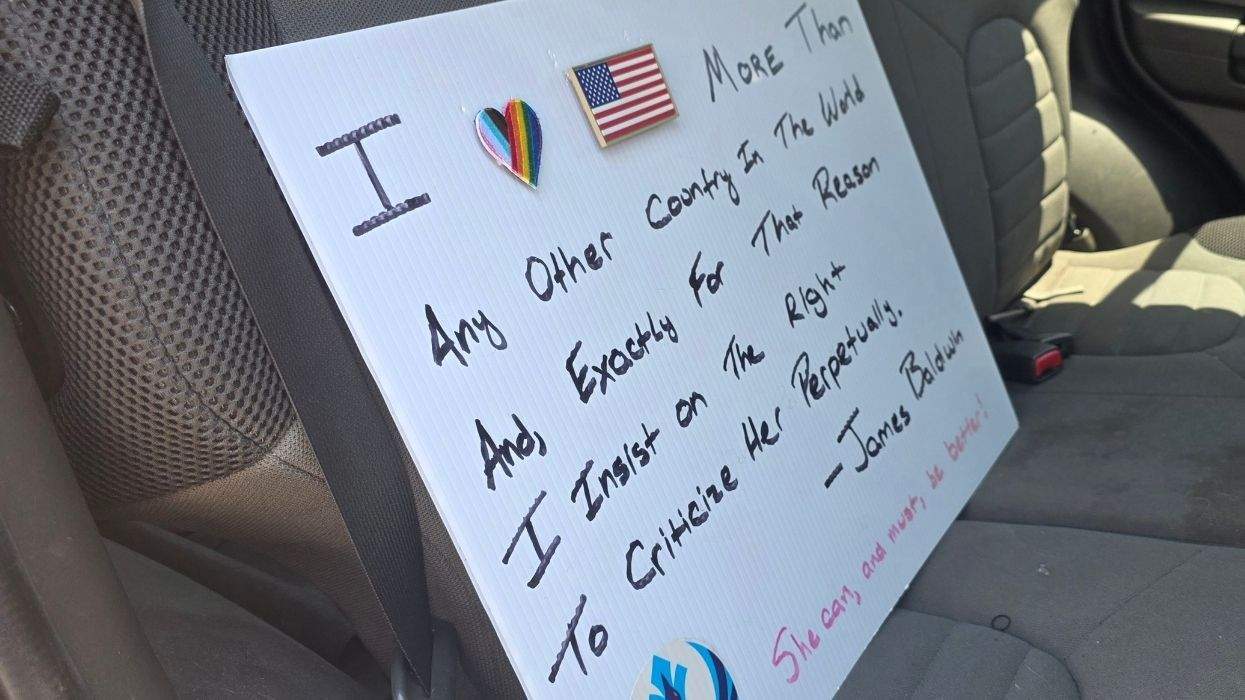

There is a protest sign in the back of my car. It has been to courthouse squares, to highway overpasses, to small towns. It’s too long to be a truly great protest sign, but I take it everywhere. It carries one sentence, from James Baldwin:
"I love America more than any other country in the world, and, exactly for this reason, I insist on the right to criticize her perpetually."
I made the sign because Baldwin put into one sentence what I’ve spent a career trying to live. Twenty-three years in uniform. An oath taken again and again, never to a person, always to an idea. When people ask how I can criticize a country I served, I want to hand them the sign.
Criticism is not the opposite of patriotism. It is the evidence of it.
Today, America turns 250. There will be fireworks; I’ll go. There will be parades; I’ll march. There will be speeches about how far we have come. Much of the praise will be earned. 250 years ago, America ushered in a historical anomaly: a government of ideas rather than blood, built on revolution. An anniversary like this tempts us to treat the founding story as ending with a period rather than a comma.
Read the Declaration again. Not the poetry at the top. The engineering underneath it:
"That to secure these rights, Governments are instituted among Men, deriving their just powers from the consent of the governed, --That whenever any Form of Government becomes destructive of these ends, it is the Right of the People to alter or to abolish it, and to institute new Government, laying its foundation on such principles and organizing its powers in such form, as to them shall seem most likely to effect their Safety and Happiness."
We remember the self-evident truths. We overlook the operating instructions. The founders did not declare a perfect system into being. They declared a right. When government stops serving its ends, the people may redesign it.
Government is not sacred, nor are the rules of its operation. Its purpose is.
Look closely at one phrase: "as to them shall seem most likely." That is the humility clause. Not the perfect form. Not the final form. The form most likely to work, judged by the people living under it, at the time they judge it. That is not scripture. That is an engineering requirement. Build it. Test it. Fix what fails. The founders never claimed to have finished the job. Treating their work as untouchable gets their intent exactly backward.
The executive order that ended my career declared that people like me cannot meet the standard of humility and selflessness required by service. So I have thought hard about the word. Engineers who don’t learn humility can cause tragedy. We learn to assume a design has flaws, hunt for them, invite outside perspective, and fix them before they fail. Humility is the willingness to be publicly wrong, to learn from it, and to grow. The founders had that kind of humility. They wrote it into the sentence. Declaring any work finished and sacred, whether a document or a judgment about who belongs, is the opposite.
Our first draft government, the Articles of Confederation, was riddled with flaws. The people we canonize as founders were also the first generation to admit their government was not working and do something about it. The Constitution, our second draft, was built on the contradiction of liberty and slavery and the needs of states that didn’t always think of themselves as Americans first. At the end of the Constitutional Convention in 1787, Benjamin Franklin was asked what we had created. He answered, “A republic, if you can keep it.” And, with amendment, we have, though it is on shaky ground.
Eleven years from now, in 2037, the Constitution turns 250.
The founding generation used their eleven years to go from principle to a functional machine of self-government. We should use ours to go from celebrating the principle to repairing it.
I know how "alter or abolish" sounds in 2026. Those words were shouted by people who stormed the Capitol. They were twisted to justify political violence at a demagogue’s behest. The Declaration itself warns against changing governments for “light and transient causes.” It is not a permission slip to torch and pitchfork every time people are frustrated.
We must be precise about what the founders actually did with their political revolution. They built a pathway for evolution. Article V of the Constitution is "alter" made lawful, peaceful, and repeatable. A constitutional convention could rework the entire document if peaceful revolution is ever called for. We have done it before. The founders took the most dangerous sentence in the Declaration and built a system so we would never need the second verb. Anyone who invokes this passage to justify violence is skipping the part where the founders created the alternative to violence.
The Declaration is also a charge to pay attention when our systems no longer work as intended. When representation becomes distorted away from the ideal of one person, one vote. When rights become conditional and subject to authoritarian whims. When power escapes accountability, and corruption reigns. When too many people feel that their own government is something done to them rather than something they help shape.
John Lewis spent his life showing what it looks like when citizens refuse to accept a government that treats their rights as optional. In the last words he left us, he wrote: “democracy is not a state. It is an act, and each generation must do its part…” Noticing the failure is not the work. The work is what comes after the noticing.
The Declaration contains a test as well: "destructive of these ends." The ends are the point, the animating force behind everything we do. Safety. Happiness. Powers derived from consent.
What we are watching now is not alteration in service of those ends. It is abandonment of the ends while the government is bent to cater to the already powerful. Loyalty demanded in place of merit. Agencies warped to serve one man instead of the public. That is not reform. Reform keeps the ends and redesigns the means. Autocracy keeps the form and discards the ends. The Declaration's own language tells us which one we are looking at.
Of course, the Declaration’s promise was not extended equally at the beginning. The people who declared that all were created equal lived in a nation that enslaved human beings, denied women political power, displaced and slaughtered Native people, and defined citizenship far more narrowly than we do today.
That contradiction is not a reason to discard the promise. It is a reason to take it seriously.
For 250 years, Americans have pushed the country to live up to words it had not yet earned. Abolitionists, suffragists, labor organizers, civil-rights leaders, immigrants, veterans, disabled Americans, LGBTQ+ people, and countless others have insisted that “we” should mean more people than it did before.
That is the best of our history. Not perfection. Progress. Not a country that always got it right. A country in which people kept demanding that it do better.
After twenty-three years in uniform, that is what patriotism means to me. From Seneca Falls to Selma to Stonewall, that kind of patriotism drives the change we honor today.
Along with the sign, I’m carrying an audacious goal into today’s celebration. The eleven years between this anniversary and the next one are for the work the founders modeled: honest assessment, deliberate redesign, lawful change. They are for answering questions.
How do we ensure that the right to vote is real, equal, and protected for every American?
How do we make certain that no president can place themselves, their allies, or their family beyond accountability?
How do we preserve a judiciary that is independent, ethical, and trusted?
How do we guarantee that equal citizenship does not depend on someone’s race, gender, faith, disability, whom they love, where they live, or whether they are transgender?
How do we make representation more responsive to the people who live under the laws Congress passes?
How do we protect privacy, autonomy, and dignity in a century the founders could not possibly have imagined?
These questions determine whether people believe democracy still belongs to them and who is included under “We the People.” So, pick one. Ask it out loud this weekend, at the parade, at the cookout, with someone who might disagree with you. Some of that work is constitutional. Most of it starts smaller, in the systems that shape whether government actually serves the people it answers to. Maps. Courts. Ballots. The machinery of consent.
The answers will not come from one party, one election, one commission, or one document drafted behind closed doors. They should come from a serious, sustained national conversation: in classrooms and town halls, at kitchen tables and city councils, in state legislatures and houses of worship, among people who disagree but still believe this country is worth the effort.
There will be people who hear any call to update the Constitution as disrespect. I understand the instinct. The Constitution is an extraordinary achievement. It has survived civil war, economic collapse, world war, social upheaval, and the slow, uneven expansion of rights. But reverence must not become paralysis.
This Independence Day, celebrate. Gather with family. Watch the fireworks. Hang the flags. Remember the sacrifices that brought us here. They were mighty and legion.
But do not mistake celebration for completion. The next 250 years begin with what we choose to do now.
The founders gave us more than a government. They gave us the right to improve it.
For the next eleven years, I intend to use that right.
Bree Fram is a retired Space Force colonel forced out of the U.S. military by Donald Trump’s ban on transgender military service members. She is a parent, rocket scientist, public speaker, and former candidate for Congress in Virginia.
Opinion is dedicated to featuring a wide range of inspiring personal stories and impactful opinions from the LGBTQ+ community and its allies. Visit Advocate.com/submit to learn more about submission guidelines. We welcome your thoughts and feedback on any of our stories. Email us at voices@equalpride.com. Views expressed in Voices stories are those of the guest writers, columnists, and editors, and do not directly represent the views of The Advocate or our parent company, equalpride.