'%3E%3Cpath d='M16.3574 35.6519H12.9537L15.0491 18.8873L16.3574 35.6519ZM30.4229 54.0093L22.309 0.994385H7.91795L0 54.0093H10.6634L11.5802 46.3855H17.4014L17.9914 54.0093H30.4229Z' fill='%23971B20'/%3E%3Cpath d='M48.2073 41.8813C48.2073 43.4049 47.4892 44.0011 46.1144 44.0011H43.7595V11.0687H46.1144C47.4892 11.0687 48.2073 11.6636 48.2073 13.1885V41.8813ZM59.5273 43.6695V11.3326C59.5273 3.71323 53.5729 0.994385 47.8157 0.994385H31.7213V54.0093H47.8157C53.5729 54.0093 59.5273 51.29 59.5273 43.6695Z' fill='%23971B20'/%3E%3Cpath d='M90.183 0.994385H78.6039L75.0711 30.6157L71.9955 0.994385H59.4346L69.2474 54.0093H80.373L90.183 0.994385Z' fill='%23971B20'/%3E%3Cpath d='M107.063 42.3448C107.063 43.7359 105.951 44.5974 104.643 44.5974C103.269 44.5974 102.157 43.7359 102.157 42.3448V12.658C102.157 11.2676 103.269 10.4058 104.643 10.4058C105.951 10.4058 107.063 11.2676 107.063 12.658V42.3448ZM119.233 43.2723V11.7312C119.233 6.36384 112.952 -3.8147e-06 104.643 -3.8147e-06C96.2667 -3.8147e-06 89.9867 6.36384 89.9867 11.7312V43.2723C89.9867 48.6393 96.2667 55 104.643 55C112.952 55 119.233 48.6393 119.233 43.2723Z' fill='%23971B20'/%3E%3Cpath d='M150.976 43.9349V33.7309H139.069V42.3448C139.069 43.7359 137.957 44.5974 136.582 44.5974C135.076 44.5974 133.964 43.7359 133.964 42.3448V12.658C133.964 11.2676 135.076 10.4058 136.582 10.4058C137.957 10.4058 139.069 11.2676 139.069 12.658V21.2723H150.976V11.0687C150.976 5.70107 145.283 -3.8147e-06 136.582 -3.8147e-06C127.75 -3.8147e-06 121.796 5.70107 121.796 11.0687V43.9349C121.796 49.3022 127.75 55 136.582 55C145.283 55 150.976 49.3022 150.976 43.9349Z' fill='%23971B20'/%3E%3Cpath d='M167.478 35.6519H164.076L166.17 18.8873L167.478 35.6519ZM181.544 54.0093L173.432 0.994385H159.037L151.123 54.0093H161.785L162.704 46.3855H168.523L169.114 54.0093H181.544Z' fill='%23971B20'/%3E%3Cpath d='M205.412 10.4058V0.994385H177.081V10.4058H185.392V54.0093H197.428V10.4058H205.412Z' fill='%23971B20'/%3E%3Cpath d='M230.002 54.0093V43.9349H218.914V31.8746H226.635V21.8028H218.914V10.4058H230.002V0.994385H206.875V54.0093H230.002Z' fill='%23971B20'/%3E%3C/g%3E%3Cdefs%3E%3CclipPath id='clip0_260_7080'%3E%3Crect width='230' height='55' fill='white'/%3E%3C/clipPath%3E%3C/defs%3E%3C/svg%3E)
People think they know that men are stronger than women. But what is strength? One of us might see our mother as the strongest person we know because strength is not measured solely by muscle and arm length. It can be fortitude. The entire premise of sex differences rests on the fundamental distinction between male and female participants. It is an assumption that may fall apart under closer analysis. In sport, average men and women do not compete; individuals do — unless, of course, they are transgender.
Fundamentally, sports are about winning and losing. And while nobody likes losing, there are good losses where participants learn how to improve. But there are also bad losses that leave people demoralized, broken, and without a viable path forward.
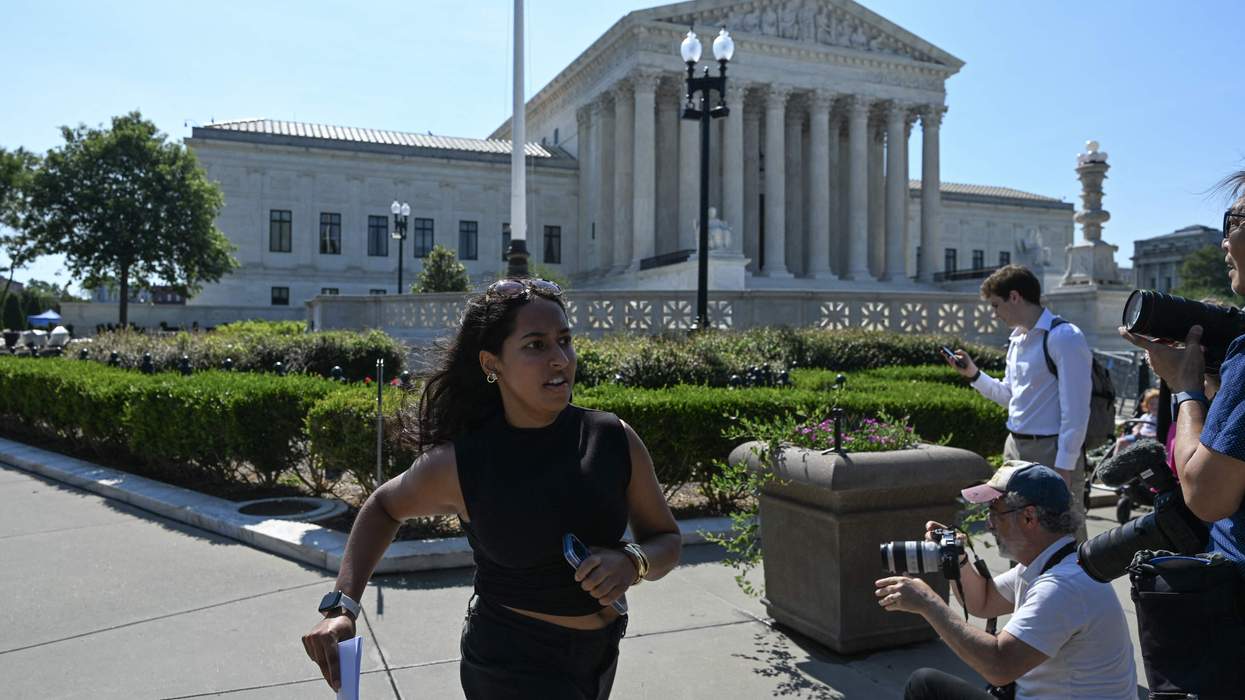
On Tuesday, the U.S. Supreme Court dealt the transgender community a bad loss. While the Court upheld state laws blocking transgender people from playing sports in alignment with their gender identity, the decision went far beyond that. News media largely ignored this fact, but that is where the bad loss should not be ignored.
The way the Court waved away equal protection claims for the transgender community and blocked many as-applied challenges to particular applications of a law will have devastating effects on the lives of transgender individuals. Functionally, the Court rubber-stamped state policies designed to erase transgender people, provided a state can justify the policy as a sex-based classification. As Justice Sonia Sotomayor warned in dissent, almost any policy involving a remotely defensible sex classification can now require transgender people to live according to their sex assigned at birth.
Related: States can ban transgender women and girls from sports, according to U.S. Supreme Court
In effect, the Court has opened the door for states to issue "trans bans" anywhere sex-based classifications exist. Justice Neil Gorsuch noted in his concurrence that sex-differentiated dress codes are not covered by the logic of Bostock, preserving that precedent while narrowing it. Under that reasoning, a transgender man could be required to wear women's business attire at work despite Bostock's protections against discrimination. Likewise, transgender women who have medically transitioned can still be forced into men's prisons under state policies based on birth sex.
Combined with Skrmetti, this decision effectively allows states, and likely the federal government, to regulate transgender health care for adults out of existence. A government need only say it is regulating procedures differently for men and women, and the policy may survive constitutional scrutiny. Even transgender people who have already undergone gender-affirming medical care could lose access to follow-up treatment.
The ruling also forecloses challenges to sex-based classifications even when an individual can show the state's justification does not apply in their particular circumstances. In the West Virginia portion of the decision, a transgender student who never experienced a male puberty because of puberty blockers was still barred from girls' sports. Intersex people likewise face diminished ability to challenge policies that erase their existence.
Related: What the Supreme Court did not decide in the trans sports case
Before the decision, and in much of the coverage afterward, the public conversation centered on fairness in women's sports. As Justice Brett Kavanaugh wrote, these cases are often viewed as "zero-sum": if someone wins, someone else loses. Fair enough. But this ruling reaches far beyond athletics.
Justice Clarence Thomas went further still, arguing that transgender people do not exist as a constitutional category but are simply men or women with gender dysphoria. He characterized gender identity as "a mutable mental state that is the object of psychiatric treatment" and suggested that transgender people are dishonest when they live according to their gender identity.
This decision is catastrophic not only for transgender people but for the broader LGBTQ+ community because sex, gender, gender identity, and sexual orientation are deeply interconnected. It is not the first major defeat LGBTQ+ people have suffered at the Supreme Court.
What do we do after a bad loss? We get angry. We pick ourselves up. We learn from the experience.
The ACT UP movement emerged in part after the Supreme Court's 1986 decision in Bowers v. Hardwick, which upheld laws criminalizing same-sex intimacy. Over time, advocacy organizations and ordinary people changed public attitudes. Our own research on transgender public opinion shows that work must continue today.
Public attitudes toward transgender people remain troubling. They are often closer to Clarence Thomas's view than to the hopes of LGBTQ+ advocates. The transgender community and its allies must continue reaching beyond the courts and into the hearts and minds of the public.
Too many Americans still lack a basic understanding of transgender people's lives. That makes it easy to treat transgender people as political footballs. It blinds people to injustice.
Make no mistake: this decision is an injustice.
The Court today lacks even the understanding it displayed in Bowers. Only by building greater public understanding can we show both the Court and the American public how profoundly misguided this ruling is. Its consequences extend well beyond sports into nearly every aspect of transgender people's lives.
Underlying the anti-trans focus of this ruling is sexism—a force often intertwined with racism. Those are also issues on which this Court has delivered significant setbacks in recent years.
Wins and losses are part of sports. In law, however, a loss can shape generations. This decision carries implications far beyond athletics, and those consequences will become increasingly apparent as transgender lives are disrupted.
Andrew R. Flores and Jami K. Taylor authored this entry independent of our institutional affiliations.
Andrew R. Flores, PhD, and Jami K. Taylor, PhD, are political scientists. The views and opinions expressed in this article are those of the authors in their personal capacities as private citizens, and these opinions do not reflect the official policies or positions of their employers. Drs. Flores and Taylor have published peer-reviewed research in leading journals in political science and public policy.
Opinion is dedicated to featuring a wide range of inspiring personal stories and impactful opinions from the LGBTQ+ community and its allies. Visit Advocate.com/submit to learn more about submission guidelines. We welcome your thoughts and feedback on any of our stories. Email us at voices@equalpride.com. Views expressed in Voices stories are those of the guest writers, columnists, and editors, and do not directly represent the views of The Advocate or our parent company, equalpride.