'%3E%3Cpath d='M16.3574 35.6519H12.9537L15.0491 18.8873L16.3574 35.6519ZM30.4229 54.0093L22.309 0.994385H7.91795L0 54.0093H10.6634L11.5802 46.3855H17.4014L17.9914 54.0093H30.4229Z' fill='%23971B20'/%3E%3Cpath d='M48.2073 41.8813C48.2073 43.4049 47.4892 44.0011 46.1144 44.0011H43.7595V11.0687H46.1144C47.4892 11.0687 48.2073 11.6636 48.2073 13.1885V41.8813ZM59.5273 43.6695V11.3326C59.5273 3.71323 53.5729 0.994385 47.8157 0.994385H31.7213V54.0093H47.8157C53.5729 54.0093 59.5273 51.29 59.5273 43.6695Z' fill='%23971B20'/%3E%3Cpath d='M90.183 0.994385H78.6039L75.0711 30.6157L71.9955 0.994385H59.4346L69.2474 54.0093H80.373L90.183 0.994385Z' fill='%23971B20'/%3E%3Cpath d='M107.063 42.3448C107.063 43.7359 105.951 44.5974 104.643 44.5974C103.269 44.5974 102.157 43.7359 102.157 42.3448V12.658C102.157 11.2676 103.269 10.4058 104.643 10.4058C105.951 10.4058 107.063 11.2676 107.063 12.658V42.3448ZM119.233 43.2723V11.7312C119.233 6.36384 112.952 -3.8147e-06 104.643 -3.8147e-06C96.2667 -3.8147e-06 89.9867 6.36384 89.9867 11.7312V43.2723C89.9867 48.6393 96.2667 55 104.643 55C112.952 55 119.233 48.6393 119.233 43.2723Z' fill='%23971B20'/%3E%3Cpath d='M150.976 43.9349V33.7309H139.069V42.3448C139.069 43.7359 137.957 44.5974 136.582 44.5974C135.076 44.5974 133.964 43.7359 133.964 42.3448V12.658C133.964 11.2676 135.076 10.4058 136.582 10.4058C137.957 10.4058 139.069 11.2676 139.069 12.658V21.2723H150.976V11.0687C150.976 5.70107 145.283 -3.8147e-06 136.582 -3.8147e-06C127.75 -3.8147e-06 121.796 5.70107 121.796 11.0687V43.9349C121.796 49.3022 127.75 55 136.582 55C145.283 55 150.976 49.3022 150.976 43.9349Z' fill='%23971B20'/%3E%3Cpath d='M167.478 35.6519H164.076L166.17 18.8873L167.478 35.6519ZM181.544 54.0093L173.432 0.994385H159.037L151.123 54.0093H161.785L162.704 46.3855H168.523L169.114 54.0093H181.544Z' fill='%23971B20'/%3E%3Cpath d='M205.412 10.4058V0.994385H177.081V10.4058H185.392V54.0093H197.428V10.4058H205.412Z' fill='%23971B20'/%3E%3Cpath d='M230.002 54.0093V43.9349H218.914V31.8746H226.635V21.8028H218.914V10.4058H230.002V0.994385H206.875V54.0093H230.002Z' fill='%23971B20'/%3E%3C/g%3E%3Cdefs%3E%3CclipPath id='clip0_260_7080'%3E%3Crect width='230' height='55' fill='white'/%3E%3C/clipPath%3E%3C/defs%3E%3C/svg%3E)
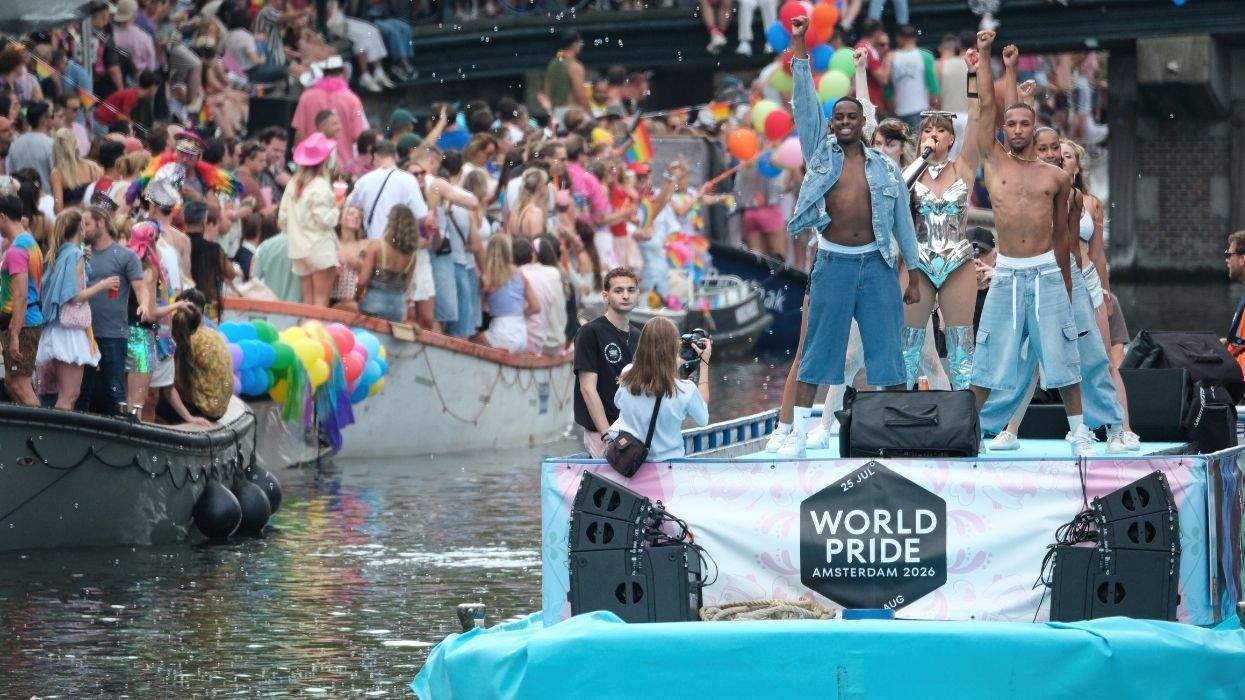

As boats float down Amsterdam’s Prinsengracht canal during this year’s WorldPride Canal Parade, security guards pace alongside the temporary bleachers, repeatedly asking attendees to remain seated. One man in vibrant red sunglasses keeps rising anyway, eager for a better view of the next float.
The float for COC Netherlands, the world’s oldest continuously operating LGBTQ+ organization, sails into view. At the bow, a large red sign reads, “Join our fight for human rights.” The man in the red glasses is on his feet again, clapping and dancing to Diana Ross’s “I’m Coming Out,” blaring from the boat’s speakers.
WorldPride draws attendees from around the globe. Some are celebrating their very first Pride. Others are attending their 10th Pride this summer. But few people can say they were at the uprising that sparked the modern LGBTQ+ rights movement. Mark Segal, recognizable by his signature red glasses, was at the Stonewall Inn on June 28, 1969.
“Seeing every segment of the LGBTQ community represented at WorldPride made me so proud,” Segal said. “Watching the Canal Parade celebrate everyone from seniors to refugees to firefighters and the openly gay prime minister warmed my old activist heart. I felt like I was floating along with all of them, it was so joyful.”
Sporting a tank top covered in gold sequin paillettes borrowed from a drag queen, Singaporean content creator Joel Tay radiated joy as he joined the synchronized dance to “Golden” from “KPop Demon Hunters” on the Asia Pride float. This was not only his first WorldPride but also his first Pride outside Asia.
Related: I survived the Berlin Pride terror attack. Don’t let the right weaponize our grief
“I joined the Asia Pride float solo and met everyone for the first time that day. There were so many nationalities: Thais, Japanese, Taiwanese, Malaysians, and me from Singapore — but we connected naturally,” Tay said. “It was a core memory for me sailing through the canals and seeing the faces of people cheering, waving and showing love to our float.”
It is an experience few WorldPride attendees elsewhere can replicate. Amsterdam is the only city that celebrates Pride by boat through its canals. About every two years, InterPride, the global organization, selects a different city to host WorldPride. InterPride grants the city a license to hold the flagship international Pride event, offering an opportunity to bring its existing celebration to a global audience.
In 2026, Amsterdam celebrates not only 30 years of Amsterdam Pride but also 25 years since the Netherlands became the first country in the world to legalize same-sex marriage. I experienced my first WorldPride in 2019, riding on a float celebrating the 50th anniversary of the Stonewall uprising, just four years after the United States legalized same-sex marriage. I wondered how a city as progressive as Amsterdam could have been slower to establish a Pride event while moving faster to secure legal rights for LGBTQ+ people.
Amsterdam Pride co-founders Siep de Haan and Peter Kramer offered an explanation in an interview with Barbara Driessen.
“In other cities, you had to ring the bell at a gay bar, and someone would first open a small hatch to see who was trying to come in,” Kramer told Driessen. “In Amsterdam, people simply stood outside on the street with a beer. Everyone mixed together.”
In other cities, such as New York City, Pride grew out of protests against police brutality and discrimination, as well as the fight for equal rights. Kramer and Haan said they left “Gay” out of the event's name, simply calling it Amsterdam Pride.
Related: Amsterdam Canal Pride Floats Our Boat (Photos)
In 1996, Amsterdam Pride was a celebration of the community and the city’s acceptance of it. Thirty years later, Amsterdam was no longer celebrating Pride only for itself. As the host of WorldPride, it became a gathering place for LGBTQ+ people from around the globe carrying their own histories, fears, and expectations.
For Tay, Pride looks very different in Singapore.
“We have an annual Pride event called Pink Dot,” he said. “It’s a gathering and demonstration of support for the LGBTQ+ community, but unlike many Pride celebrations around the world, we don’t have a Pride parade. The event is held in an open field, and participation is only allowed for Singaporeans as it’s viewed as a protest.”
Talking with Tay, I realized that even debating whether Pride is a protest or a celebration is, itself, a privilege. In Amsterdam’s Museumplein, the Zero Flags Project displays flags representing the 63 countries where homosexuality or gender diversity remains punishable by law. For many, WorldPride doesn’t just provide a chance to party; it gives them hope that their home will one day offer the same chance to live freely. Amsterdam's LGBTQ+ community understands the weight of welcoming the world.
“Having WorldPride in Amsterdam feels like a huge honor, but also a responsibility,” said Karl Krause, who runs the LGBTQ+ travel blog Couple of Men with his husband, Daan Colijn. “Amsterdam is often considered a ‘queer utopia’ and while we’re proud of the history and the rights we have, we know that’s not the full story.”
Related: These are the 38 countries that have legalized marriage equality (in order)
Krause's description of Amsterdam as a place often viewed as a “queer utopia” stood in stark contrast to my previous WorldPride experience. In June 2025, I drove from my home in Cleveland to attend WorldPride in Washington, D.C. With anti-LGBTQ+ legislation continuing to rise, I didn’t necessarily feel like celebrating Pride in my nation’s capital, but I did feel like protesting alongside my community.
The atmosphere felt different, and it looked different, too. Organizer Capital Pride Alliance lost half of its corporate sponsorships while facing boycotts from international counterparts.
The contrast with Amsterdam was striking. As some companies have reduced or completely withdrawn their sponsorship of Pride events in recent years, particularly in the United States, Booking.com has continued to visibly support WorldPride Amsterdam and other LGBTQ+ initiatives.
While D.C.’s local businesses and organizations displayed Pride flags and rainbows, the city’s streets were lined with temporary fencing for the Army’s 250th anniversary parade, conveniently scheduled for the week after Pride. The Netherlands’ first openly gay prime minister, Rob Jetten, participated in Amsterdam’s Canal Parade and spoke at WorldPride’s Human Rights Conference.
In D.C., my wife and I attended both the parade and rally with a safety plan in place. Balancing our queer joy with our safety is part of our daily life as a couple living in Ohio. Our home in Cleveland feels safe, but driving just 30 minutes away means we don’t feel safe holding hands.
For Sanne Pols, founder of LGBTOUR Amsterdam and a Netherlands native, fear has never been part of her daily reality as a queer person.
“On the tour sometimes when there's a loud sound on the tour, and everyone turns their head but not me,” Pols said. “And then I see the reaction.”
But in the week after the terrorist attack at Berlin Pride, Amsterdam Pride felt different for Pols.
Related: The 21 most sexually liberal cities in the world for LGBTQ+ people
“For the first time, I felt a little bit scared when I was on the bleachers,” Pols said. “I was so sad to feel that because we don't have so much fear in society here.”
Krause and Colijn were in Berlin celebrating Pride on July 26. During the parade, Krause received a call from his worried mother. He reassured her that he was fine, telling her about the celebratory energy and the people they had met. Later that evening, Krause and Colijn made very different calls to tell their loved ones they were safe. They had been at the site of the attack only 90 minutes before the car drove into the crowd.
“I remember my initial reaction was confusion,” Colijn said. “It didn’t compute that such violence could happen in a space that just moments before had felt so safe, full of love and community. Then it quickly turned into panic: checking messages, asking, ‘Who is there? Are they okay?’ It felt like the ground shifted under my feet. Pride is supposed to be our safe space, and in that moment, it felt brutally violated.”
Before living together in Amsterdam, the couple met 13 years ago at a fetish club in Berlin. Colijn described Berlin as a place of “radical acceptance,” but his feelings about both Berlin and Amsterdam are more complicated now.
Even those who weren't in Berlin carried the weight of the attack into WorldPride Amsterdam. At a party celebrating the fifth anniversary of Booking.com’s Travel Proud program, Diana Rodriguez, CEO and co-founder of the Stonewall National Monument Visitor Center, became emotional as she explained that she had started writing her speech before July 26. The attack in Berlin had a clear parallel to her work at the visitor center.
“Their Pride Celebration is called Christopher Street Day. How much more connected to Stonewall can that be?” Rodriguez said. “For me, it tells a story of Berlin making a decisive decision to connect their Pride celebrations to Stonewall and our collective history, and that matters. That we understand that Stonewall belongs to everyone, especially during this time when there are constant attempts to rewrite or completely erase our history.”
For Segal, the roots of the movement he helped build were still visible at WorldPride Amsterdam.
“We’ve often debated whether Pride was a celebration or a protest, but in Amsterdam they have both represented on their floats,” Segal said. “We were very politically active back then, and it continues today. The float with Donald Trump kissing Vladimir Putin is an example. You have to be creative to make change, and creativity is something that has endured too.”
When Stonewall-era pioneer Miss Major died last October, I mourned her loss and found myself wondering how we had reached another moment when so many of the LGBTQ+ rights she fought for felt under threat. In 2025, the ACLU tracked 616 anti-LGBTQ+ bills.
Standing along Amsterdam’s canals with one of Miss Major’s contemporaries, Mark Segal, I realized that perhaps every generation of activists has wrestled with that same fear: that progress can be reversed. Yet they kept organizing anyway.
“This 18-year-old standing outside Stonewall in June 1969 and joining Gay Liberation Front could never have dreamed of what our work would become,” Segal said. “So even if you see a backslide in acceptance, know that we’re still pushing forward.”
Visit Netherlands and Booking.com provided support for this trip. All views and opinions are the author’s.