'%3E%3Cpath d='M16.3574 35.6519H12.9537L15.0491 18.8873L16.3574 35.6519ZM30.4229 54.0093L22.309 0.994385H7.91795L0 54.0093H10.6634L11.5802 46.3855H17.4014L17.9914 54.0093H30.4229Z' fill='%23971B20'/%3E%3Cpath d='M48.2073 41.8813C48.2073 43.4049 47.4892 44.0011 46.1144 44.0011H43.7595V11.0687H46.1144C47.4892 11.0687 48.2073 11.6636 48.2073 13.1885V41.8813ZM59.5273 43.6695V11.3326C59.5273 3.71323 53.5729 0.994385 47.8157 0.994385H31.7213V54.0093H47.8157C53.5729 54.0093 59.5273 51.29 59.5273 43.6695Z' fill='%23971B20'/%3E%3Cpath d='M90.183 0.994385H78.6039L75.0711 30.6157L71.9955 0.994385H59.4346L69.2474 54.0093H80.373L90.183 0.994385Z' fill='%23971B20'/%3E%3Cpath d='M107.063 42.3448C107.063 43.7359 105.951 44.5974 104.643 44.5974C103.269 44.5974 102.157 43.7359 102.157 42.3448V12.658C102.157 11.2676 103.269 10.4058 104.643 10.4058C105.951 10.4058 107.063 11.2676 107.063 12.658V42.3448ZM119.233 43.2723V11.7312C119.233 6.36384 112.952 -3.8147e-06 104.643 -3.8147e-06C96.2667 -3.8147e-06 89.9867 6.36384 89.9867 11.7312V43.2723C89.9867 48.6393 96.2667 55 104.643 55C112.952 55 119.233 48.6393 119.233 43.2723Z' fill='%23971B20'/%3E%3Cpath d='M150.976 43.9349V33.7309H139.069V42.3448C139.069 43.7359 137.957 44.5974 136.582 44.5974C135.076 44.5974 133.964 43.7359 133.964 42.3448V12.658C133.964 11.2676 135.076 10.4058 136.582 10.4058C137.957 10.4058 139.069 11.2676 139.069 12.658V21.2723H150.976V11.0687C150.976 5.70107 145.283 -3.8147e-06 136.582 -3.8147e-06C127.75 -3.8147e-06 121.796 5.70107 121.796 11.0687V43.9349C121.796 49.3022 127.75 55 136.582 55C145.283 55 150.976 49.3022 150.976 43.9349Z' fill='%23971B20'/%3E%3Cpath d='M167.478 35.6519H164.076L166.17 18.8873L167.478 35.6519ZM181.544 54.0093L173.432 0.994385H159.037L151.123 54.0093H161.785L162.704 46.3855H168.523L169.114 54.0093H181.544Z' fill='%23971B20'/%3E%3Cpath d='M205.412 10.4058V0.994385H177.081V10.4058H185.392V54.0093H197.428V10.4058H205.412Z' fill='%23971B20'/%3E%3Cpath d='M230.002 54.0093V43.9349H218.914V31.8746H226.635V21.8028H218.914V10.4058H230.002V0.994385H206.875V54.0093H230.002Z' fill='%23971B20'/%3E%3C/g%3E%3Cdefs%3E%3CclipPath id='clip0_260_7080'%3E%3Crect width='230' height='55' fill='white'/%3E%3C/clipPath%3E%3C/defs%3E%3C/svg%3E)

For nearly a year, LGBTQ+ students in one rural Virginia county watched the adults overseeing their education move the goalposts.
Students at King George Middle School followed the rules to establish a Gay-Straight Alliance. The principal approved it. Seventeen students expressed interest. Then conservative backlash erupted on Facebook, the club was suspended, and the King George County School Board changed its policy so middle school students could no longer form noncurricular organizations.
Now, after being sued in federal court, the board has changed the rules back.
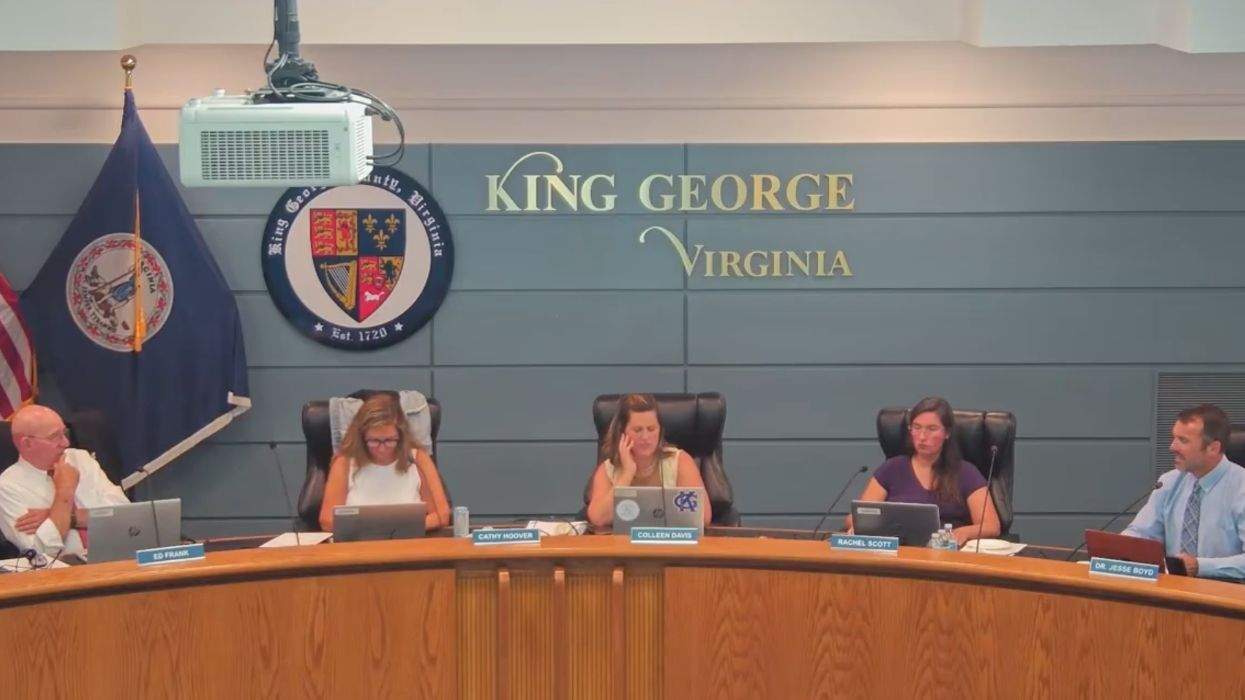
The board voted unanimously on Friday to allow “secondary school students” to organize and conduct meetings of noncurricular groups, according to the Fredericksburg Free Press. The revision removes language adopted last November that restricted those organizations to King George High School.
The September 11 vote followed a closed session that began at 8 a.m. for briefings involving “actual or probable litigation.” Board members did not publicly mention the lawsuit brought by two middle school students and their families.
But one week earlier, a federal judge disclosed that the litigation had produced a settlement.
“Having been advised that the parties have reached a settlement,” Senior U.S. District Judge Robert E. Payne wrote in a September 4 order obtained by The Advocate, “any further discovery deadlines are stayed until further order of this Court.”
The order came one day after the parties attended a settlement conference before U.S. Magistrate Judge Summer L. Speight. It halted a case that had been moving unusually quickly toward a resolution in court.
Payne had scheduled a bench trial for October 27 at 10 a.m. in Richmond, less than three months after the lawsuit was filed. The trial was set to decide the merits of the students’ claims, including their request for a permanent injunction requiring the district to allow the GSA to operate.
The judge had previously denied the students’ request for a preliminary injunction, finding that their delay in filing the lawsuit prevented them from establishing the irreparable harm required for emergency relief. He canceled an October 2 hearing on that motion and instead placed the full case on an expedited path to trial.
The one-page settlement order does not disclose the agreement’s terms or whether it required the policy reversal.
The lawsuit accused the school board, Superintendent Jesse Boyd, and King George Middle School Principal Casey Nice of violating the First Amendment and the federal Equal Access Act by blocking the GSA while finding ways for other student organizations to continue operating.
The legal principle is well established. In Board of Education v. Mergens, the U.S. Supreme Court upheld the Equal Access Act, which requires federally funded public secondary schools that permit noncurricular clubs to provide other student groups equal access regardless of their message. Federal courts have repeatedly applied that protection to GSAs, including rulings for students in California and Kentucky. In 2016, a federal appeals court also ruled that the act covered a Florida middle school. Schools can close their forums to all noncurricular clubs, but once they allow even one, courts have said they cannot exclude an LGBTQ+ student group because officials or community members object to what it represents.
The board’s reversal restores middle school students’ eligibility to form noncurricular groups. It does not automatically establish the GSA.
Under a regulation adopted Friday, students must provide proof of written parental permission to form or join such an organization. Groups seeking to return in subsequent years must submit a membership list and proof that every student has parental permission to renew their participation.
It remains unclear whether the students must restart the application process, when the GSA will be allowed to meet, or whether the settlement contains protections against selective enforcement of the new requirements.
The Advocate contacted the King George County School Board, all five members of the King George County Board of Supervisors, and the ACLU of Virginia for comment and additional information about the settlement, the policy reversal, and whether the GSA will now be allowed to operate.
Related: A Virginia school board bent over backward to block an LGBTQ+ club. One mom explains why she’s suing
The club was approved. Then the community found out.
As The Advocate first reported, a seventh grader identified in court records as Z.J.W. began organizing the GSA in August 2025. A teacher agreed to sponsor it, and Nice initially approved it.
The students wrote a constitution, prepared a calendar, created a flyer, and submitted an interest form. After information about the club appeared on the school’s Canvas platform that September, 17 students expressed interest within three days.
Then conservative parents and other community members circulated the materials on Facebook. According to court filings, the faculty sponsor was doxxed, accused of “grooming” children, and targeted with demands that she be fired.
Administrators placed the GSA “on pause” days later, saying its proposed formation had divided the community. The school board later amended its policy so that only high school students could form noncurricular organizations.
Other groups survived.
Yearbook, Robotics, Beta Club, Book of the Month Club, and an Outdoor Club where students made fishing lures and skinned squirrels continued operating after officials classified them as curricular. Court records also showed that employees explored connecting a proposed Fellowship of Christian Athletes group to a leadership class, potentially allowing it to operate under the revised rules.
The school offered no comparable accommodation to the GSA.
Internal emails later filed in court showed that Nice had approved the organization and linked its suspension to the intensity of the public reaction.
“I understood that there would be some negative response from the community when I approved the formation of this club, but I never dreamed it would reach the levels we saw on social media,” Nice wrote to a parent.
Boyd framed the dispute more directly.
“The real question that the community is wrestling with is whether gender and sexuality are appropriate topics for pre-teen students,” he wrote in an October email.
Nice later suggested that the board might accept a “Kindness Club” devoted to student belonging “without engaging in discussions related to sexuality or LGBTQ topics.” The students rejected the prospect of gaining a club only by erasing the identity that made it necessary.
Their attorneys described the district’s conduct as “textbook viewpoint discrimination.”
The students sought both a declaration that the district had violated their rights and an injunction requiring officials to provide the GSA the same access afforded to other organizations.
Related: Virginia school board adopts anti-transgender policy and blocks LGBTQ+ club
The board defends its intentions
In a statement announcing Friday’s changes, the school division said the revised rules demonstrate the board’s commitment to “emphasizing family involvement, prioritizing transparency, and fostering direct communication between school and home,” the Fredericksburg Free Press reports.
Board member Ed Frank said every student deserves safety, dignity, and protection from bullying. He defended the board’s focus on “age appropriateness, parental transparency, and rules governing extracurricular discussions.”
“In this situation, there is nothing to boast about, because the real victims are the students who aren’t yet developmentally ready,” Frank said.
Board member Colleen Hoover said “a lot of blood, sweat, and tears” went into the deliberations. She urged the community to support board members more when decisions become difficult.
Related: Emails reveal Virginia school officials approved an LGBTQ+ club — until conservative backlash hit
Boyd thanked members for what he described as “a very long, well-thought-out conversation.”
“At no time did you waver from your beliefs,” he said.
The Advocate asked the school board what changed in its assessment, whether it now recognizes LGBTQ+ students’ right to meet on equal terms, and whether it will respond differently when outrage stirred up on social media targets students or school employees.
The county’s supervisors were asked how anti-LGBTQ+ hostility was allowed to influence public policy, what their previous silence communicated to the county’s LGBTQ+ residents, and what they would do to ensure that Facebook outrage does not become an informal veto over minority rights.
Neither group of officials immediately responded Saturday.