'%3E%3Cpath d='M16.3574 35.6519H12.9537L15.0491 18.8873L16.3574 35.6519ZM30.4229 54.0093L22.309 0.994385H7.91795L0 54.0093H10.6634L11.5802 46.3855H17.4014L17.9914 54.0093H30.4229Z' fill='%23971B20'/%3E%3Cpath d='M48.2073 41.8813C48.2073 43.4049 47.4892 44.0011 46.1144 44.0011H43.7595V11.0687H46.1144C47.4892 11.0687 48.2073 11.6636 48.2073 13.1885V41.8813ZM59.5273 43.6695V11.3326C59.5273 3.71323 53.5729 0.994385 47.8157 0.994385H31.7213V54.0093H47.8157C53.5729 54.0093 59.5273 51.29 59.5273 43.6695Z' fill='%23971B20'/%3E%3Cpath d='M90.183 0.994385H78.6039L75.0711 30.6157L71.9955 0.994385H59.4346L69.2474 54.0093H80.373L90.183 0.994385Z' fill='%23971B20'/%3E%3Cpath d='M107.063 42.3448C107.063 43.7359 105.951 44.5974 104.643 44.5974C103.269 44.5974 102.157 43.7359 102.157 42.3448V12.658C102.157 11.2676 103.269 10.4058 104.643 10.4058C105.951 10.4058 107.063 11.2676 107.063 12.658V42.3448ZM119.233 43.2723V11.7312C119.233 6.36384 112.952 -3.8147e-06 104.643 -3.8147e-06C96.2667 -3.8147e-06 89.9867 6.36384 89.9867 11.7312V43.2723C89.9867 48.6393 96.2667 55 104.643 55C112.952 55 119.233 48.6393 119.233 43.2723Z' fill='%23971B20'/%3E%3Cpath d='M150.976 43.9349V33.7309H139.069V42.3448C139.069 43.7359 137.957 44.5974 136.582 44.5974C135.076 44.5974 133.964 43.7359 133.964 42.3448V12.658C133.964 11.2676 135.076 10.4058 136.582 10.4058C137.957 10.4058 139.069 11.2676 139.069 12.658V21.2723H150.976V11.0687C150.976 5.70107 145.283 -3.8147e-06 136.582 -3.8147e-06C127.75 -3.8147e-06 121.796 5.70107 121.796 11.0687V43.9349C121.796 49.3022 127.75 55 136.582 55C145.283 55 150.976 49.3022 150.976 43.9349Z' fill='%23971B20'/%3E%3Cpath d='M167.478 35.6519H164.076L166.17 18.8873L167.478 35.6519ZM181.544 54.0093L173.432 0.994385H159.037L151.123 54.0093H161.785L162.704 46.3855H168.523L169.114 54.0093H181.544Z' fill='%23971B20'/%3E%3Cpath d='M205.412 10.4058V0.994385H177.081V10.4058H185.392V54.0093H197.428V10.4058H205.412Z' fill='%23971B20'/%3E%3Cpath d='M230.002 54.0093V43.9349H218.914V31.8746H226.635V21.8028H218.914V10.4058H230.002V0.994385H206.875V54.0093H230.002Z' fill='%23971B20'/%3E%3C/g%3E%3Cdefs%3E%3CclipPath id='clip0_260_7080'%3E%3Crect width='230' height='55' fill='white'/%3E%3C/clipPath%3E%3C/defs%3E%3C/svg%3E)
Just days before LGBTQ+ ally, Gov.-elect Abigail Spanberger, a Democrat, is set to replace Virginia’s anti-trans Republican governor, Glenn Youngkin, when she is sworn in on Saturday, a rural school board has adopted a sweeping new policy restricting transgender students, while simultaneously continuing to block a proposed middle school Gender and Sexualities Alliance.
Keep up with the latest in LGBTQ+ news and politics. Sign up for The Advocate's email newsletter.
The board’s moves prompted emotional warnings from students, parents, and educators who say the decisions could deepen bullying, isolation, and suicide risk for LGBTQ+ youth.
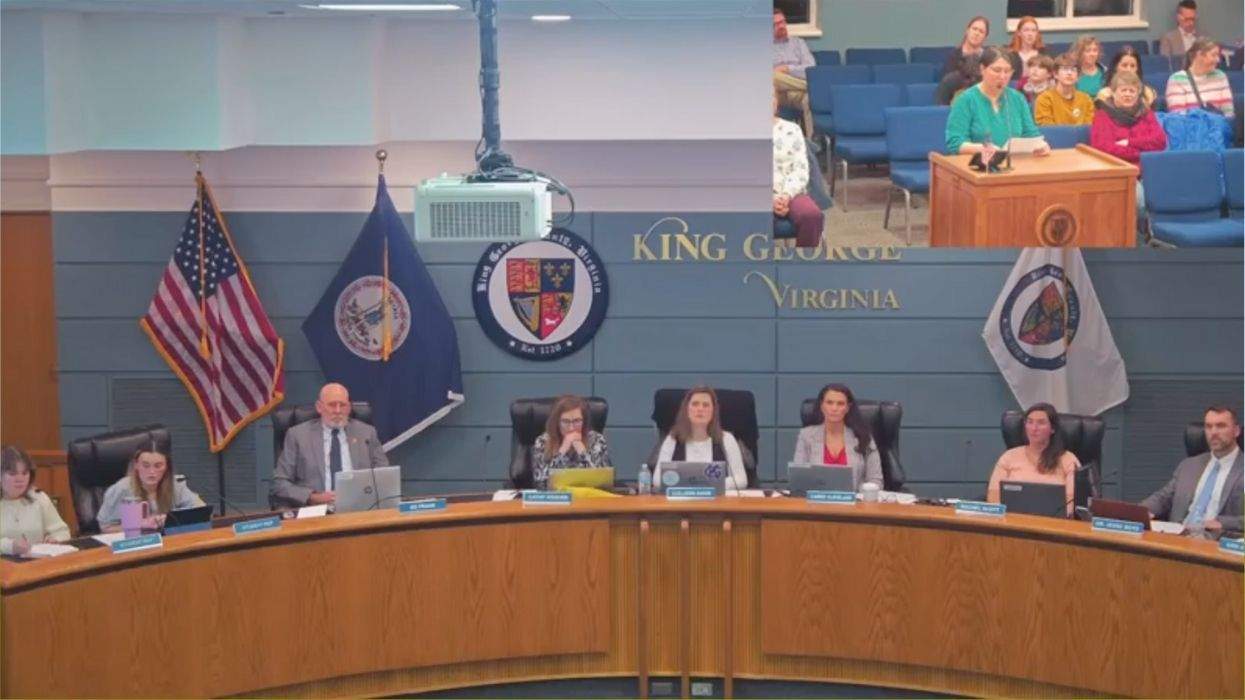
On January 7, the King George County School Board unanimously adopted Policy JBB, which requires school staff to refer to students only by the name and pronouns on the student’s record, without discussing the matter. The policy bars recognition of a student’s affirmed name or gender identity in official records, restricts bathroom access, overnight travel accommodations, and participation in sex-segregated activities based on sex assigned at birth, and limits any deviation from those rules to cases in which parents provide written permission, while still prohibiting any changes to a student’s legal sex or name in school records.
Related: Thousands of Virginia Students Walk Out to Protest Anti-Trans Policies
Related: Glenn Youngkin appoints ‘failed Moms for Liberty candidate’ to Virginia Board of Education
The adoption came as the board in the fall also refused to allow non-curricular clubs at the middle school level, halting efforts to create a Gender and Sexualities Alliance at King George Middle School, a peer support group that multiple students and parents argued would provide a safe space for LGBTQ+ youth in a district where they say harassment and fear already shape daily school life.
Together, the two actions have thrust King George County into the center of a broader national backlash against transgender rights in public education, one that has accelerated across conservative-led states but is now unfolding in a district represented in Congress until recently by Spanberger.
A policy modeled on Youngkin-era guidance
Policy JBB closely mirrors the controversial “Model Policies on Ensuring Privacy, Dignity, and Respect for All Students and Parents in Virginia’s Public Schools” issued by Youngkin in 2023, which drew national scrutiny and legal challenges from civil rights groups. The American Civil Liberties Union of Virginia sued the state over those model policies, arguing that they failed to meet the evidence-based standards required under Virginia law and placed transgender students at risk of discrimination and harm. Many school districts resisted implementing the policies, with some in Northern Virginia refusing to do so entirely.
Related: Transgender Teen’s Question on Bathrooms Stumps Va.'s Republican Governor
Supporters of similar policies have argued they clarify expectations for schools and protect parental rights. But civil rights advocates say the measures formalize discrimination, undermine student safety, and contradict established medical and mental-health guidance on the benefits of affirming students’ identities.
“Do you really want your kid to feel like that?”
At the January 7 meeting, King George students and parents delivered some of the most emotionally charged public testimony the board has heard in years, describing a school climate they said already feels isolating, and warning that the board’s decisions risk deepening that harm.
Eighth-grader Artemis Park told board members that queer youth face sharply elevated risks of suicide, citing federal data and research from The Trevor Project, a national LGBTQ+ youth suicide prevention organization.
“If the school doesn’t care about that,” Artemis said, “then they shouldn’t be in charge of what they are in charge of — children.”
Related: Glenn Youngkin Goes After Transgender Kids in Revised School Policies
Artemis criticized the new rules as “so unnecessary,” calling them “weird and demanding and draining for all parties,” and said they will make classrooms more hostile rather than safer.
In an interview with The Advocate, Artemis said the environment inside King George schools has long felt unsafe.
“I can’t say that I’ve ever thought that I liked my school,” Artemis said. “I never felt really safe there, and none of my friends have felt that either. It’s always felt very hostile toward me, toward my friends, and people like me.”
He said LGBTQ+ students in the district are far more numerous than officials appear to acknowledge. “There are so many,” Artemis said. “They don’t realize how large a part of their school those kids make up.”
Artemis said bullying is pervasive. “I get a lot of slurs per day,” he said, adding that a friend “got punched in the bathroom a couple of days ago.”
Related: Virginia Gov. Glenn Youngkin Declares War on Transgender Kids
Susan Park, Artemis’s mother, warned that King George is importing national political battles into local schools and that LGBTQ+ students are paying the price.
“When adults feel anxious about social change, they often look for a group to blame,” Susan Park said. “History shows marginalized groups become targets during those moments.” She told board members that using students’ affirmed names and pronouns is “not a political statement,” but “a show of kindness and respect that helps school feel less stressful for kids who already feel unsafe.”
In her interview with The Advocate, Park said the refusal to allow a GSA while continuing to permit other non-curricular clubs sends a message of exclusion.
“They just want a club like any other club,” Park said, noting that other social clubs are still allowed to meet. “Only the GSA club is somehow non-curricular. So I think that just sends a message to LGBTQ kids that there’s a stigma — that there’s something wrong with being in that community.”
Susan Park also criticized the new name and pronoun rules as unworkable and punitive. “That policy just seems so unrealistic, and I don’t even know how they would enforce it,” she said. “If a teacher wants to be unkind and cruel and call a student by a name that they don’t prefer, then I guess they have the school board’s blessing.”
Madison Hatch, a student at King George High School, told the board that a Gay-Straight Alliance could provide critical mental-health support for students.
“Did you know that in a year, LGBTQ+ youth reported that their anxiety symptoms rose from 57 percent to 68 percent? Depressive symptoms climbed from 48 percent to 54 percent. And suicidal ideation grew from 41 percent to 47 percent,” Hatch said, citing data from The Trevor Project.
Hatch said the same research shows that affirming environments save lives.
“Fifty-four percent of transgender and nonbinary young people who found their schools to be gender-affirming reported lower rates of attempted suicide,” Hatch said. “And LGBTQ+ youth who reported living in very accepting communities attempted suicide at less than half the rate of those living in unaccepting communities.”
Hatch said a GSA could help provide that support locally.
“This club could be a safe space for our youth, a place where they could go and make friends and hang out without worrying about school, home life, online pressure, and, most importantly, other youth,” Hatch said. “By providing this space, we’ve unofficially designated a safe teacher for anything.”
Hatch urged the board to consider the stakes.
“Please help improve teens’ mental health here in King George County by allowing a Gay-Straight Alliance club,” Hatch said, noting that nearly 42 percent of LGBTQ+ teens in Virginia have seriously considered suicide. “This is important to me because I’ve had friends who are LGBTQ+ youth who were hospitalized for weeks for mental-health reasons, and I didn’t know — and I was very scared for them.”
Seventh-grader Zoe Jane Wheeler, who had attempted to form the GSA, described the board’s refusal as institutional bullying. “This is a form of bullying,” Zoe said. “It tells kids that it’s not okay to be themself.”
Her father, John Wheeler, told the board he was no longer trying to appeal to members’ compassion, saying such efforts had gone nowhere. “I’m not going to try to appeal to your humanity,” Wheeler said. “A lot of people have tried to do that over the last few months, and it hasn’t made a difference.”
Wheeler then argued that the board’s justification for blocking non-curricular clubs did not hold up. He pointed to board members’ own statements acknowledging that middle school clubs had been absent for years, questioned why that history justified banning them now, and said staffing concerns were contradicted by Boyd's prior assurances that non-curricular clubs require only a teacher willing to volunteer. Wheeler noted that a teacher had, in fact, volunteered.
He also challenged the timing of the decision, saying it was not credible to treat the cancellation of non-curricular clubs as unrelated to the proposed GSA, particularly given that he had learned an elementary school was still allowing a non-curricular club. Wheeler said the sequence of events raised legal concerns and warned that the board’s actions could face scrutiny.
Tim Hatch, Madison Hatch’s father and a resident of the Dahlgren District, told the board he supported the proposed GSA and criticized the effort to block it.
“I come to you tonight to express my support for the Gay-Straight Alliance club and my disappointment that you would even consider banning it,” Hatch said.
Hatch questioned how opposing the club aligns with Biblical teachings.
“How are we loving our children — our neighbors — if we are preventing them from gathering peacefully and giving them a safe place?” he asked. “This club is not mandatory for anyone. It simply provides a safe place for kids.”
Hatch closed by appealing directly to the board.
“As members of the school board, your school system is your household, and these children are your own,” he said. “You can provide them the opportunity to feel safe and loved, which is what Jesus taught us.”
The Advocate contacted members of the King George County School Board, including Chair Colleen Davis and board members Cathy Hoover, Rachel Scott, Carrie Cleveland, and Ed Franks, as well as county supervisors David Sullins, William Davis, Cathy Binder, Bryan Metts, and Kenneth Stroud. None responded to questions.
“Affirming schools save lives”
Narissa Rahaman, executive director of Equality Virginia, said King George County’s actions reflect a broader political campaign targeting transgender youth and diverting attention from urgent school needs.
“There are real issues facing K-12 public schools in Virginia, like adequate funding, teacher pay, and mental health resources for students,” Rahaman told The Advocate. “King George County’s leaders have a job to put kids first, and public schools have a job to affirm their students. Virginia’s leaders at the local and state level must focus on making Virginia schools safe for students of all gender identities.”
Rahaman warned that the push to restrict transgender students’ rights is part of a nationwide political movement.
“There is a nationwide effort by some politicians and interest groups to force transgender youth and LGBTQ+ people out of public life,” she said. “These political attacks harm all students, whether they are transgender or not, because they foster discrimination, create fear, and spread misinformation about who transgender young people are.”
She added that Equality Virginia is working with the incoming administration on a different path forward.
“One of our organization’s top priorities is working with the incoming administration to ensure we have model policies that support and affirm the dignity and humanity of our transgender and nonbinary students,” Rahaman said.
Civil rights and youth suicide prevention advocates say the King George County policy contradicts decades of public health research on what protects LGBTQ+ students.
“The actions taken by the King George County School Board are deeply concerning and directly contradict what we know helps students learn and thrive,” Casey Pick, director of law and policy at The Trevor Project, told The Advocate. “The Trevor Project’s research finds that even a single anti-LGBTQ+ school policy is associated with higher rates of anxiety, depression, and past-year suicide attempts among LGBTQ+ youth.”
Pick added that affirming school environments are linked to significantly lower suicide risk. “Affirming schools save lives: more than half of transgender and nonbinary young people who describe their school as gender-affirming report lower rates of suicide attempts,” she said.
GLSEN Executive Director Melanie Willingham-Jaggers told The Advocate in a statement that King George County’s actions are likely to worsen students' school experiences.
“At a time when LGBTQ+ students are already under attack, it’s disappointing to see the King George County School Board passing additional policies that will have a harmful impact on already marginalized students,” Willingham-Jaggers said.
“Our research shows LGBTQ+ students are harmed when policies like this are passed,” they added. “Approximately 77 percent of LGBTQ+ students have already reported multiple forms of harassment based on sexual orientation, gender, or gender expression. We fear this number will only rise as local school boards diminish access to clubs that help students build their communities and provide a safe space.”
Willingham-Jaggers warned that restrictive policies will have negative effects on kids.
“Students will stop showing up to classes. They’ll avoid school bathrooms, locker rooms, and P.E.,” Willingham-Jaggers said. “Currently, about one-third of LGBTQ+ students are reported missing at least one entire day of school in the past month because they felt unsafe or uncomfortable.”
Willingham-Jaggers said families and educators should understand that policies restricting affirmed names, pronouns, facilities, and student support organizations have direct academic and safety consequences.
“Every policy change that restricts the ability of our young people to participate fully in schools will have a negative impact,” they said.
The superintendent acknowledges suicide risk, while declining to answer questions
King George County Schools Superintendent Jesse Boyd acknowledged during the meeting that he heard repeated warnings about bullying, harassment, and suicidal ideation among students, but raised concerns about allowing students to gather in a GSA to discuss those same issues.
“I heard bullying. I heard harassment. I heard suicidal ideations. All of those are huge concerns for me,” Boyd said. He added that the school has professional educators and counselors to help students, something Artemis Park said is insufficient, “because all they do is call your parents without really helping.”
When contacted by The Advocate regarding the policy and the GSA ban, Boyd did not address the questions. Instead, he replied by email that “a turnaround time of this afternoon is not possible given my schedule” and offered to schedule a meeting “in the near future.”
A county at a political crossroads
The timing of the board’s actions has drawn scrutiny. King George County lies within the congressional district formerly represented by Spanberger in the U.S. House of Representatives.
Susan Park questioned whether the board moved to formalize Youngkin-era guidance before a change in state leadership that could bring a more affirming approach to LGBTQ+ student protections.
National implications
Across the country, school districts have become flashpoints in battles over gender identity. For families in King George County, the debate is no longer theoretical.
As Policy JBB goes into effect, King George County stands as a case study in how local school boards, often with little public debate, are becoming frontline actors in a national struggle over whether public education will function as a refuge or a battleground for transgender and LGBTQ+ youth.
Spanberger’s transition team also did not respond to The Advocate’s request for comment.
Watch the King George County school board meeting below.
If you or someone you know needs mental health resources and support, please call, text, or chat with the 988 Suicide & Crisis Lifeline or visit 988lifeline.org for 24/7 access to free and confidential services. Trans Lifeline, designed for transgender or gender-nonconforming people, can be reached at (877) 565-8860. The lifeline also provides resources to help with other crises, such as domestic violence situations. The Trevor Project Lifeline, for LGBTQ+ youth (ages 24 and younger), can be reached at (866) 488-7386. Users can also access chat services at TheTrevorProject.org/Help or text START to 678678.
Edit’s note: A previous version of this story misquoted Tim Hatch and Madison Hatch.
- YouTube youtu.be