'%3E%3Cpath d='M16.3574 35.6519H12.9537L15.0491 18.8873L16.3574 35.6519ZM30.4229 54.0093L22.309 0.994385H7.91795L0 54.0093H10.6634L11.5802 46.3855H17.4014L17.9914 54.0093H30.4229Z' fill='%23971B20'/%3E%3Cpath d='M48.2073 41.8813C48.2073 43.4049 47.4892 44.0011 46.1144 44.0011H43.7595V11.0687H46.1144C47.4892 11.0687 48.2073 11.6636 48.2073 13.1885V41.8813ZM59.5273 43.6695V11.3326C59.5273 3.71323 53.5729 0.994385 47.8157 0.994385H31.7213V54.0093H47.8157C53.5729 54.0093 59.5273 51.29 59.5273 43.6695Z' fill='%23971B20'/%3E%3Cpath d='M90.183 0.994385H78.6039L75.0711 30.6157L71.9955 0.994385H59.4346L69.2474 54.0093H80.373L90.183 0.994385Z' fill='%23971B20'/%3E%3Cpath d='M107.063 42.3448C107.063 43.7359 105.951 44.5974 104.643 44.5974C103.269 44.5974 102.157 43.7359 102.157 42.3448V12.658C102.157 11.2676 103.269 10.4058 104.643 10.4058C105.951 10.4058 107.063 11.2676 107.063 12.658V42.3448ZM119.233 43.2723V11.7312C119.233 6.36384 112.952 -3.8147e-06 104.643 -3.8147e-06C96.2667 -3.8147e-06 89.9867 6.36384 89.9867 11.7312V43.2723C89.9867 48.6393 96.2667 55 104.643 55C112.952 55 119.233 48.6393 119.233 43.2723Z' fill='%23971B20'/%3E%3Cpath d='M150.976 43.9349V33.7309H139.069V42.3448C139.069 43.7359 137.957 44.5974 136.582 44.5974C135.076 44.5974 133.964 43.7359 133.964 42.3448V12.658C133.964 11.2676 135.076 10.4058 136.582 10.4058C137.957 10.4058 139.069 11.2676 139.069 12.658V21.2723H150.976V11.0687C150.976 5.70107 145.283 -3.8147e-06 136.582 -3.8147e-06C127.75 -3.8147e-06 121.796 5.70107 121.796 11.0687V43.9349C121.796 49.3022 127.75 55 136.582 55C145.283 55 150.976 49.3022 150.976 43.9349Z' fill='%23971B20'/%3E%3Cpath d='M167.478 35.6519H164.076L166.17 18.8873L167.478 35.6519ZM181.544 54.0093L173.432 0.994385H159.037L151.123 54.0093H161.785L162.704 46.3855H168.523L169.114 54.0093H181.544Z' fill='%23971B20'/%3E%3Cpath d='M205.412 10.4058V0.994385H177.081V10.4058H185.392V54.0093H197.428V10.4058H205.412Z' fill='%23971B20'/%3E%3Cpath d='M230.002 54.0093V43.9349H218.914V31.8746H226.635V21.8028H218.914V10.4058H230.002V0.994385H206.875V54.0093H230.002Z' fill='%23971B20'/%3E%3C/g%3E%3Cdefs%3E%3CclipPath id='clip0_260_7080'%3E%3Crect width='230' height='55' fill='white'/%3E%3C/clipPath%3E%3C/defs%3E%3C/svg%3E)
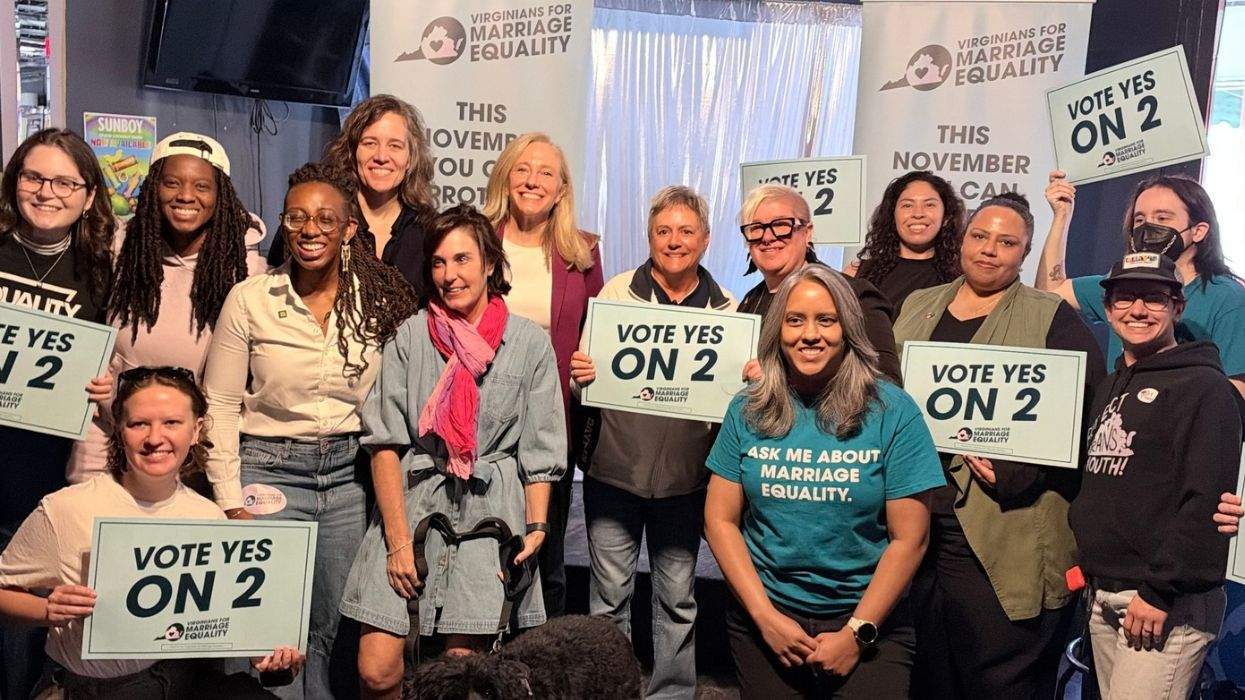
Virginia Gov. Abigail Spanberger stood Saturday morning inside the oldest lesbian bar on the East Coast, urging voters to erase a 20-year-old constitutional ban on same-sex marriage. Three days before Election Day, the commonwealth’s first woman governor argued that a right recognized by the U.S. Supreme Court more than a decade ago should no longer exist under the shadow of Virginia’s discriminatory past.
On Tuesday, voters will decide whether to remove it and affirm the right of two adults to marry regardless of sex, gender, or race.
“The fact that at this moment we still have a ban in our state constitution casts a bit of a shadow,” Spanberger told The Advocate after joining Human Rights Campaign President Kelley Robinson and Equality Virginia Executive Director Narissa Rahaman at a get-out-the-vote gathering at Babes of Carytown in Richmond.
She hopes Tuesday’s vote will offer “a bit of solace or contentment to those who have lived under the shadow of our current constitutional ban.”
Among those listening was Kimberly Ewton, an old college friend who had traveled thousands of miles from Germany to support Spanberger and help get out the vote.
Decades earlier, the two women had visited Babes together while attending the University of Virginia. Spanberger, who graduated in 2001, also helped Ewton navigate a difficult coming-out experience with her conservative family.
“There was even a time when, I don’t know, I think I was still in the closet, I’m not quite sure,” Ewton recalled. “We were both in college, and we actually came here together.”
“She just was my friend that night, and it’s more than a full circle moment to come back here to see her on stage and then to get a shout-out from her,” she said.
Now, the friend who had helped her find acceptance was governor, asking an entire state to provide LGBTQ+ couples a measure of that same security.
When Ewton tried to describe what it meant to witness the moment, she began to cry.
“I'm just really moved to see my friend here advocating for our rights,” she told The Advocate. “Sorry, I’m a crier.”
In 2006, Virginia voters approved the Marshall-Newman Amendment, prohibiting same-sex marriage. Although subsequent court rulings rendered the ban unenforceable, culminating in the Supreme Court’s 2015 decision in Obergefell v. Hodges, the language remains in Virginia’s Constitution.
For Spanberger, who won the governorship decisively last year, the referendum represents another moment of change in a state that voted to prohibit same-sex marriage just two decades ago.
For Ewton, the effort is deeply personal.
“My coming out was a difficult time with my parents, and she was always there for me,” she said of Spanberger. “Her parents were also there for me.”
Related: Virginia Gov. Abigail Spanberger sends marriage equality & abortion rights amendments to voters
Twenty years after Virginia voted against marriage equality
Virginia’s 2006 marriage ban passed with about 57 percent of the vote, reflecting a period when opposition to marriage equality was widespread nationally.
Question 2 would replace the prohibition with an affirmative constitutional right to marry, requiring Virginia to recognize lawful marriages equally regardless of sex, gender, or race.
Same-sex couples can marry in Virginia today under federal constitutional protections and state law. But future legislatures can change ordinary laws. If Obergefell were overturned, Virginia’s existing constitutional prohibition could again become enforceable unless removed.
That possibility has concerned LGBTQ+ families since Justice Clarence Thomas, in a concurring opinion accompanying the Supreme Court’s 2022 Dobbs v. Jackson Women’s Health Organization decision overturning Roe v. Wade, called for reconsidering precedents including Obergefell.
Public attitudes have shifted dramatically over two decades. According to Gallup, 42 percent of Americans supported legal same-sex marriage in 2006. By May 2026, support stood at 65 percent, down from a peak of 71 percent in 2022 and 2023.
The numbers suggest substantial progress, but also its fragility. At Babes on Saturday, that fragility was personal.
Robinson recalled marrying her wife in 2020, during the COVID-19 pandemic, when fears about hospital visitation, health insurance and parental rights made marriage feel especially urgent.
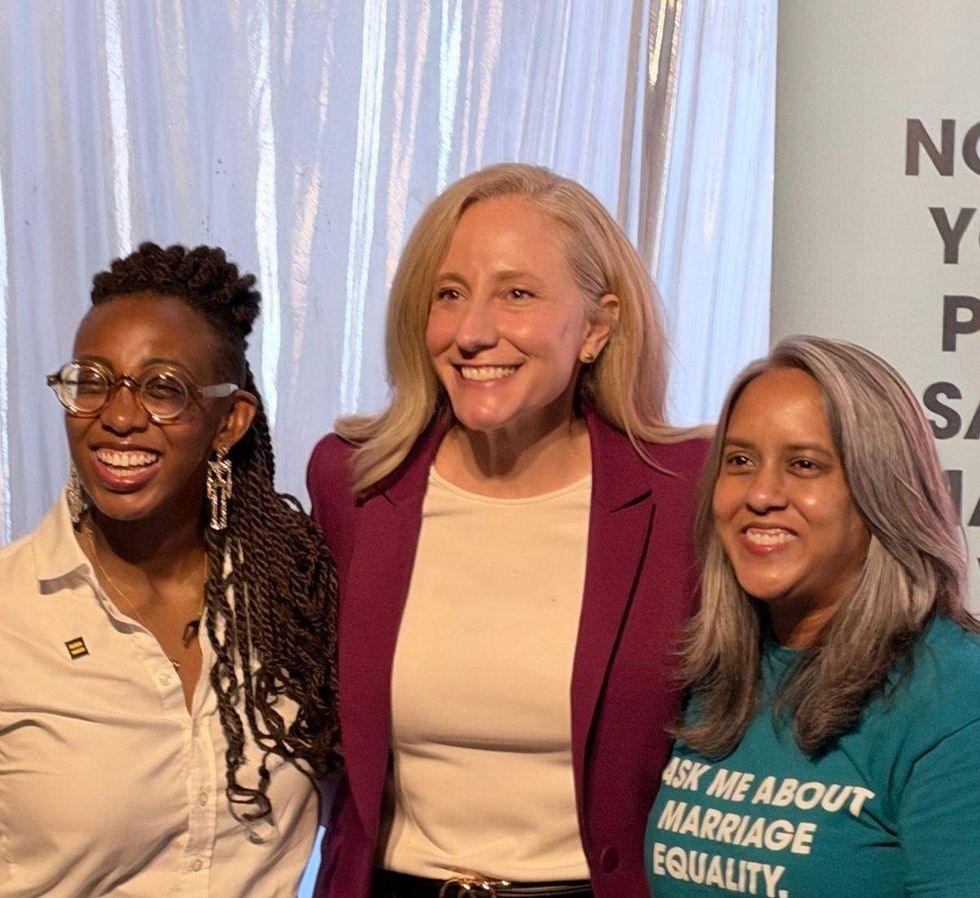 Virginia Gov. Abigail Spanberger (center) with Human Rights Campaign President Kelley Robinson (left) and Equality Virginia Executive Director Narissa Rahaman.Christopher Wiggins for The Advocate
“Marriage shouldn’t ever be about fear. It should always be about love,” Robinson told the crowd at Babes.
Spanberger made a similar argument, recalling how the Supreme Court’s reversal of Roe demonstrated that established precedents could disappear.
But she said removing the marriage ban was important regardless of what the Supreme Court might do.
“The fact that there is still a ban on marriage equality in our constitution for me is something — it’s a wrong that needs to be rectified,” she told volunteers.
Speaking separately with The Advocate, Spanberger said that the ban’s continued existence could carry an emotional cost for people who remembered their neighbors voting to exclude them.
“Whether it’s someone who might be worried about the Supreme Court overturning their prior precedent or someone who just feels a little heavy-hearted about the fact that 20 years ago their fellow Virginians voted to ban them from marrying,” she said, passage on Tuesday could offer reassurance.
“It means a lot to me as a person. It means a lot to me because I have many friends who are married under the shadow of that ban,” Spanberger said.
“And I think it would speak to the fact that when given the opportunity to right a past wrong of our commonwealth, that the people of Virginia take it.”
A different political direction for Virginia
Spanberger’s appearance at Babes underscored how dramatically Virginia’s political leadership has changed.
In November 2025, she defeated Republican Lt. Gov. Winsome Earle-Sears, winning 57.6 percent of the vote to her opponent’s 42.2 percent, a margin of more than half a million votes. Her victory returned the governor’s mansion to Democratic control after four years under Republican Gov. Glenn Youngkin.
In September, Spanberger attended Virginia Pride Fest in Richmond, telling thousands of attendees that they had a friend in the governor’s mansion who took LGBTQ+ equality seriously.
For Ewton, the governor’s commitment to inclusion predates her political career.
“From the moment I met Abigail at UVA, she’s always, always just been a true friend, the person who believed that everyone should be included in society and that everyone should have a voice,” Ewton said.
“I have been a supporter of hers ever since she’s been in politics because she’s been a supporter of me ever since she’s known me.”
At Babes, generations of LGBTQ+ history meet
Few places better capture Virginia’s evolution than Babes of Carytown, which has provided generations of LGBTQ+ Virginians somewhere to gather, dance and find community. During a Richmond tourism press trip in May 2025, The Advocate explored the bar’s enduring significance. Its longtime owner, Vicky Hester, who died in September 2025 at age 71, helped sustain that legacy. In September, Richmond officials voted to name a street beside the bar Vicky Hester Way, recognizing her contributions to the city’s LGBTQ+ community.
On Saturday, volunteers prepared to knock on doors and make calls before an afternoon drag show. Spanberger, Robinson, and Rahaman stood together before the crowd.
Robinson reflected on the historical significance of a Black queer woman leading the nation’s largest LGBTQ+ advocacy organization alongside Virginia’s first woman governor in a state central to the legal battle over interracial marriage.
“You can’t tell me change isn’t happening. You can’t tell me progress is impossible because we are living proof that it is,” Robinson said.
Virginia’s prohibition on interracial marriage produced the Supreme Court’s landmark 1967 decision in Loving v. Virginia.
Speaking with The Advocate, Robinson described Tuesday’s referendum as a possible beginning for similar efforts nationwide.
“If and when we can win here in Virginia, that puts us on the path to repeal the other 30 remaining bans on marriage equality that are still in place in states across the country,” she said. “I think this is the beginning of something important.”
Rahaman, who married her wife three years ago and is managing Virginians for Marriage Equality, described the campaign as the culmination of two decades of organizing.
“Our work to protect the freedom to marry in Virginia has not just been the last six months of this campaign. It’s been 20 years in the making,” she told The Advocate.
She emphasized that securing marriage equality would be another milestone, not the movement’s conclusion.
“Marriage equality has never been the end goal for our community. It has been one stop along the way,” Rahaman said.
The friend who never changed
Ewton has witnessed nearly every major milestone in Spanberger’s political career. She was there when Spanberger won her first congressional election in 2018, returned for subsequent campaigns and attended her inauguration in January.
Living as an American citizen in Germany has not diminished her desire to be part of those moments.
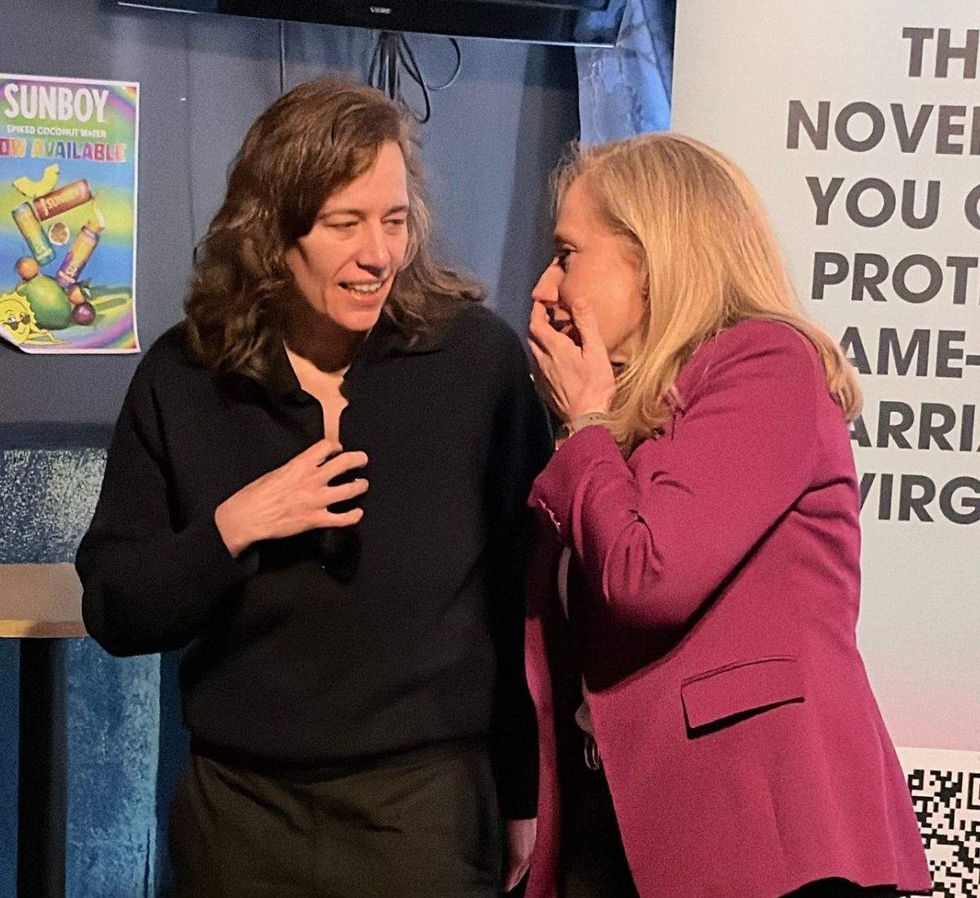 Virginia Gov. Abigail Spanberger (right) with Kimberly Ewton, a good friend from college. Christopher Wiggins for The Advocate
“I find it intensely inspiring,” Ewton said of watching Spanberger’s political career unfold. “And that’s one reason I love coming back and visiting her and being a part of these events because I know that what she’s doing comes from a truly undeniably authentic space.”
When the governor mentioned her from the stage Saturday, she joked about a plan to persuade Ewton to return to the U.S.
“So this is how I recruit people back to live in Virginia again so she can come with her partner and live here,” Spanberger said.
Ewton had already teased her friend about expecting a shout-out.
For her, the political significance was inseparable from a personal memory. Her friend had supported her when coming out was difficult. Her friend’s family had helped her feel accepted. Now that friend, the governor of Virginia, was asking an entire state to provide LGBTQ+ families with greater security.
“She believes in it, and she’s always stood for it before she got into politics, and after she got into politics,” Ewton said.