'%3E%3Cpath d='M16.3574 35.6519H12.9537L15.0491 18.8873L16.3574 35.6519ZM30.4229 54.0093L22.309 0.994385H7.91795L0 54.0093H10.6634L11.5802 46.3855H17.4014L17.9914 54.0093H30.4229Z' fill='%23971B20'/%3E%3Cpath d='M48.2073 41.8813C48.2073 43.4049 47.4892 44.0011 46.1144 44.0011H43.7595V11.0687H46.1144C47.4892 11.0687 48.2073 11.6636 48.2073 13.1885V41.8813ZM59.5273 43.6695V11.3326C59.5273 3.71323 53.5729 0.994385 47.8157 0.994385H31.7213V54.0093H47.8157C53.5729 54.0093 59.5273 51.29 59.5273 43.6695Z' fill='%23971B20'/%3E%3Cpath d='M90.183 0.994385H78.6039L75.0711 30.6157L71.9955 0.994385H59.4346L69.2474 54.0093H80.373L90.183 0.994385Z' fill='%23971B20'/%3E%3Cpath d='M107.063 42.3448C107.063 43.7359 105.951 44.5974 104.643 44.5974C103.269 44.5974 102.157 43.7359 102.157 42.3448V12.658C102.157 11.2676 103.269 10.4058 104.643 10.4058C105.951 10.4058 107.063 11.2676 107.063 12.658V42.3448ZM119.233 43.2723V11.7312C119.233 6.36384 112.952 -3.8147e-06 104.643 -3.8147e-06C96.2667 -3.8147e-06 89.9867 6.36384 89.9867 11.7312V43.2723C89.9867 48.6393 96.2667 55 104.643 55C112.952 55 119.233 48.6393 119.233 43.2723Z' fill='%23971B20'/%3E%3Cpath d='M150.976 43.9349V33.7309H139.069V42.3448C139.069 43.7359 137.957 44.5974 136.582 44.5974C135.076 44.5974 133.964 43.7359 133.964 42.3448V12.658C133.964 11.2676 135.076 10.4058 136.582 10.4058C137.957 10.4058 139.069 11.2676 139.069 12.658V21.2723H150.976V11.0687C150.976 5.70107 145.283 -3.8147e-06 136.582 -3.8147e-06C127.75 -3.8147e-06 121.796 5.70107 121.796 11.0687V43.9349C121.796 49.3022 127.75 55 136.582 55C145.283 55 150.976 49.3022 150.976 43.9349Z' fill='%23971B20'/%3E%3Cpath d='M167.478 35.6519H164.076L166.17 18.8873L167.478 35.6519ZM181.544 54.0093L173.432 0.994385H159.037L151.123 54.0093H161.785L162.704 46.3855H168.523L169.114 54.0093H181.544Z' fill='%23971B20'/%3E%3Cpath d='M205.412 10.4058V0.994385H177.081V10.4058H185.392V54.0093H197.428V10.4058H205.412Z' fill='%23971B20'/%3E%3Cpath d='M230.002 54.0093V43.9349H218.914V31.8746H226.635V21.8028H218.914V10.4058H230.002V0.994385H206.875V54.0093H230.002Z' fill='%23971B20'/%3E%3C/g%3E%3Cdefs%3E%3CclipPath id='clip0_260_7080'%3E%3Crect width='230' height='55' fill='white'/%3E%3C/clipPath%3E%3C/defs%3E%3C/svg%3E)


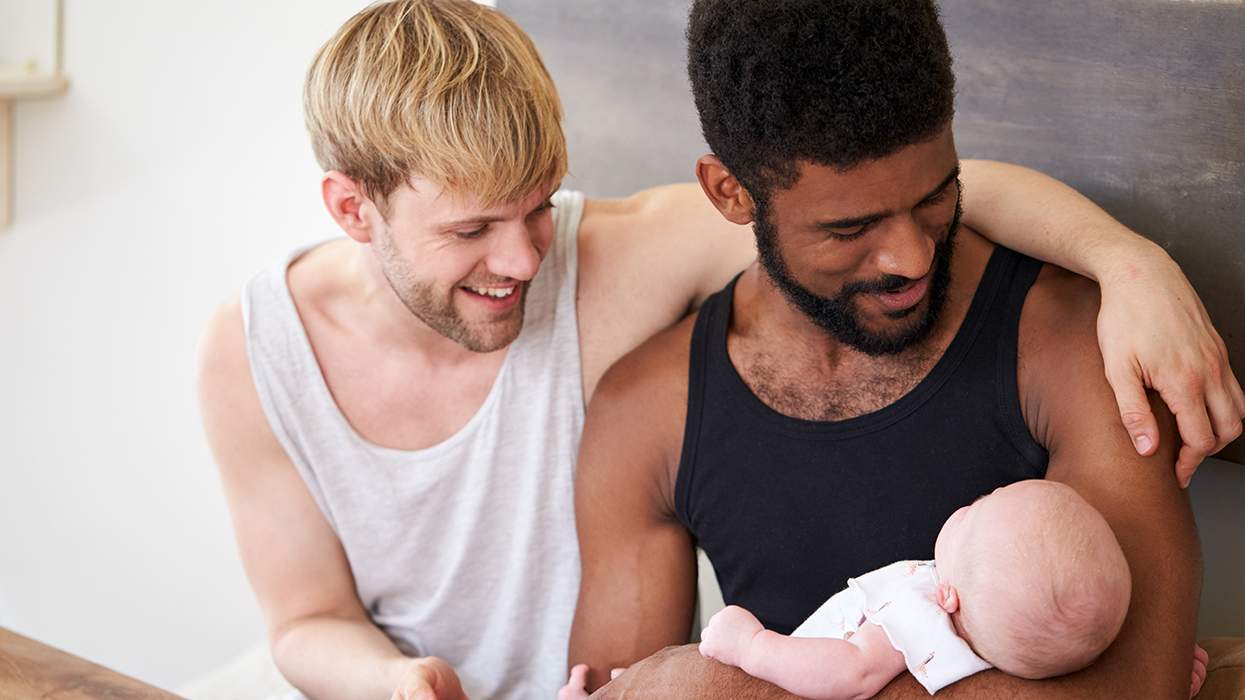
To our neighbors, my wife, Nancy, and I don't appear in the least unusual. To those in the quiet Oregon community where we live, we are viewed just as we are -- a happy couple deeply in love. Our desire to work hard, buy our first home, and start a family was nothing out of the ordinary. That is, until we decided that I would carry our child.
I am transgender, legally male, and legally married to Nancy. Unlike those in same-sex marriages, domestic partnerships, or civil unions, Nancy and I are afforded the more than 1,100 federal rights of marriage. Sterilization is not a requirement for sex reassignment, so I decided to have chest reconstruction and testosterone therapy but kept my reproductive rights. Wanting to have a biological child is neither a male nor female desire, but a human desire.
Ten years ago, when Nancy and I became a couple, the idea of us having a child was more dream than plan. I always wanted to have children. However, due to severe endometriosis 20 years ago, Nancy had to undergo a hysterectomy and is unable to carry a child. But after the success of our custom screen-printing business and a move from Hawaii to the Pacific Northwest two years ago, the timing finally seemed right. I stopped taking my bimonthly testosterone injections. It had been roughly eight years since I had my last menstrual cycle, so this wasn't a decision that I took lightly. My body regulated itself after about four months, and I didn't have to take any exogenous estrogen, progesterone, or fertility drugs to aid my pregnancy.
Our situation sparks legal, political, and social unknowns. We have only begun experiencing opposition from people who are upset by our situation. Doctors have discriminated against us, turning us away due to their religious beliefs. Health care professionals have refused to call me by a male pronoun or recognize Nancy as my wife. Receptionists have laughed at us. Friends and family have been unsupportive; most of Nancy's family doesn't even know I'm transgender.
This whole process, from trying to get pregnant to being pregnant, has been a challenge for us. The first doctor we approached was a reproductive endocrinologist. He was shocked by our situation and told me to shave my facial hair. After a $300 consultation, he reluctantly performed my initial checkups. He then required us to see the clinic's psychologist to see if we were fit to bring a child into this world and consulted with the ethics board of his hospital. A few months and a couple thousand dollars later, he told us that he would no longer treat us, saying he and his staff felt uncomfortable working with "someone like me."
In total, nine different doctors have been involved. This is why it took over one year to get access to a cryogenic sperm bank to purchase anonymous donor vials, and why Nancy and I eventually resorted to home insemination.
When I finally got pregnant for the first time, I ended up having an ectopic pregnancy with triplets. It was a life-threatening event that required surgical intervention, resulting in the loss of all embryos and my right fallopian tube. When my brother found out about my loss, he said, "It's a good thing that happened. Who knows what kind of monster it would have been."
On successfully getting pregnant a second time, we are proud to announce that this pregnancy is free of complications and our baby girl has a clean bill of health. We are happily awaiting her birth, with an estimated due date of July 3, 2008.
How does it feel to be a pregnant man? Incredible. Despite the fact that my belly is growing with a new life inside me, I am stable and confident being the man that I am. In a technical sense I see myself as my own surrogate, though my gender identity as male is constant. To Nancy, I am her husband carrying our child -- I am so lucky to have such a loving, supportive wife. I will be my daughter's father, and Nancy will be her mother. We will be a family.
Outside the local medical community, people don't know I'm five months' pregnant. But our situation ultimately will ask everyone to embrace the gamut of human possibility and to define for themselves what is normal.