'%3E%3Cpath d='M16.3574 35.6519H12.9537L15.0491 18.8873L16.3574 35.6519ZM30.4229 54.0093L22.309 0.994385H7.91795L0 54.0093H10.6634L11.5802 46.3855H17.4014L17.9914 54.0093H30.4229Z' fill='%23971B20'/%3E%3Cpath d='M48.2073 41.8813C48.2073 43.4049 47.4892 44.0011 46.1144 44.0011H43.7595V11.0687H46.1144C47.4892 11.0687 48.2073 11.6636 48.2073 13.1885V41.8813ZM59.5273 43.6695V11.3326C59.5273 3.71323 53.5729 0.994385 47.8157 0.994385H31.7213V54.0093H47.8157C53.5729 54.0093 59.5273 51.29 59.5273 43.6695Z' fill='%23971B20'/%3E%3Cpath d='M90.183 0.994385H78.6039L75.0711 30.6157L71.9955 0.994385H59.4346L69.2474 54.0093H80.373L90.183 0.994385Z' fill='%23971B20'/%3E%3Cpath d='M107.063 42.3448C107.063 43.7359 105.951 44.5974 104.643 44.5974C103.269 44.5974 102.157 43.7359 102.157 42.3448V12.658C102.157 11.2676 103.269 10.4058 104.643 10.4058C105.951 10.4058 107.063 11.2676 107.063 12.658V42.3448ZM119.233 43.2723V11.7312C119.233 6.36384 112.952 -3.8147e-06 104.643 -3.8147e-06C96.2667 -3.8147e-06 89.9867 6.36384 89.9867 11.7312V43.2723C89.9867 48.6393 96.2667 55 104.643 55C112.952 55 119.233 48.6393 119.233 43.2723Z' fill='%23971B20'/%3E%3Cpath d='M150.976 43.9349V33.7309H139.069V42.3448C139.069 43.7359 137.957 44.5974 136.582 44.5974C135.076 44.5974 133.964 43.7359 133.964 42.3448V12.658C133.964 11.2676 135.076 10.4058 136.582 10.4058C137.957 10.4058 139.069 11.2676 139.069 12.658V21.2723H150.976V11.0687C150.976 5.70107 145.283 -3.8147e-06 136.582 -3.8147e-06C127.75 -3.8147e-06 121.796 5.70107 121.796 11.0687V43.9349C121.796 49.3022 127.75 55 136.582 55C145.283 55 150.976 49.3022 150.976 43.9349Z' fill='%23971B20'/%3E%3Cpath d='M167.478 35.6519H164.076L166.17 18.8873L167.478 35.6519ZM181.544 54.0093L173.432 0.994385H159.037L151.123 54.0093H161.785L162.704 46.3855H168.523L169.114 54.0093H181.544Z' fill='%23971B20'/%3E%3Cpath d='M205.412 10.4058V0.994385H177.081V10.4058H185.392V54.0093H197.428V10.4058H205.412Z' fill='%23971B20'/%3E%3Cpath d='M230.002 54.0093V43.9349H218.914V31.8746H226.635V21.8028H218.914V10.4058H230.002V0.994385H206.875V54.0093H230.002Z' fill='%23971B20'/%3E%3C/g%3E%3Cdefs%3E%3CclipPath id='clip0_260_7080'%3E%3Crect width='230' height='55' fill='white'/%3E%3C/clipPath%3E%3C/defs%3E%3C/svg%3E)
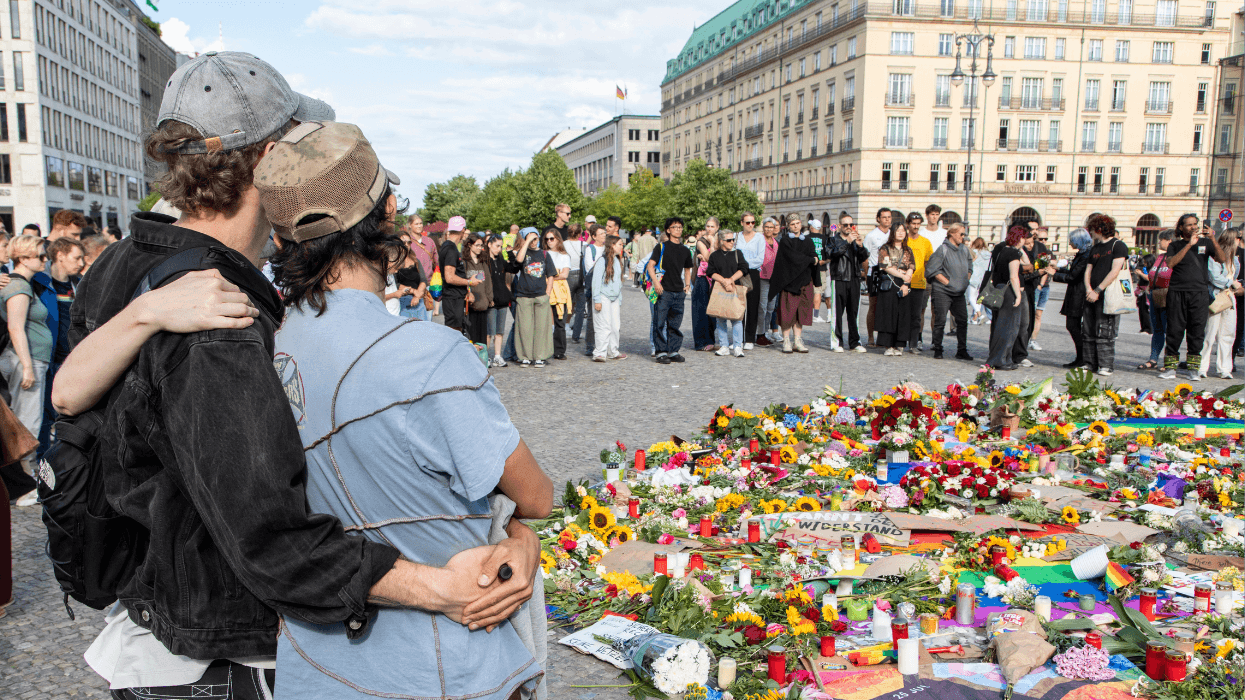
Last Saturday burned hot and beautiful in Berlin. I woke up late and joined hundreds of thousands of people marching through the city for Christopher Street Day, our biggest Pride event. Several Pride events happened that weekend, but I went to the big one because my boyfriend worked a shift that day at a shop in Schöneberg, Berlin’s classic gayborhood, near the start of the parade route, and I wanted to spend this holiest of days with him.
When he got off work, we finally joined the throng, a bit too late, well behind our friends and lovers who had followed the route all day to the Tiergarten, the large park where the parade ends in front of the Brandenburg Gate and becomes a street party so full of people that it becomes hard to move. That’s where, just before 10 p.m., a man drove a van into the crowd.
Related: Terrorist attack at huge Berlin Pride parade celebration leaves 1 dead, dozens injured
Per the German newspaper Tagesspiegel, the van entered the park and struck people leaving the finale before colliding with a tree; the driver continued on foot with a machete, the Associated Press reported. One friend said the van blew past him so close that he saw the driver's face through the window and described it as blank, unfeeling, determined. The man killed one woman, a 65-year-old Polish citizen, who was visiting Berlin with her daughter, and wounded 29 more, some severely. Thankfully, no one I knew was hurt, and I was not hurt, but still, it brought a painful, abrupt end to a day of joy and love.
How did a known subject carry out a deadly terrorist attack?
How did it happen? The attack took place in one of the most heavily policed parts of the city, a short walk from the Bundestag, the seat of the German government. After a daylong manhunt, officers shot and killed the attacker, 21-year-old Abdul Ballout. Ballout had attempted to join the Islamic State, the jihadist terror group, in Syria, and authorities ruled it a terrorist attack.
Being attacked and experiencing violence is hardly new for queer people, but something smells off here. The German police knew of the attacker. A joint investigation by the newspaper Süddeutsche Zeitung and the public broadcasters Norddeutscher Rundfunk and Westdeutscher Rundfunk revealed that a police camera mounted opposite Ballout's front door filmed him leaving his house at 8:58 p.m. on Saturday, roughly an hour before the attack. A federal risk assessment in late May had placed him in the highest risk category, "Red." He was on a watch list. The threat was known.
It's no secret that Germany has been severely cracking down on pro-Palestine protests; indeed, nine people at the Internationalist Queer Pride, held in another part of the city, were arrested, largely for shouting banned pro-Palestine slogans, per Tagesspiegel. Ballout's attack was immediately weaponized by far-right and conservative politicians. The Berlin mayor declared Islamism the greatest threat to the queer community in Germany. Chancellor Friedrich Merz, who last year defended the Bundestag's refusal to fly a rainbow flag during Pride by calling the parliament building "not a circus tent where any flag could be hoisted," promised to do everything to protect the country's freedom.
Politicians rushed to weaponize queer grief
The attack was immediately politicized, weaponized, and presented as a reason to cast queer people, who in Berlin seem to largely oppose Israel’s genocide in Gaza and the German government's funding of it, as victims of the very cultural forces we defend.
This is a time to mourn, to be sad that a mother, who could be any of our mothers, who came to Pride to support us, is gone. It’s also time to mourn the fact that all our quiet calculation at public gatherings, all that looking over the shoulder, is warranted; the risk and danger is real, as has been proved again and again, at Pulse in 2016, at Club Q in 2022, at a London gay bar in 1999, and on and on. But it is also a time to be wary.
Related: 2 Homophobic Assaults Reported After Berlin's Pride Celebrations
In recent days, our grief has been used politically, and that, too, is an act of violence against us.
On Sunday, I stood with thousands at the vigil at the Brandenburg Gate and watched flowers pile up on the sidewalk. By Monday, every party had used the attack for political statements: the German far-right party, the AfD, demanded deportations, and the center-right CDU, the party of both the chancellor and Berlin's mayor, accused the Left party, which leads some Berlin polls, of denying the reality of the Islamist threat.
Seeing it happening, Berliner CSD e.V., the organization that organizes Pride, spoke at a press conference on Sunday. "We do not want this deed to be used for political ends.” The board added on Monday that the country must name Islamist terror, but it will fight attempts to turn this rhetoric into hatred of Muslims.
Queer Muslims are not the enemy
Let's look at the facts. One radicalized, very young man attacked us because he saw queer people as a monolith, a single category, a dangerous and sinful populace that together amounts to something inhuman and poisonous. I've witnessed that same view from radicalized Christians in the American Deep South, where I'm from. But even there, some Christians defended me while others condemned me. Christians, like Muslims, like queer people, defy monoliths. Some Berliners I hugged Saturday marched as queer Muslims, and I can only imagine what they feel now, watching politicians turn one man into an indictment of everyone who prays as they do.
Saying he represents Islam is as wrong as saying I represent all queer people. Monolithic views of people are what fuel this kind of violence, and it falls on the intelligent and empathetic among us to remind others not to fall into mass-generalizing traps, which are a kind of mind violence, a refusal to acknowledge human diversity and submit to ugly, base tribalism, as our politicians and leaders would like us to do.
If we answer violence like this by conjuring up monolithic images of people and increasing surveillance and deportation of those people, we adopt the killer's way of seeing the world. That trap can wait inside grief, and grief makes it seductive. Don't fall for it.
The fear followed us home
By the end of CSD weekend, my boyfriend and I thought of going to a gay bar, our favorite, a busy one where the crowd tends to spill into the street. Was it safe? What if someone drove a van into that crowd, or drove by it and sprayed bullets? I wrote about living through Pulse in my 2021 book. After it happened, I was afraid, for months, to go to any gay bar, and after this weekend, that same fear bubbled up again. Was it worth it?
In the end, I arrived at the same conclusion I did years ago: There’s nothing to prevent that kind of violence, yet there's nowhere I'd rather be, nowhere I'd rather die than among my own. That violence is always possible, always hovering in the margins of reality, always painfully real.
The far right remains the greater threat
And yet, in the real world, especially in Germany in recent years, that violence has largely been fueled by fascist far-right parties, not the Islamic State. Per Federal Criminal Police Office statistics reported by queer.de, hate crimes against LGBTQ+ people have more than doubled since 2022, and of the offenses investigators could tie to an ideology, 84 percent came from the right. The Amadeu Antonio Stiftung counted disruptions or attacks at 111 of 245 German Pride events in 2025, a record, largely by far-right agitators. The record shows we have more to fear from people fueling anti-immigrant and anti-Muslim rhetoric than radicalized Muslim men.
The fascist right-wing governments of the world want us dead. Why not use our deaths to fuel their own political agendas? I don't know what really happened behind the scenes last weekend, or what was allowed to happen, but I'm grateful most of my friends were scared but overall unharmed. I'll grieve, then get back to defending good people, back with the queers who think genocide is wrong. Free queer people, free Palestine, support trans people, punch Nazis, with liberty and justice for all.
Opinion is dedicated to featuring a wide range of inspiring personal stories and impactful opinions from the LGBTQ+ community and its allies. Visit Advocate.com/submit to learn more about submission guidelines. We welcome your thoughts and feedback on any of our stories. Email us at voices@equalpride.com. Views expressed in Voices stories are those of the guest writers, columnists, and editors, and do not directly represent the views of The Advocate or our parent company, equalpride.