
'%3E%3Cpath d='M16.3574 35.6519H12.9537L15.0491 18.8873L16.3574 35.6519ZM30.4229 54.0093L22.309 0.994385H7.91795L0 54.0093H10.6634L11.5802 46.3855H17.4014L17.9914 54.0093H30.4229Z' fill='%23971B20'/%3E%3Cpath d='M48.2073 41.8813C48.2073 43.4049 47.4892 44.0011 46.1144 44.0011H43.7595V11.0687H46.1144C47.4892 11.0687 48.2073 11.6636 48.2073 13.1885V41.8813ZM59.5273 43.6695V11.3326C59.5273 3.71323 53.5729 0.994385 47.8157 0.994385H31.7213V54.0093H47.8157C53.5729 54.0093 59.5273 51.29 59.5273 43.6695Z' fill='%23971B20'/%3E%3Cpath d='M90.183 0.994385H78.6039L75.0711 30.6157L71.9955 0.994385H59.4346L69.2474 54.0093H80.373L90.183 0.994385Z' fill='%23971B20'/%3E%3Cpath d='M107.063 42.3448C107.063 43.7359 105.951 44.5974 104.643 44.5974C103.269 44.5974 102.157 43.7359 102.157 42.3448V12.658C102.157 11.2676 103.269 10.4058 104.643 10.4058C105.951 10.4058 107.063 11.2676 107.063 12.658V42.3448ZM119.233 43.2723V11.7312C119.233 6.36384 112.952 -3.8147e-06 104.643 -3.8147e-06C96.2667 -3.8147e-06 89.9867 6.36384 89.9867 11.7312V43.2723C89.9867 48.6393 96.2667 55 104.643 55C112.952 55 119.233 48.6393 119.233 43.2723Z' fill='%23971B20'/%3E%3Cpath d='M150.976 43.9349V33.7309H139.069V42.3448C139.069 43.7359 137.957 44.5974 136.582 44.5974C135.076 44.5974 133.964 43.7359 133.964 42.3448V12.658C133.964 11.2676 135.076 10.4058 136.582 10.4058C137.957 10.4058 139.069 11.2676 139.069 12.658V21.2723H150.976V11.0687C150.976 5.70107 145.283 -3.8147e-06 136.582 -3.8147e-06C127.75 -3.8147e-06 121.796 5.70107 121.796 11.0687V43.9349C121.796 49.3022 127.75 55 136.582 55C145.283 55 150.976 49.3022 150.976 43.9349Z' fill='%23971B20'/%3E%3Cpath d='M167.478 35.6519H164.076L166.17 18.8873L167.478 35.6519ZM181.544 54.0093L173.432 0.994385H159.037L151.123 54.0093H161.785L162.704 46.3855H168.523L169.114 54.0093H181.544Z' fill='%23971B20'/%3E%3Cpath d='M205.412 10.4058V0.994385H177.081V10.4058H185.392V54.0093H197.428V10.4058H205.412Z' fill='%23971B20'/%3E%3Cpath d='M230.002 54.0093V43.9349H218.914V31.8746H226.635V21.8028H218.914V10.4058H230.002V0.994385H206.875V54.0093H230.002Z' fill='%23971B20'/%3E%3C/g%3E%3Cdefs%3E%3CclipPath id='clip0_260_7080'%3E%3Crect width='230' height='55' fill='white'/%3E%3C/clipPath%3E%3C/defs%3E%3C/svg%3E)

There have been countless thousands of Black activists who’ve devoted their lives to combating HIV/AIDS in their communities over the years.
Here, we highlight a few courageous individuals who were able to create great change and awareness in the U.S. since the epidemic began.
Reverend Charles Angel
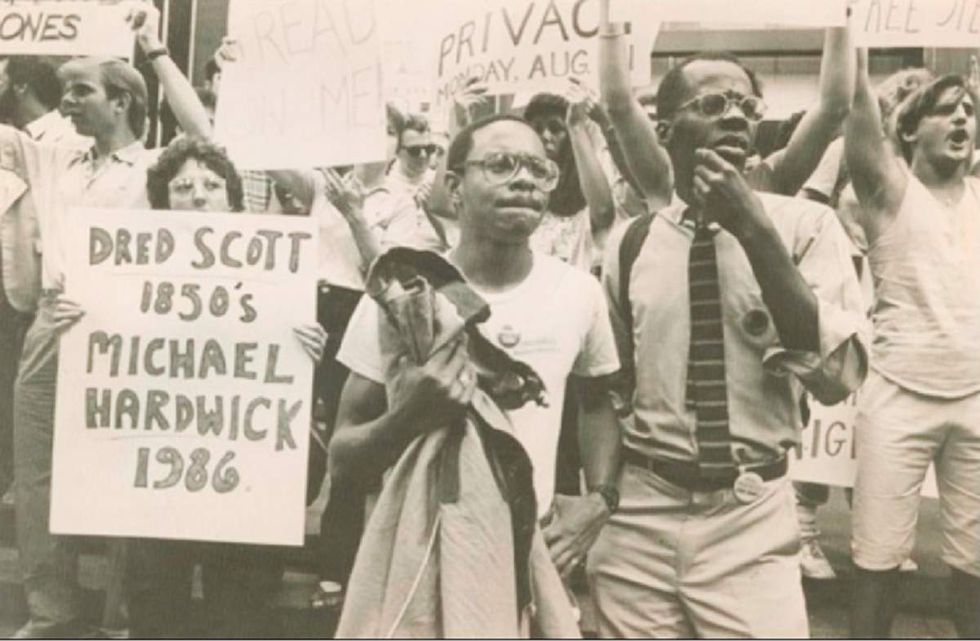
Charles Angel (on right, with striped tie) and Colin Robinson attend a protest protest following the 1986 'Bowers v. Hardwick' ruling.
Donna Binder/New York Public Library
By the mid-1980s, the AIDS epidemic had completely gripped the nation. Its victims, primarily queer men, were dying by the thousands. Fear and misinformation reigned supreme, and our government refused to respond to the crisis. Reverend Charles Angel, a community leader and activist who was living with HIV himself, recognized that queer men of color faced additional disparities due to cultural norms and societal inequities.
On July 16, 1986, Angel called a meeting at the recently established Lesbian and Gay Community Services Center in Manhattan to discuss the need for more support for gay Black men. The group consisted of fellow leaders and activists, including Tony Crusor, Cary Alan Johnson, Reggie Patterson, Len Richardson, Colin Robinson, Harold Robinson, and Ali Wadud. As a result, Gay Men of African Descent (GMAD) was born — making it the first Black gay organization exclusively dedicated to political activism. According to their mission statement at the time, it was a “support group dedicated to consciousness-raising and the development of the Lesbian and Gay community” and was “inclusive of African, Afro-American, Caribbean, and [Hispanic/Latino] men of color.”
Sadly, Angel passed due to HIV complications that same year.
Hydeia Broadbent
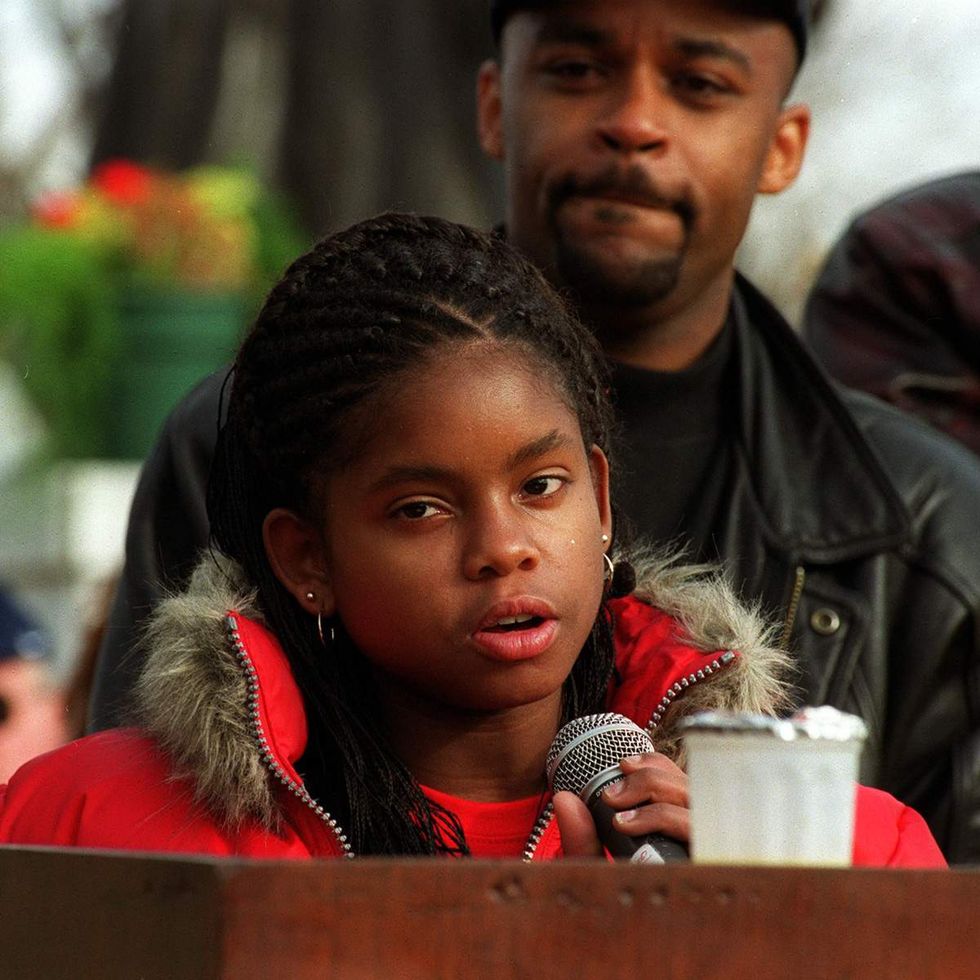
Hydeia Broadbent speaks at the 2000 Martin Luther King Jr. Marade in Denver (behind her is Michael Hancock, who would later become Denver's mayor).
Lyn Alweis/The Denver Post via Getty Images
Hydeia Broadbent’s began her life with some extreme challenges — though she would go on to become one of the most beloved and inspiring activists in the fight against HIV/AIDS. At birth, she was abandoned at the University Medical Center of Southern Nevada in Las Vegas. Her parents, Loren and Patricia Broadbent, adopted her as an infant, but it would be three more years until it was discovered that she was born HIV-positive.
At the tender age of six, Broadbent made her debut as an HIV activist and public speaker. By 12, she had appeared on many national television programs, including The Oprah Winfrey Show, 20/20, Good Morning America, and the 1992 Nickelodeon special, “A Conversation with Magic Johnson.”
In the decades that followed, Broadbent continued to spread messages of HIV/AIDS awareness and prevention by promoting abstinence and safe-sex practices. She was a notable speaker and guest panelist at many of America’s most respected educational institutions, including Duke University, Spelman, UCLA, USC, and Howard University.
Sadly, Broadbent passed away in February of 2024 at age 39. In a post on X, Earvin “Magic” Johnson paid tribute to the brave young activist he had met so many years before.
“Hydeia changed the world with her bravery, speaking about how living with HIV affected her life since birth,” Johnson wrote. “She dedicated her life to activism and became a change agent in the HIV/AIDS fight. By speaking out at such a young age, she helped so many people, young and old, because she wasn’t afraid to share her story and allowed everyone to see that those living with HIV and AIDS were everyday people and should be treated with respect.”
Watch a clip from Broadbent's appearance on Oprah's "Where are They Now?" series in 2014.
Earvin "Magic" Johnson
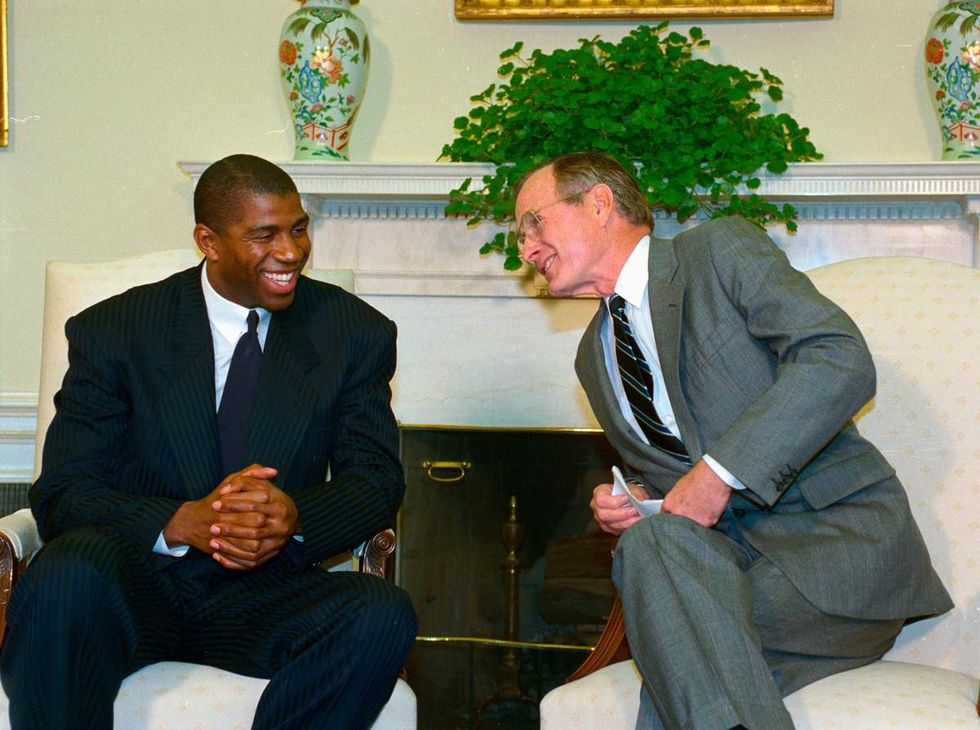
Johnson was appointed to the National Commission on AIDS by then-president George Bush Sr. but resigned from the post the following year due to the administration's lack of action in response to the epidemic.
Bettman Collection/Getty Images
On November 7, 1991, beloved Los Angeles Lakers point guard Earvin “Magic” Johnson shocked world when he announced that he was living with HIV and was retiring from the NBA after 12 amazing seasons. At the time, not only was the virus primarily associated with gay and bi men, it was also considered a death sentence, as today’s highly effective antiretroviral treatments had not yet been developed.
That same year, Johnson established his own organization, the Magic Johnson Foundation, which has continued to thrive for 35 years. Since its founding, MJF has provided over 40,000 free HIV screenings in 8 states, focusing on reaching the most vulnerable populations. The foundation has also provided over 700 inner-city youth with four-year college scholarships, given 45,000 children in need with toys, bikes, and Christmas trees during the holidays, as well as supplied over 20,000 families with food, clothing, and gifts.
Fortunately, Johnson has also defied the odds and is a long-term survivor of HIV and continues to live a happy healthy life today. Certainly, his positive attitude about his diagnosis helped.
“HIV changed my life, but it doesn't keep me from living,” said Johnson at the 1991 press conference where he shared his status with the world. “I’m going to go on, I’m going to beat it, and I’m going to have fun.”
Phill Wilson
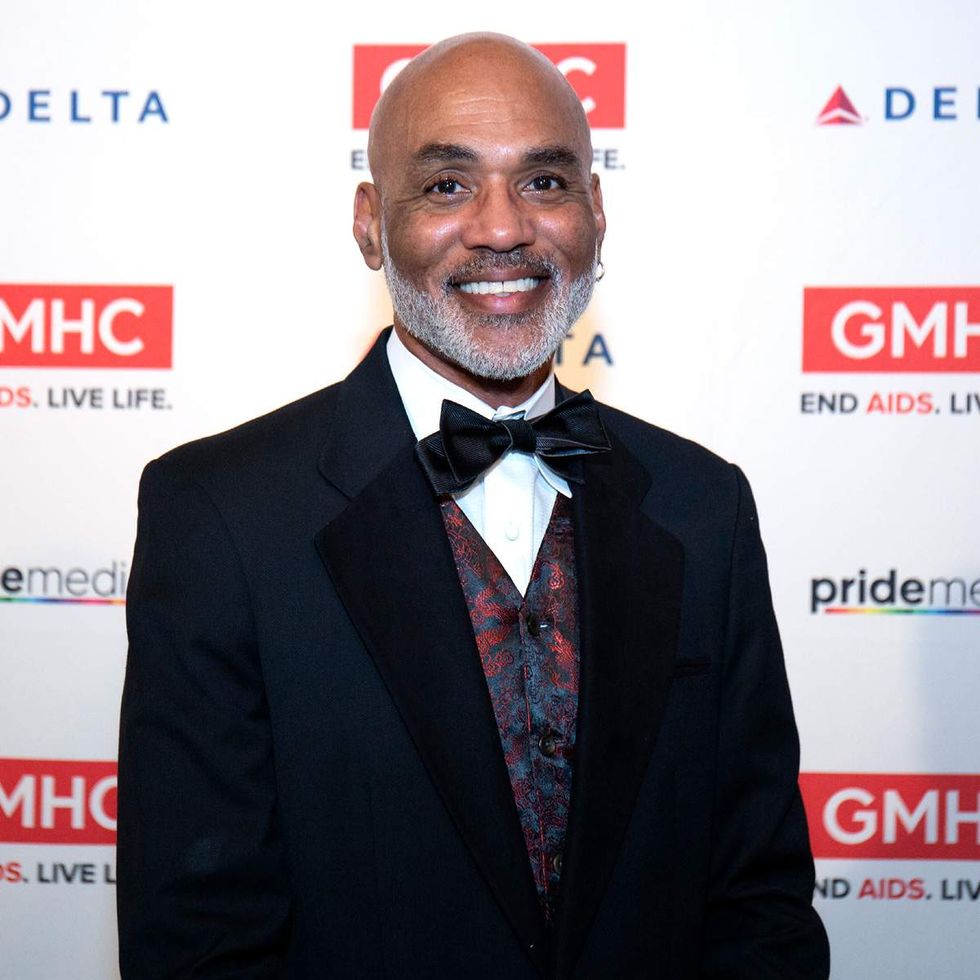
Phill Wilson at the Gay Men's Health Crisis Annual Gala
Santiago Felipe/Getty Images
Phill Wilson is one of the most prominent and accomplished Black HIV activists in the country today, having been working in the field since the earliest days of the epidemic. He's served in leadership roles in multiple Los Angeles-based HIV organizations and has made many national TV appearances over the years, including on Larry King Live, Nightline, and The Oprah Winfrey Show. Wilson is also the founder and former of the Black AIDS Institute. Established in 1999, BAI the only major national HIV organization that exclusively focuses on serving the Black community. He stepped down from his leadership role at BAI in 2018, after acting as its executive director for nearly 20 years.
“In order for a movement to endure, there must be a plan for the future,” Wilson said in a press release at the time. “Stepping down…is bittersweet for me. I have been involved in this fight for almost my entire adult life."
In addition, Wilson cofounded Chris Brownlie Hospice, named for a former partner of his who passed in 1990, and also cofounded the AIDS Health Care Foundation. Wilson has worked with the White House as a delegate numerous times, speaking at international AIDS conferences and working with federally-funded HIV organizations, and has been a member of several boards, including the National Association of Black and White Men Together, the National AIDS Network, the AIDS Action Council, and the Minority AIDS Project.
Tori Cooper
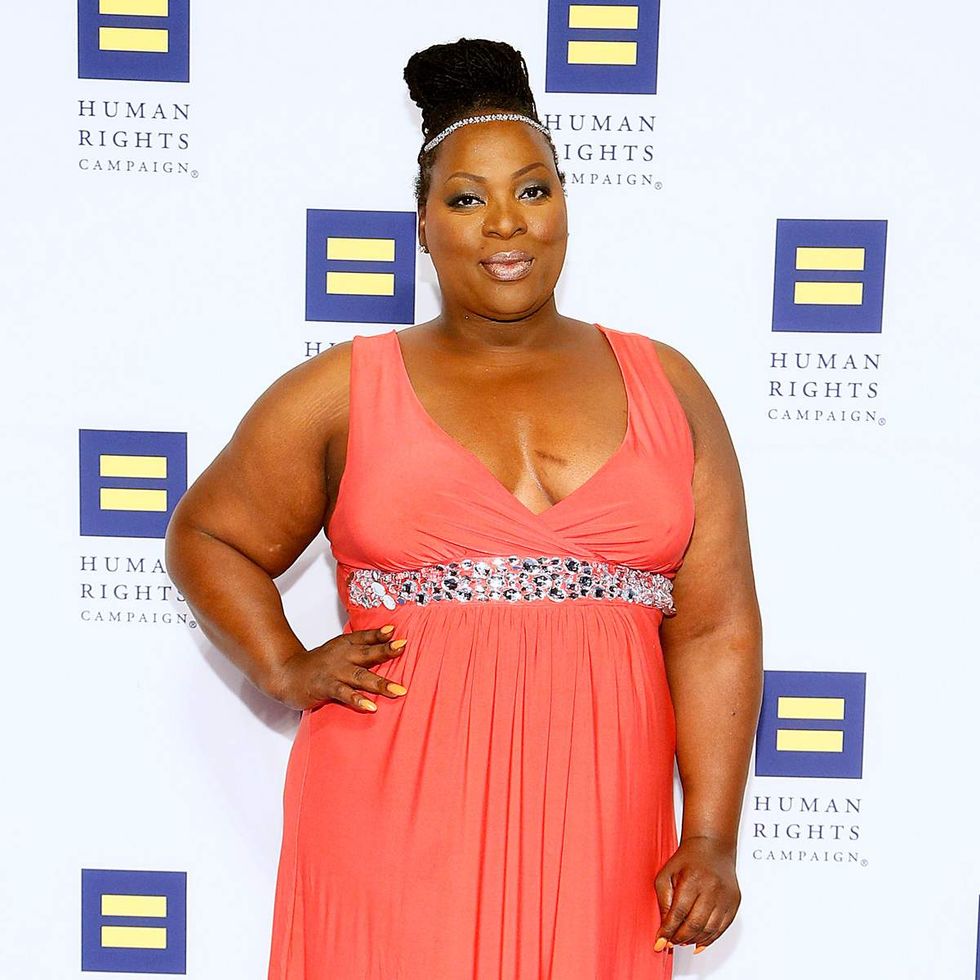
Tori Cooper at a Human Rights Campaign event
Paul Morigi/Getty Images
In 2021, Cooper made history as the first Black trans person appointed to the Presidential Advisory Council on HIV/AIDS. “I never saw anything as impossible. If there was ever a challenge, I always felt I could do it. I just always thought of myself as capable," she recently said in an interview with Gilead, after being named one of its Champions of Change.
“AIDS decimated Black gay clubs,” she added, explaining how the dark early days of the AIDS crisis spurred her into action. “There’s no other way to describe it. We’d be partying together, and a couple weeks later there’d be a funeral announcement. My very best friend died when I was 23.”
She started by helping to create fliers and pass out condom packets for the Gay Men’s Health Crisis in New York. In 1993, Cooper, along with fellow activist Zakia Jemaceye, helped to establish Sistas Too, a CDC program to designed to reduce HIV transmission within the trans community.
Cooper's big heart and advocacy extends beyond HIV. She's also is the founder of Advocates for Better Care Atlanta, which provides health needs for the city’s forgotten residents, and served as a consultant and prevention specialist at Atlanta’s Positive Impact Health Centers, providing HIV care to trans folks and other marginalized individuals.
“My hope is that moving forward the trans community doesn’t have to fight as hard to be seen as humans who are worthy of love and respect," she said in 2023, when she was honored as an Advocate of the Year. "My trans family needs to understand their collective and individual powers and have every opportunity to find peace, liberation and happiness in their journey.”
Cooper currently serves the director of strategic outreach and training for the Human Rights Campaign.
Deondre Moore
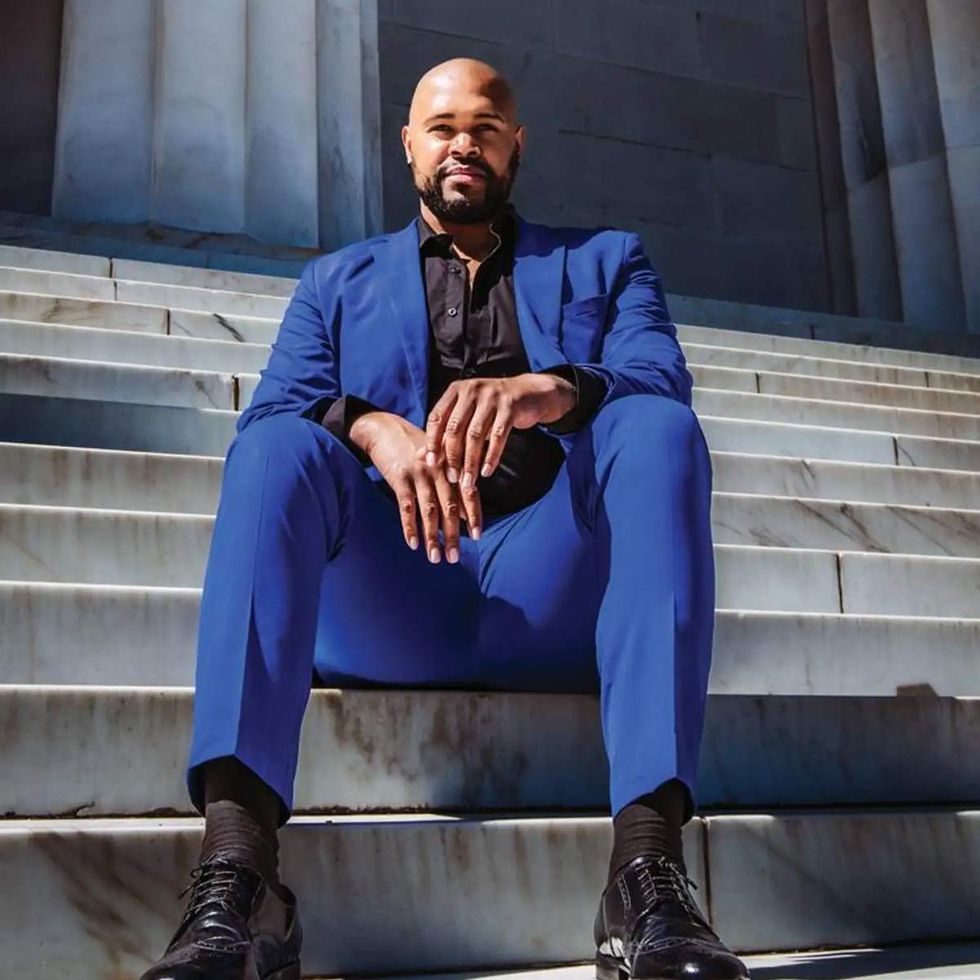
Deondre Moore on the steps of the Lincoln Memorial in Washington, D.C.
Kollin Benson
Deondre Moore is a shining example of what HIV activism looks like today. The GLAAD Award-winning community engagement expert and public speaker has been dedicated to helping improve the lives of people living with HIV for over a decade now — and even brought the message of U=U all the way to the White House.
Moore didn't hesitate to jump into action immediately following his own HIV diagnosis as a 19-year-old college student. He started with providing peer outreach and support for other young people living with HIV on his college campus. By speaking out and not hiding his diagnosis, Moore says he felt “layers of shame [and] layers of weight being lifted off my shoulders.” Since then, HIV activism has become his life's work.
From 2020 to 2022, Moore served as director of community engagement at Prevention Access Campaign, an organization with a goal of creating awareness around U=U, or “undetectable equals untransmittable.” U=U is a scientifically proven fact which states that an HIV-positive person who is on treatment and has an undetectable viral load has zero chance of transmitting the virus to a sexual partner, even without the use of a condom.
In March of 2022 (during the Biden administration), Moore spoke at the President’s Advisory Council on HIV/AIDS (PACHA), explaining the message of U=U to the group. This led to "conversations with HHS, Dr. Fauci, and the CDC to coordinate a collaborative effort with U=U to announce their support and plans to integrate U=U into programming and federal guidelines.”
The White House officially announced its endorsement of U=U a couple months later at the International AIDS Society’s AIDS 2022 conference in July, for which Moore was present. For his integral role in pushing the U=U initiative as well as his decade-long career in activism and community leadership, Moore was also honored with a GLAAD Award that year.








Charlie Kirk DID say stoning gay people was the 'perfect law' — and these other heinous quotes
These are some of his worst comments about LGBTQ+ people made by Charlie Kirk.