'%3E%3Cpath d='M16.3574 35.6519H12.9537L15.0491 18.8873L16.3574 35.6519ZM30.4229 54.0093L22.309 0.994385H7.91795L0 54.0093H10.6634L11.5802 46.3855H17.4014L17.9914 54.0093H30.4229Z' fill='%23971B20'/%3E%3Cpath d='M48.2073 41.8813C48.2073 43.4049 47.4892 44.0011 46.1144 44.0011H43.7595V11.0687H46.1144C47.4892 11.0687 48.2073 11.6636 48.2073 13.1885V41.8813ZM59.5273 43.6695V11.3326C59.5273 3.71323 53.5729 0.994385 47.8157 0.994385H31.7213V54.0093H47.8157C53.5729 54.0093 59.5273 51.29 59.5273 43.6695Z' fill='%23971B20'/%3E%3Cpath d='M90.183 0.994385H78.6039L75.0711 30.6157L71.9955 0.994385H59.4346L69.2474 54.0093H80.373L90.183 0.994385Z' fill='%23971B20'/%3E%3Cpath d='M107.063 42.3448C107.063 43.7359 105.951 44.5974 104.643 44.5974C103.269 44.5974 102.157 43.7359 102.157 42.3448V12.658C102.157 11.2676 103.269 10.4058 104.643 10.4058C105.951 10.4058 107.063 11.2676 107.063 12.658V42.3448ZM119.233 43.2723V11.7312C119.233 6.36384 112.952 -3.8147e-06 104.643 -3.8147e-06C96.2667 -3.8147e-06 89.9867 6.36384 89.9867 11.7312V43.2723C89.9867 48.6393 96.2667 55 104.643 55C112.952 55 119.233 48.6393 119.233 43.2723Z' fill='%23971B20'/%3E%3Cpath d='M150.976 43.9349V33.7309H139.069V42.3448C139.069 43.7359 137.957 44.5974 136.582 44.5974C135.076 44.5974 133.964 43.7359 133.964 42.3448V12.658C133.964 11.2676 135.076 10.4058 136.582 10.4058C137.957 10.4058 139.069 11.2676 139.069 12.658V21.2723H150.976V11.0687C150.976 5.70107 145.283 -3.8147e-06 136.582 -3.8147e-06C127.75 -3.8147e-06 121.796 5.70107 121.796 11.0687V43.9349C121.796 49.3022 127.75 55 136.582 55C145.283 55 150.976 49.3022 150.976 43.9349Z' fill='%23971B20'/%3E%3Cpath d='M167.478 35.6519H164.076L166.17 18.8873L167.478 35.6519ZM181.544 54.0093L173.432 0.994385H159.037L151.123 54.0093H161.785L162.704 46.3855H168.523L169.114 54.0093H181.544Z' fill='%23971B20'/%3E%3Cpath d='M205.412 10.4058V0.994385H177.081V10.4058H185.392V54.0093H197.428V10.4058H205.412Z' fill='%23971B20'/%3E%3Cpath d='M230.002 54.0093V43.9349H218.914V31.8746H226.635V21.8028H218.914V10.4058H230.002V0.994385H206.875V54.0093H230.002Z' fill='%23971B20'/%3E%3C/g%3E%3Cdefs%3E%3CclipPath id='clip0_260_7080'%3E%3Crect width='230' height='55' fill='white'/%3E%3C/clipPath%3E%3C/defs%3E%3C/svg%3E)

This story is part of History is Queer, an Advocate series examining key LGBTQ+ moments, events, and people in history and their ongoing impact. Is there a piece of LGBTQ+ history we should write about? Email us at history@advocate.com.
Even if you’re just a casual jazz fan, you probably recognize “Take the A Train,” Duke Ellington’s swinging theme song. Or you’ve heard the melancholy ballad “Lush Life” sung by Nat King Cole, by Linda Ronstadt during her Great American Songbook era, or by Lady Gaga on the album she recorded with Tony Bennett.
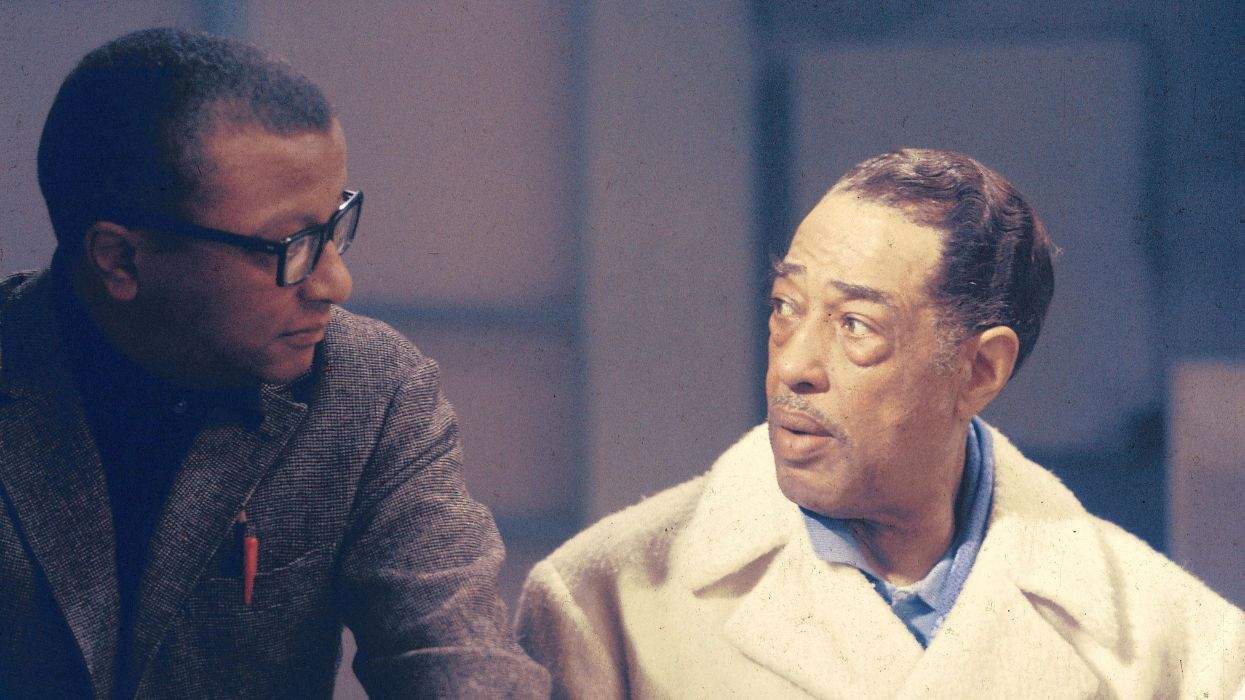
Both of those — and many other tunes — were written by a gay man, musician, composer, and arranger Billy Strayhorn. He refused to live in the closet in mid-20th-century America, and that may have cost him some public recognition. But he left an incredible body of work over his too-short life.
William Thomas Strayhorn was born in 1915 in Dayton, Ohio. As a child, he often visited his maternal grandmother in Hillsborough, North Carolina. She had a piano that he played “from the moment he was tall enough to reach the keys,” according to a biography on BillyStrayhorn.com, the website maintained by his heirs. Later, his family moved to Pittsburgh, where his father had found work. Young Billy played in his high school band (he was the only Black member), took private piano lessons, and studied at the Pittsburgh Musical Institute.
He wrote the book, music, and lyrics for Fantastic Rhythm, a musical revue performed by the school band, and after his studies at the institute, played gigs around Pittsburgh with a jazz combo called the Mad Hatters. He wrote “Lush Life” while still a teenager.
- YouTube www.youtube.com
In 1938 came a life-changing meeting. A friend of Strayhorn’s introduced him to Ellington, one of the giants of jazz, when the latter was playing an engagement in Pittsburgh with his orchestra. Strayhorn sat at a piano in Ellington’s dressing room between shows and demonstrated that he could play some tunes exactly as Ellington did and then that he could switch it up and play them his own way.
“Brazenly (or naively) the twenty-three-year-old artist demonstrated both a crafty facility with his renowned elder’s idiom and a spirited capacity to expand it through his own sensibility,” David Hajdu wrote in his 1996 biography of Strayhorn, Lush Life. Strayhorn joined Ellington’s band the following year.
“Neither one was sure what Strayhorn’s function in the band would be, but their musical talents had attracted each other,” notes the BillyStrayhorn.com bio. “By the end of the year Strayhorn had become essential to the Duke Ellington Band; arranging, composing, sitting-in at the piano.”
It was the height of the big band era, when the highly accessible, danceable form of jazz known as swing was the dominant form of American popular music. Audiences, mostly young adults, flooded nightclubs and ballrooms to dance to their favorite bands, or they contented themselves with dancing in their seats when one of the major bands played in a theater, sometimes as a prelude to a movie screening. Ellington was one of the originators of the big band sound, and his band was among the most sophisticated of the outfits.
In the early 1940s, there was a dispute between radio stations and the American Society of Composers, Authors, and Publishers over how much the stations would pay to play music licensed by ASCAP. Soon the broadcasters were refusing to play any ASCAP songs, but there were plenty of new songs to fill the void. Strayhorn was not a member of ASCAP, so the songs he wrote for the Ellington band, such as “Take the A Train,” could be played on the radio.
- YouTube www.youtube.com
The big band era faded at the end of World War II, as returning soldiers were drawn to hearth and home. Swing was no longer America’s popular music, but other forms of jazz found popularity with niche audiences. Strayhorn went out on his own for much of the 1950s, but he eventually returned to collaborating with Ellington. Their work pushed boundaries and sometimes veered into classical territory. Such Sweet Thunder, an instrumental suite first performed in 1957, was inspired by the works of Shakespeare. Strayhorn and Ellington also wrote an adaptation of the Nutcracker Suite, recorded in 1960.
Ellington valued Strayhorn’s talent but sometimes shut him out. “Until well after his death, Strayhorn often failed to receive accurate billing or credit for his contributions,” noted a 2007 Advocate article. “His name was originally left off ‘Satin Doll,’ and it was Ellington alone who got the Grammy for the score of Otto Preminger’s movie Anatomy of a Murder, even though Duke spent most of the filming in his hotel while Strayhorn haunted the set and composed underscore.”
Ellington may not have been particularly homophobic, but he was reluctant to share the spotlight — or the royalties. He “was delighted to promote Strayhorn whenever he could — he generally announced the younger man’s name when performing his work and even produced an album by Strayhorn in 1965 — as long as boosting his collaborator took nothing away from him,” Will Friedwald wrote in a New York Times review of Lush Life.
But Ellington did recognize Strayhorn’s gifts. “Billy Strayhorn was my right arm, my left arm, all the eyes in the back of my head, my brainwaves in his head, and his in mine,” Ellington once said.
Being less famous than Ellington is likely what allowed Strayhorn to live an out life. He had several long-term relationships with men. He and fellow musician Aaron Bridgers lived together in New York's Harlem neighborhood from 1939 to 1947, and later in Strayhorn’s life his partner was graphic designer Bill Grove, who was with him when Strayhorn died of esophageal cancer in 1967.
Strayhorn had an important friendship with singer and actress Lena Horne, who said she would have married him if he were straight. He was her mentor and coach, and he often escorted her to social functions.
Strayhorn was deeply involved in the civil rights movement. He attended the March on Washington for Jobs and Freedom in Washington, D.C., in 1963, where Martin Luther King Jr. gave his “I Have a Dream” speech, and he performed at many other events for King.
Related: Black LGBTQ+ Pioneers You Should Know
In 1997, Strayhorn’s family established Billy Strayhorn Songs Inc. to recognize his contributions and manage the rights to his music. A related group, the Billy Strayhorn Foundation, offers music education and scholarships.
So while Strayhorn spent much of his life in Ellington’s shadow, he is posthumously getting his due. BillyStrayhorn.com lists his discography, and there is plenty of his music available. A documentary film, Billy Strayhorn: Lush Life aired in 2007 as an episode of PBS’s Independent Lens series. It won the Emmy for Best Documentary, the Peabody Award, and the Writers Guild Award for Best Documentary Screenplay. It does not appear to be available on streaming services or DVD, but there is an excerpt on Vimeo. And Hajdu's book is still available.
Musician and bandleader Marlon Martinez offers an excellent short biography of Strayhorn in the video below, the first of eight episodes in Ever Up and Onward: A Tribute to Billy Strayhorn. “Ever up and onward” was Strayhorn’s motto. The rest of the episodes are available at BillyStrayhorn.com.
- YouTube www.youtube.com