'%3E%3Cpath d='M16.3574 35.6519H12.9537L15.0491 18.8873L16.3574 35.6519ZM30.4229 54.0093L22.309 0.994385H7.91795L0 54.0093H10.6634L11.5802 46.3855H17.4014L17.9914 54.0093H30.4229Z' fill='%23971B20'/%3E%3Cpath d='M48.2073 41.8813C48.2073 43.4049 47.4892 44.0011 46.1144 44.0011H43.7595V11.0687H46.1144C47.4892 11.0687 48.2073 11.6636 48.2073 13.1885V41.8813ZM59.5273 43.6695V11.3326C59.5273 3.71323 53.5729 0.994385 47.8157 0.994385H31.7213V54.0093H47.8157C53.5729 54.0093 59.5273 51.29 59.5273 43.6695Z' fill='%23971B20'/%3E%3Cpath d='M90.183 0.994385H78.6039L75.0711 30.6157L71.9955 0.994385H59.4346L69.2474 54.0093H80.373L90.183 0.994385Z' fill='%23971B20'/%3E%3Cpath d='M107.063 42.3448C107.063 43.7359 105.951 44.5974 104.643 44.5974C103.269 44.5974 102.157 43.7359 102.157 42.3448V12.658C102.157 11.2676 103.269 10.4058 104.643 10.4058C105.951 10.4058 107.063 11.2676 107.063 12.658V42.3448ZM119.233 43.2723V11.7312C119.233 6.36384 112.952 -3.8147e-06 104.643 -3.8147e-06C96.2667 -3.8147e-06 89.9867 6.36384 89.9867 11.7312V43.2723C89.9867 48.6393 96.2667 55 104.643 55C112.952 55 119.233 48.6393 119.233 43.2723Z' fill='%23971B20'/%3E%3Cpath d='M150.976 43.9349V33.7309H139.069V42.3448C139.069 43.7359 137.957 44.5974 136.582 44.5974C135.076 44.5974 133.964 43.7359 133.964 42.3448V12.658C133.964 11.2676 135.076 10.4058 136.582 10.4058C137.957 10.4058 139.069 11.2676 139.069 12.658V21.2723H150.976V11.0687C150.976 5.70107 145.283 -3.8147e-06 136.582 -3.8147e-06C127.75 -3.8147e-06 121.796 5.70107 121.796 11.0687V43.9349C121.796 49.3022 127.75 55 136.582 55C145.283 55 150.976 49.3022 150.976 43.9349Z' fill='%23971B20'/%3E%3Cpath d='M167.478 35.6519H164.076L166.17 18.8873L167.478 35.6519ZM181.544 54.0093L173.432 0.994385H159.037L151.123 54.0093H161.785L162.704 46.3855H168.523L169.114 54.0093H181.544Z' fill='%23971B20'/%3E%3Cpath d='M205.412 10.4058V0.994385H177.081V10.4058H185.392V54.0093H197.428V10.4058H205.412Z' fill='%23971B20'/%3E%3Cpath d='M230.002 54.0093V43.9349H218.914V31.8746H226.635V21.8028H218.914V10.4058H230.002V0.994385H206.875V54.0093H230.002Z' fill='%23971B20'/%3E%3C/g%3E%3Cdefs%3E%3CclipPath id='clip0_260_7080'%3E%3Crect width='230' height='55' fill='white'/%3E%3C/clipPath%3E%3C/defs%3E%3C/svg%3E)
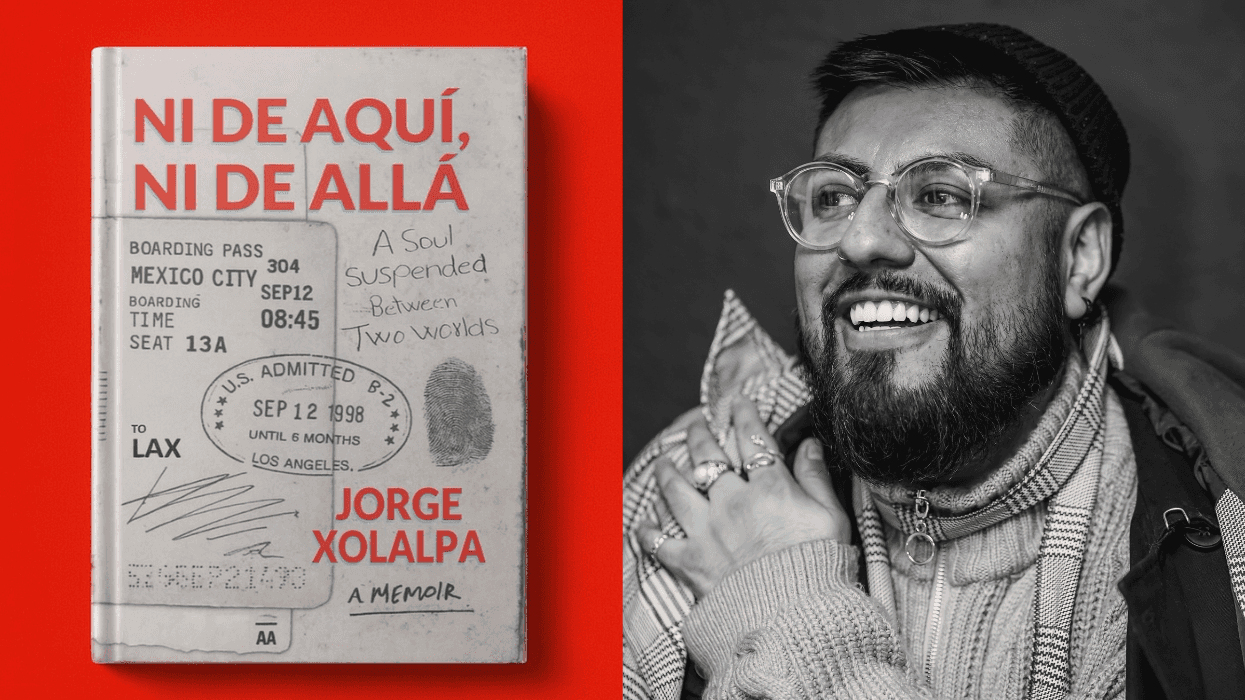

The following is an excerpt from Ni De Aqui, Ni De Alla: A Soul Suspended Between Two Worlds, a new memoir from Out100 honoree Jorge Xolalpa about his journey growing up as an undocumented Mexican immigrant in the United States. Learn more about the book at xolalpa.com.
A message from the author: "This tour has allowed me to sit across from people who were taught to fear everything I represent, gay, undocumented, unapologetically myself and in those moments, we’ve found a shared humanity. It doesn’t erase our differences, but it shows me that connection is still possible, even in the most unexpected places."
____
I still remember the day I came out to my dad with a kind of clarity that lives in your bones, not just your memory. It wasn’t just a day; it was the day. It was December, wrapped in the bittersweet scent of the holidays and the quiet ache of turning another year older. My birthday. A time when everything feels a little rawer, a little more honest, when you're surrounded by the weight of reflection and the hope that maybe, just maybe, you're becoming more of who you’re meant to be. The air was cold, that soft winter kind of cold that lingers on your skin but doesn’t chill your soul, because beneath it all was warmth: the warmth of meaning, of intention, of timing that felt too right to ignore.
The day wasn’t random. I didn’t just blurt it out or stumble into the truth. It had been building, slowly, quietly, inside me for years. Therapy helped me untangle the knots. Time gave me courage. And somewhere along the way, that inner voice, the one I used to bury, grew louder. Steadier. It told me that I didn’t have to hide anymore. That I deserved to be whole in front of the people who claimed to love me. That I was finally ready.
So that day, I took my dad shopping. Just the two of us. I was buying him a belated birthday gift, some new suits for Sunday service, something to add to the rotation of sharp clothes he wore when he stepped up to the pulpit. Because, yes, my dad, the same man who used to come home at 3 a.m., the smell of alcohol clinging to him like regret, the same man who once lived for pride and power, was now a man of God. A pastor. A preacher. A symbol of transformation.
His story had already been rewritten in so many ways. He had gone from a Catholic man married to my mother in a church in Mexico to a Pentecostal Christian, preaching about grace, redemption, and love. Every Sunday, he stood before a congregation and spoke about second chances. About becoming new. About turning away from the darkness and walking toward the light.
And in that moment, standing beside racks of fabric and hangers of pressed suits, I wondered if those words he preached extended to me. If the redemption he believed in could include the parts of me I was about to reveal. If the love he spoke of so often had enough room for the truth of who I was.
So I told him.
Not just because it was time, but because I was ready to stop apologizing for existing. Because I believed that if he could change, then maybe, just maybe, he could love all of me, too.
Our story wasn’t simple. It never followed a straight line. Our relationship wasn’t some tidy narrative of father and child, it was jagged, unpredictable. Volatile. We moved through cycles of silence so loud they echoed, through anger that burned quietly beneath the surface, through distance so wide it sometimes felt permanent. And then came regret, brief flickers of closeness that never lasted long enough to feel real.
Before we came to the U.S., my dad was a different man, or maybe he wasn’t different at all. Maybe he was just better at wearing the mask. In Mexico, he was a man of stature. An executive banker for Banorte, one of the biggest banks in the country. A general manager. A man who walked into a room and knew everyone would take notice. He lived in ambition like it was a second skin, wore pride like a badge, and feared almost nothing. But power has a way of hiding rot, and in hindsight, I see how much was decaying just beneath the surface.
My memories of him during those years are like flashes of light through thick fog, brief, disjointed, haunting. I rarely saw him. He’d stumble home in the early hours of the morning, long after I’d gone to sleep. And by the time I woke up, he was already gone again. His “days off” were built on lies, working Saturdays, business emergencies, client meetings that never existed. The truth was always murky. The only time we really shared space was on Sundays. Our days, supposedly. But even those felt borrowed, like they belonged more to his hangover than to me.
I remember those Sundays so vividly. They were supposed to be simple moments, fly a kite, take me for a bike ride, get tacos to soak up the vodka still in his veins. I was just a kid trying to make memories. But even then, something felt off. They weren’t our days. They were his recovery. I was never the focus. I was the background noise, the afterthought, the accessory to his redemption that never quite arrived.
As a child, I didn’t understand the cracks that ran through my parents’ relationship. I didn’t know about the bruises that bloomed beneath my mother’s clothes, or the invisible wounds he left on her heart. I didn’t know that love could be weaponized, or that silence could be a kind of violence, too.
It wasn’t until we moved to the United States that everything unraveled. That the dam broke. That all the secrets that had been quietly drowning us came rushing in. I was 10 when the truth came flooding out, his affairs, the abuse, the betrayal, the mess of a man who had once seemed untouchable to me. And in that moment, I had to grieve. Not just the image of the father I thought I had, but the very idea of having a father at all. I realized I had spent years chasing the ghost of someone who never truly existed, not for me.
And I was angry. Furious.
Not just at him. But at the version of myself who had once waited at the door, hoping he’d come home in time for dinner. At the kid who thought a bike ride on a Sunday could mean something more than it did. At the little boy who needed his father’s love, even when it was never freely given.
Our move to the United States wasn’t some grand pursuit of the so-called American Dream. It wasn’t full of excitement or promise or even hope. It was escape. A survival move. A desperate step away from the wreckage my father left behind. He had lost everything, his job, his reputation, his marriage, his family. And we, his collateral damage, were left to carry the pieces. So we moved. Undocumented. Uncertain. Already tired.
Jorge Xolalpa is a Mexican American activist, filmmaker, and storyteller known for the groundbreaking series Strangelove and the upcoming immigration thriller Huehxolotl. Learn more about his work and new memoir at xolalpa.com.
Opinion is dedicated to featuring a wide range of inspiring personal stories and impactful opinions from the LGBTQ+ community and its allies. Visit Advocate.com/submit to learn more about submission guidelines. We welcome your thoughts and feedback on any of our stories. Email us at voices@equalpride.com. Views expressed in Voices stories are those of the guest writers, columnists, and editors, and do not directly represent the views of The Advocate or our parent company, equalpride.