'%3E%3Cpath d='M16.3574 35.6519H12.9537L15.0491 18.8873L16.3574 35.6519ZM30.4229 54.0093L22.309 0.994385H7.91795L0 54.0093H10.6634L11.5802 46.3855H17.4014L17.9914 54.0093H30.4229Z' fill='%23971B20'/%3E%3Cpath d='M48.2073 41.8813C48.2073 43.4049 47.4892 44.0011 46.1144 44.0011H43.7595V11.0687H46.1144C47.4892 11.0687 48.2073 11.6636 48.2073 13.1885V41.8813ZM59.5273 43.6695V11.3326C59.5273 3.71323 53.5729 0.994385 47.8157 0.994385H31.7213V54.0093H47.8157C53.5729 54.0093 59.5273 51.29 59.5273 43.6695Z' fill='%23971B20'/%3E%3Cpath d='M90.183 0.994385H78.6039L75.0711 30.6157L71.9955 0.994385H59.4346L69.2474 54.0093H80.373L90.183 0.994385Z' fill='%23971B20'/%3E%3Cpath d='M107.063 42.3448C107.063 43.7359 105.951 44.5974 104.643 44.5974C103.269 44.5974 102.157 43.7359 102.157 42.3448V12.658C102.157 11.2676 103.269 10.4058 104.643 10.4058C105.951 10.4058 107.063 11.2676 107.063 12.658V42.3448ZM119.233 43.2723V11.7312C119.233 6.36384 112.952 -3.8147e-06 104.643 -3.8147e-06C96.2667 -3.8147e-06 89.9867 6.36384 89.9867 11.7312V43.2723C89.9867 48.6393 96.2667 55 104.643 55C112.952 55 119.233 48.6393 119.233 43.2723Z' fill='%23971B20'/%3E%3Cpath d='M150.976 43.9349V33.7309H139.069V42.3448C139.069 43.7359 137.957 44.5974 136.582 44.5974C135.076 44.5974 133.964 43.7359 133.964 42.3448V12.658C133.964 11.2676 135.076 10.4058 136.582 10.4058C137.957 10.4058 139.069 11.2676 139.069 12.658V21.2723H150.976V11.0687C150.976 5.70107 145.283 -3.8147e-06 136.582 -3.8147e-06C127.75 -3.8147e-06 121.796 5.70107 121.796 11.0687V43.9349C121.796 49.3022 127.75 55 136.582 55C145.283 55 150.976 49.3022 150.976 43.9349Z' fill='%23971B20'/%3E%3Cpath d='M167.478 35.6519H164.076L166.17 18.8873L167.478 35.6519ZM181.544 54.0093L173.432 0.994385H159.037L151.123 54.0093H161.785L162.704 46.3855H168.523L169.114 54.0093H181.544Z' fill='%23971B20'/%3E%3Cpath d='M205.412 10.4058V0.994385H177.081V10.4058H185.392V54.0093H197.428V10.4058H205.412Z' fill='%23971B20'/%3E%3Cpath d='M230.002 54.0093V43.9349H218.914V31.8746H226.635V21.8028H218.914V10.4058H230.002V0.994385H206.875V54.0093H230.002Z' fill='%23971B20'/%3E%3C/g%3E%3Cdefs%3E%3CclipPath id='clip0_260_7080'%3E%3Crect width='230' height='55' fill='white'/%3E%3C/clipPath%3E%3C/defs%3E%3C/svg%3E)
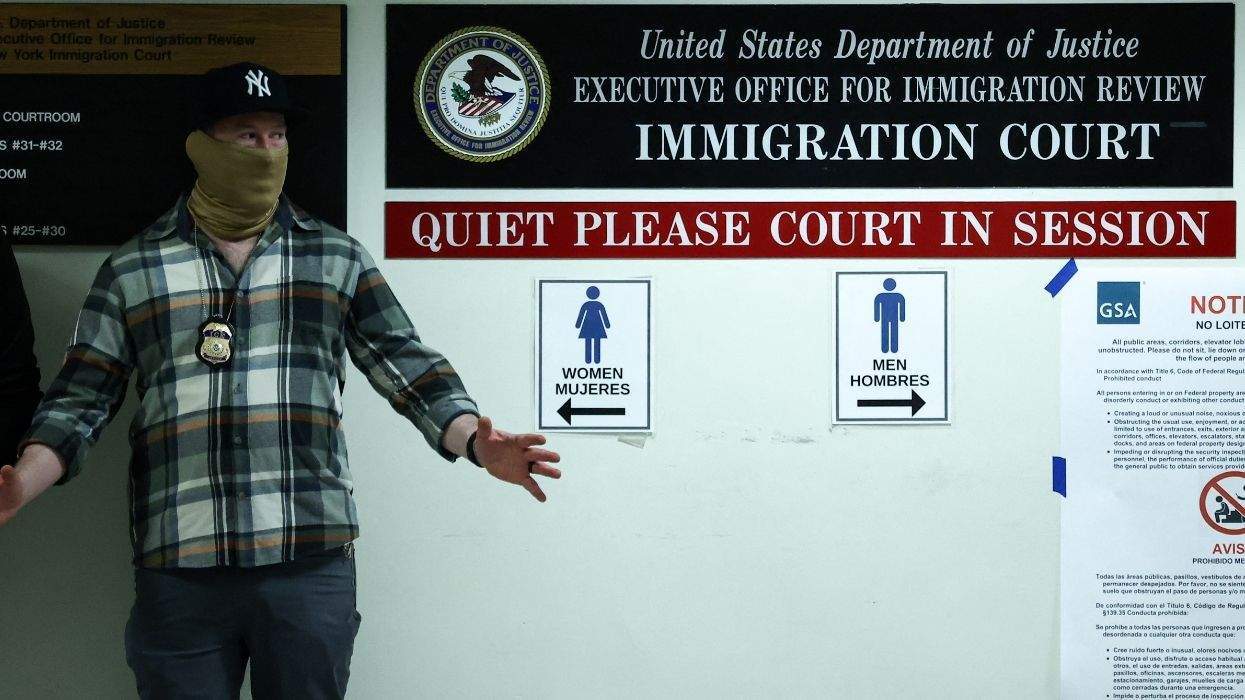
A federal immigration judge in southern New Mexico spent nearly three hours pressing a gay Iranian asylum seeker about his same-sex relationship, a recording obtained by The Advocate shows, alarming his attorney and raising concerns about how LGBTQ+ asylum claims are judged in the Trump administration.
Keep up with the latest in LGBTQ+ news and politics. Sign up for The Advocate's email newsletter.
The man is one of two Iranian asylum seekers in a same-sex relationship who fled their country fearing execution for “homosexual conduct,” which is criminalized in Iran and can be punishable by death. Their attorney, Rebekah Wolf of the American Immigration Council, described their case as a “textbook” asylum claim.
At issue is Immigration Judge Samuel Williams, who presides over cases at the Otero detention court. A late-2024 appointee to the bench, Williams came to immigration court after a career as a prosecutor and military attorney, with no publicly documented prior experience in immigration law.
Both men remain in immigration detention while their cases move forward, protected from immediate deportation after securing stays of removal that allow their appeals to proceed. One obtained a stay from the Board of Immigration Appeals; the other received protection through federal court intervention.
Related: Canada pauses nonbinary American's deportation to U.S., citing Trump's hostile policies
At a spring 2025 hearing, in which the man represented himself before securing legal representation, Williams repeatedly pressed the applicant about details of his personal life.
“And you are currently married. Is that your spouse’s name?" Williams asked about the woman the Iranian married 14 years ago, before turning to his relationship with another man.
“Y’all all sleep in the same room?” he later asked after the applicant described living with both his wife and male partner in Iran.
Williams also pressed the applicant on who, if anyone, knew about his sexual orientation in a line of questioning that advocates say can misunderstand how LGBTQ+ people survive in countries where disclosure can be deadly.
“You never told anybody else that you were gay?” Williams pressed.
Through an interpreter, the man said secrecy was not a choice but a necessity for survival. He testified that only his wife knew about his relationship with another man and that disclosing his sexual orientation more broadly in Iran could have placed him in immediate danger. He described living under constant fear, maintaining a heterosexual marriage as cover while privately navigating a same-sex relationship in a country where discovery could lead to arrest or death. He also told the court he had been detained by Iranian authorities after being discovered with his partner, and described physical abuse and fear of further punishment if he were returned.
Related: Your rights, explained: What to do if you encounter ICE or DHS agents
Related: Massachusetts federal judge orders gay asylum-seeker deported under Trump returned to U.S.
Still, the judge’s questions returned to what could be demonstrated and how clearly it could be articulated.
“These are almost yes or no questions… I just want to know… so I can check the box to say that your case at least smells like it meets the elements for asylum,” Williams said, according to the recording.
After the applicant described detention and abuse, Williams asked, "So, you had no physical injuries?" Advocates say an emphasis on visible injury can narrow how persecution is understood in asylum proceedings, particularly in cases involving psychological harm, coercion, or credible threats of future violence.
Wolf told The Advocate that the exchange reflects what she described as an implicit expectation that applicants prove their sexual orientation in ways that may not account for the risks of disclosure in countries where same-sex relationships are criminalized. She said concerns about credibility have extended beyond this case, with LGBTQ+ asylum seekers at times facing detailed questioning about their identity and experiences that differ in tone or scope from other types of claims.
Wolf pointed to another case involving a South American asylum seeker, in which she said similar dynamics played out. In that case, she said the judge repeatedly questioned the applicant’s account of sexual violence, focusing on perceived inconsistencies and pressing the applicant in ways she described as dismissive, including questioning whether repeated sexual assaults her client described were in fact consensual.
“The language is so atrocious,” Wolf said. “Asking, ‘Every time they hold you down and rape you, are you sure that these aren’t consensual relationships?’"
The scrutiny comes as the administration has increasingly relied on so-called third-country deportations, sending some migrants to countries like Uganda, where they are not citizens and may have no prior ties. The practice has drawn criticism from legal experts and human rights groups, who warn it can place asylum seekers, including LGBTQ+ people, at risk if they are transferred to countries where they could face persecution.
Legal experts say credibility is central to asylum cases but caution that it must be applied carefully, particularly in claims involving sexual orientation.
“It does seem like [judges] are exhibiting some type of bias in these cases," Vanessa Dojaquez-Torres, of the American Immigration Lawyers Association, told The Advocate. She emphasized that such concerns are based on patterns observed by practitioners. She noted that judges are expected to evaluate demeanor, responsiveness, and plausibility, but said misunderstandings about how LGBTQ+ people navigate identity in hostile environments can affect those assessments.
Wolf also pointed to a Moroccan client who speaks a rare regional language and has been detained for more than a year without having his asylum hearing, because the government has been unable to secure a qualified interpreter. She said the court has at times suggested proceeding with an interpreter in another language, while also accusing the client of “pretending” not to understand.
Related: Trump and El Salvador's president attack transgender people during White House meeting
Related: Gay man says ICE is keeping his husband jailed even though they’ve agreed to leave the U.S.
Dojaquez-Torres said such challenges are common in immigration court, including among clients from Mexico who speak Indigenous languages rather than Spanish. In those cases, she said, courts sometimes push applicants to proceed in Spanish even though it is not their primary language.
“The judge might say, ‘We again can’t find the Indigenous interpreter for you, but we have a Spanish interpreter. Do you want to go back to detention for another month or do you want to do your case today in Spanish, a language that might not be your most comfortable language?’” she said. “We find people making a lot of hard decisions like that.”
Immigration judges are employees of the Justice Department, not members of the independent federal judiciary, and avenues for addressing alleged bias are limited, advocates say. Even when decisions are overturned on appeal, cases are often remanded to the same judge for further proceedings.
Those structural limitations are compounded by the broader conditions facing LGBTQ+ migrants in detention. A 2024 report from the advocacy organizations National Immigrant Justice Center, Immigration Equality, and Human Rights First found that LGBTQ+ people in U.S. immigration detention reported high rates of physical and sexual violence, frequent use of solitary confinement, and systemic barriers to medical care.
"Discrimination and abuse against LGBTQIA+ individuals is a frequent occurrence inside detention,” Jeff Migliozzi, of Freedom for Immigrants, told The Advocate. Oversight, he added, has become "virtually nonexistent."
Dojaquez-Torres said incidents of in-detention assault rarely affect asylum outcomes.
"An immigration judge will go, 'That’s very sad. Now let’s get back to your asylum case,'” she said. "And so, unless you are lucky enough to get it reported on by a sheriff who will actually continue to press charges in that case, getting assaulted in the detention center will likely have very little impact on your immigration case."
"It will be of almost no consequence on their immigration case," she added.
The Executive Office for Immigration Review, which oversees immigration courts, declined to comment on the specific allegations. "EOIR does not comment on immigration judge decision-making," spokesperson Kathryn Mattingly told The Advocate, adding that the agency investigates credible complaints but does not publicly disclose outcomes.
The Justice Department did not respond to The Advocate's request for comment.