'%3E%3Cpath d='M16.3574 35.6519H12.9537L15.0491 18.8873L16.3574 35.6519ZM30.4229 54.0093L22.309 0.994385H7.91795L0 54.0093H10.6634L11.5802 46.3855H17.4014L17.9914 54.0093H30.4229Z' fill='%23971B20'/%3E%3Cpath d='M48.2073 41.8813C48.2073 43.4049 47.4892 44.0011 46.1144 44.0011H43.7595V11.0687H46.1144C47.4892 11.0687 48.2073 11.6636 48.2073 13.1885V41.8813ZM59.5273 43.6695V11.3326C59.5273 3.71323 53.5729 0.994385 47.8157 0.994385H31.7213V54.0093H47.8157C53.5729 54.0093 59.5273 51.29 59.5273 43.6695Z' fill='%23971B20'/%3E%3Cpath d='M90.183 0.994385H78.6039L75.0711 30.6157L71.9955 0.994385H59.4346L69.2474 54.0093H80.373L90.183 0.994385Z' fill='%23971B20'/%3E%3Cpath d='M107.063 42.3448C107.063 43.7359 105.951 44.5974 104.643 44.5974C103.269 44.5974 102.157 43.7359 102.157 42.3448V12.658C102.157 11.2676 103.269 10.4058 104.643 10.4058C105.951 10.4058 107.063 11.2676 107.063 12.658V42.3448ZM119.233 43.2723V11.7312C119.233 6.36384 112.952 -3.8147e-06 104.643 -3.8147e-06C96.2667 -3.8147e-06 89.9867 6.36384 89.9867 11.7312V43.2723C89.9867 48.6393 96.2667 55 104.643 55C112.952 55 119.233 48.6393 119.233 43.2723Z' fill='%23971B20'/%3E%3Cpath d='M150.976 43.9349V33.7309H139.069V42.3448C139.069 43.7359 137.957 44.5974 136.582 44.5974C135.076 44.5974 133.964 43.7359 133.964 42.3448V12.658C133.964 11.2676 135.076 10.4058 136.582 10.4058C137.957 10.4058 139.069 11.2676 139.069 12.658V21.2723H150.976V11.0687C150.976 5.70107 145.283 -3.8147e-06 136.582 -3.8147e-06C127.75 -3.8147e-06 121.796 5.70107 121.796 11.0687V43.9349C121.796 49.3022 127.75 55 136.582 55C145.283 55 150.976 49.3022 150.976 43.9349Z' fill='%23971B20'/%3E%3Cpath d='M167.478 35.6519H164.076L166.17 18.8873L167.478 35.6519ZM181.544 54.0093L173.432 0.994385H159.037L151.123 54.0093H161.785L162.704 46.3855H168.523L169.114 54.0093H181.544Z' fill='%23971B20'/%3E%3Cpath d='M205.412 10.4058V0.994385H177.081V10.4058H185.392V54.0093H197.428V10.4058H205.412Z' fill='%23971B20'/%3E%3Cpath d='M230.002 54.0093V43.9349H218.914V31.8746H226.635V21.8028H218.914V10.4058H230.002V0.994385H206.875V54.0093H230.002Z' fill='%23971B20'/%3E%3C/g%3E%3Cdefs%3E%3CclipPath id='clip0_260_7080'%3E%3Crect width='230' height='55' fill='white'/%3E%3C/clipPath%3E%3C/defs%3E%3C/svg%3E)

Another day, another think piece by a gay man distancing himself from queerness. If it feels like we were just here, it's because we were.
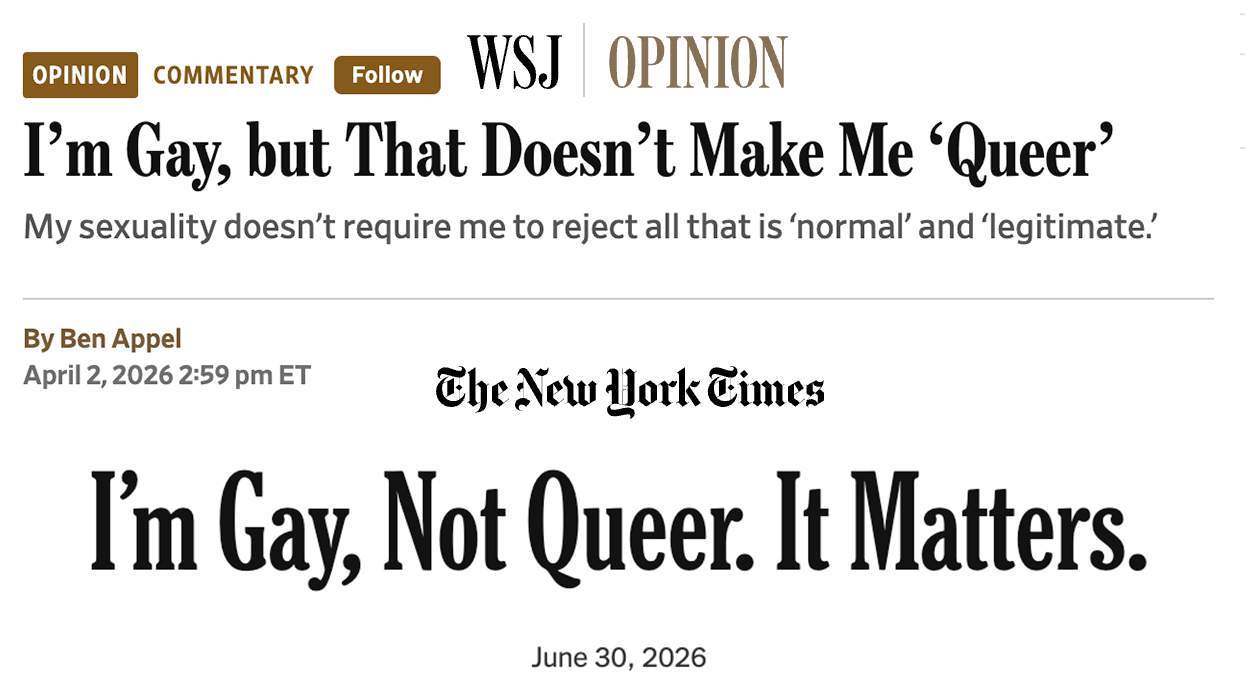
Three months after The Wall Street Journal published an essay arguing, "I'm Gay, but That Doesn't Make Me 'Queer,'" The New York Times has now published a remarkably familiar variation: "I'm Gay, Not Queer. It Matters."
The arguments take different paths to arrive at the exact same destination. In WSJ, Ben Appel warns readers about queer theory and academic radicalism. In NYT, Matthew Vines argues that the language of queerness is undermining public support for marriage equality. One frames queerness as ideological excess while the other recasts it as a political liability. But both ultimately deliver the exact same message: Gay is respectable, queer is the problem.
Within months of one another, The Wall Street Journal and The New York Times have each devoted coveted opinion space to essays urging readers to separate "gay" from "queer."
Taken together, they don't simply reflect a debate inside the LGBTQ+ community. They elevate a familiar respectability narrative that distills queer life into something cleaner, safer, and more acceptable to the mainstream while treating everything outside that frame as an embarrassment to be quietly pushed back into the closets and shadows.
These editorial choices deserve scrutiny. After years of criticism over whose voices these institutions elevate on LGBTQ+ issues, including widespread backlash over The New York Times' coverage of transgender people, both papers have now amplified different versions of the same argument: that queerness itself has become the problem. At a moment when LGBTQ+ rights are under coordinated political attack, it is remarkable that two of America's largest newspapers have chosen to devote their platforms not to confronting that assault, but to publishing essays that ask gay people to distance themselves from the broader community that fought to make their acceptance possible.
But really, why are America's most influential newspapers suddenly so interested in convincing gay people to distance themselves from queerness?
It's worth considering the moment in which these essays appear. Republicans are openly discussing overturning marriage equality. State legislatures continue introducing hundreds of anti-LGBTQ+ bills each year. Transgender Americans have become the centerpiece of a coordinated political campaign built on fear and scapegoating, while Pride celebrations, school libraries, classrooms, and even corporate support for LGBTQ+ communities have become recurring fronts in the same manufactured culture war. Questions that should have been relegated to history, including where it is safe to live openly, whether our marriages will remain protected, and whether our children will enjoy the same rights we fought to secure, have become part of everyday conversation again. That is the backdrop against which two of America's most influential newspapers have decided the pressing question of the day is whether gay people should stop calling themselves queer.
Neither of these essays is really about language. They are about respectability, reviving one of the oldest bargains in modern queer politics: acceptance in exchange for distance. They suggest we can have our rights so long as we reassure the broader public that we are not too political, too gender-nonconforming, too disruptive, too trans, too angry, too difficult, too visible, too queer. Every generation seems to produce a new version of the "good gay": the one who is safe, usually white, comfortably masculine, eager to assure straight America that he wants the same things everyone else wants and that he is nothing like those other queer people making everyone so uncomfortable.
We've watched this pattern repeat itself for decades. Gay organizations distanced themselves from drag queens because they were considered too embarrassing for the movement. White-led organizations sidelined Black queer activists whose struggles complicated a cleaner public narrative. Transgender people were told, explicitly and implicitly, that their visibility threatened everyone else's acceptance and that their liberation could wait until a more politically convenient moment. The names and targets change, but the promise never does. If we simply push those deemed the least respectable to the edge of the movement, perhaps the rest of us will finally be allowed to belong. History has never been especially kind to that strategy, because respectability politics offers a promise it cannot keep. It imagines acceptance as something earned through conformity, when conformity only invites an ever narrower definition of what is considered acceptable.
What makes both essays especially weird is how completely they ignore the reality outside the opinion page. The people leading today's attacks on LGBTQ+ rights are not making careful distinctions between gay and queer. To them, the difference is largely meaningless. They are targeting our books, our families, our schools, our health care, and increasingly our legal rights with little concern for where one identity ends and another begins. The distinction between "gay" and "queer" exists almost entirely for our own internal consumption, encouraging us to debate one another while others debate whether any of us deserve equality at all.
Opinion editors make choices every day about which arguments deserve national attention and which voices will help shape public understanding. It is difficult to ignore that, at a moment defined by escalating attacks on LGBTQ+ people, two of America's largest newspapers have chosen to elevate different versions of the exact same argument: that perhaps the real problem lies somewhere under our own umbrella.
No one is asking these men to identify as queer. But there is an enormous difference between explaining your own relationship to a word and using one of the world's most influential opinion platforms to suggest that queerness itself has become a political liability. Queerness was never simply another synonym for gay. It became a home for people whose lives resisted easy categorization, whose identities complicated inherited assumptions, and whose existence rarely fit comfortably inside institutions that preferred cleaner stories. Its expansiveness has always unsettled people because it refuses the tidy boundaries that respectability politics depends upon.
That is what stinks most about this sudden editorial trend. At a time when LGBTQ+ communities are facing some of the most coordinated political attacks in a generation, America's largest newspapers seem increasingly interested in publishing essays that ask us to make ourselves smaller. That reality tells us considerably more about the editorial priorities of those institutions than it does about queer people.
Josh Ackley is a political strategist and the frontman of the queerpunk band The Dead Betties. @momdarkness
Opinion is dedicated to featuring a wide range of inspiring personal stories and impactful opinions from the LGBTQ+ community and its allies. Visit Advocate.com/submit to learn more about submission guidelines. We welcome your thoughts and feedback on any of our stories. Email us at voices@equalpride.com. Views expressed in Voices stories are those of the guest writers, columnists, and editors, and do not directly represent the views of The Advocate or our parent company, equalpride.