'%3E%3Cpath d='M16.3574 35.6519H12.9537L15.0491 18.8873L16.3574 35.6519ZM30.4229 54.0093L22.309 0.994385H7.91795L0 54.0093H10.6634L11.5802 46.3855H17.4014L17.9914 54.0093H30.4229Z' fill='%23971B20'/%3E%3Cpath d='M48.2073 41.8813C48.2073 43.4049 47.4892 44.0011 46.1144 44.0011H43.7595V11.0687H46.1144C47.4892 11.0687 48.2073 11.6636 48.2073 13.1885V41.8813ZM59.5273 43.6695V11.3326C59.5273 3.71323 53.5729 0.994385 47.8157 0.994385H31.7213V54.0093H47.8157C53.5729 54.0093 59.5273 51.29 59.5273 43.6695Z' fill='%23971B20'/%3E%3Cpath d='M90.183 0.994385H78.6039L75.0711 30.6157L71.9955 0.994385H59.4346L69.2474 54.0093H80.373L90.183 0.994385Z' fill='%23971B20'/%3E%3Cpath d='M107.063 42.3448C107.063 43.7359 105.951 44.5974 104.643 44.5974C103.269 44.5974 102.157 43.7359 102.157 42.3448V12.658C102.157 11.2676 103.269 10.4058 104.643 10.4058C105.951 10.4058 107.063 11.2676 107.063 12.658V42.3448ZM119.233 43.2723V11.7312C119.233 6.36384 112.952 -3.8147e-06 104.643 -3.8147e-06C96.2667 -3.8147e-06 89.9867 6.36384 89.9867 11.7312V43.2723C89.9867 48.6393 96.2667 55 104.643 55C112.952 55 119.233 48.6393 119.233 43.2723Z' fill='%23971B20'/%3E%3Cpath d='M150.976 43.9349V33.7309H139.069V42.3448C139.069 43.7359 137.957 44.5974 136.582 44.5974C135.076 44.5974 133.964 43.7359 133.964 42.3448V12.658C133.964 11.2676 135.076 10.4058 136.582 10.4058C137.957 10.4058 139.069 11.2676 139.069 12.658V21.2723H150.976V11.0687C150.976 5.70107 145.283 -3.8147e-06 136.582 -3.8147e-06C127.75 -3.8147e-06 121.796 5.70107 121.796 11.0687V43.9349C121.796 49.3022 127.75 55 136.582 55C145.283 55 150.976 49.3022 150.976 43.9349Z' fill='%23971B20'/%3E%3Cpath d='M167.478 35.6519H164.076L166.17 18.8873L167.478 35.6519ZM181.544 54.0093L173.432 0.994385H159.037L151.123 54.0093H161.785L162.704 46.3855H168.523L169.114 54.0093H181.544Z' fill='%23971B20'/%3E%3Cpath d='M205.412 10.4058V0.994385H177.081V10.4058H185.392V54.0093H197.428V10.4058H205.412Z' fill='%23971B20'/%3E%3Cpath d='M230.002 54.0093V43.9349H218.914V31.8746H226.635V21.8028H218.914V10.4058H230.002V0.994385H206.875V54.0093H230.002Z' fill='%23971B20'/%3E%3C/g%3E%3Cdefs%3E%3CclipPath id='clip0_260_7080'%3E%3Crect width='230' height='55' fill='white'/%3E%3C/clipPath%3E%3C/defs%3E%3C/svg%3E)
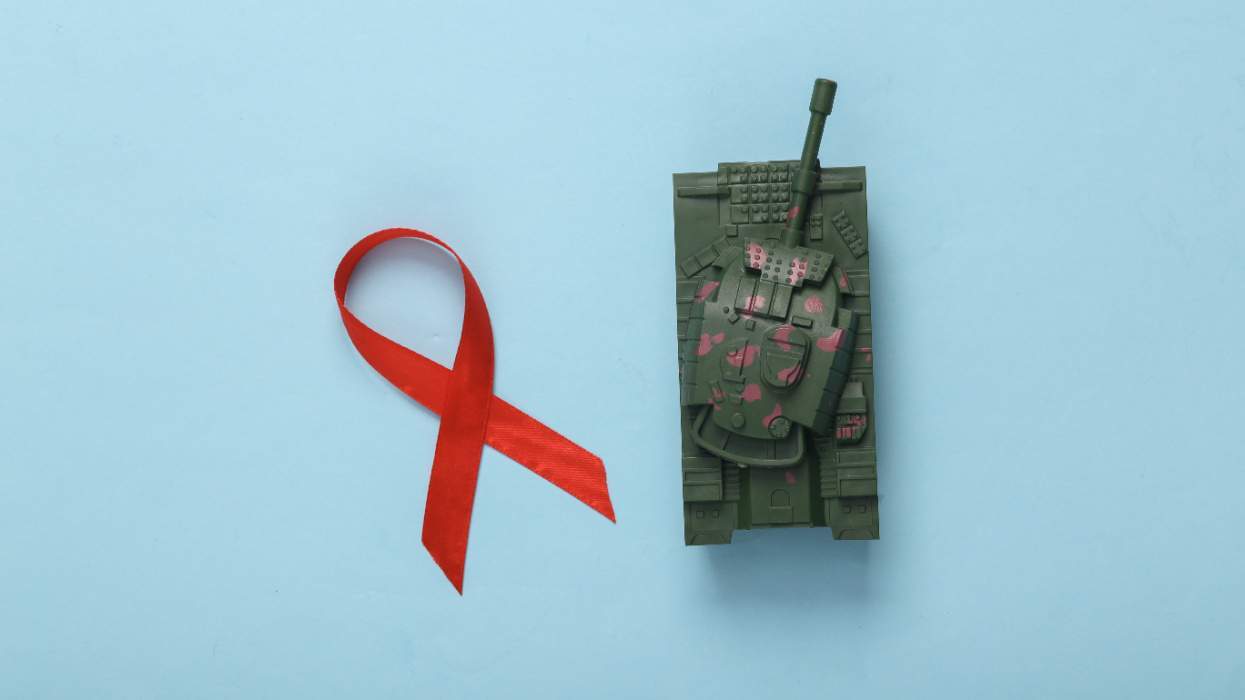

The Trump administration's fight to prevent HIV-positive people from enlisting in the military will soon be settled, but not before upending the lives of those who want nothing more than to serve.
The Department of Defense has ordered officials not to train new recruits who are HIV-positive, according to guidance sent by the U.S. Military Entrance Processing Command and obtained by CNN. The order, sent January 16, states "we are pausing shipping any HIV+ applicants and will follow-up in the coming weeks," pending a ruling from an appeals court.
Related: Pete Hegseth really doesn’t like LGBTQ+ people in the military
"As someone who was illegally kicked out of the Peace Corps for testing positive for HIV in 2008, I can tell you that it is extremely demoralizing to be told by your government that you're not fit for service for a condition that can be easily and completely managed with one pill a day," Jeremiah Johnson, cofounder of the HIV Funding Campaign and executive director of PrEP4All, tells The Advocate. "These unscientific policies on HIV also have a tendency to be contagious across government, leading to other discriminatory hiring policies, and influencing recent efforts to defund critical HIV treatment, care, and prevention services."
Courts had previously ruled in Harrison v. Austin and Roe & Voe v. Austin that the military policy preventing the commissioning and retention of HIV-positive troops with undetectable viral loads who face no health limitations and pose no risk of transmission is unconstitutional. This prompted the Biden administration to announce in July 2022 that it would no longer defend the restrictions, which Defense Secretary Lloyd Austin did not appeal, instead ordering all military branches to change their regulations. However, his order did not change the barrier to enlistment.
Several HIV-positive enlistees who are asymptomatic and undetectable, represented by Lambda Legal, then filed a lawsuit againt the rule in November 2022: Isaiah Wilkins, a Black gay man who wishes to join the Army; Carol Coe, a transgender Latina lesbian, identified by a pseudonym, who wants to reenlist after having been discharged; and Natalie Noe, also identified by a pseudonym, a straight woman who wishes to enlist.
A federal district judge ruled in their favor and struck down the ban in August 2024. The case, Wilkins v. Austin, determined that the policy violates the Fifth Amendment’s equal protection clause and the Administrative Procedure Act, as it adds "to the ongoing stigma surrounding HIV-positive individuals while actively hampering the military’s own recruitment goals."
Trump's DOD has appealed the case to the U.S. Court of Appeals for the Fourth Circuit in Richmond, Virginia, which is expected to issue a ruling in the coming weeks. Greg Nevins, senior counsel at Lambda Legal, says that as the court has "approved an injunction we got in the earlier case and made many rulings favorable to us ... the same court should not and probably will not contradict."
"It should be unlawful, and it has been held to be unlawful in every ruling so far," Nevins says. "Specifically, the military's HIV ban was held to be irrational, discriminatory, arbitrary, and capricious regarding asymptomatic individuals living with HIV with an undetectable viral load."
Until the court issues its ruling, those who were recently recruited are in limbo. Reggie Dunbar II, founder and CEO of Poz Military & Veterans USA INTL who himself is a veteran, says that the policy has created a state of confusion throughout the ranks.
Many enlistees have been suddenly iced out with no communication from the Pentagon, such as one friend of Dunbar's whose deployment date was pushed back to October without explanation or warning, leaving him in a "strange mental place." Those he knows currently living with HIV and serving are keeping their status to themselves "almost like they're in a little hush-hush group."
"It is very disheartening and very discouraging in a way because it takes me personally back to days of ACT UP," Dunbar says. "It may be that we have to use some of the same tactics that we did back in the '80s for things to get noticed. Because a lot of times, HIV, a person's sexual orientation, are things that get swept under the rug."
Meanwhile, a federal appeals court in December temporarily upheld the Trump administration's ban on trans people serving in the military by preventing a nationwide injunction from going into effect while a lawsuit against the policy moves forward. Those currently serving have been forced into retirement.
Advocates worry that the ban on HIV-positive enlistees could strengthen the case against trans troops or provide a legal pathway to ban HIV-positive service members altogether. While the return of "don't ask, don't tell" isn't likely, Dunbar notes "anything can happen" under Trump.
"My grandmother used to say something back in the day about a backdoor way to get to the front," Dunbar says. "I think trying to keep people enlisting out that are living with HIV is a backdoor way to get to the front of possibly putting out people that are living with HIV that are still active duty, as well as transgender members."