'%3E%3Cpath d='M16.3574 35.6519H12.9537L15.0491 18.8873L16.3574 35.6519ZM30.4229 54.0093L22.309 0.994385H7.91795L0 54.0093H10.6634L11.5802 46.3855H17.4014L17.9914 54.0093H30.4229Z' fill='%23971B20'/%3E%3Cpath d='M48.2073 41.8813C48.2073 43.4049 47.4892 44.0011 46.1144 44.0011H43.7595V11.0687H46.1144C47.4892 11.0687 48.2073 11.6636 48.2073 13.1885V41.8813ZM59.5273 43.6695V11.3326C59.5273 3.71323 53.5729 0.994385 47.8157 0.994385H31.7213V54.0093H47.8157C53.5729 54.0093 59.5273 51.29 59.5273 43.6695Z' fill='%23971B20'/%3E%3Cpath d='M90.183 0.994385H78.6039L75.0711 30.6157L71.9955 0.994385H59.4346L69.2474 54.0093H80.373L90.183 0.994385Z' fill='%23971B20'/%3E%3Cpath d='M107.063 42.3448C107.063 43.7359 105.951 44.5974 104.643 44.5974C103.269 44.5974 102.157 43.7359 102.157 42.3448V12.658C102.157 11.2676 103.269 10.4058 104.643 10.4058C105.951 10.4058 107.063 11.2676 107.063 12.658V42.3448ZM119.233 43.2723V11.7312C119.233 6.36384 112.952 -3.8147e-06 104.643 -3.8147e-06C96.2667 -3.8147e-06 89.9867 6.36384 89.9867 11.7312V43.2723C89.9867 48.6393 96.2667 55 104.643 55C112.952 55 119.233 48.6393 119.233 43.2723Z' fill='%23971B20'/%3E%3Cpath d='M150.976 43.9349V33.7309H139.069V42.3448C139.069 43.7359 137.957 44.5974 136.582 44.5974C135.076 44.5974 133.964 43.7359 133.964 42.3448V12.658C133.964 11.2676 135.076 10.4058 136.582 10.4058C137.957 10.4058 139.069 11.2676 139.069 12.658V21.2723H150.976V11.0687C150.976 5.70107 145.283 -3.8147e-06 136.582 -3.8147e-06C127.75 -3.8147e-06 121.796 5.70107 121.796 11.0687V43.9349C121.796 49.3022 127.75 55 136.582 55C145.283 55 150.976 49.3022 150.976 43.9349Z' fill='%23971B20'/%3E%3Cpath d='M167.478 35.6519H164.076L166.17 18.8873L167.478 35.6519ZM181.544 54.0093L173.432 0.994385H159.037L151.123 54.0093H161.785L162.704 46.3855H168.523L169.114 54.0093H181.544Z' fill='%23971B20'/%3E%3Cpath d='M205.412 10.4058V0.994385H177.081V10.4058H185.392V54.0093H197.428V10.4058H205.412Z' fill='%23971B20'/%3E%3Cpath d='M230.002 54.0093V43.9349H218.914V31.8746H226.635V21.8028H218.914V10.4058H230.002V0.994385H206.875V54.0093H230.002Z' fill='%23971B20'/%3E%3C/g%3E%3Cdefs%3E%3CclipPath id='clip0_260_7080'%3E%3Crect width='230' height='55' fill='white'/%3E%3C/clipPath%3E%3C/defs%3E%3C/svg%3E)


If there’s a glass ceiling for gay people in the tech industry, Sam Altman has said he doesn’t like to think about it. The out OpenAI CEO said in a 2019 “Tech Pride” interview hosted by Lexus that he avoided thinking about his sexual orientation as a barrier to his profession.
“I was going to make every career decision as if there weren’t,” Altman said.
For many, Altman’s sexuality can come as a surprise, unless they saw his leaked wedding photos in 2024 or were longtime readers of his blog. He rarely comments about his sexuality, including talking about his husband — whom Altman didn’t mention when he announced the birth of their first child.
In a 2024 interview with The Advocate, Altman said he didn’t really think about being a gay CEO. Today, Altman is a household name, his net worth is nearing $2 billion, according to Forbes, and ChatGPT is one of the most notable tech products of the past five years. Depending on who you ask, that product might be reinventing or destroying society as we know it.
Altman has quietly become a gay tech titan, part of a tiny club that didn’t openly exist at the turn of the century. Its members are inspirational to some people by that virtue. But measuring their actual impact on other LGBTQ+ people shows a less rosy picture. Their tech companies have been known to wreak havoc in the lives of marginalized people. They have enriched themselves by aligning with Donald Trump and the far right. And even when it comes to other gay people in tech, they’ve modeled privacy over pride.
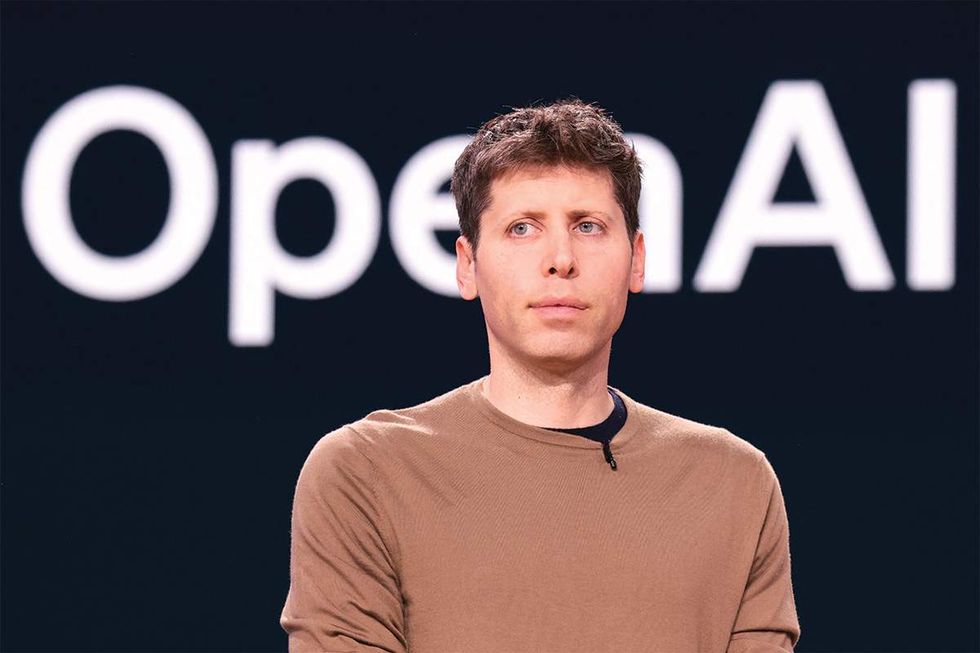 OpenAI CEO Sam AltmanJason Redmond/AFP via Getty Images
Retreating from LGBTQ+ representation
Riana Lynn hasn’t been on the cover of Time magazine like Altman has, but she boasts an impressive résumé as a “serial entrepreneur.” Currently, she’s the CEO of Journey Foods, an AI service for food and beverage businesses. She’s worked in roles at the White House under Barack Obama’s administration, at Google, and in venture capital. She’s also Black and queer. There are some times when she’s more vocal about that and other times when she’s less so.
“I don’t always like to lead with my identity, being a woman or being Black or being LGBTQ, because my focus is on living a very joyful life but also building a global company that scales,” Lynn says. “Sometimes it goes into the search algorithm, and people forget that you built a very great company or that you’re an AI leader.”
Altman has indirectly contributed to Journey Foods through an investment fund he supported, Lynn says. Sometimes she forgets he’s gay and that she’s “not alone in this.” At times in her career, Lynn has felt like she should hide a part of herself, like introducing a romantic partner as a colleague during a Zoom call. Other times, her identity feels like the “easy angle” for publicity, instead of her work to innovate supply chains.
“As I’ve pushed through that and proven myself more and made more money and gotten more investments and global partners, I’ve been able to find a better home in that true identity,” she says. But Lynn has also noticed another shift happening. She started her career before same-sex marriage was legalized, watching as more stars and CEOs came out as gay. Now, on the brink of a financial crisis and after tens of thousands of jobs were cut due to AI, some of Lynn’s peers are intentionally staying closeted.
 Apple CEO Tim CookJason Armond/Los Angeles Times via Getty Images
“People are like ‘We’re about to head into a recession, I can’t even talk about being gay,’” Lynn says with a dry laugh. “It’s almost like it’s been good momentum, and then in the past year, people are like ‘Let me just put all my different identities to the side and just focus on money.’”
It’s not just bleak economic prospects coaxing LGBTQ+ people to stay hidden or try to mitigate the risk of losing out on opportunities. It’s also the violent conservative backlash to the previous decade of queer and trans movements. Altman and his peers are the most insulated from the fallout, and they haven’t worked to shield their community. Instead, they’ve helped build the infrastructure for their oppression.
Conservative politics and proclivities
Altman first met his husband late at night in a hot tub belonging to venture capitalist Peter Thiel, according to Keach Hagey, Altman’s biographer. After cofounding surveillance tech company Palantir and online payments service PayPal, Thiel became the first outside investor in Facebook. He later mentored and supported Altman and OpenAI. In 2007, the news outlet Gawker published a piece about how nobody publicly acknowledged that Thiel was gay, likely because of homophobia in the VC world. Years later, Thiel funded unrelated lawsuits against Gawker that ultimately sank the company. He spoke out against the 2007 article about his sexuality as an invasion of privacy. Then he started supporting Donald Trump.
The backsliding for LGBTQ+ rights over the past decade coincides exactly with when Thiel, who is the richest out gay man on Earth, with an estimated net worth of over $25 billion, joined ranks with other billionaires to support far-right politicians around the world. As Thiel accumulated wealth and power, the gap between him and everyday queer and trans people has only grown.
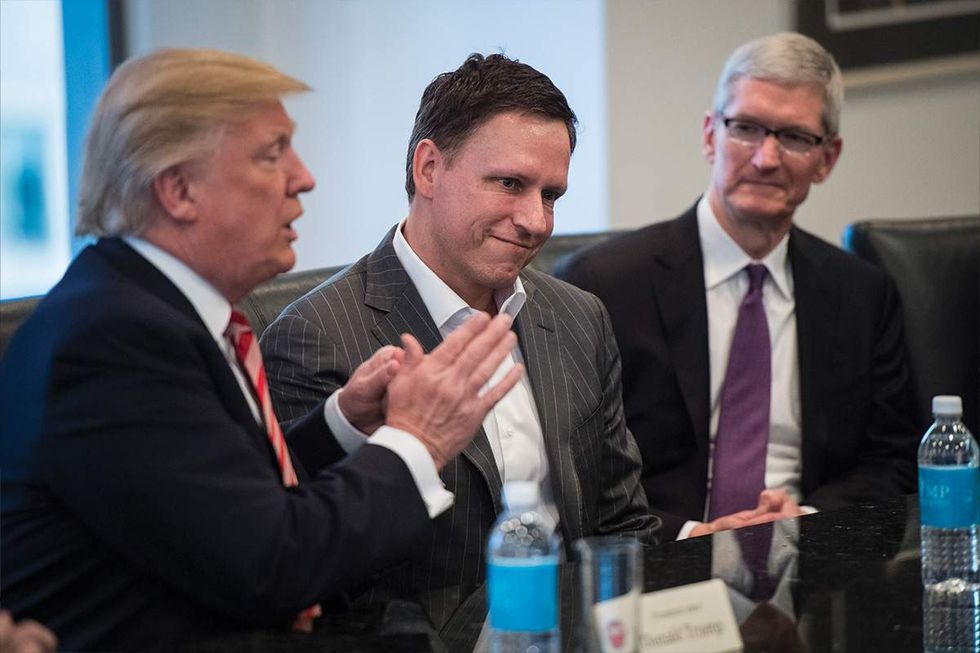 Donald Trump meeting with Peter Thiel and Tim CookJabin Botsford/The Washington Post via Getty Images
“That gap could not be wider,” says Evan Greer, the director of digital rights nonprofit Fight for the Future. There have always been wealthy members of the queer community who maintained it as a private lifestyle while making the world less safe for LGBTQ+ people as a whole, she says: “They’re pulling the ladder up behind them in a lot of ways.”
Thiel’s Palantir has contracts with Trump’s administration for hundreds of millions of dollars of data analysis and surveillance services, including technologies created for Immigration and Customs Enforcement to track and deport people. Altman’s OpenAI has also developed OpenAI for Government and won equally massive contracts to equip the Department of Defense with ChatGPT. At the same time, Altman has started declaring himself “politically homeless.”
“It’s not an exaggeration to say that the techno-enabled fascism that we are looking at right now is the biggest threat that LGBTQ people have faced in decades,” Greer says. “At a time when homosexuality was still criminalized in most states in the U.S., if the U.S. government had access to surveillance technology like what Palantir is currently providing to ICE and to other law enforcement agencies, it’s not hard to imagine that the modern LGBTQ rights movement might never have formed.”
Altman attended Trump’s second inauguration with a cadre of other tech billionaires, including Apple CEO Tim Cook, who in 2014 became the first head of a Fortune 500 company to come out as gay. Cook previously spoke out against Trump’s stance on immigration and was once even considered a potential candidate for vice president by Hillary Clinton’s campaign. But during Trump’s second term, Cook has bent over backwards to appease him. He brought a 24- karat gold plaque to the Oval Office and attended a White House screening of the Melania documentary hours after Minnesotan Alex Pretti was shot and killed by Border Patrol agents, sowing furor among Apple employees.
Neither Altman, Cook, nor Thiel responded to requests for comment for this story.
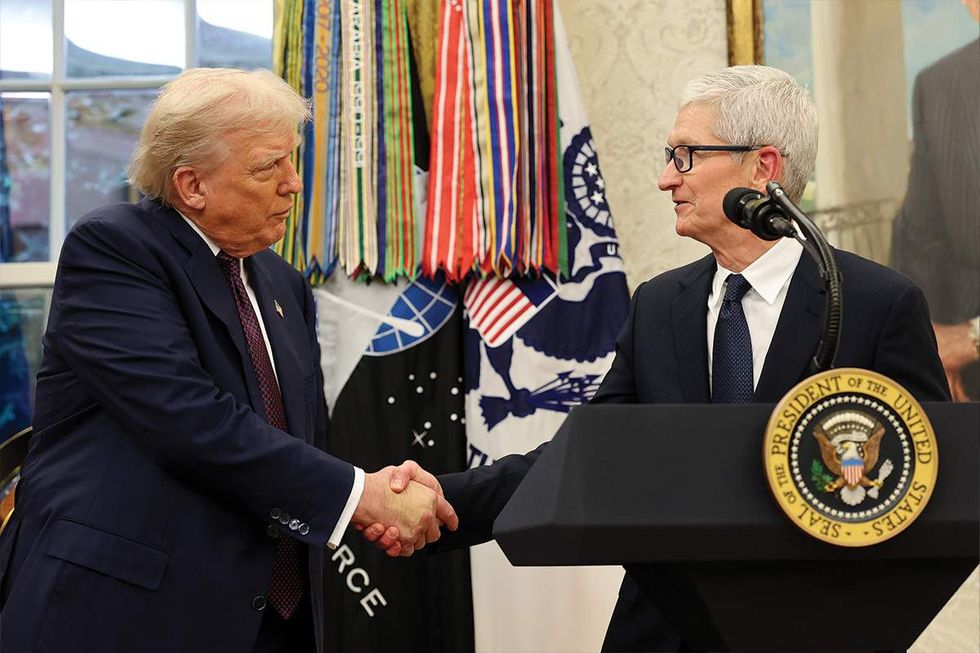 Trump and Cook shake hands at a White House eventWin McNamee/Getty Images
For Thiel and Altman, the controversies around them extend beyond their politics. In addition to being an early Trump backer in the lead-up to the 2016 election, Thiel’s name also appeared thousands of times in the Epstein files released by the Department of Justice in recent months. Thiel’s correspondence with deceased sex trafficker Jeffrey Epstein continued after Epstein pleaded guilty to sex crimes involving minors in 2008. In 2016 emails, Epstein told Thiel that Brexit was “just the beginning” of an impending global “collapse.”
And last year, Altman’s younger sister, Annie, filed a lawsuit against him in Missouri, where they grew up. In the suit, she accused him of childhood sexual assault and battery spanning nine years. Over the years, she has also accused him and their mother of withholding Annie’s funds from a trust set up by their father before he died in 2018. Altman, his mother, and his brothers released a joint statement denying that he sexually abused Annie, and Altman sued Annie for defamation.
Adverse impacts downstream
In the tech industry where Altman, Thiel, and Cook loom large, researchers have found growing systemic harms against women and LGBTQ+ people, both inside companies and because of the products and services they offer. A study released last July by the Business and Human Rights Resource Centre found more than 200 allegations of gender-based harm against big tech companies, including fueling hate speech, sexual violence, discriminatory hiring practices, and threats to freedom of expression. Most of the companies, including Cook’s Apple, didn’t even respond when the group reached out for comment.
“I think that the historic lack of attention is not too different from what we see in other aspects of society, where women’s needs are getting less attention in pharmaceuticals [and] vaccines for the queer community are not prioritized,” says Meredith Veit, a technology and human rights researcher who worked on the report. “It’s this vicious cycle where the law is not neutral, state governance is not neutral, tech is not neutral, and we need to break this cycle of negligence.”
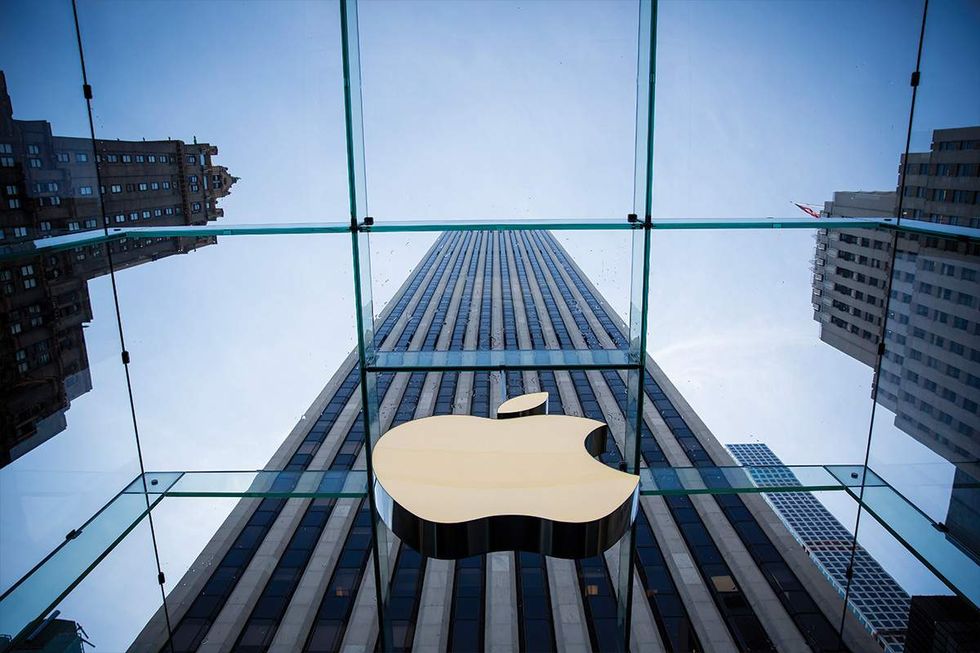 Apple store in New York CityEric Thayer/Getty Images
In 2019, a survey of more than 7,000 Silicon Valley workers found that almost 40 percent of LGBTQ+ tech employees had witnessed homophobic behavior at work. This is despite California’s laws against workplace discrimination based on sexual orientation and gender identity. Apple was ranked as the third worst in a portion of the survey that asked if the company felt like a safe space, with PayPal not far behind.
When Altman spoke to The Advocate in 2024, he said he was proud of the progress LGBTQ+ people had made and that he hoped queer people wouldn’t have a reason not to work in the tech industry. Years before that, he shared that the internet was formative for him and other LGBTQ+ people. But he also said being queer should be a “nonfactor,” which it mainly is — for him.
Other, more visibly queer people don’t have that option. Brian Richardson, the CEO of StartOut, a nonprofit for empowering LGBTQ+ entrepreneurs, says queer founders are still struggling to make inroads in the same industry.
“Being queer brings added value to any entrepreneur or businessperson, because we learned from an early age to be resilient and persistent and malleable and creative, all of which are characteristics that are necessary to succeed in business,” Richardson says. “And as a community, queer people have to support each other, whether it is in protest for our basic human rights or in the boardroom making hiring decisions. Because no one else will stand up for us.”
Richardson knows Lynn through StartOut, where she’s on the board of directors. They both say one of the biggest challenges their LGBTQ+ founders face now is securing venture capital funding. Ironically, this was one of the same issues highlighted by Gawker in its article about Thiel’s covert sexuality nearly 20 years ago. Venture capitalists were unlikely to fund out gay and lesbian entrepreneurs, there were few if any out gay VCs, and straight, white, and male VCs “instinctively prefer entrepreneurs who remind them of themselves,” the piece said.
“There’s still a tremendous gap between LGBTQ entrepreneurs and non-LGBTQ entrepreneurs,” Lynn says. “I wish some of the billionaire LGBTQ leaders would funnel them tens of millions.”
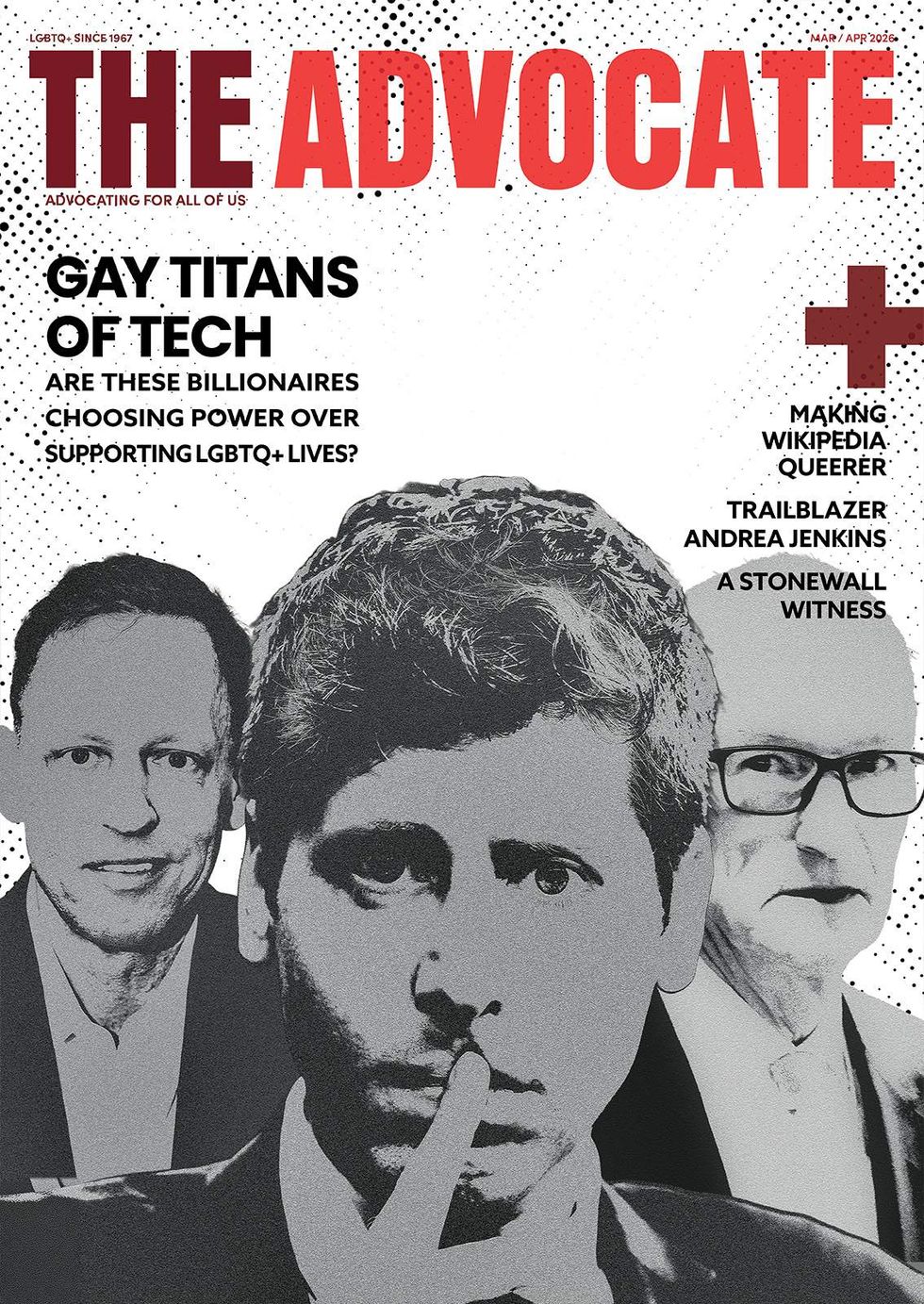
This article is part of The Advocate’s Mar-Apr 2026 print issue, which hits newsstands March 24. Support queer media and subscribe — or download the issue through Apple News+, Zinio, Nook, or PressReader starting March16.