'%3E%3Cpath d='M16.3574 35.6519H12.9537L15.0491 18.8873L16.3574 35.6519ZM30.4229 54.0093L22.309 0.994385H7.91795L0 54.0093H10.6634L11.5802 46.3855H17.4014L17.9914 54.0093H30.4229Z' fill='%23971B20'/%3E%3Cpath d='M48.2073 41.8813C48.2073 43.4049 47.4892 44.0011 46.1144 44.0011H43.7595V11.0687H46.1144C47.4892 11.0687 48.2073 11.6636 48.2073 13.1885V41.8813ZM59.5273 43.6695V11.3326C59.5273 3.71323 53.5729 0.994385 47.8157 0.994385H31.7213V54.0093H47.8157C53.5729 54.0093 59.5273 51.29 59.5273 43.6695Z' fill='%23971B20'/%3E%3Cpath d='M90.183 0.994385H78.6039L75.0711 30.6157L71.9955 0.994385H59.4346L69.2474 54.0093H80.373L90.183 0.994385Z' fill='%23971B20'/%3E%3Cpath d='M107.063 42.3448C107.063 43.7359 105.951 44.5974 104.643 44.5974C103.269 44.5974 102.157 43.7359 102.157 42.3448V12.658C102.157 11.2676 103.269 10.4058 104.643 10.4058C105.951 10.4058 107.063 11.2676 107.063 12.658V42.3448ZM119.233 43.2723V11.7312C119.233 6.36384 112.952 -3.8147e-06 104.643 -3.8147e-06C96.2667 -3.8147e-06 89.9867 6.36384 89.9867 11.7312V43.2723C89.9867 48.6393 96.2667 55 104.643 55C112.952 55 119.233 48.6393 119.233 43.2723Z' fill='%23971B20'/%3E%3Cpath d='M150.976 43.9349V33.7309H139.069V42.3448C139.069 43.7359 137.957 44.5974 136.582 44.5974C135.076 44.5974 133.964 43.7359 133.964 42.3448V12.658C133.964 11.2676 135.076 10.4058 136.582 10.4058C137.957 10.4058 139.069 11.2676 139.069 12.658V21.2723H150.976V11.0687C150.976 5.70107 145.283 -3.8147e-06 136.582 -3.8147e-06C127.75 -3.8147e-06 121.796 5.70107 121.796 11.0687V43.9349C121.796 49.3022 127.75 55 136.582 55C145.283 55 150.976 49.3022 150.976 43.9349Z' fill='%23971B20'/%3E%3Cpath d='M167.478 35.6519H164.076L166.17 18.8873L167.478 35.6519ZM181.544 54.0093L173.432 0.994385H159.037L151.123 54.0093H161.785L162.704 46.3855H168.523L169.114 54.0093H181.544Z' fill='%23971B20'/%3E%3Cpath d='M205.412 10.4058V0.994385H177.081V10.4058H185.392V54.0093H197.428V10.4058H205.412Z' fill='%23971B20'/%3E%3Cpath d='M230.002 54.0093V43.9349H218.914V31.8746H226.635V21.8028H218.914V10.4058H230.002V0.994385H206.875V54.0093H230.002Z' fill='%23971B20'/%3E%3C/g%3E%3Cdefs%3E%3CclipPath id='clip0_260_7080'%3E%3Crect width='230' height='55' fill='white'/%3E%3C/clipPath%3E%3C/defs%3E%3C/svg%3E)
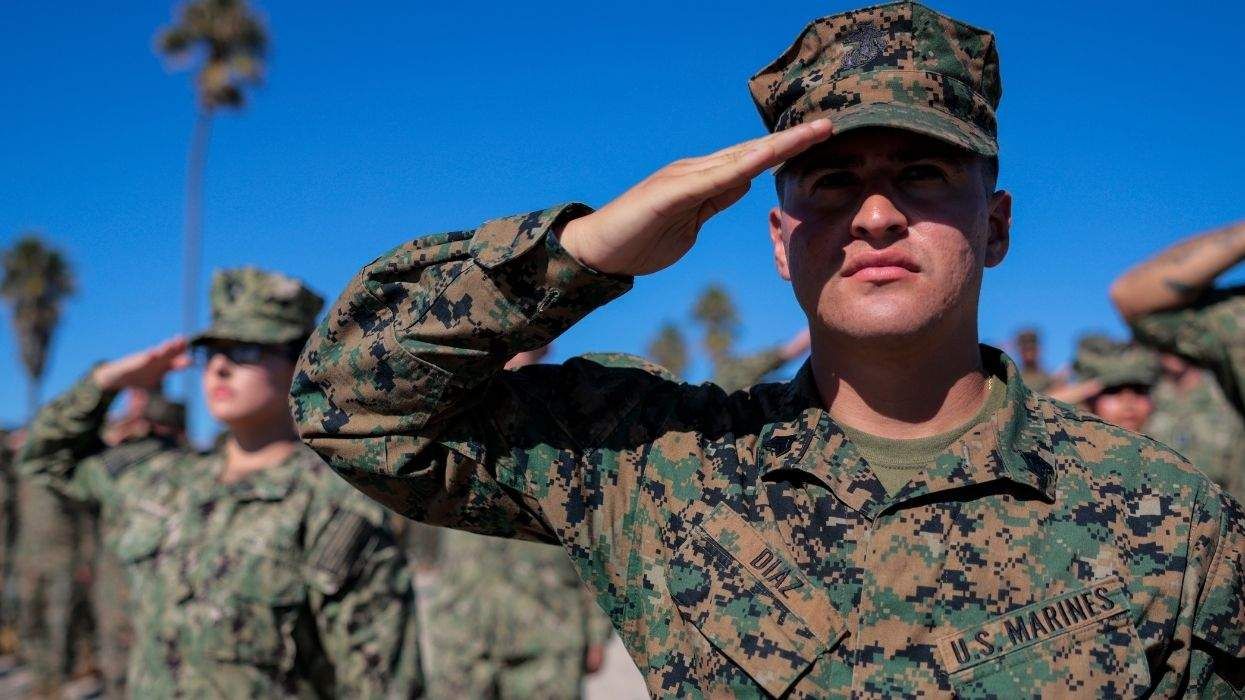
A federal appeals court in Washington, D.C., has handed the Trump administration a major win in its effort to purge transgender people from the U.S. military, ordering that a nationwide block on the ban remain on hold while the case continues.
Keep up with the latest in LGBTQ+ news and politics. Sign up for The Advocate's email newsletter.
In a two-to-one, 52-page ruling issued Tuesday, a three-judge panel of the U.S. Court of Appeals for the District of Columbia Circuit said the Pentagon can keep enforcing its 2025 policy, which bars transgender individuals from service, while the government appeals a lower court ruling against the ban. The judges dissolved a short-term administrative stay they put in place in March and replaced it with a full stay pending appeal of U.S. District Judge Ana C. Reyes’s injunction.
The panel consists of Circuit Judges Gregory Katsas and Neomi Rao, both appointed by President Donald Trump, and Circuit Judge Cornelia Pillard, appointed by President Barack Obama. Katsas, joined by Rao, wrote a concurring statement explaining why they believe the policy is likely legal. Pillard filed a blistering dissent.
What the order actually does
In March, Reyes issued a nationwide preliminary injunction in Talbott v. United States, finding that the 2025 “Hegseth policy,” named for Defense Secretary Pete Hegseth, likely violates the Constitution’s guarantee of equal protection because it targets transgender people and appears rooted in hostility, not evidence. She called the government’s reasoning “soaked in animus and dripping with pretext.”
The Trump Justice Department immediately appealed and asked the D.C. Circuit to stay her ruling. On March 27, the appeals court granted an emergency administrative stay, a temporary pause, while it considered that request. Tuesday’s order dissolves that stay and formally puts Reyes’s injunction on ice for the duration of the appeal.
Related: Why is the Army recommending training for this transgender officer that the Pentagon plans to oust?
In practical terms, nothing gets easier for transgender troops. The military can continue enforcing the ban because of the administrative stay and a separate U.S. Supreme Court order in a related case, United States v. Shilling. Now, the appeals court has explicitly said the ban should remain in place while the government fights to overturn Reyes’s injunction.
The underlying lawsuit itself is not over. The case continues in Reyes’s court, and the D.C. Circuit has already scheduled a separate oral argument on the appeal of her injunction for January 22.
“Today, the court declined to halt the unjust discharge process now threatening thousands of transgender service members," National Center for LGBTQ+ Rights legal director Shannon Minter, who represents transgender military members in the case, told The Advocate after the ruling. “On January 22, we will argue before the DC Circuit that District Judge Ana Reyes correctly found that this ban causes irreparable harm and is rooted not in facts, data, or reason—but in animus. Notably, all three judges on today’s panel acknowledged that Hegseth’s ban is driven by animus."
A ban framed as “medical,” experienced as exclusion
U.S. Army Reserve Second Lieutenant Nicolas Talbott, the lead plaintiff, told The Advocate that he's disappointed but remains focused. "As leaders in the Army we are taught to stay mission focused despite any challenges or disappointments along the way," he said. "Today’s decision simply means the current status quo remains in place. We remain committed to the case and preparing for the next hearing. In the meantime, my priority is to continue to do my job, serve my country, and provide support to my soldiers as we continue through the holiday season."
The policy at issue, adopted after Trump returned to office and signed Executive Order 14183, generally bars people with a diagnosis, history, or even “symptoms consistent with gender dysphoria” from serving in the armed forces.
In his concurring statement, Katsas portrays the rule as a medical standard rather than an attack on transgender people. He notes that strict medical rules have long governed who can serve and describes the Hegseth policy as part of a series of changes that restricted transgender service in 2018, loosened those limits in 2021, and then tightened them again in 2025.
Katsas says the policy “likely does not violate equal protection,” pointing to the Supreme Court’s 2025 decision in United States v. Skrmetti, which upheld a state ban on gender-affirming hormone treatment for minors and treated that law as a regulation of medical treatment rather than discrimination based on sex or transgender status. He suggests the same logic applies here, arguing that the policy “classifies based on the medical condition of gender dysphoria.”
Even if higher scrutiny is applied, he adds, courts are supposed to show “great deference” to the political branches on military decisions and should not second-guess “complex, subtle, and professional” judgments about readiness, cohesion, and cost. Katsas also downplays the harm to transgender service members, noting that anyone discharged under the policy will receive an honorable discharge and could, in theory, seek back pay or reinstatement later.
A dissent focused on "animus" toward trans service members
Pillard’s dissent tells a very different story. She starts with the plaintiffs themselves — dozens of transgender soldiers, sailors, airmen, Marines, and Guardians with “over 130 years of military service” and more than 80 commendations among them. She stresses that senior commanders testified that allowing transgender troops to serve has had “either no detrimental effect or [a] positive” effect on readiness.
She then turns to the political context, including Trump’s Executive Order 14183. In plain language, she writes that the order “vilifies transgender people as dishonorable, dishonest, and undisciplined” and “brands all transgender people, without regard to individual merit, as unworthy to serve in our armed forces solely because they are transgender.”
Related: Meet the transgender Army lieutenant who is challenging Donald Trump's military ban
Pillard quotes from Defense Department documents and public statements that, in her view, show the policy is driven by hostility, not neutral medical judgment. One Hegseth memo, she notes, repeats a claim that people “expressing a false ‘gender identity’ divergent from an individual’s [birth] sex cannot satisfy the rigorous standards necessary for military service.” Another implementing document lists military virtues — “honesty, humility, uniformity, and integrity” — and then declares that anyone with “symptoms consistent with gender dysphoria” categorically lacks those traits.
She also points to public comments from Hegseth and official accounts celebrating the ban, including a Defense Department social media post stating, “Transgender service members are disqualified from service without an exemption,” and a Hegseth speech in which he said, “No more dudes in dresses, we’re done with that shit.”
For Pillard, those words matter. They show, she argues, that the policy is “based on nothing more than negative attitudes about transgender identity,” not genuine concern for a “strong and ready military.” And she faults the government for failing to identify any specific harm to readiness from letting qualified transgender troops keep serving during the appeal — a showing she says is required to justify emergency relief.
Related: DOJ denies existence of transgender people in stunning court filing defending Trump’s military ban
“In advocating for a stay, the government does not dispute the animus pervading the Executive Order but shrugs it off as legally beside the point,” Pillard wrote.
Lives in limbo, again
The ruling comes after months in which transgender troops have already been squeezed between court orders and shifting Pentagon directives.
As The Advocate has reported, many service members have seen promotions and transfers stall, health care disrupted, and commanders quietly warn them to brace for separation as the military tries to interpret the new rules and the Supreme Court’s earlier Shilling order.
In the meantime, though, Tuesday’s order makes one thing clear: the policy stays in force.
“The court still has the opportunity to protect our troops and their families by upholding Judge Reyes’s decision,” Minter said.
Editor's note: This story has been updated with remarks from second Lieutenant Nicolas Talbott.