'%3E%3Cpath d='M16.3574 35.6519H12.9537L15.0491 18.8873L16.3574 35.6519ZM30.4229 54.0093L22.309 0.994385H7.91795L0 54.0093H10.6634L11.5802 46.3855H17.4014L17.9914 54.0093H30.4229Z' fill='%23971B20'/%3E%3Cpath d='M48.2073 41.8813C48.2073 43.4049 47.4892 44.0011 46.1144 44.0011H43.7595V11.0687H46.1144C47.4892 11.0687 48.2073 11.6636 48.2073 13.1885V41.8813ZM59.5273 43.6695V11.3326C59.5273 3.71323 53.5729 0.994385 47.8157 0.994385H31.7213V54.0093H47.8157C53.5729 54.0093 59.5273 51.29 59.5273 43.6695Z' fill='%23971B20'/%3E%3Cpath d='M90.183 0.994385H78.6039L75.0711 30.6157L71.9955 0.994385H59.4346L69.2474 54.0093H80.373L90.183 0.994385Z' fill='%23971B20'/%3E%3Cpath d='M107.063 42.3448C107.063 43.7359 105.951 44.5974 104.643 44.5974C103.269 44.5974 102.157 43.7359 102.157 42.3448V12.658C102.157 11.2676 103.269 10.4058 104.643 10.4058C105.951 10.4058 107.063 11.2676 107.063 12.658V42.3448ZM119.233 43.2723V11.7312C119.233 6.36384 112.952 -3.8147e-06 104.643 -3.8147e-06C96.2667 -3.8147e-06 89.9867 6.36384 89.9867 11.7312V43.2723C89.9867 48.6393 96.2667 55 104.643 55C112.952 55 119.233 48.6393 119.233 43.2723Z' fill='%23971B20'/%3E%3Cpath d='M150.976 43.9349V33.7309H139.069V42.3448C139.069 43.7359 137.957 44.5974 136.582 44.5974C135.076 44.5974 133.964 43.7359 133.964 42.3448V12.658C133.964 11.2676 135.076 10.4058 136.582 10.4058C137.957 10.4058 139.069 11.2676 139.069 12.658V21.2723H150.976V11.0687C150.976 5.70107 145.283 -3.8147e-06 136.582 -3.8147e-06C127.75 -3.8147e-06 121.796 5.70107 121.796 11.0687V43.9349C121.796 49.3022 127.75 55 136.582 55C145.283 55 150.976 49.3022 150.976 43.9349Z' fill='%23971B20'/%3E%3Cpath d='M167.478 35.6519H164.076L166.17 18.8873L167.478 35.6519ZM181.544 54.0093L173.432 0.994385H159.037L151.123 54.0093H161.785L162.704 46.3855H168.523L169.114 54.0093H181.544Z' fill='%23971B20'/%3E%3Cpath d='M205.412 10.4058V0.994385H177.081V10.4058H185.392V54.0093H197.428V10.4058H205.412Z' fill='%23971B20'/%3E%3Cpath d='M230.002 54.0093V43.9349H218.914V31.8746H226.635V21.8028H218.914V10.4058H230.002V0.994385H206.875V54.0093H230.002Z' fill='%23971B20'/%3E%3C/g%3E%3Cdefs%3E%3CclipPath id='clip0_260_7080'%3E%3Crect width='230' height='55' fill='white'/%3E%3C/clipPath%3E%3C/defs%3E%3C/svg%3E)
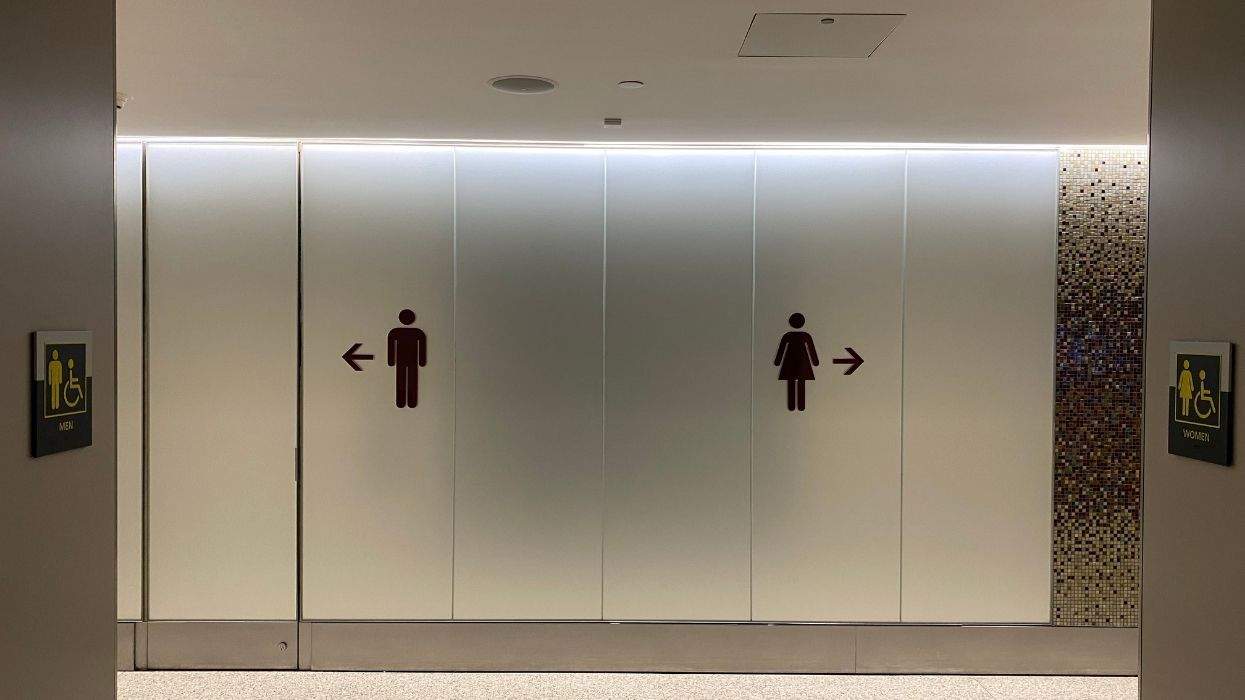

The federal government’s chief workplace civil rights agency has reversed course on one of its most consequential transgender rights precedents, allowing federal agencies to bar trans employees from using restrooms that align with their gender identity.
Keep up with the latest in LGBTQ+ news and politics. Sign up for The Advocate's email newsletter.
The Equal Employment Opportunity Commission has reversed a key portion of its 2015 landmark transgender rights ruling, narrowing protections for transgender federal employees and intensifying a growing clash between the Trump administration and congressional Democrats over the future of workplace equality.
In a 2–1 decision issued February 26, the EEOC ruled against a transgender federal employee who filed a discrimination complaint after being denied access to the women’s restroom at work. The policy barring her from the restroom had been adopted under President Donald Trump’s Executive Order 14168, “Defending Women From Gender Ideology Extremism and Restoring Biological Truth to the Federal Government,” issued on the day of Trump’s inauguration in January 2025.
Related: Trump administration moves to strip transgender people of employment discrimination protections
Related: EEOC won't advocate for trans and nonbinary people, in keeping with Trump's 'two sexes' order
Related: Lawsuit challenges EEOC's failure to investigate anti-transgender discrimination
That executive order declared it the policy of the United States to recognize only binary sexes, male and female, and directed federal agencies to remove all references to “gender ideology” from policies and guidance. It called for the revision of forms, communications, and internal documents to reflect a person’s sex assigned at birth, and for protections in “intimate spaces” to be enforced on that basis.
The new federal sector appellate decision overturns a portion of Lusardi v. Department of the Army that held it was unlawful sex discrimination under Title VII of the Civil Rights Act of 1964 to prohibit a transgender employee from using restrooms consistent with their gender identity. The 2015 ruling also concluded that repeated, intentional misgendering could violate federal law. The original Lusardi decision arose from a complaint filed by a transgender civilian employee of the Army who was barred from using the women’s restroom and instead directed to use a single-user facility.
Related: Congress members demand that EEOC address gender identity discrimination
Related: The government abandoned LGBTQ+ workers. Its former civil rights lawyers stepped up
The EEOC concluded that the agency’s actions violated Title VII’s prohibition on sex discrimination, building on its earlier 2012 ruling in Macy v. Holder, which held that discrimination against transgender people constitutes discrimination “because of sex.” The commission wrote at the time that denying restroom access consistent with a worker’s gender identity “deprived Complainant of equal status, respect, and dignity in the workplace.”
Under the new decision, federal agencies may exclude transgender employees from bathrooms aligned with their gender identity. The ruling states that a “man who identifies as a ‘transwoman’ is still a man; a woman who identifies as a ‘transman’ is still a woman,” and misgenders the employee who brought the complaint. According to the Human Rights Campaign, the commission acknowledged that existing case law did not support its new interpretation.
“This green lighting of discrimination against hardworking Americans is an egregious abdication of responsibility by the EEOC, capitulation by Chair Andrea Lucas to Donald Trump's orders, and will make the job of keeping workers safe harder everywhere,” HRC Director of Legal Policy Cathryn Oakley said in a statement. “To transgender workers reading yet another in the long string of attacks on your dignity from this administration: We will not stop fighting for an America where you can go to work, get a paycheck, and make it home to put food on the table without having to fear that your ability to provide for yourselves and your family hinges on weathering discrimination and bigotry in the workplace.”
Related: What can trans people do about Trump’s executive orders? Be plaintiffs, says Lambda Legal
The decision applies only to federal agencies subject to the EEOC’s administrative complaint process. It does not extend to private employers and does not bind federal courts, which remain governed by the U.S. Supreme Court’s 2020 decision in Bostock v. Clayton County, holding that Title VII protects gay and transgender workers from discrimination because of sex.
Out U.S. Rep. Mark Takano of California, chair of the Congressional Equality Caucus, criticized the move.
“The EEOC was created with the explicit mission of protecting American workers from discrimination—but under Trump and Chair Andrea Lucas, the Commission has abandoned its duty in order to push Trump’s radical, anti-equality, and anti-worker agenda,” Takano said in a statement. “The Supreme Court made clear in Bostock that transgender workers are protected from discrimination; the EEOC cannot [undo] those protections.”
The decision comes as Democrats attempt a legislative response. Earlier in February, Rep. Ayanna Pressley of Massachusetts and Sen. Patty Murray of Washington reintroduced the BE HEARD Act, a workplace harassment bill that would end mandatory arbitration and nondisclosure agreements, expand civil rights protections to independent contractors and interns, extend the time to report harassment, and clarify that federal civil rights law protects against discrimination based on sexual orientation and gender identity.
“Every worker should be safe and respected in their workplace; this shouldn’t be controversial,” Pressley said. “Under the Trump Administration, the EEOC is weakening protections and exposing workers to discrimination, harassment, and abuse at their jobs.”