'%3E%3Cpath d='M16.3574 35.6519H12.9537L15.0491 18.8873L16.3574 35.6519ZM30.4229 54.0093L22.309 0.994385H7.91795L0 54.0093H10.6634L11.5802 46.3855H17.4014L17.9914 54.0093H30.4229Z' fill='%23971B20'/%3E%3Cpath d='M48.2073 41.8813C48.2073 43.4049 47.4892 44.0011 46.1144 44.0011H43.7595V11.0687H46.1144C47.4892 11.0687 48.2073 11.6636 48.2073 13.1885V41.8813ZM59.5273 43.6695V11.3326C59.5273 3.71323 53.5729 0.994385 47.8157 0.994385H31.7213V54.0093H47.8157C53.5729 54.0093 59.5273 51.29 59.5273 43.6695Z' fill='%23971B20'/%3E%3Cpath d='M90.183 0.994385H78.6039L75.0711 30.6157L71.9955 0.994385H59.4346L69.2474 54.0093H80.373L90.183 0.994385Z' fill='%23971B20'/%3E%3Cpath d='M107.063 42.3448C107.063 43.7359 105.951 44.5974 104.643 44.5974C103.269 44.5974 102.157 43.7359 102.157 42.3448V12.658C102.157 11.2676 103.269 10.4058 104.643 10.4058C105.951 10.4058 107.063 11.2676 107.063 12.658V42.3448ZM119.233 43.2723V11.7312C119.233 6.36384 112.952 -3.8147e-06 104.643 -3.8147e-06C96.2667 -3.8147e-06 89.9867 6.36384 89.9867 11.7312V43.2723C89.9867 48.6393 96.2667 55 104.643 55C112.952 55 119.233 48.6393 119.233 43.2723Z' fill='%23971B20'/%3E%3Cpath d='M150.976 43.9349V33.7309H139.069V42.3448C139.069 43.7359 137.957 44.5974 136.582 44.5974C135.076 44.5974 133.964 43.7359 133.964 42.3448V12.658C133.964 11.2676 135.076 10.4058 136.582 10.4058C137.957 10.4058 139.069 11.2676 139.069 12.658V21.2723H150.976V11.0687C150.976 5.70107 145.283 -3.8147e-06 136.582 -3.8147e-06C127.75 -3.8147e-06 121.796 5.70107 121.796 11.0687V43.9349C121.796 49.3022 127.75 55 136.582 55C145.283 55 150.976 49.3022 150.976 43.9349Z' fill='%23971B20'/%3E%3Cpath d='M167.478 35.6519H164.076L166.17 18.8873L167.478 35.6519ZM181.544 54.0093L173.432 0.994385H159.037L151.123 54.0093H161.785L162.704 46.3855H168.523L169.114 54.0093H181.544Z' fill='%23971B20'/%3E%3Cpath d='M205.412 10.4058V0.994385H177.081V10.4058H185.392V54.0093H197.428V10.4058H205.412Z' fill='%23971B20'/%3E%3Cpath d='M230.002 54.0093V43.9349H218.914V31.8746H226.635V21.8028H218.914V10.4058H230.002V0.994385H206.875V54.0093H230.002Z' fill='%23971B20'/%3E%3C/g%3E%3Cdefs%3E%3CclipPath id='clip0_260_7080'%3E%3Crect width='230' height='55' fill='white'/%3E%3C/clipPath%3E%3C/defs%3E%3C/svg%3E)

This story was originally reported by Orion Rummler of The 19th. Meet Orion and read more of their reporting on gender, politics and policy.
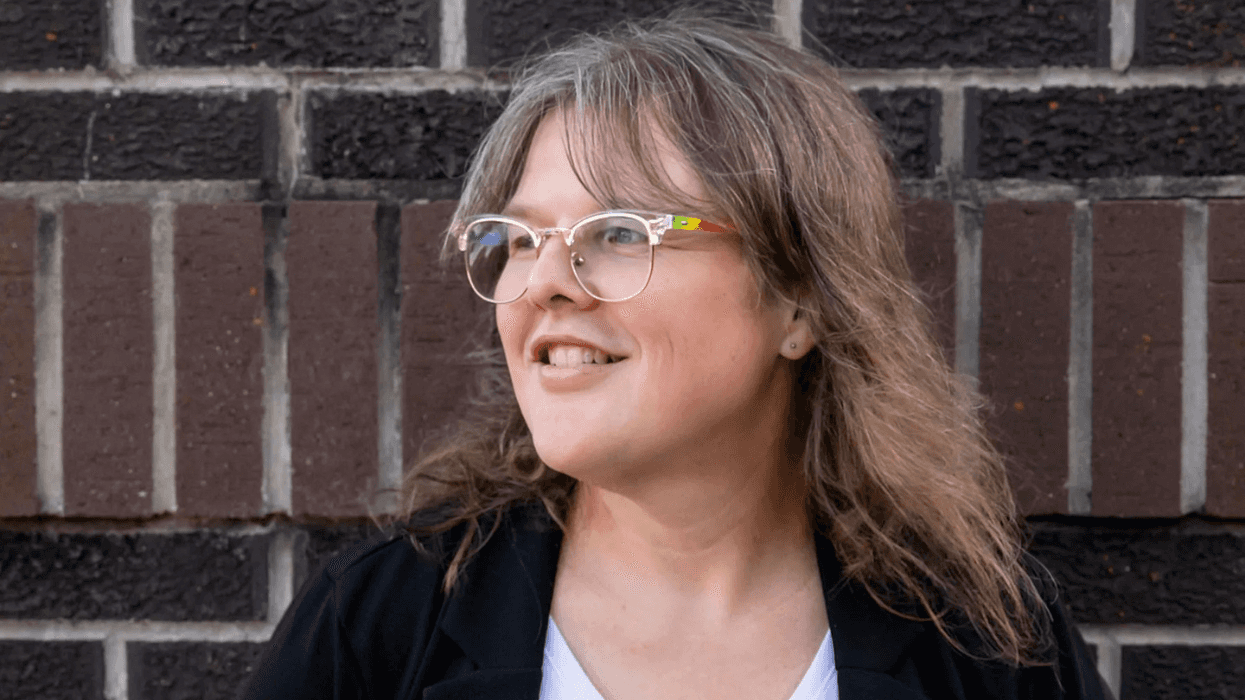
Avery Rowland, a transgender woman in small-town Kansas, is running as a Democrat to represent a state legislative district in the bottom-right corner of the state, about two hours south of Kansas City. She wants to bring more highways, hospitals and schools to her rural, deep-red district.
Her race was fairly uneventful until she got wind of a Kansas Republican Party official questioning her eligibility to vote.
Kansas Reflector, a local news outlet, came to her with records showing that the state GOP treasurer, Roger Lomshek, had called the secretary of state’s office and asked why a new law invalidating transgender Kansans’ licenses wasn’t being applied to voter registration. Specifically, he wanted to know why that law didn’t apply to Rowland and her ability to vote.
“I was a little bit pissed off,” she told The 19th. “That’s kind of a chicken move to do. Just be a man, but, whatever.”
Lomshek was asking about SB 244, which invalidated thousands of Kansans’ drivers licenses based on gender identity and required immediate replacement.
In response to Lomshek’s inquiry, state officials found that election officers are not responsible for enforcing SB244 when it comes to voting or running for office.
“Gender discrepancies can never be a basis for denying anyone the right to vote,” a spokeswoman for the Kansas secretary of state office said in a statement to Reflector.
Lomshek did not respond to multiple requests for comment. The Kansas Republican Party also did not respond.
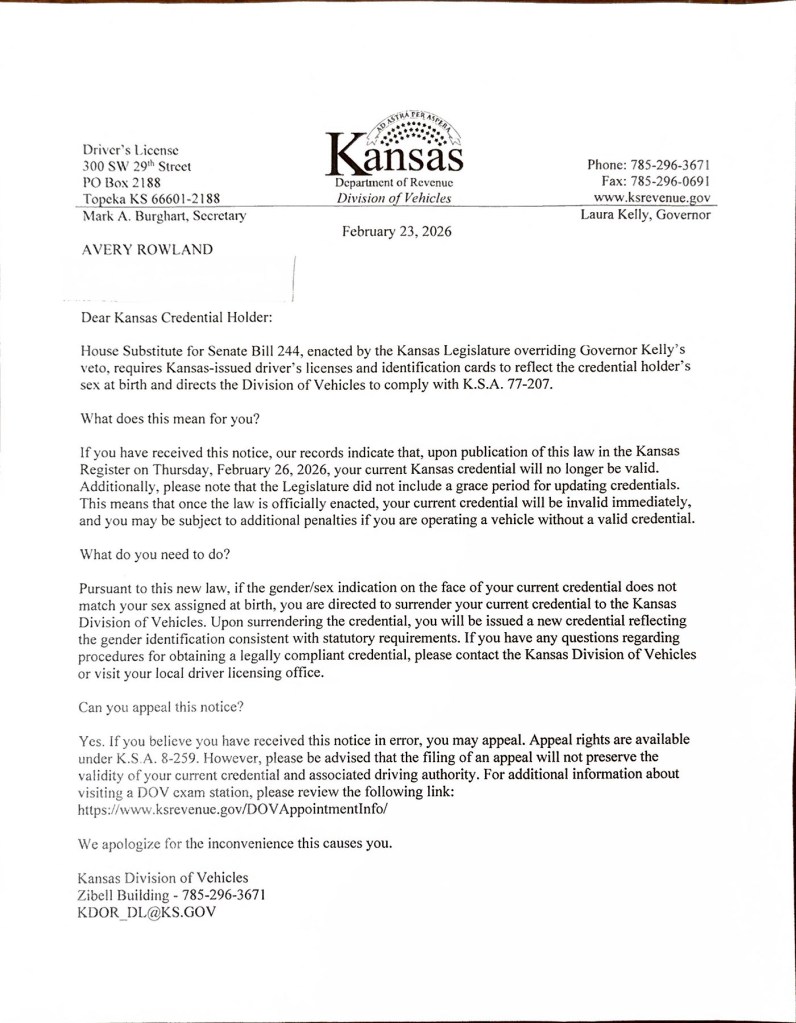
In February, Rowland and thousands of other trans people across the state received letters stating they had only days before their driver’s licenses would be invalidated. The state was forcing them to get IDs labeled with their sex at birth, not their current gender. They would face penalties for driving with their old license. There was no grace period. The law, passed by the GOP-controlled legislature over the governor’s veto, revoked licenses and banned trans people from public restrooms on government property, threatening fines on both counts.
Trans people across Kansas are carrying incorrect IDs due to this new law. The midterms are the first test of whether this causes issues at the ballot box. So far, when it comes to voting, these mismatched IDs don’t seem to be a problem. That could be a rare good sign for Kansans, who are living under the most restrictive ID law for transgender people in the country.
 (Courtesy of Avery Rowland)
The 19th spoke with four trans women about their plans to vote in the midterms this November. Three of them have licenses that incorrectly ID them as male. All of them voted in the primaries without issue and plan to vote in the general election. But all of them still live with some amount of anxiety about being trans in Kansas right now.
Jessie Lawson, who was born and raised in Kansas and now lives in Wichita, is optimistic that Democrats will sweep the elections and trans people in Kansas will soon have accurate IDs again. Despite the state’s restrictive laws, she says everyday people don’t seem to care what bathroom she uses or what her license says.
Lawson said she reluctantly changed her license because she didn’t want anything to stop her from being able to vote — and other trans people she knows feel the same. She’s closely watching local races, especially the race for Kansas attorney general.
“My future is on the line, and I’m watching out for others too by my vote,” she said.
Kenzie Classen, who plans to vote in-person in November, lives in Andover, just outside Wichita. She came out as trans two years ago and is determined to live authentically, despite how scary it’s been to be out during the second Trump administration. Her ID stays in her wallet, and she avoids traveling so other people don’t see it.
Classen feels trapped in Kansas. She makes too much money as an engineer to justify leaving, but not enough to relocate. State law forbids her from using the women’s restroom in public, so she only goes only at home or at work.
Hazel Krebs, who has lived in Westwood outside Kansas City for almost 11 years, never got a letter declaring her license invalid. So she still carries an ID marked “F.” She plans to vote in advance, which gives her extra time to deal with issues that may stem from her license.
Even though Krebs’ current license has gone unnoticed under the new law, she has dealt with paperwork headaches about her identity before. Back in 2023, after the state passed SB 180 — a “women’s bill of rights” requiring that gender be defined in state law by “biological sex” — Kansas tried to block trans residents from changing gender markers on their licenses. Krebs had to get her license renewed before it expired in 2024. But what gender the state would slap on her card varied by the month, if not the week, as the law went back and forth in the courts. Ultimately, she got a license with “F” on it. But if she had done it a month earlier, her license would say “M.”
In the end, that old law was blocked by a court order. But the state hasn’t given up.
Krebs has two kids in high school, so she plans to stay in Kansas until they graduate. Until then, she’s decided she can live with the risk of staying. But her friends have already left, finding greener pastures in Colorado, Minnesota or Oregon. And that exodus impacts the political makeup of the state, as most LGBTQ+ people vote Democrat, even if they don’t necessarily call themselves a Democrat.
“You know the people who are like, ‘oh, make sure everyone votes.’ Well, they will vote. But they’ll be voting in Minnesota, they’ll be voting in Denver, they’ll be voting in these other places,” Krebs said.
Then there’s Rowland, who quit her job at a state agency to run for office in a Republican-controlled district where President Donald Trump took 70 percent of the vote in 2024. Rowland’s campaign website gives voters the full picture of who she is: 43, transgender, and living in Girard with her wife.
“I’ve got nothing that they can hold over on me. What’s the worst they’re going to find out, I like to wear dresses? I already told you that,” she said.
After the 2024 election, her wife wanted them to leave the country. Rowland wanted to stay and fight. So they stayed in Kansas. It’s not an easy decision for everyone to stay in such a ruby red state, although the political winds may be changing. A Democrat has a chance of winning a Senate seat in the midterms, which hasn’t happened in this state in almost 100 years. Polls show Democrat Adam Hamilton and Senator Roger Marshall in a dead heat.
In a state that requires a photo ID to vote, transgender Kansans are living in uncertainty. Many feel trapped in a bureaucratic nightmare littered with unknown consequences. And in Rowland's case, it appears that following the law can still attract scrutiny.
When Rowland got her letter in February, she drove to the DMV the very next day. She had only one day to turn in her license, marked “F” for female, and get a new one with an “M” on it. The young woman working at the bureau that morning didn’t know about the new law, Rowland said, and had to call the Topeka office to get more information.
“It was a mess,” Rowland said. In the end, she got her new license, which incorrectly labels her a man. She doesn’t care what it says; it’s just a piece of paper. And she followed the law. Why that attracted scrutiny from a state Republican official is unclear to her. But she feels Republicans see her as a threat because she’s a trans woman running for office with a robust platform and actual funding, she said. Campaign finance records show that she has raised over $20,000 in her bid for a state House seat.
“I have more than they ever expected me to have,” she said.