'%3E%3Cpath d='M16.3574 35.6519H12.9537L15.0491 18.8873L16.3574 35.6519ZM30.4229 54.0093L22.309 0.994385H7.91795L0 54.0093H10.6634L11.5802 46.3855H17.4014L17.9914 54.0093H30.4229Z' fill='%23971B20'/%3E%3Cpath d='M48.2073 41.8813C48.2073 43.4049 47.4892 44.0011 46.1144 44.0011H43.7595V11.0687H46.1144C47.4892 11.0687 48.2073 11.6636 48.2073 13.1885V41.8813ZM59.5273 43.6695V11.3326C59.5273 3.71323 53.5729 0.994385 47.8157 0.994385H31.7213V54.0093H47.8157C53.5729 54.0093 59.5273 51.29 59.5273 43.6695Z' fill='%23971B20'/%3E%3Cpath d='M90.183 0.994385H78.6039L75.0711 30.6157L71.9955 0.994385H59.4346L69.2474 54.0093H80.373L90.183 0.994385Z' fill='%23971B20'/%3E%3Cpath d='M107.063 42.3448C107.063 43.7359 105.951 44.5974 104.643 44.5974C103.269 44.5974 102.157 43.7359 102.157 42.3448V12.658C102.157 11.2676 103.269 10.4058 104.643 10.4058C105.951 10.4058 107.063 11.2676 107.063 12.658V42.3448ZM119.233 43.2723V11.7312C119.233 6.36384 112.952 -3.8147e-06 104.643 -3.8147e-06C96.2667 -3.8147e-06 89.9867 6.36384 89.9867 11.7312V43.2723C89.9867 48.6393 96.2667 55 104.643 55C112.952 55 119.233 48.6393 119.233 43.2723Z' fill='%23971B20'/%3E%3Cpath d='M150.976 43.9349V33.7309H139.069V42.3448C139.069 43.7359 137.957 44.5974 136.582 44.5974C135.076 44.5974 133.964 43.7359 133.964 42.3448V12.658C133.964 11.2676 135.076 10.4058 136.582 10.4058C137.957 10.4058 139.069 11.2676 139.069 12.658V21.2723H150.976V11.0687C150.976 5.70107 145.283 -3.8147e-06 136.582 -3.8147e-06C127.75 -3.8147e-06 121.796 5.70107 121.796 11.0687V43.9349C121.796 49.3022 127.75 55 136.582 55C145.283 55 150.976 49.3022 150.976 43.9349Z' fill='%23971B20'/%3E%3Cpath d='M167.478 35.6519H164.076L166.17 18.8873L167.478 35.6519ZM181.544 54.0093L173.432 0.994385H159.037L151.123 54.0093H161.785L162.704 46.3855H168.523L169.114 54.0093H181.544Z' fill='%23971B20'/%3E%3Cpath d='M205.412 10.4058V0.994385H177.081V10.4058H185.392V54.0093H197.428V10.4058H205.412Z' fill='%23971B20'/%3E%3Cpath d='M230.002 54.0093V43.9349H218.914V31.8746H226.635V21.8028H218.914V10.4058H230.002V0.994385H206.875V54.0093H230.002Z' fill='%23971B20'/%3E%3C/g%3E%3Cdefs%3E%3CclipPath id='clip0_260_7080'%3E%3Crect width='230' height='55' fill='white'/%3E%3C/clipPath%3E%3C/defs%3E%3C/svg%3E)
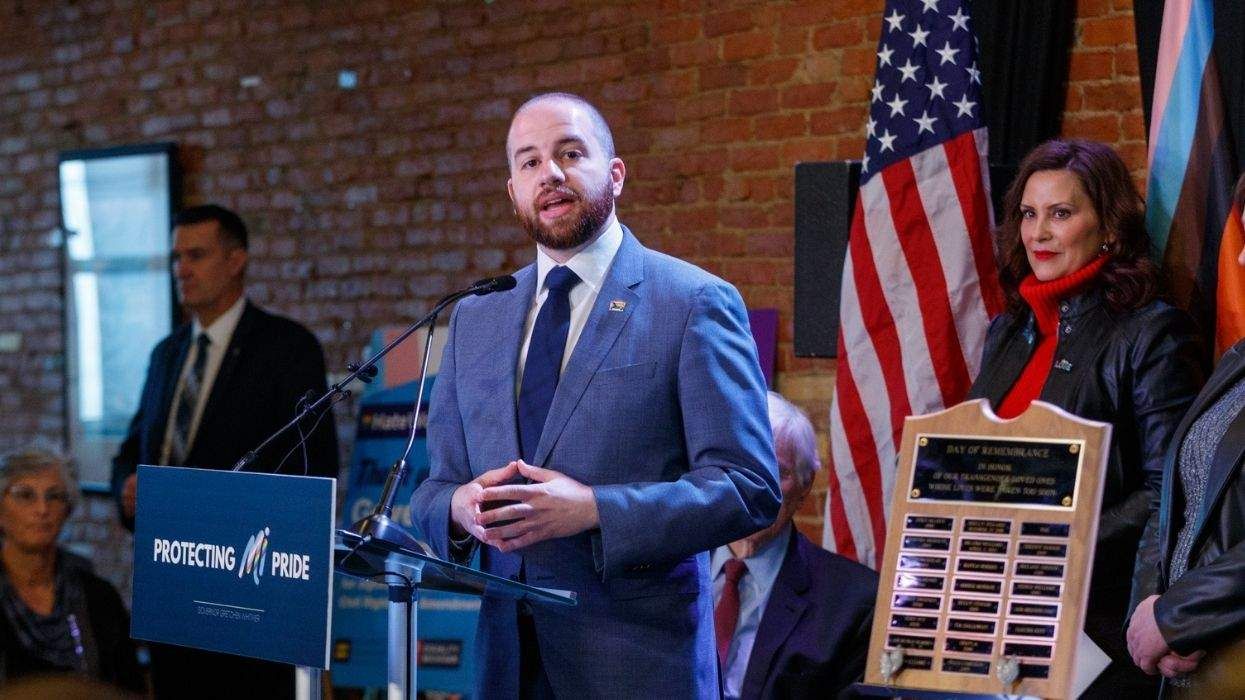
Jeremy Moss remembers what it felt like to have his future put to a vote.
He was 18 in 2004 when Michigan voters approved a constitutional amendment banning same-sex marriage and civil unions. The message reached well beyond the legal question on the ballot.
“It was really a signal to me that there’s no future for me here,” Moss told The Advocate.
Twenty-two years later, the Democratic state senator is seeking to become Michigan’s first out LGBTQ+ member of Congress. He believes that Democrats must defend their convictions forcefully enough to win power, then use it to make people’s lives more secure.
“First and foremost, I think voters want fighters and not folders,” he said in an interview.
Moss faces Republican Ethan Baker in the November 3 election for Michigan’s 11th Congressional District, an Oakland County seat that opened when Democratic Rep. Haley Stevens launched her unsuccessful Senate campaign.
In a separate interview with The Advocate, Rep. Mark Takano, cochair of Equality PAC, described Moss as “widely regarded to be on a glide path to a victory in the general election in November.”
Decision Desk HQ’s forecast rates the seat “Safe Democratic.”
The national environment also favors Democrats. Silver Bulletin’s generic congressional ballot average, updated October 14, showed an 8.6-percentage-point Democratic advantage. A Reuters/Ipsos survey conducted September 30 through October 5 found Democrats leading Republicans 44 percent to 37 percent among 3,526 registered voters.
For Moss, favorable conditions are an opportunity Democrats still must prove they deserve.
“We need a stronger, bolder, tougher Democratic Party, one that does not show up to the knife fight carrying a pie chart,” he said.
He wants Democrats to speak about healthcare, gun safety, and congressional checks on President Donald Trump with the confidence Trump brings to his own agenda. Having served in legislative minorities and majorities, Moss has little patience for opposition that cannot translate into governing authority.
“The worst day in the majority is still better than the best day serving in the minority,” he said.
His prescription includes an unambiguous defense of transgender people. Asked how Democrats should respond to political attacks centered on transgender athletes, Moss rejected the premise that those athletes explain the problems confronting Michigan families.
“There is no trans athlete in Michigan that is causing gas prices to spike,” he said. “There is no trans athlete in Michigan that is putting up barriers to affordable healthcare.”
He recognizes the strategy from earlier fights over gay rights: isolate a vulnerable population, portray its inclusion as a threat, and turn that fear into political advantage.
“We have to protect everyone under this LGBTQ umbrella equally,” he said.
In a written response to The Advocate’s questions, Baker offered a different approach. “We are absolutely exhausted by the fighting and division,” he said. “When I disagree with the President, I’ll say so. When I agree, I’ll say that too.”
Baker did not identify a specific disagreement with Trump. He said he supports increasing housing supply, expanding workforce training, lowering prescription drug costs, and protecting coverage for people with preexisting conditions.
Asked whether he supports the Equality Act, including its protections for transgender people, Baker endorsed federal nondiscrimination protections without explicitly endorsing the bill.
“I do support equality and believe we need legislation that protects people from discrimination,” he said. “I also believe we need to balance these protections while respecting religious liberty and other constitutional rights.”
Moss’s argument rests on a legislative achievement The Advocate has followed closely. He sponsored the Senate bill expanding Michigan’s Elliott-Larsen Civil Rights Act to protect sexual orientation and gender identity or expression explicitly. Gov. Gretchen Whitmer signed it in March 2023, extending explicit protections in employment, housing, and public accommodations after decades of advocacy.
Democratic control made passage possible. Republican votes helped make it bipartisan. Moss said securing that support required sustained conversations with colleagues who did not begin as allies.
He described identifying a reachable lawmaker among several anti-LGBTQ+ Republicans and arguing that discrimination damaged Michigan’s ability to attract talent, families, and investment. Persuasion required giving someone room to move.
“If you’re only talking with the 40 percent of people who agree with you, at the end of the day, you’re going to still have 40 percent of people agreeing with you,” he said.
In Congress, he says he will support the Equality Act and explicit federal LGBTQ+ nondiscrimination protections.
He is also concerned about rights resting on judicial decisions. As The Advocate reported in November 2025, Moss introduced a resolution to put repeal of Michigan’s constitutional marriage ban before voters. The proposal received a Senate committee hearing in March, but did not reach the ballot this November.
For Moss, representation changes both who gets heard and what lawmakers understand as an LGBTQ+ concern. He has worked with Republicans on housing, economic development, and government transparency while being openly gay.
Recalling a critic who demanded he stop focusing on a "gay agenda" and fix Michigan’s roads, Moss described his answer: “Well, part of my gay agenda is fixing the roads because actually gay people drive on them too.”
The teenager who once questioned his future in Michigan now wants younger LGBTQ+ people to see public office as a place they belong.
“I think that is a really big thing to be a first so that you can provide the pathway to the second, the third, and the fourth,” he said.
He added, “They’re going to talk about us whether or not we’re in the room, so we might as well get in the room and pull up our seat to the table.”