'%3E%3Cpath d='M16.3574 35.6519H12.9537L15.0491 18.8873L16.3574 35.6519ZM30.4229 54.0093L22.309 0.994385H7.91795L0 54.0093H10.6634L11.5802 46.3855H17.4014L17.9914 54.0093H30.4229Z' fill='%23971B20'/%3E%3Cpath d='M48.2073 41.8813C48.2073 43.4049 47.4892 44.0011 46.1144 44.0011H43.7595V11.0687H46.1144C47.4892 11.0687 48.2073 11.6636 48.2073 13.1885V41.8813ZM59.5273 43.6695V11.3326C59.5273 3.71323 53.5729 0.994385 47.8157 0.994385H31.7213V54.0093H47.8157C53.5729 54.0093 59.5273 51.29 59.5273 43.6695Z' fill='%23971B20'/%3E%3Cpath d='M90.183 0.994385H78.6039L75.0711 30.6157L71.9955 0.994385H59.4346L69.2474 54.0093H80.373L90.183 0.994385Z' fill='%23971B20'/%3E%3Cpath d='M107.063 42.3448C107.063 43.7359 105.951 44.5974 104.643 44.5974C103.269 44.5974 102.157 43.7359 102.157 42.3448V12.658C102.157 11.2676 103.269 10.4058 104.643 10.4058C105.951 10.4058 107.063 11.2676 107.063 12.658V42.3448ZM119.233 43.2723V11.7312C119.233 6.36384 112.952 -3.8147e-06 104.643 -3.8147e-06C96.2667 -3.8147e-06 89.9867 6.36384 89.9867 11.7312V43.2723C89.9867 48.6393 96.2667 55 104.643 55C112.952 55 119.233 48.6393 119.233 43.2723Z' fill='%23971B20'/%3E%3Cpath d='M150.976 43.9349V33.7309H139.069V42.3448C139.069 43.7359 137.957 44.5974 136.582 44.5974C135.076 44.5974 133.964 43.7359 133.964 42.3448V12.658C133.964 11.2676 135.076 10.4058 136.582 10.4058C137.957 10.4058 139.069 11.2676 139.069 12.658V21.2723H150.976V11.0687C150.976 5.70107 145.283 -3.8147e-06 136.582 -3.8147e-06C127.75 -3.8147e-06 121.796 5.70107 121.796 11.0687V43.9349C121.796 49.3022 127.75 55 136.582 55C145.283 55 150.976 49.3022 150.976 43.9349Z' fill='%23971B20'/%3E%3Cpath d='M167.478 35.6519H164.076L166.17 18.8873L167.478 35.6519ZM181.544 54.0093L173.432 0.994385H159.037L151.123 54.0093H161.785L162.704 46.3855H168.523L169.114 54.0093H181.544Z' fill='%23971B20'/%3E%3Cpath d='M205.412 10.4058V0.994385H177.081V10.4058H185.392V54.0093H197.428V10.4058H205.412Z' fill='%23971B20'/%3E%3Cpath d='M230.002 54.0093V43.9349H218.914V31.8746H226.635V21.8028H218.914V10.4058H230.002V0.994385H206.875V54.0093H230.002Z' fill='%23971B20'/%3E%3C/g%3E%3Cdefs%3E%3CclipPath id='clip0_260_7080'%3E%3Crect width='230' height='55' fill='white'/%3E%3C/clipPath%3E%3C/defs%3E%3C/svg%3E)


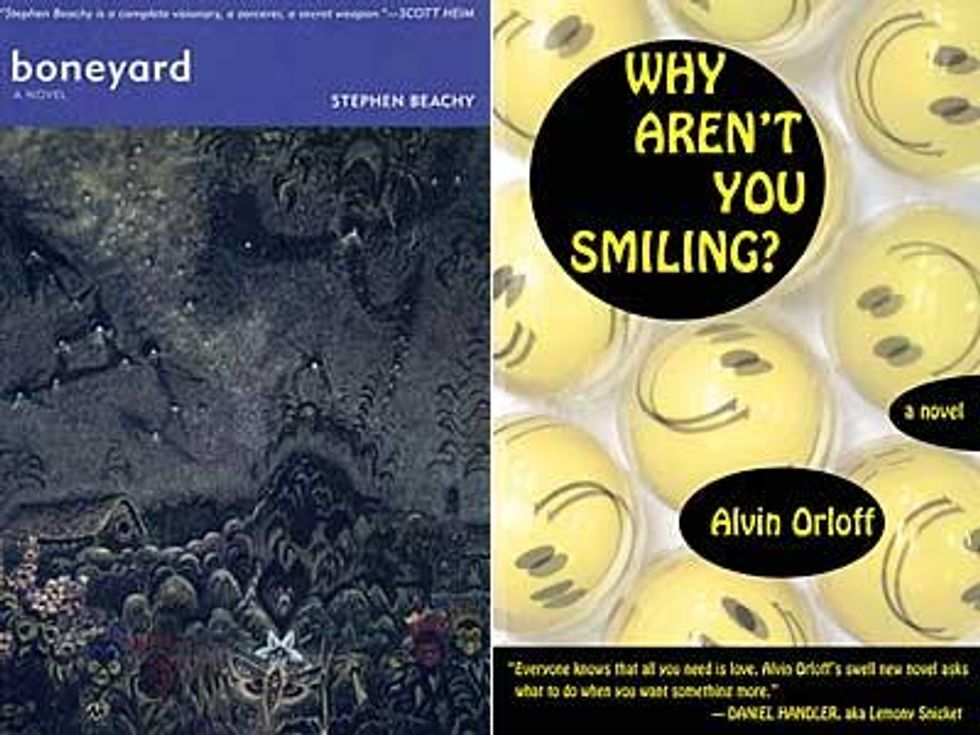
Alvin Orloff, the gay author of Why Aren't You Smiling? began writing as a teenager in the 1970s, a decade from which he says he has never fully recovered. He chats about fashion, LSD, Kathy Acker, and literature's first bromance with Stephen Beachy, the gay man who authored the novel boneyard in collaboration with a very disturbed Amish boy, Jake Yoder, whose existence is unverified.
Orloff: One of the many things I loved about boneyard was the way it describes the Amish, a group I've never encountered in fiction before. Your narrator describes them as "a religious cult that believes war and electricity are evil" and mentions taboos against "permed hair, patterned cloth, and overly decorative linoleum." Fascinating! Are there novels about the Amish that influenced you or is this familiarity from personal experience?
Beachy: Most novels about the Amish belong to one of two genres, Amish romances and mysteries set in Amish country. The only good novel about the Amish I know of is Michael Lowenthal's Avoidance, so my familiarity comes from personal experience: My dad grew up Amish; my grandparents, many uncles, aunts, and cousins were Amish, so I spent many hours of my early childhood rolling marbles down convoluted ramps to hear their frenzied clickety-clacking sound -- a major form of entertainment for Amish children.
I'm wondering what your own experiences are with groovy '70s cults. I loved how unterrifying the cultists are in Why Aren't You Smiling? and their odd hodgepodge of vocabulary from varied spiritual sources. Pleroma is my favorite word ever; I think Philip K. Dick used it a lot. Did you ever join a cult?
Orloff: I never joined any cults due to a combination of good sense, misanthropy, and shyness, but growing up in New Age 1970s California, I was surrounded by them. Rajneeshis, Moonies, we had 'em all. The fashion of the day was to be an earnest seeker of spiritual wisdom. This led to many people becoming rather gullible and mystically inclined, which in turn led to their joining cults. Fortunately, the era was also one of rampant flakiness and self-indulgence, which led to many people dropping out of cults.
Part of the inspiration for Why Aren't You Smiling? came from some itinerant Jesus freaks who called a kid I knew "Little Lamb of God." Seriously, can you think of a more off-putting thing to call a teenage boy? There is a misconception that all cults are good at recruiting and brainwashing, but actually that stuff is difficult. The Jesus freaks in my novel might aspire to culthood, but like so many hippies, they were too unfocused -- i.e., stoned -- to make their dreams come true.
Which brings us to the inevitable comparison: Amish versus hippies. They both hate war and modern technology (though the Amish much more so). While the Amish are Plain Folk, the hippies were Un-Plain Folk. Their households were wildly cluttered and decorated with psychedelic posters and ornate Indian fabrics. Conveying unusual physical environments in a novel is difficult. I hate spending time describing physical environments while the plot just sits there waiting to resume. Yet it must be done because so much of individual perceived reality rests on fashion and interior decorating.
Beachy: While Amish individual decorating does celebrate an aesthetic of "plainness," there's some overlap there too -- the quilts can be quite psychedelic. When I was an undergrad in the '80s, I had a quilt my grandmother made hanging in my dorm room so that me and all of my stoner and LSD-taking friends could hallucinate to its soothing Escheresque symmetries. Fashion and decor are certainly essential aspects of how people define themselves and others -- and music, especially for the young, is a kind of fashion accessory that enters our brains. But I find the many nuances of what fashion means a difficult maze to represent, since its context is always shifting.
Why Aren't You Smiling? is so rooted in its era that it seems like you really had to deal with it in a big way. So many of our ideas of the past are based on usually simplistic ideas about how people dressed and what that means. You do a great job of complicating the interplay of fashion with various characters developing their sense of self. Because much of boneyard represents a kind of fairy-tale reality, it skirts some of the requirements of realistic setting. Except for the Amish, whose fashion evolves at such a snail's pace it's a bit like they've stepped outside of time.
 Orloff: I found the fairy-tale, outside-of-time aspects of boneyard appealing. Is that a literary device, or do the Amish, unsullied by television, computers, and i-everythings, actually perceive the world more in that mythic fashion?
Beachy: The Amish actually disapprove of stories involving magic, talking animals, and erotico-apocalyptic fantasy unless it's, you know, the Bible. Part of the project, with all the educational, bickering footnotes from me and Judith Owsley Brown, is about demystifying the Amish. Mostly, they're about work and theology, but they're consistently used by the culture to represent the supposedly simpler, more innocent past that somebody imagines we should be nostalgic for -- a white, agrarian, pre-feminist, and heterosexual past. They're also used to represent an extreme that reassures us about our own supposedly more reasonable embrace of technology. Did you struggle with the question of how to represent your marginalized groups -- hippies, cultists, adolescents?
Orloff: I try to portray all social groups accurately and sympathetically, whether they're marginal or not -- a task I make easy on myself by never writing about people I hate. Stories have to contain conflict, though, so rather than creating a showdown between good and bad guys, I pit the misguided against the clueless.
Writing about hippies terrified me at first because every aspect of that subculture has been reduced to a media cliche. "Har de har har, look at the people in bell-bottoms!" The focus on the countercultural style obscures the real difference between the hippie, or New Age, era and our own: They sought transcendence and community while we're obsessed with technological geegaws and gourmet foodstuffs. The book that inspired me to tackle the era was Who Will Run the Frog Hospital? by Lorrie Moore. She is amazingly deft at describing in a fresh manner situations that have become hackneyed media tropes. My other literary model was Herman Hesse, the German author who wrote all sorts of spiritual bildungsromans in the early part of the last century. They were wildly popular in the '70s and I ate them up as a teen. Though Hesse was deeply serious and I'm a satirist, I definitely had him in mind while writing Why Aren't You Smiling?
Beachy: Herman Hesse is so gay. Narcissus and Goldmund is like the original homoerotic bromance, isn't it? Actually, I suppose that's the epic of Gilgamesh.
Orloff: Are there any queer, GLBTQQIA (or otherwise) writers who influenced or inspired boneyard?
Beachy: I've been describing it as a cross between Kathy Acker and the Hungarian writer Agota Kristof; I think Kathy could safely be described as queer. Kristof for her fairy-tale style that creates a sense of layers of stories overlapping each other, and Kathy for her sentences, which could really just go anywhere at any time. I definitely learned things from Rebecca Brown, especially The Terrible Girls, and from Stacey Levine that I fed into boneyard. And then Burroughs, who was such a huge influence that I can usually see the tangled threads of his influence peeking out. The novel I'm working on now is more social satire -- more influenced by Roberto Bolano, Han Ong, and Gary Indiana. What are you working on now?
Orloff: I'm writing a memoir focusing on my experiences with queer oppositional subcultures during the AIDS years, i.e., my misspent youth. Expect hilarity, terror, heartbreak, and perhaps footnotes.
About the Authors
Stephen Beachy is the author of the novel boneyard, in collaboration with a very disturbed Amish boy, Jake Yoder, whose existence is unverified. Beachy is the author of two previous novels, The Whistling Song and Distortion, and the twin novellas Some Phantom/No Time Flat. His writing has appeared in New York magazine, The New York Times Magazine, Chicago Review, Best Gay American Fiction, BOMB, and elsewhere. He teaches in the MFA in Writing program at the University of San Francisco. He can be reached through his website, www.livingjelly.com.
Alvin Orloff, a California native, began writing as a teenager in the 1970s, a decade from which he has never fully recovered. He is the author of I Married an Earthling (Manic D), a genre- and gender-bending sci-fi sendup, and Gutter Boys (Manic D), a novel of decadent romance with ghosts. Orloff is also the coauthor of The Unsinkable Bambi Lake, a transsexual showbiz memoir, and his short work has appeared in Pills, Chills, Thrills, and Heartache (Alyson) among other publications. He holds an MFA in creative writing from San Francisco State University.