'%3E%3Cpath d='M16.3574 35.6519H12.9537L15.0491 18.8873L16.3574 35.6519ZM30.4229 54.0093L22.309 0.994385H7.91795L0 54.0093H10.6634L11.5802 46.3855H17.4014L17.9914 54.0093H30.4229Z' fill='%23971B20'/%3E%3Cpath d='M48.2073 41.8813C48.2073 43.4049 47.4892 44.0011 46.1144 44.0011H43.7595V11.0687H46.1144C47.4892 11.0687 48.2073 11.6636 48.2073 13.1885V41.8813ZM59.5273 43.6695V11.3326C59.5273 3.71323 53.5729 0.994385 47.8157 0.994385H31.7213V54.0093H47.8157C53.5729 54.0093 59.5273 51.29 59.5273 43.6695Z' fill='%23971B20'/%3E%3Cpath d='M90.183 0.994385H78.6039L75.0711 30.6157L71.9955 0.994385H59.4346L69.2474 54.0093H80.373L90.183 0.994385Z' fill='%23971B20'/%3E%3Cpath d='M107.063 42.3448C107.063 43.7359 105.951 44.5974 104.643 44.5974C103.269 44.5974 102.157 43.7359 102.157 42.3448V12.658C102.157 11.2676 103.269 10.4058 104.643 10.4058C105.951 10.4058 107.063 11.2676 107.063 12.658V42.3448ZM119.233 43.2723V11.7312C119.233 6.36384 112.952 -3.8147e-06 104.643 -3.8147e-06C96.2667 -3.8147e-06 89.9867 6.36384 89.9867 11.7312V43.2723C89.9867 48.6393 96.2667 55 104.643 55C112.952 55 119.233 48.6393 119.233 43.2723Z' fill='%23971B20'/%3E%3Cpath d='M150.976 43.9349V33.7309H139.069V42.3448C139.069 43.7359 137.957 44.5974 136.582 44.5974C135.076 44.5974 133.964 43.7359 133.964 42.3448V12.658C133.964 11.2676 135.076 10.4058 136.582 10.4058C137.957 10.4058 139.069 11.2676 139.069 12.658V21.2723H150.976V11.0687C150.976 5.70107 145.283 -3.8147e-06 136.582 -3.8147e-06C127.75 -3.8147e-06 121.796 5.70107 121.796 11.0687V43.9349C121.796 49.3022 127.75 55 136.582 55C145.283 55 150.976 49.3022 150.976 43.9349Z' fill='%23971B20'/%3E%3Cpath d='M167.478 35.6519H164.076L166.17 18.8873L167.478 35.6519ZM181.544 54.0093L173.432 0.994385H159.037L151.123 54.0093H161.785L162.704 46.3855H168.523L169.114 54.0093H181.544Z' fill='%23971B20'/%3E%3Cpath d='M205.412 10.4058V0.994385H177.081V10.4058H185.392V54.0093H197.428V10.4058H205.412Z' fill='%23971B20'/%3E%3Cpath d='M230.002 54.0093V43.9349H218.914V31.8746H226.635V21.8028H218.914V10.4058H230.002V0.994385H206.875V54.0093H230.002Z' fill='%23971B20'/%3E%3C/g%3E%3Cdefs%3E%3CclipPath id='clip0_260_7080'%3E%3Crect width='230' height='55' fill='white'/%3E%3C/clipPath%3E%3C/defs%3E%3C/svg%3E)


The temptation to apply layers of meaning to the story Madonna tells in her new film, the cryptically titled W.E., is irresistible.
The pop superstar's second feature film as a director, W.E. is a tale of two women, two cultures, and two eras. Wallis Simpson was a real-life American socialite of the 1930s who was vilified for falling in love with England's King Edward VIII; he abdicated the throne to marry the divorcee. Madonna's movie attempts to reclaim Wallis's image by turning a polarizing woman often perceived as a villain into a sympathetic figure.
And then there's Wally Winthrop, the other woman -- this one fictional -- in New York City in the late 1990s, at a time when Simpson's jewels and other possessions were being auctioned off for charity. Trapped in an abusive marriage that appeared to be fairy-tale perfect, Wally obsesses over Wallis, her bygone namesake, and turns to her for support.
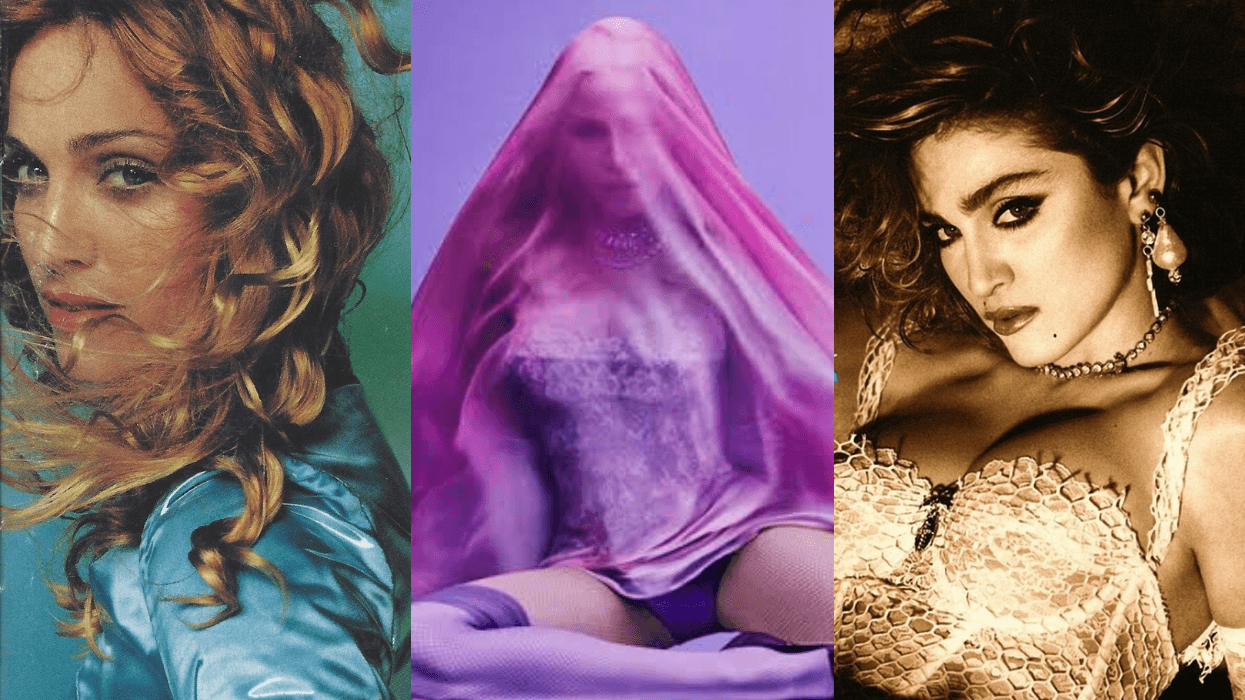
Like Madonna's best videos and music, W.E. is a pastiche of eras past and present, with a heavy emphasis on style, fashion, and design. Her presence is clearly felt. More oblique is the connection to Madonna's own life. The movie depicts Wallis as a dramatically different person than she was in her private, tortured reality. Wally's fantasy facade, concealing a darker truth, invites comparison to Madonna's now-dissolved marriage to filmmaker Guy Ritchie and raises the question of whether Madonna feels as vilified as Wallis.
"I was intrigued," Madonna says of the royals. She had a vague awareness of Wallis but only really got to know her story when she moved to England. "Like Wallis Simpson, I felt like an outsider. I thought, Life is so different here, and I'm used to being a New Yorker, and I have to learn how to drive on the other side of the road. Suddenly, I found myself living out in an English country house and trying to find my way in this world, so I decided to really take it on and do research and find out about English history and learn about the royal family."
Madonna read every book she could find about Simpson and her time. She became obsessed with the tragic notion that a woman then was only as good as the man she would marry. "The idea of making a choice for love wasn't really part of their world," says Madonna. "The fact that they eventually found each other and were willing to jump into this fishbowl of scandal and rile people up, even though Wallis knew, as she says in the film, that she would become the most hated woman in the world" -- that's what captivated Madonna.
While she doesn't claim the title "most hated" for herself, she feels a connection to Simpson. "I mean, I certainly don't engage [with the media] as much as I did," she says. "When people are writing about you in the beginning and they're saying nice things, you're like, 'Oh!' You feel this lift of energy. Then they say bad things, and of course, you're affected by that too."
Madonna spent a lot of time caring about the bad, but she claims to have moved on. "I don't really dwell on it anymore. I used to be kind of fixated on it and think, It's not fair, it's not fair, it's not fair, but it is what it is, and I just have to get on with my life."
But Madonna's passion for this topic belies that resolute attitude: "If you are threatened by me as a female or you think I'm doing too much or saying too much or being too much of a provocateur, then no matter how great of a song I write or how amazing of a film I make, you're not going to allow yourself to enjoy it, because you're going to be too entrenched in being angry with me or putting me in my place or punishing me."
 Meeting Madonna in person can be a little jarring. For someone so larger-than-life, she's surprisingly petite. Sitting down and launching into conversation, she is disarmingly engaged, and she slouches a bit, like any mere mortal. But she's not, of course. A burly man is guarding the door of the suite at New York's Waldorf-Astoria Hotel where she has settled in for the afternoon. And she's dressed eccentrically -- black leather fingerless Chanel gloves cover her hands, silver bracelets of varying shapes run up both forearms (and, predictably, a red kabbalah string), and a royal blue asymmetrical shift hugs her taut figure.
Her experience of feeling burned by the press has made her particularly deft at dodging questions, discussing what she wants to discuss. But after a few tangential monologues about duchesses and dowagers, the most famous woman in the world offers a bit of insight into the connection she feels to Wallis Simpson. "It's intriguing because we are raised to believe in the fairy-tale kind of love, that we are going to be swept off our feet by ... you know, in both of our cases, Mr. Right, and our knight in shining armor is going to come along and save us, pick us up, and put us on the back of his beautiful steed, and we're going to ride off into the sunset and live happily ever after." She pauses. "God knows, that doesn't happen."
Now she's on a roll. "There are so many things about her. The fact that she said he left his prison" -- Madonna's talking about King Edward feeling imprisoned by the monarchy -- "only to incarcerate me in a prison of my own." And with that, Madonna answers the question. And doesn't. "In spite of it all, I think she lived her life in a very dignified manner. And she wasn't a victim."
When Madonna first became famous, almost 30 years ago, she was defined by that very quality: She was no victim.
For the gay men who were there in the beginning, when she was shaking it on the dance floors of New York City, the men who reveled in her early hits, Madonna was the ultimate expression of in-your-face sexuality. She was self-possessed and uninhibited. She dressed up for the party, and she took it all off for the after-party.
Her impact wasn't limited to gay men. Madonna boldly toyed with transgender imagery on a grand stage: She co-opted the Harlem drag balls for the "Vogue" video, she featured trans people and cross-dressers of all stripes in her banned "Justify My Love" video, and her coffee-table tome, Sex, posited couples in all sorts of configurations. Her high profile are-they-or-aren't-they friendships with such queer women as Sandra Bernhard, Rosie O'Donnell, and Ingrid Casares as well as her promotion of bisexual artists like Meshell Ndegeocello helped to take queer sensibility into the mainstream.
In the midst of the AIDS crisis, when fear was rampant and gay men were dying at a horrifying rate, Madonna was among the first to take a stand, to say, as she did in the tour documentary Truth or Dare, that it's OK to be a gay man who is openly sexual.
"That it's OK to be gay, period," Madonna says emphatically before launching into an impassioned recounting of her experience of the AIDS onslaught. "I was extremely affected by it. I remember lying on a bed with a friend of mine who was a musician, and he had been diagnosed with this kind of cancer, but nobody knew what it was. He was this beautiful man, and I watched him kind of waste away, and then another gay friend, and then another gay friend, and then another gay friend. They were all artists and all truly special and dear to me."
In retrospect, Madonna sees that as the moment when her sense of self became entangled with that of gay men. "I saw how people treated them differently," she says. "I saw the prejudices, and I think probably I got that confused with, intertwined with, you know, maybe things that...ways that people treated me differently."
As Madonna reinvented herself, gay fans hung on through thick and thin, through Who's That Girl and Body of Evidence, weathering reported flings with Dennis Rodman and Vanilla Ice. Fans bowed down at the sight of her as Evita and shored up support upon hearing Ray of Light, only to have to endure Swept Away and American Life and that British accent. It's been a bumpy ride for Madonna fans.
Perhaps Madonna wasn't the only one to "confuse" her personal treatment with that of gay men. The feeling was mutual. As she exploded in popularity Madonna became identified with the collective gay male sense of self. So when she moved on, devoting less and less time to her gay compatriots, many felt a twinge of abandonment. That's when bitching about Madonna became the great gay pastime.
"I never left them," insists Madonna, echoing a lyric from Evita. "When you're single, you certainly have more time to socialize and hang out with your gay friends, but then you get married and you have a husband and you have children, and your husband wants you to spend time with him. I'm not married anymore, but I have four kids, and I don't have a lot of time for socializing." She's been back in New York for two years, after splitting with Ritchie.
"I hope nobody's taking that personally. It certainly was not a conscious decision. As it stands, most of my friends in England are gay. But I'm back," she says, adding reassuringly, "Never fear."
Madonna is most certainly back. And love her or hate her (or love her, then hate her, then love her again) one thing is for sure: The world-renowned provocateur, boundary-pushing mother of reinvention still makes news. Tidbits about her latest film and MDNA, her first album in four years, even her high-dollar, three-record deal with Interscope have sparked a host of headlines. As did the announcement of her Super Bowl halftime show. You can't get more all-American than that. (And, yes, she was warned to avoid a repeat of Janet Jackson's Nipplegate.)
Indeed, who hasn't already seen Madonna's nipples? Whether she was writhing in a wedding dress at the Video Music Awards or photographed while hitchhiking naked, when she rose to fame Madonna was all about pushing sexual boundaries. But sex is old news. Madonna paved the way, and everyone since -- including Britney Spears and Nicki Minaj, both of whom she's smooched -- has walked that path.
One such successor speaks to a new generation of LGBT fans. Recently Time magazine referred to Madonna as "the Lady Gaga of the '80s." When I ask about this, a bit of a chill sweeps over the room.
"I have no thoughts," she says. "What's the question?" So I ask it a different way: What do you think of how Gaga connects with her fans, and is it parallel to the relationship you had with gay fans early on?
Madonna pauses for a moment, composing herself. "It seems genuine," she says, also seeming genuine. "It seems natural, and I can see why she has a young gay following. I can see that they connect to her kind of not fitting into the conventional norm. I mean, she's not Britney Spears. She's not built like a brick shithouse. She seems to have had a challenging upbringing, and so I can see where she would also have that kind of connection, a symbiotic relationship with gay men."
To many fans, that symbiosis has the outward appearance of the relationship Madonna had with her gay fans earlier in her career. Gaga has an intertwined dependence in which her fans' pain and alienation are bound up with her own. Perhaps every generation gets the gay icon it needs. For today's wave of queer youth, it's Gaga, who is spreading the antibullying gospel. But she has undoubtedly taken cues from the Madonna playbook. Whether she's singing the "Express Yourself" -- reminiscent "Born This Way" or producing her Truth or Dare-like HBO concert film, Gaga is following a trail that Madonna blazed.
"I'm magnificent!" Madonna says initially when asked what she's like as a director. Then she gets serious. "I don't know -- I'm pretty methodical and detail-oriented, very specific with everybody from the camera crew to the actors to the costume designer to the hair and makeup people. I was very specific with everybody all the time. I love giving actors as much information as possible and helping them as much as I can and then leaving them alone if they want me to."
She learned that she is resilient, which one would think Madonna already knows. "Yeah, but now I really know that," she says, pointing out that she wrote a script that takes place on two continents and in two time periods with two sets of actors. It's a pretty complicated undertaking for a novice director.
Making a movie is never an easy process, and yet Madonna keeps at it, sometimes with little success. Early press releases for W.E. touted it as "Madonna's directorial debut," a misrepresentation that has since been corrected. But for most of the world, it may as well be. Hardly anyone saw the last one she directed, 2008's Filth and Wisdom.
"Madonna is self-aware enough to know that there are people who actively dislike her, who don't know her and yet presume that they do and pass vitriolic judgments against her," says Alek Keshishian, who ought to know. He directed Truth or Dare 21 years ago and teamed up with Madonna again on W.E., for which they're co-screenwriters.
"I was like 23 years old when she called me to do Truth or Dare," says Keshishian, who went on to direct the film With Honors as well as numerous commercials. "We always remained in touch."
Though he's used to being in the director's chair himself, Keshishian recognized that in this situation Madonna's in charge. It's a characterization she doesn't attempt to dispute. "Yeah, yeah, for sure," she says, shedding a bit of light on their method. "We're like two schoolchildren. I would look away, and then I would look up at the screen and he would have typed something completely X-rated and pornographic."
But Madonna would never participate in that, right? "No, no," she says, grinning broadly. "Well, he would drag me into it. And then I would be like, 'OK, OK, let's stop this, we have to get back to work.' And then he would get on his BlackBerry and I'd scream at him, and then I would have to go and do something with one of my kids and he would scream at me, and we would accuse each other of being unprofessional."
Madonna is even more firm as a parent. "I'm a strict mother," she says. "My daughter doesn't know why I won't allow her to get everything pierced or a tattoo or dye her hair blond on the tips and pink at the roots." Lourdes, 15 now, can do any of those things once she's 18. "But from now until then..."
Like most mothers, Madonna can be more than a bit embarrassing. "They just really want me to just be Mom and be normal, and don't show up dressed in any outlandish way," says the woman who's not accustomed to deflecting attention. "Just come to school, do the parent-teacher meetings. I can't even wear a tracksuit. That attracts attention too. You know, they don't really want to see me as a famous person or a celebrity or somebody. They don't get it right now. They think I'm a little quirky."
Recently she's found herself wistful for the old days. "Reading Patti Smith's book Just Kids really helped me," says Madonna, reminded of her early days in New York, that magical time when being creative and innocent and free was everything. "It's important to remember that and bring that forward into your life and to have spontaneous moments." She decided to reclaim a bit of that lost impulsiveness recently. "On Sunday, I squeezed my four kids into the car and [went] shopping in East Hampton. It was very weird. The people in Ralph Lauren were not prepared. I never go shopping. And my daughter was looking like" -- Madonna scrunches up her nose, as if in disbelief -- "because she's always trying to get me to go shopping, and I never will. That was fun."
It seems that Madonna is still enjoying what she's doing. She even seems to have mellowed a bit. Reinvention? Maybe, at 53, she's had enough of that. "Is making a film reinventing myself?" she asks. "I don't think so. I'm just telling stories with different clothes on."