'%3E%3Cpath d='M16.3574 35.6519H12.9537L15.0491 18.8873L16.3574 35.6519ZM30.4229 54.0093L22.309 0.994385H7.91795L0 54.0093H10.6634L11.5802 46.3855H17.4014L17.9914 54.0093H30.4229Z' fill='%23971B20'/%3E%3Cpath d='M48.2073 41.8813C48.2073 43.4049 47.4892 44.0011 46.1144 44.0011H43.7595V11.0687H46.1144C47.4892 11.0687 48.2073 11.6636 48.2073 13.1885V41.8813ZM59.5273 43.6695V11.3326C59.5273 3.71323 53.5729 0.994385 47.8157 0.994385H31.7213V54.0093H47.8157C53.5729 54.0093 59.5273 51.29 59.5273 43.6695Z' fill='%23971B20'/%3E%3Cpath d='M90.183 0.994385H78.6039L75.0711 30.6157L71.9955 0.994385H59.4346L69.2474 54.0093H80.373L90.183 0.994385Z' fill='%23971B20'/%3E%3Cpath d='M107.063 42.3448C107.063 43.7359 105.951 44.5974 104.643 44.5974C103.269 44.5974 102.157 43.7359 102.157 42.3448V12.658C102.157 11.2676 103.269 10.4058 104.643 10.4058C105.951 10.4058 107.063 11.2676 107.063 12.658V42.3448ZM119.233 43.2723V11.7312C119.233 6.36384 112.952 -3.8147e-06 104.643 -3.8147e-06C96.2667 -3.8147e-06 89.9867 6.36384 89.9867 11.7312V43.2723C89.9867 48.6393 96.2667 55 104.643 55C112.952 55 119.233 48.6393 119.233 43.2723Z' fill='%23971B20'/%3E%3Cpath d='M150.976 43.9349V33.7309H139.069V42.3448C139.069 43.7359 137.957 44.5974 136.582 44.5974C135.076 44.5974 133.964 43.7359 133.964 42.3448V12.658C133.964 11.2676 135.076 10.4058 136.582 10.4058C137.957 10.4058 139.069 11.2676 139.069 12.658V21.2723H150.976V11.0687C150.976 5.70107 145.283 -3.8147e-06 136.582 -3.8147e-06C127.75 -3.8147e-06 121.796 5.70107 121.796 11.0687V43.9349C121.796 49.3022 127.75 55 136.582 55C145.283 55 150.976 49.3022 150.976 43.9349Z' fill='%23971B20'/%3E%3Cpath d='M167.478 35.6519H164.076L166.17 18.8873L167.478 35.6519ZM181.544 54.0093L173.432 0.994385H159.037L151.123 54.0093H161.785L162.704 46.3855H168.523L169.114 54.0093H181.544Z' fill='%23971B20'/%3E%3Cpath d='M205.412 10.4058V0.994385H177.081V10.4058H185.392V54.0093H197.428V10.4058H205.412Z' fill='%23971B20'/%3E%3Cpath d='M230.002 54.0093V43.9349H218.914V31.8746H226.635V21.8028H218.914V10.4058H230.002V0.994385H206.875V54.0093H230.002Z' fill='%23971B20'/%3E%3C/g%3E%3Cdefs%3E%3CclipPath id='clip0_260_7080'%3E%3Crect width='230' height='55' fill='white'/%3E%3C/clipPath%3E%3C/defs%3E%3C/svg%3E)
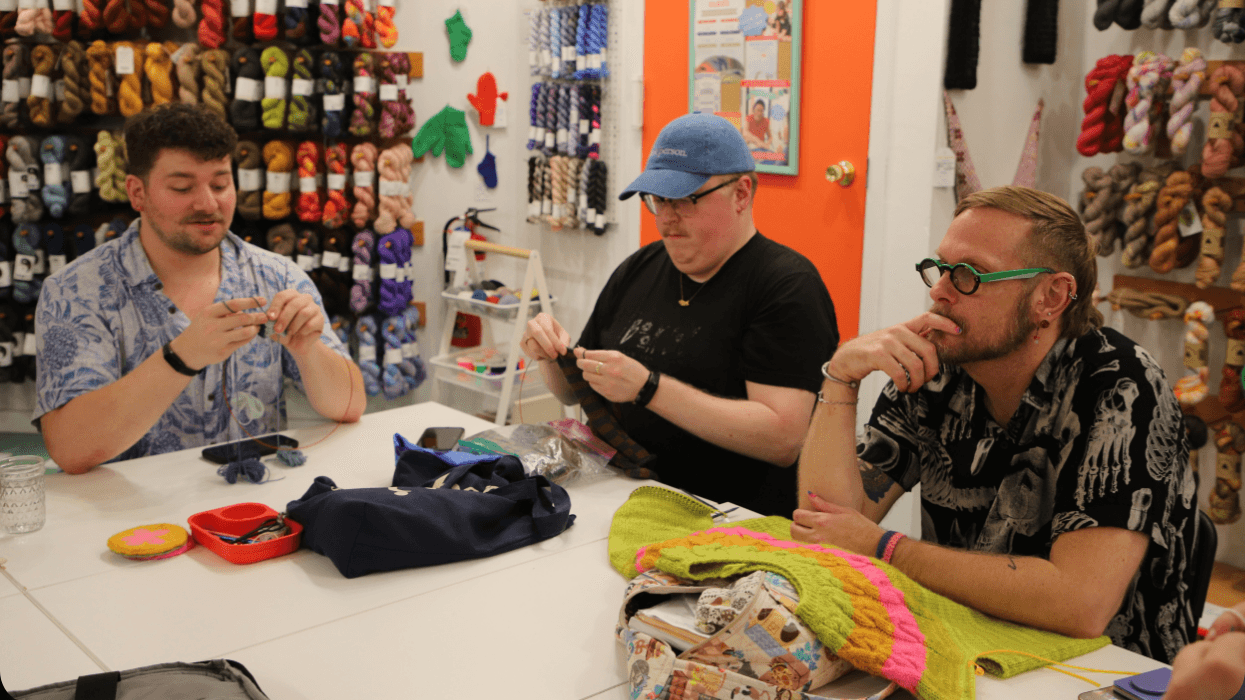
Avi Molder worked quickly through the stitches of a shirt at Cleo’s Yarn Shop in Brooklyn. He first learned to knit through his mother, and honed his skills more fully as an adult. At the shop’s monthly men’s night, Molder found a comfortable place to practice — and spend time with the boys.
“I definitely wouldn’t hang out with an exclusive group of men and not knit,” Molder, a New York City resident who works in publishing, told The Advocate.
Contemporary knitting is borne from household labor historically done by women, and hobbyists say the craft is often still viewed as intrinsically feminine. But across the country, groups of men gather regularly at yarn shops, community centers, and overnight retreats just to knit together. By carving out these spaces, men are using the craft to forge bonds around their masculinity; and, in equal measure, to deconstruct it.
For some LGBTQ+ participants, these groups offer something particularly welcome: a place to connect with other men without feeling pressure to perform a certain kind of manhood.
The Advocate visited two men’s knitting groups in New York City. They included the monthly gathering at Cleo’s in Bushwick, and another weekly meetup at Knitty City on Manhattan’s Upper West Side, where men have been gathering for 20 years.
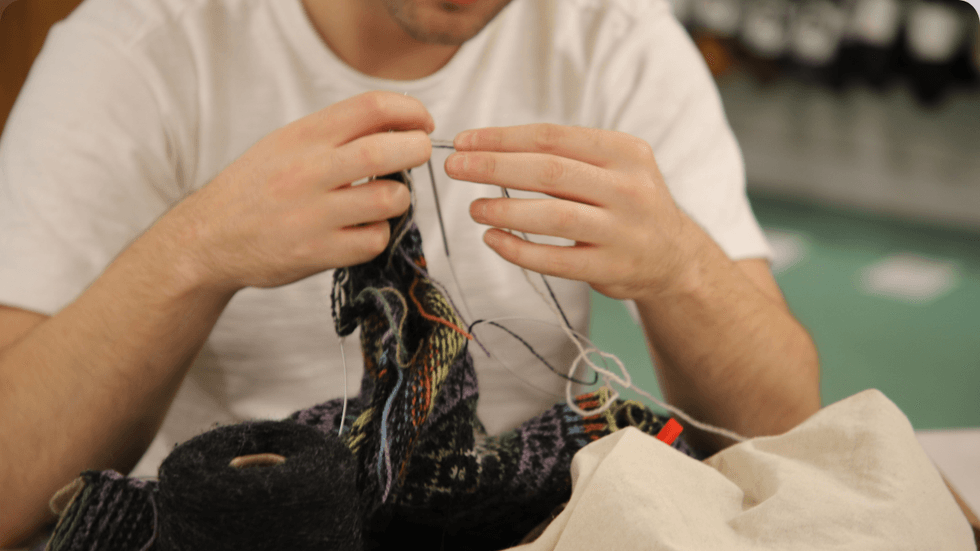 Brian Cooper works on a Fair Isle sweater, a multicolor garment that originated in Scotland. Jack Walker/The Advocate
“It’s a weekly group that my mom first started when she opened up the store,” Zac Chin, manager of Knitty City, told The Advocate. “Knitting itself is a very female-dominated space, so she wanted to make sure that it was very inclusive, and that we had space for men to come without feeling like they were the outsiders.”
Men who spoke with The Advocate widely agreed that gender stereotypes around knitting initially kept them from learning to knit or practicing openly. Brian Cooper grew up around women who regularly knitted and crocheted, but didn’t feel comfortable exploring his own interest until his mid-20s.
“There’s a familial connection, but there’s something in me that was like, ‘Well, no, I can’t do that. That’s gendered. That crosses some line.’ Like, what if someone saw me on the subway doing that?” he said. “It’s just such a silly instinct. But I guess it’s taken some training mentally to not have that knee-jerk reaction.”
Participants described the gatherings as a way to explore male friendship with fewer rigid expectations. That appealed to LGBTQ+ men who felt unwelcome in groups of cisgender, heterosexual men, as well as others uncomfortable in overtly masculine settings. “It softens some of that baggage, and lets me embrace the rest of masculinity that I enjoy,” Molder said.
Still, the premise of joining an all men's space, even just to knit, struck some members as intimidating.
“I was kind of daunted by it being a men’s group, just because I generally am more comfortable around women,” said Arik Hardin, a participant at Cleo’s. “But I wanted to try to get out of my comfort zone.”
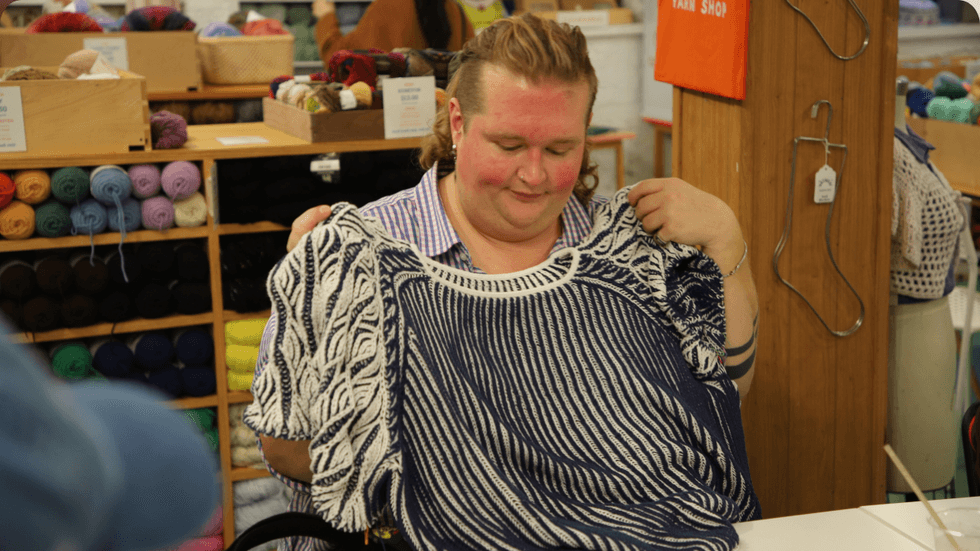 Brady Mabe holds up a nearly complete sweater using a technique called the brioche stitch. Jack Walker/The Advocate
For Ian McDonald, a bisexual knitter from Briarwood, Queens, the groups have helped him find a sense of belonging.
“There do tend to be more gay men in the community of knitters, I find, and that’s where I am comfortable,” McDonald said. “I’ve always looked for where I fit in the community, and I guess this is where I fit.”
Both yarn shops The Advocate visited are calm, cozy spaces, leaning into a homey aesthetic popular in the knitting community. Men’s group participants gathered around large crafting tables, tools and materials splayed out. Walls of plush, colorful yarn lined each room.
The two groups meet monthly, and other men’s groups around the country, from California to Minnesota to Texas, meet just as regularly. Returning to the same table gives participants time to get to know one another and develop friendships beyond a single meetup.
“It’s one of my social outlets,” said Wally Planell, an attendee at Knitty City. “To come here and knit, chat with the guys, meet new people.”
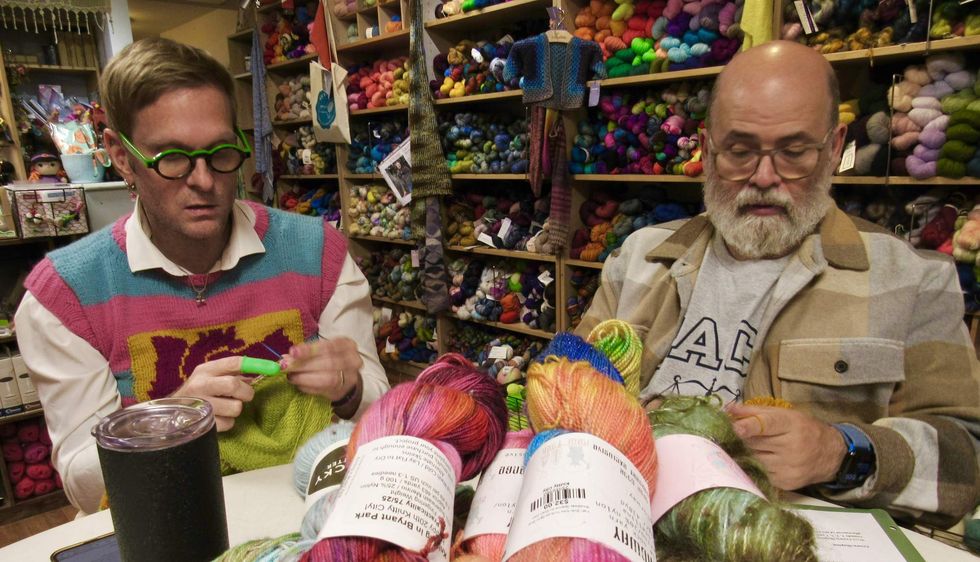 From left, Ian McDonald and Wally Planell work on projects at Knitty City, located in New York City's Upper West Side. Jack Walker/The Advocate
Participants at the two meetups agreed that conversation flows easily during men’s nights. In part, that is because of the welcoming culture the groups curate, and a shared hobby that unites attendees.
“You can jump into the conversation. Then, if you don’t have anything to say, you are focusing on your knitting and listening to the conversation around you,” said Brady Mabe, an attendee at Cleo’s.
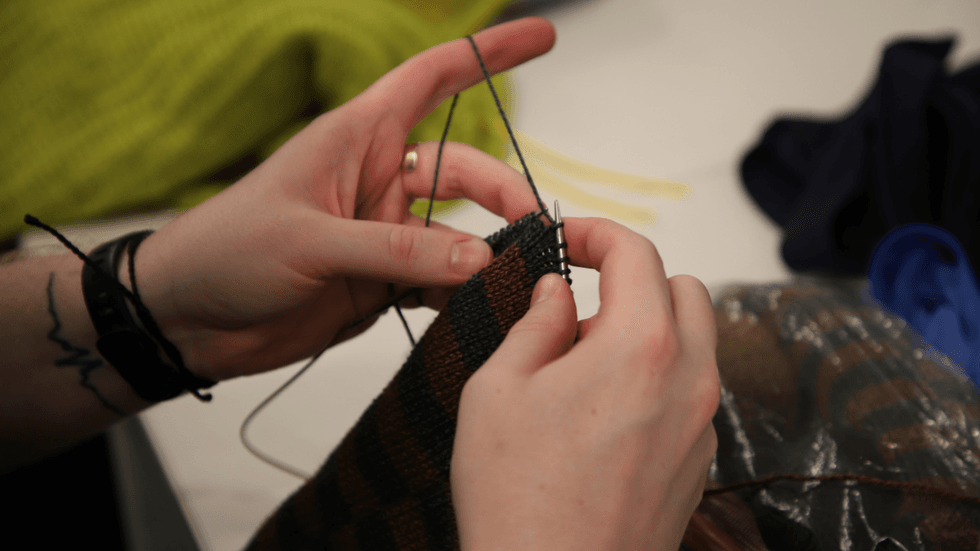
Plus, knitting is a slow, quiet craft, which lends itself well to dialogue. Having something to do with their hands can make personal conversations feel less awkward, participants said, opening space for vulnerability that can be harder to find in other men’s spaces.
“I don’t think it’s the men’s part of this that makes it very feelings-y,” Molder said. “Craft circles are very, like — just chat about whatever you want. Or, you don’t have to chat. It’s very low pressure.”
“There’s no sort of expectation around it. No pressure,” Mabe agreed. “You just show up, and you can be part of the conversation if you want to. I do think that it is a good conduit for opening people up.”
 Arik Hardin works on a knitting project. Jack Walker/The Advocate
Those connections can extend well beyond the yarn shop. Knitting festivals and conferences give enthusiasts opportunities to socialize, shop and share their work.
For some men, overnight retreats offer a chance to spend more time together on trips to the countryside.
McDonald said those outings have become a gathering point for a smaller circle within the city’s men’s knitting community.
And the more he surrounds himself with other men who knit, the less McDonald cares about the gendered stereotypes others might place on him. Being around other men immersed in the hobby makes knitting feel masculine, he said.
“The first fall [knitting] retreat I went to, I kind of equated it to my brothers and my father who go hunting,” McDonald said. “They go on hunting trips, and I have my knitting retreat.”
NEW! Please make a tax-deductible donation to The Advocate Journalism Project to directly support LGBTQ+ journalism. Help us expand our Washington, D.C., bureau to bring you more breaking news from the nation's capital and fund crucial investigative reporting, compelling video reports, and sustain our 60-year print archive, a history of the queer civil rights movement.