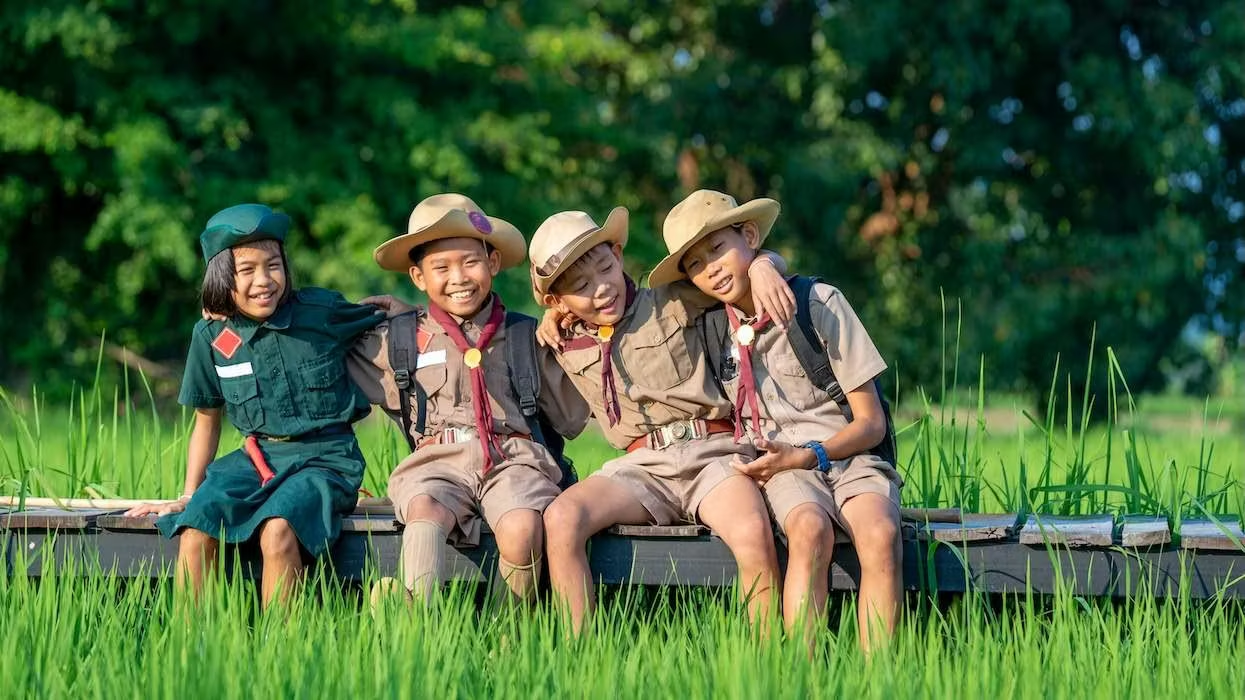
Scouting America, formerly the Boy Scouts of America, is being threatened by the Department of Defense for being too inclusive.
Defense Secretary Pete Hegseth accused the group of trying to "attack boy-friendly spaces" when it made the decision to become "genderless" in a leaked memo to Congress obtained by NPR. The memo, which has not yet been sent, calls for the Department of Defense to withdraw medical and logistical assistance during the group's National Jamboree, an event with over 20,000 attendees, and to bar Scout troops from military installations.
The name change, which was announced last year, is one of the things bothering Hegseth, and he has also claimed the group is promoting diversity, equity, and inclusion, as though that is a bad thing. The organization changed its name to stress that it has become open to girls and transgender boys. It had already lifted its ban on gay and bisexual boys and adult leaders, which had been the subject of arguments for years, spurring a case that went to the U.S. Supreme Court.
During the BSA's fight against lifting that ban, it faced scandal and bankruptcy over revelations of sexual abuse, while the Girl Scouts became a more progressive option. Here’s a look at the evolution of Scouting America.
The name change
The name change to Scouting America took effect February 8 of this year, the BSA’s 115th anniversary.
“Though our name will be new, our mission remains unchanged: We are committed to teaching young people to be Prepared. For Life,” said a statement from Roger A. Krone, the group’s president and CEO, when announcing the rebranding. “This will be a simple but very important evolution as we seek to ensure that everyone feels welcome in Scouting.”
How did the group become exclusionary and then inclusive?
The BSA put its ban on gay and bisexual Scouts and leaders in place in 1978, according to Scouts for Equality, which worked to make the BSA a more inclusive organization. Perhaps the BSA hadn’t considered the possibility of gay or bi members earlier.
There were many legal challenges to the ban. The most high-profile case, which went all the way to the U.S. Supreme Court was brought by James Dale, a New Jersey man who was removed as an assistant scoutmaster when the BSA and its local council learned he was gay. (Or, as then-Chief Justice William Rehnquist put it in his Supreme Court ruling, “an avowed homosexual.”)
Dale argued that the BSA was violating New Jersey’s law banning discrimination based on sexual orientation in public accommodations. But the Supreme Court found, in a 5-4 ruling, that being forced to accept gay or bi members and leaders would interfere with the Scouts’ “freedom of expressive association.”
The BSA lifted the ban on gay and bi youth members at the beginning of 2014, and in 2015, it decided to allow gay and bi adult leaders, with the caveat that church-sponsored troops could still exclude anyone who offended their religious sensibilities. In lifting the ban, the Scouts cited “the rapid changes in society and increasing legal challenges at the federal, state, and local levels.”
In 2017, the group announced that it would accept girls and transgender boys. Girls aged 7 to 10 began joining the Cub Scouts in 2018, and those aged 11 to 17 years old became eligible to join the main program, Scouts BSA, in 2019. So far there are more than 176,000 girls among the 1 million young people in Scouting programs.
What were the Girl Scouts doing?
The Girl Scouts, in contrast, had long had inclusive policies, including the acceptance of trans girls at least as far back as 2011, when news broke that a Denver troop had a trans member. Amid backlash from right-wing groups, including the American Family Association, the Girl Scouts released this statement in 2015: “If a girl is recognized by her family, school and community as a girl and lives culturally as a girl, Girl Scouts is an organization that can serve her in a setting that is both emotionally and physically safe. Inclusion of transgender girls is handled at a council level on a case by case basis, with the welfare and best interests of all members as a top priority.”
The far right has continued to denounce the Girl Scouts’ LGBTQ+ inclusion and also claim that the organization, God forbid, has partnered with Planned Parenthood and promoted contraception and abortion rights. For the record, the group has no relationship with Planned Parenthood and takes no stand on political issues, including reproductive rights.
How much did the sexual abuse scandal hurt the Boy Scouts?
A lot. The BSA spent more than $150 million over the past few years to settle lawsuits over sexual abuse, and it filed for bankruptcy in 2020. After it emerged from bankruptcy, it set up a court-ordered Victims Compensation Trust that will pay out a total of $2.4 billion to 82,000 abuse survivors.
“Our hope is that our Plan of Reorganization will bring some measure of peace to survivors of past abuse in Scouting, whose bravery, patience and willingness to share their experiences has moved us beyond words,” Chief Scout Executive, President, and CEO Roger Mosby said in a 2023 statement.
Responding to Hegseth's threat
A spokesperson for Scouting America told The Advocate that the group is "surprised and disappointed by today’s news about the potential policy change," especially given that "the Scouting movement has had a strong relationship with our nation’s military going back more than a century."
"Scouting is and has always been a nonpartisan organization," the spokesperson said. "Over more than a century, we’ve worked constructively with every U.S. presidential administration — Republican and Democrat — focusing on our common goal of building future leaders grounded in integrity, responsibility, and community service."
"Scouting’s American values have not changed. We remain steadfast in our 115-year mission to prepare young people for life by instilling in them the values of character, leadership, citizenship, and service," the spokesperson continued. "We have long been proud of the shared commitment to preparing youth for lives of service and leadership – values that transcend politics and reflect the best of our country’s spirit."



























Charlie Kirk DID say stoning gay people was the 'perfect law' — and these other heinous quotes