'%3E%3Cpath d='M16.3574 35.6519H12.9537L15.0491 18.8873L16.3574 35.6519ZM30.4229 54.0093L22.309 0.994385H7.91795L0 54.0093H10.6634L11.5802 46.3855H17.4014L17.9914 54.0093H30.4229Z' fill='%23971B20'/%3E%3Cpath d='M48.2073 41.8813C48.2073 43.4049 47.4892 44.0011 46.1144 44.0011H43.7595V11.0687H46.1144C47.4892 11.0687 48.2073 11.6636 48.2073 13.1885V41.8813ZM59.5273 43.6695V11.3326C59.5273 3.71323 53.5729 0.994385 47.8157 0.994385H31.7213V54.0093H47.8157C53.5729 54.0093 59.5273 51.29 59.5273 43.6695Z' fill='%23971B20'/%3E%3Cpath d='M90.183 0.994385H78.6039L75.0711 30.6157L71.9955 0.994385H59.4346L69.2474 54.0093H80.373L90.183 0.994385Z' fill='%23971B20'/%3E%3Cpath d='M107.063 42.3448C107.063 43.7359 105.951 44.5974 104.643 44.5974C103.269 44.5974 102.157 43.7359 102.157 42.3448V12.658C102.157 11.2676 103.269 10.4058 104.643 10.4058C105.951 10.4058 107.063 11.2676 107.063 12.658V42.3448ZM119.233 43.2723V11.7312C119.233 6.36384 112.952 -3.8147e-06 104.643 -3.8147e-06C96.2667 -3.8147e-06 89.9867 6.36384 89.9867 11.7312V43.2723C89.9867 48.6393 96.2667 55 104.643 55C112.952 55 119.233 48.6393 119.233 43.2723Z' fill='%23971B20'/%3E%3Cpath d='M150.976 43.9349V33.7309H139.069V42.3448C139.069 43.7359 137.957 44.5974 136.582 44.5974C135.076 44.5974 133.964 43.7359 133.964 42.3448V12.658C133.964 11.2676 135.076 10.4058 136.582 10.4058C137.957 10.4058 139.069 11.2676 139.069 12.658V21.2723H150.976V11.0687C150.976 5.70107 145.283 -3.8147e-06 136.582 -3.8147e-06C127.75 -3.8147e-06 121.796 5.70107 121.796 11.0687V43.9349C121.796 49.3022 127.75 55 136.582 55C145.283 55 150.976 49.3022 150.976 43.9349Z' fill='%23971B20'/%3E%3Cpath d='M167.478 35.6519H164.076L166.17 18.8873L167.478 35.6519ZM181.544 54.0093L173.432 0.994385H159.037L151.123 54.0093H161.785L162.704 46.3855H168.523L169.114 54.0093H181.544Z' fill='%23971B20'/%3E%3Cpath d='M205.412 10.4058V0.994385H177.081V10.4058H185.392V54.0093H197.428V10.4058H205.412Z' fill='%23971B20'/%3E%3Cpath d='M230.002 54.0093V43.9349H218.914V31.8746H226.635V21.8028H218.914V10.4058H230.002V0.994385H206.875V54.0093H230.002Z' fill='%23971B20'/%3E%3C/g%3E%3Cdefs%3E%3CclipPath id='clip0_260_7080'%3E%3Crect width='230' height='55' fill='white'/%3E%3C/clipPath%3E%3C/defs%3E%3C/svg%3E)
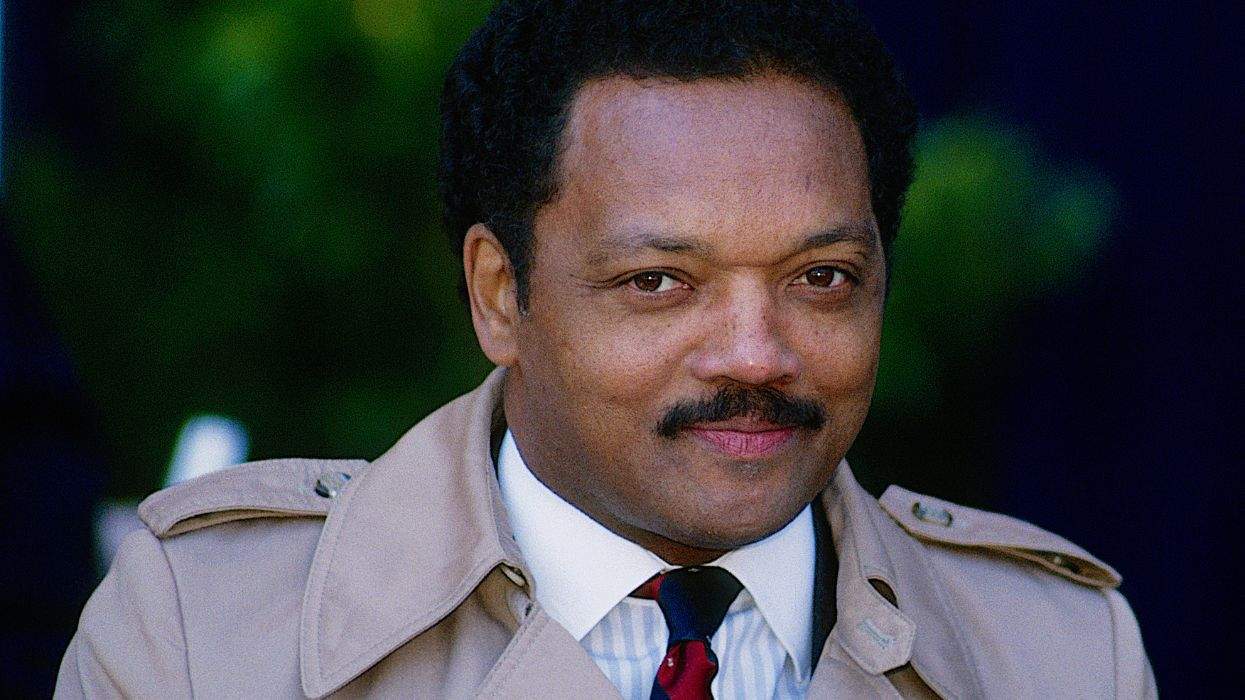

The Rev. Jesse Jackson, the civil rights leader who died Tuesday morning at age 84, was a longtime supporter of LGBTQ+ equality, arguing for an inclusive and intersectional movement championing the rights of all marginalized people.
Jackson fought against racial segregation as a young man, both independently and as a staffer for the Rev. Martin Luther King Jr.’s Southern Christian Leadership Conference. He was among the people present when King was assassinated in Memphis, Tennessee, in 1968. Jackson left the SCLC in 1971 and founded People United to Save Humanity, or Operation PUSH, in his adopted hometown of Chicago.
He sought the 1984 Democratic presidential nomination and at this time spoke out extensively for LGBTQ+ rights. The nomination went to former Vice President Walter Mondale, but Jackson gave a major speech at the 1984 convention.
“America is not like a blanket — one piece of unbroken cloth, the same color, the same texture, the same size. America is more like a quilt — many patches, many pieces, many colors, many sizes, all woven and held together by a common thread,” he said. “The white, the Hispanic, the black, the Arab, the Jew, the woman, the native American, the small farmer, the businessperson, the environmentalist, the peace activist, the young, the old, the lesbian, the gay, and the disabled make up the American quilt.” He was the first person to say the words “lesbian” and “gay” in a national convention speech.
He spoke of a “rainbow coalition,” saying, “The rainbow includes lesbians and gays. No American citizen ought to be denied equal protection from the law.” His Rainbow Coalition organization grew out of his presidential campaign, and in 1996 it merged with PUSH. The group is now the Rainbow PUSH Coalition.
“One of the many things the queer community loved about the Reverend, he wasn’t doing any of this for show,” WEHO Online notes. “Both of his presidential campaigns put queer rights front and center in ways no candidate ever dared to do before. He talked openly about ending employment discrimination against gay workers, pushed for more federal AIDS research money, and wanted the military ban on openly gay service members gone. He hired openly gay staffers and built volunteer networks inside the community, something no presidential campaign had bothered to do.”
On October 11, 1987, while seeking the 1988 Democratic presidential nomination, Jackson was one of the leaders of the Second National March on Washington for Lesbian and Gay Rights. He walked at the head of the march alongside entertainer-activist Whoopi Goldberg, labor organizer Cesar Chavez, and feminist leader Eleanor Smeal. Addressing the crowd that night, Jackson said, “We gather today to say that we insist on equal protection under the law for every American, for workers’ rights, women’s rights, for the rights of religious freedom, the rights of individual privacy, for the rights of sexual preference. We come together for the rights of all American people.”
Related: Organizing the '87 March, Sans Email
Jackson lost the nomination to Massachusetts Gov. Michael Dukakis but continued with his activism. He spoke at the 1993 March on Washington for Lesbian, Gay, and Bi Equal Rights and Liberation, telling attendees, “No more homophobia. Let’s respect people, protect people. Everyone is somebody.” He visited AIDS hospices, often staying overnight. And he successfully advocated for the Democratic platform to include gay rights.
He spoke out for marriage equality. “Gays deserve the right of choice to choose their own partners,” Jackson said in a 2004 speech in Massachusetts, which had become the first state to establish marriage rights for same-sex couples. “If you don’t agree, don't participate and don’t perform the service. In my culture, marriage is a man-woman relationship, but under the law people have a right to choose their own partner.”
In 2010, Jackson attended a rally at the U.S. Court of Appeals for the Ninth Circuit, which was then considering a case challenging California’s anti-marriage equality Proposition 8. “We stand with you today to support marriage equality and to declare that Proposition 8 must be struck down as unconstitutional,” he said at the event. “People’s right to self-expression, self-determination, be respected and affirmed. It’s time to challenge ignorance, a time to break the silence and the chains of hatred, of divisive and discriminatory bigotry. Marriage is based on love and commitment — not on sexual orientation. I support the right for any person to marry the person of their choosing.”
Two years later, when President Barack Obama came out for marriage equality, Jackson supported him. “This is a bold step in the right direction for equal protection under the law for all citizens,” Jackson told the Los Angeles Times.
He once had a cordial relationship with Donald Trump, who donated office space in New York City to the Rainbow PUSH Coalition in 1997 for its project of pushing major corporations to be more inclusive. But Jackson began to oppose Trump after the latter promoted the “birther” conspiracy theory, claiming Obama was not born in the U.S. and therefore could not be president. Jackson also objected to Trump’s ideas about foreign policy, immigration, and the Affordable Care Act. Trump has long vowed to repeal and replace the ACA, but that hasn’t happened.
“These ideas are not just conservative, they are somewhat way off the main line,” Jackson told Bloomberg Television in 2016. “They could destabilize the country.” He endorsed Hillary Clinton in the 2016 presidential election.
Two of Jackson’s sons, both Democrats, have served in the U.S. House of Representatives, representing Illinois districts, and have been LGBTQ+ allies. Jesse Jackson Jr. was a member from 1995 to 2012, earning perfect scores on the Human Rights Campaign’s Congressional Scorecard throughout his tenure, but he resigned amid allegations of misuse of campaign funds. He was eventually charged, pleaded guilty, and spent time in prison. Jonathan Jackson has been a member since 2023 and received a score of 94 out of 100 from HRC in his first term. This month, he spoke at the National Prayer Breakfast, urging Trump to be “invested in the elevation of suffering” of Americans, including “the families preparing to bury their loved ones in Minneapolis.”
Tributes to their father are coming in from LGBTQ+ activists and others. “The fight for justice requires courage, hope, and a relentlessness that will not be denied. Rev. Jesse Jackson embodied that fight every day,” said a statement from HRC President Kelley Robinson. “From disrupting political systems and building people power to helping this country imagine a freer future for all of us, Rev. Jackson was a force. … His support for marriage equality and for LGBTQ+ people affirmed a simple, powerful truth: Our liberation is bound together.”
U.S. Rep. Ritchie Torres of New York, the only Black gay member of the House, posted on X, “Rev. Jesse Jackson was a towering figure in the fight for civil rights and economic justice. He spent his life speaking up for people who too often went unheard and pushing America to live up to its true promise. We stand on the shoulders of his courage, faith, and lifelong commitment to equality.”
U.S. Sen. Tammy Baldwin of Wisconsin, a lesbian, also paid tribute on X: “Reverend Jesse Jackson was a giant in the fight for civil rights, and all Americans are better for his work. Today, we remember his incredible legacy and life’s work to uplift the oppressed, build bridges, and make justice for all a reality.”
U.S. Rep. Mark Pocan of Wisconsin, a gay man, posted on Threads, “Reverend Jesse Jackson was an American icon who dedicated his life to fighting for racial and economic justice and stood with the LGBTQI+ community before it was politically safe. He continued Dr. King’s work by pushing America to live up to its founding ideals. Now it is our turn to continue the fight.”
U.S. Rep. Eric Sorensen of Illinois, also gay, was sworn in to Congress the same time as Jackson’s son Jonathan, and Rev. Jackson was present. “The next day, my Dad told me how much Jesse Jackson meant to him over the years,” Sorensen wrote on X. “‘And it means a lot that I feel the same pride for my son as Jesse Jackson feels for his.’ It’s a memory I won’t ever forget. And a reminder that we all stand on the shoulders of giants.”