'%3E%3Cpath d='M16.3574 35.6519H12.9537L15.0491 18.8873L16.3574 35.6519ZM30.4229 54.0093L22.309 0.994385H7.91795L0 54.0093H10.6634L11.5802 46.3855H17.4014L17.9914 54.0093H30.4229Z' fill='%23971B20'/%3E%3Cpath d='M48.2073 41.8813C48.2073 43.4049 47.4892 44.0011 46.1144 44.0011H43.7595V11.0687H46.1144C47.4892 11.0687 48.2073 11.6636 48.2073 13.1885V41.8813ZM59.5273 43.6695V11.3326C59.5273 3.71323 53.5729 0.994385 47.8157 0.994385H31.7213V54.0093H47.8157C53.5729 54.0093 59.5273 51.29 59.5273 43.6695Z' fill='%23971B20'/%3E%3Cpath d='M90.183 0.994385H78.6039L75.0711 30.6157L71.9955 0.994385H59.4346L69.2474 54.0093H80.373L90.183 0.994385Z' fill='%23971B20'/%3E%3Cpath d='M107.063 42.3448C107.063 43.7359 105.951 44.5974 104.643 44.5974C103.269 44.5974 102.157 43.7359 102.157 42.3448V12.658C102.157 11.2676 103.269 10.4058 104.643 10.4058C105.951 10.4058 107.063 11.2676 107.063 12.658V42.3448ZM119.233 43.2723V11.7312C119.233 6.36384 112.952 -3.8147e-06 104.643 -3.8147e-06C96.2667 -3.8147e-06 89.9867 6.36384 89.9867 11.7312V43.2723C89.9867 48.6393 96.2667 55 104.643 55C112.952 55 119.233 48.6393 119.233 43.2723Z' fill='%23971B20'/%3E%3Cpath d='M150.976 43.9349V33.7309H139.069V42.3448C139.069 43.7359 137.957 44.5974 136.582 44.5974C135.076 44.5974 133.964 43.7359 133.964 42.3448V12.658C133.964 11.2676 135.076 10.4058 136.582 10.4058C137.957 10.4058 139.069 11.2676 139.069 12.658V21.2723H150.976V11.0687C150.976 5.70107 145.283 -3.8147e-06 136.582 -3.8147e-06C127.75 -3.8147e-06 121.796 5.70107 121.796 11.0687V43.9349C121.796 49.3022 127.75 55 136.582 55C145.283 55 150.976 49.3022 150.976 43.9349Z' fill='%23971B20'/%3E%3Cpath d='M167.478 35.6519H164.076L166.17 18.8873L167.478 35.6519ZM181.544 54.0093L173.432 0.994385H159.037L151.123 54.0093H161.785L162.704 46.3855H168.523L169.114 54.0093H181.544Z' fill='%23971B20'/%3E%3Cpath d='M205.412 10.4058V0.994385H177.081V10.4058H185.392V54.0093H197.428V10.4058H205.412Z' fill='%23971B20'/%3E%3Cpath d='M230.002 54.0093V43.9349H218.914V31.8746H226.635V21.8028H218.914V10.4058H230.002V0.994385H206.875V54.0093H230.002Z' fill='%23971B20'/%3E%3C/g%3E%3Cdefs%3E%3CclipPath id='clip0_260_7080'%3E%3Crect width='230' height='55' fill='white'/%3E%3C/clipPath%3E%3C/defs%3E%3C/svg%3E)
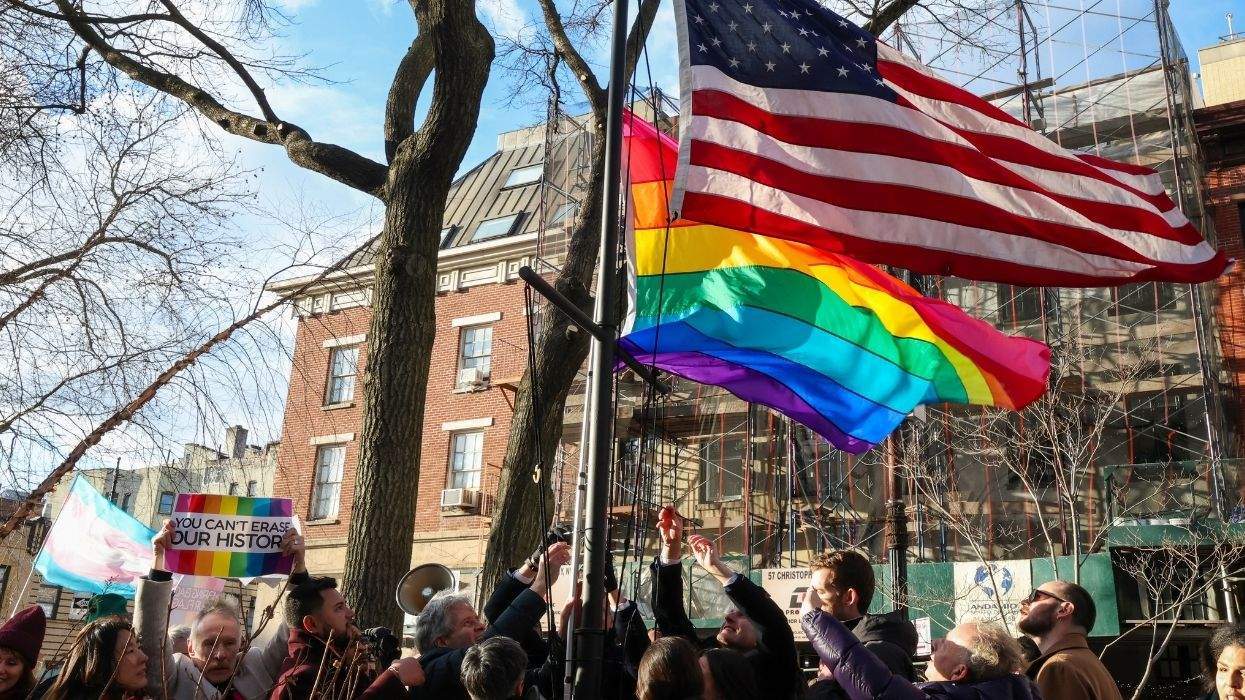
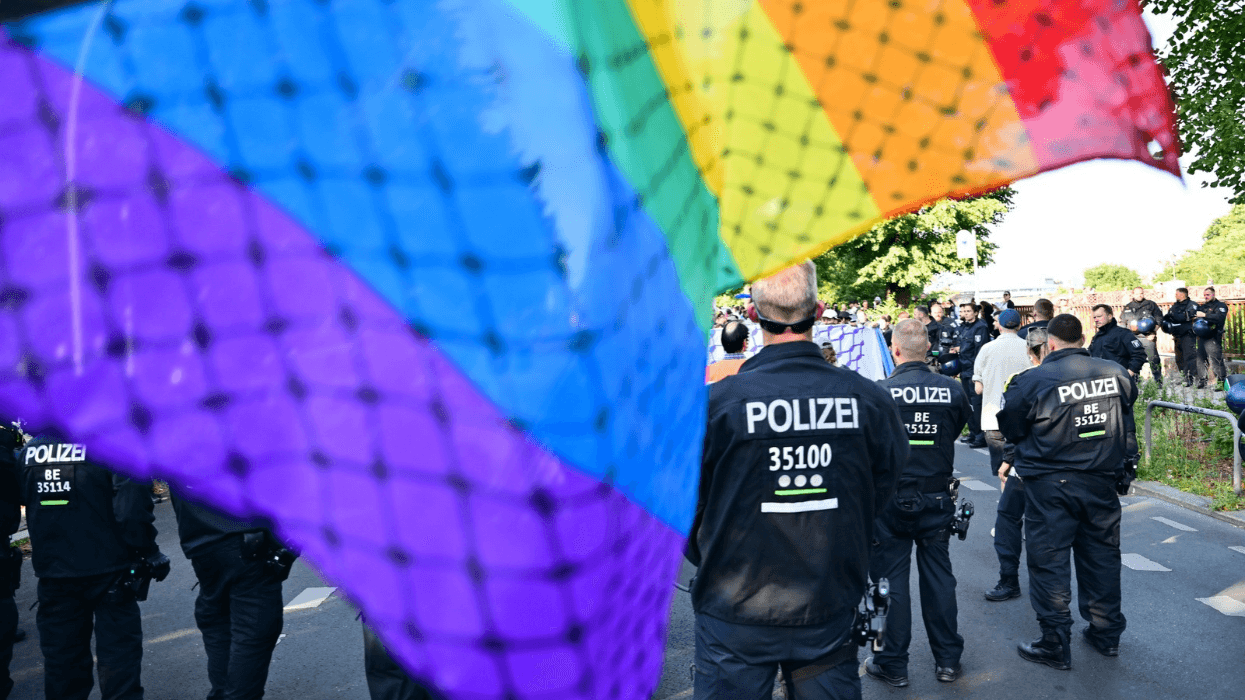
The Pride flag is flying at Stonewall again. More than 1,000 people formed a sea of rainbow and transgender flags and handmade signs, flooding the area surrounding Lower Manhattan’s Christopher Park in Greenwich Village on Thursday after the Trump administration ordered the Pride flag removed from the Stonewall National Monument earlier this week.
Keep up with the latest in LGBTQ+ news and politics. Sign up for The Advocate's email newsletter.
Stonewall, the site of the June 1969 uprising against a police raid that helped ignite the modern LGBTQ+ rights movement, has always been more than a landmark. Designated a national monument by President Barack Obama in 2016, it has become a site where history is not only remembered but actively contested.
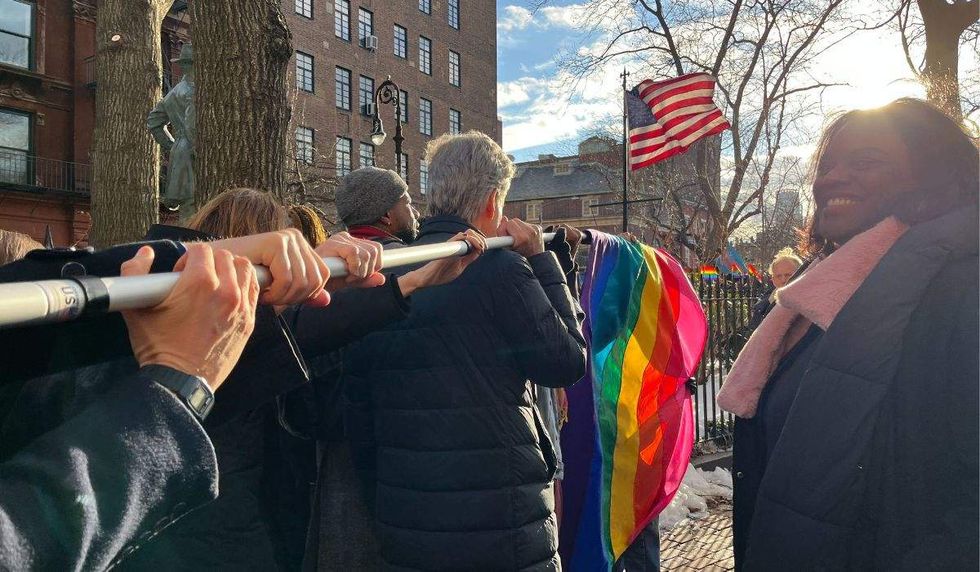 Leaders carry the LGBTQ+ Pride flag to be reraised at the Stonewall National Monument in New York City.Jack Walker for The Advocate
The gathering followed days of condemnation from city, state, and federal leaders who denounced the removal, which the National Park Service said on Tuesday was done to comply with longstanding federal flag policy, as an attempt to erase LGBTQ+ history from the nation’s capital for queer memory. New York City Mayor Zohran Mamdani called the removal “deeply outrageous” and said that “no act of erasure will ever change, or silence, that history.”
He added that the city has a “duty not just to honor this legacy, but to live up to it” and vowed to continue fighting for LGBTQ+ dignity and protection.
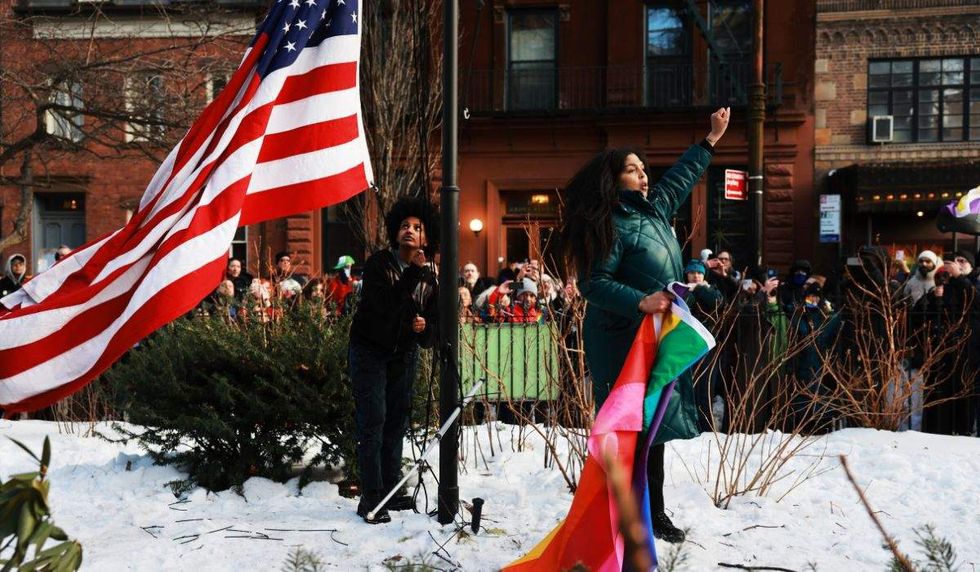 Activists put up an LGBTQ+ Pride flag at the Stonewall National Monument after the Trump administration had the National Park Service remove it earlier in the week on February 12, 2026, in New York City. Spencer Platt/Getty Images
By late afternoon, the park was packed. People lined its perimeter and spilled onto nearby streets and sidewalks, some bearing rainbow and transgender pride flags and handmade signs. One sign read, “Honey, Stonewall was the warning.” Chants rippled through the crowd like a rising tide of frustration and resolve.
A phalanx of New York elected officials, including gay State Sen. Erik Bottcher, U.S. Rep. Dan Goldman, and movement leaders like Human Rights Campaign president Kelley Robinson, had gathered to raise the Pride flag inside Christopher Park in defiance of the administration’s decision, but they were quickly pushed to the margins by a fired-up crowd that wanted more than symbolism. It wanted sovereignty over the meaning of Stonewall itself.
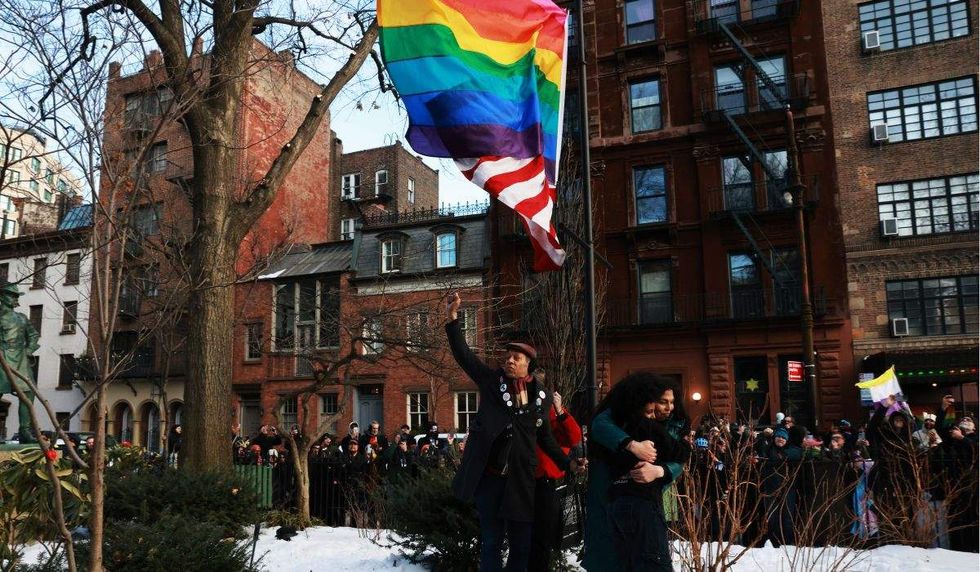 Jay W. Walker raises his fist in solidarity as people put up an LGBTQ+ Pride flag at the Stonewall National Monument after the Trump administration had the National Park Service remove it earlier in the week on February 12, 2026, in New York City. Spencer Platt/Getty Images
Shortly after 4 p.m., officials and advocacy leaders carried a Gilbert Baker rainbow flag toward the flagpole, where a U.S. flag had been placed after the original Pride flag was taken down. They attached a make-shift pole to the permanent one and tried to fly the Pride flag, though it appeared lower and not properly attached.
But the crowd was not satisfied with shared symbolism. As Robinson began speaking, the crowd pushed back.
“This is our flag! This is our flag!” voices roared. Others chanted, “Raise our flag,” and “Our flag only,” demanding that the Pride flag stand alone. “F*ck Trump,” chants broke out from different parts of the park.
The crowd first tried to pull down the American flag.
Related: Trump erased trans & queer history from Stonewall. Lawmakers are fighting to get it back
Attempts to raise the Pride flag on its own initially faltered; at one point, it fluttered only at half-mast. The temporary attachment looked flimsy next to the larger Stars and Stripes. Eventually, the crowd succeeded in binding the rainbow flag to the U.S. flag so that both flew together.
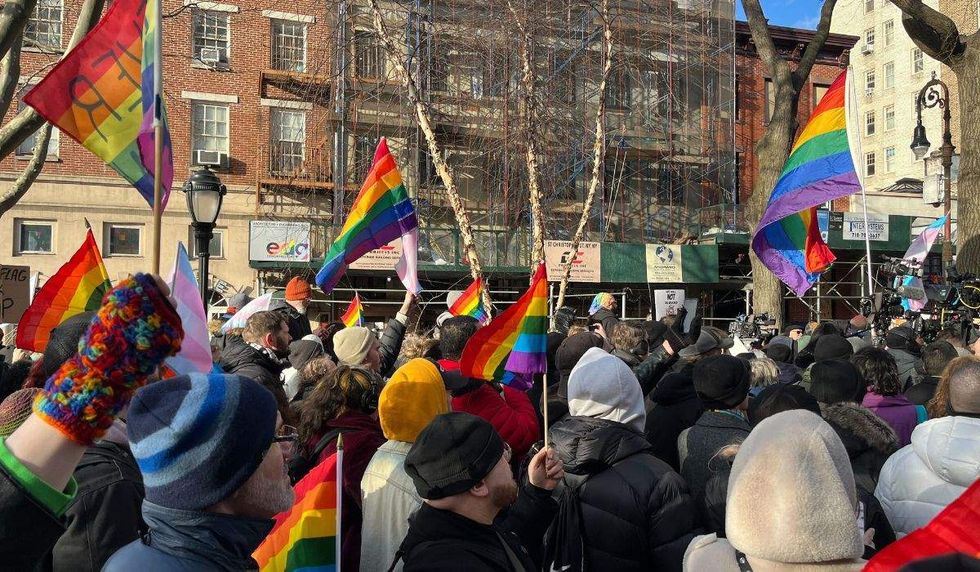 Supporters re-raised the LGBTQ+ Pride flat at the Stonewall National Monument on Thursday, February 12, 2026.Jack Walker for The Advocate
“Take it down! Take it down!” the crowd shouted, at times turning their anger toward the politicians nearby: “Cowards! Cowards!”
By 4:20 p.m., one onlooker breached a fence near the flagpole, yanked down the temporary Pride flag, and cut it off its pole with a knife. A second person joined them. As the crowd surged and shouted, someone began a chant: “This is what democracy looks like.” The call-and-response echoed across the park, reverberating off the trees, the monument, and the bar across the street that still bears the weight of history.
Jay W. Walker, a longtime local activist, joined the two people struggling with the flags and helped secure the Pride flag to the same pole as the American flag. Both flags were left flying side by side in a vigorous wind, as onlookers cheered.
For a moment, it was impossible to tell where the ceremony ended, and the protest began, or whether that distinction still mattered.
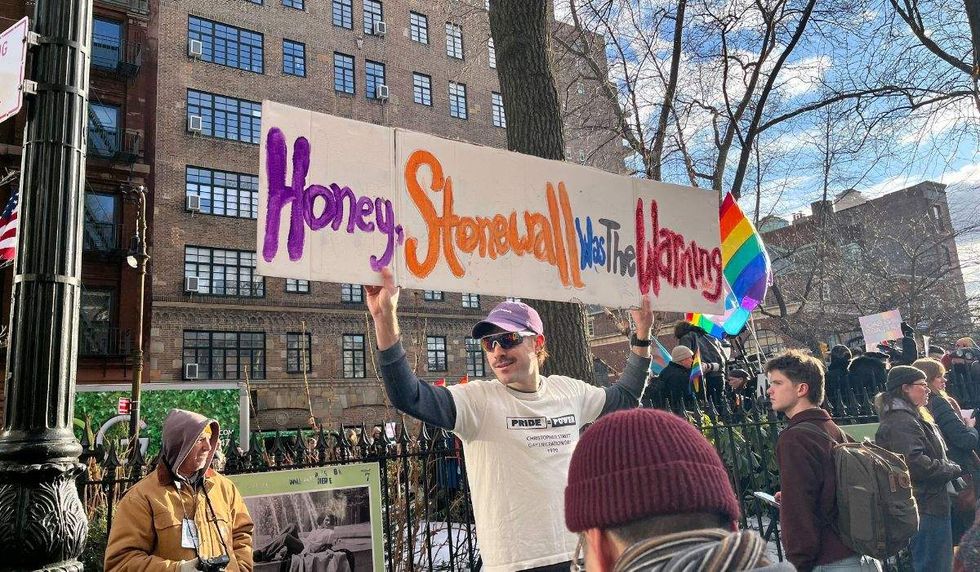 A supporter at Stonewall National Monument with a sign that reads "Honey, Stonewall was the warning."Jack Walker for The Advocate
The tension was not simply about flags. It was about presence, power, and the meaning of Stonewall itself. Many in the crowd saw the newly hoisted U.S. flag, one that had not flown there before this week, not as an addition but as an intrusion, transforming a space long associated with queer liberation into something that felt narrower and managed from afar.
Robinson told The Advocate that the crowd’s size and urgency reflected a sense that waiting was no longer an option. She said hundreds of people showed up to “put our flag back up” after the Trump administration removed it earlier in the week, arguing that the attack on the symbol fit a broader pattern. “They’ve come for our books, our existence, and even pulled down our flag two days ago,” Robinson said. “Two days is too long for the flag to be down, so we came out, and we put it back up ourselves.”
Robinson placed the moment in the context of what she described as a sustained, nationwide fight over LGBTQ+ lives and visibility, pointing to federal and state actions targeting transgender service members, access to gender-affirming care, and protections at work and in schools. The flag’s return, she said, was both symbolic and practical: a reminder that the community often has to fill the gaps when government fails to protect it. Standing at Stonewall, she added, carried particular weight.
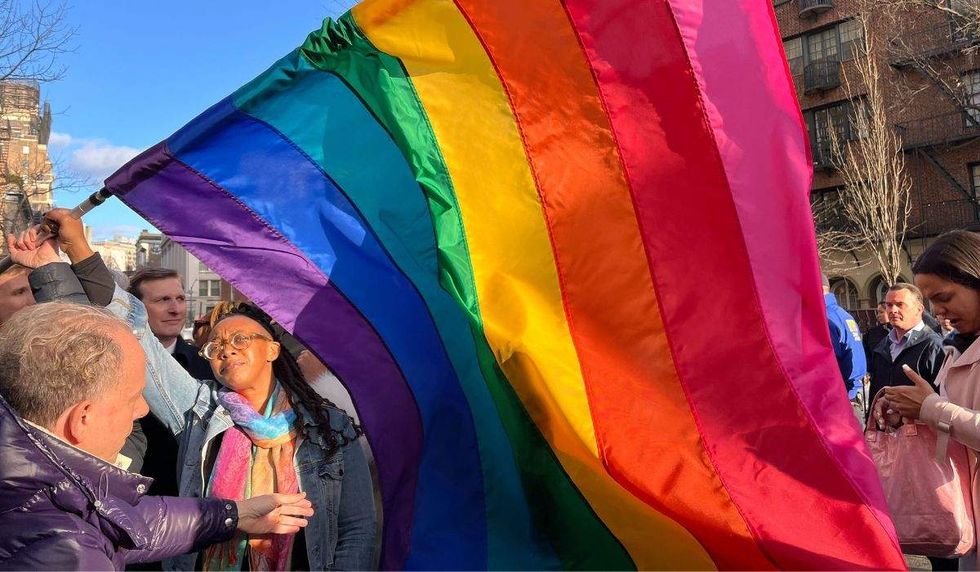 U.S. Rep. Dan Goldman (in the black coat above) looks on as HRC President Kelley Robinson helps guide the LGBTQ+ Pride flag at the Stonewall National Monument in New York City.Jack Walker for The Advocate
“This is sacred ground,” Robinson said. “I wasn’t there in 1969. But to be here in 2026 and say, definitively, you are not going to erase us — that’s powerful.”
Kei Williams, executive director of the New Pride Agenda, said the re-raising was about more than restoring a symbol, calling it a necessary show of visible solidarity after what they described as deliberate provocation. Williams said the community had returned to the site repeatedly, on Tuesday night, again Wednesday morning, and again Thursday, because the moment demanded it, and argued the flag’s removal should be understood as part of a strategic pattern rather than an isolated incident.
Marti Gould Cummings, a state Democratic committee member representing Assembly District 75, placed the confrontation in a longer historical frame, saying Stonewall “started as a riot” and remains part of an unfinished struggle. With trans rights under sustained attack, Cummings said, the fight over a flag is inseparable from broader efforts to erase history, pointing to what they described as similar rollbacks involving slavery and Indigenous history at other national parks. A flag, Cummings said, may be dismissed as just a symbol, but taking it down signals something larger: “a long list of erasure.” Queer people, they added, are resilient and “not going anywhere.”
Ahead of the assembly, Tyler Hack, founder and executive director of the Christopher Street Project, a pro-trans PAC, described the flag’s removal as part of a broader political campaign against LGBTQ+ visibility and rights.
“This event is symbolic of Trump’s war on the queer community,” Hack said before the crowd assembled, describing the episode as “a visual manifestation of the ways in which the Trump administration has chipped away at our rights and freedoms.” They said the response was meant to show that the community would not quietly absorb another erasure. “This is a fight that they have picked with our community, and we will fight that fight.”
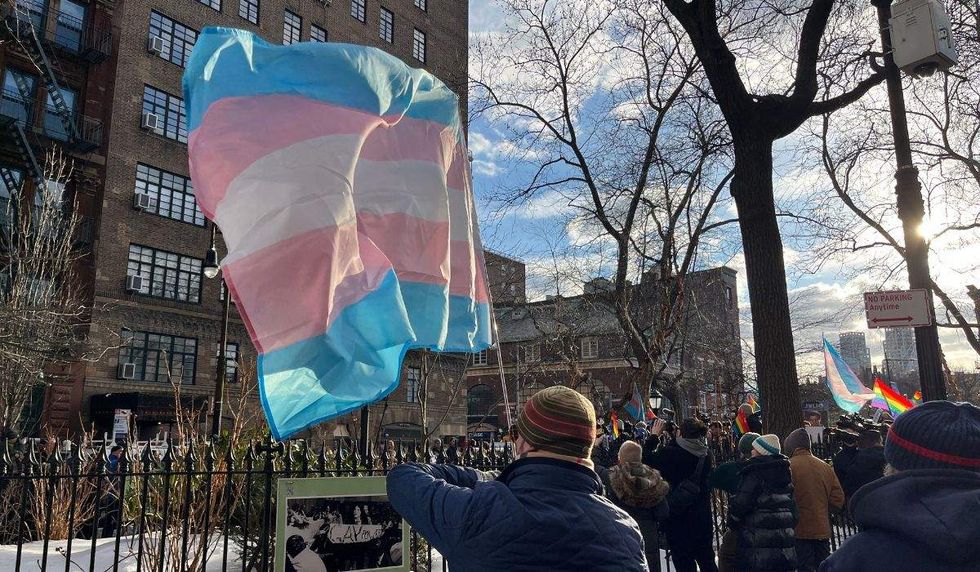 A trans pride flag is flown at the Stonewall National Monument.Jack Walker for The Advocate
In the crowd was Lynn Paltrow, who told The Advocate that she came to stand with friends, family, and neighbors, and because she wanted to live “in a country that’s an inclusive democracy for everybody.” She described the episode as deliberate provocation meant to insult and provoke, and said the demonstration was a peaceful objection to removing “the symbol of this community, the symbol of a very important piece of our progress towards being a truly egalitarian democracy.”
Nearby stood Jamie Leo. “I’m a 71-year-old American. I fought to be here, and I’m not going away,” Leo told The Advocate. “The people who want to … tear it to pieces bit by bit … are not going to do well with us, because we’ve already been beaten, and we’ve already triumphed.”