'%3E%3Cpath d='M16.3574 35.6519H12.9537L15.0491 18.8873L16.3574 35.6519ZM30.4229 54.0093L22.309 0.994385H7.91795L0 54.0093H10.6634L11.5802 46.3855H17.4014L17.9914 54.0093H30.4229Z' fill='%23971B20'/%3E%3Cpath d='M48.2073 41.8813C48.2073 43.4049 47.4892 44.0011 46.1144 44.0011H43.7595V11.0687H46.1144C47.4892 11.0687 48.2073 11.6636 48.2073 13.1885V41.8813ZM59.5273 43.6695V11.3326C59.5273 3.71323 53.5729 0.994385 47.8157 0.994385H31.7213V54.0093H47.8157C53.5729 54.0093 59.5273 51.29 59.5273 43.6695Z' fill='%23971B20'/%3E%3Cpath d='M90.183 0.994385H78.6039L75.0711 30.6157L71.9955 0.994385H59.4346L69.2474 54.0093H80.373L90.183 0.994385Z' fill='%23971B20'/%3E%3Cpath d='M107.063 42.3448C107.063 43.7359 105.951 44.5974 104.643 44.5974C103.269 44.5974 102.157 43.7359 102.157 42.3448V12.658C102.157 11.2676 103.269 10.4058 104.643 10.4058C105.951 10.4058 107.063 11.2676 107.063 12.658V42.3448ZM119.233 43.2723V11.7312C119.233 6.36384 112.952 -3.8147e-06 104.643 -3.8147e-06C96.2667 -3.8147e-06 89.9867 6.36384 89.9867 11.7312V43.2723C89.9867 48.6393 96.2667 55 104.643 55C112.952 55 119.233 48.6393 119.233 43.2723Z' fill='%23971B20'/%3E%3Cpath d='M150.976 43.9349V33.7309H139.069V42.3448C139.069 43.7359 137.957 44.5974 136.582 44.5974C135.076 44.5974 133.964 43.7359 133.964 42.3448V12.658C133.964 11.2676 135.076 10.4058 136.582 10.4058C137.957 10.4058 139.069 11.2676 139.069 12.658V21.2723H150.976V11.0687C150.976 5.70107 145.283 -3.8147e-06 136.582 -3.8147e-06C127.75 -3.8147e-06 121.796 5.70107 121.796 11.0687V43.9349C121.796 49.3022 127.75 55 136.582 55C145.283 55 150.976 49.3022 150.976 43.9349Z' fill='%23971B20'/%3E%3Cpath d='M167.478 35.6519H164.076L166.17 18.8873L167.478 35.6519ZM181.544 54.0093L173.432 0.994385H159.037L151.123 54.0093H161.785L162.704 46.3855H168.523L169.114 54.0093H181.544Z' fill='%23971B20'/%3E%3Cpath d='M205.412 10.4058V0.994385H177.081V10.4058H185.392V54.0093H197.428V10.4058H205.412Z' fill='%23971B20'/%3E%3Cpath d='M230.002 54.0093V43.9349H218.914V31.8746H226.635V21.8028H218.914V10.4058H230.002V0.994385H206.875V54.0093H230.002Z' fill='%23971B20'/%3E%3C/g%3E%3Cdefs%3E%3CclipPath id='clip0_260_7080'%3E%3Crect width='230' height='55' fill='white'/%3E%3C/clipPath%3E%3C/defs%3E%3C/svg%3E)
A Democratic congressional candidate in Southern California is facing backlash from LGBTQ+ leaders and party officials after circulating a campaign memo that critics say implies LGBTQ+ candidates are unelectable, while campaigning against a fellow Democrat who is queer.
Keep up with the latest in LGBTQ+ news and politics. Sign up for The Advocate's email newsletter.
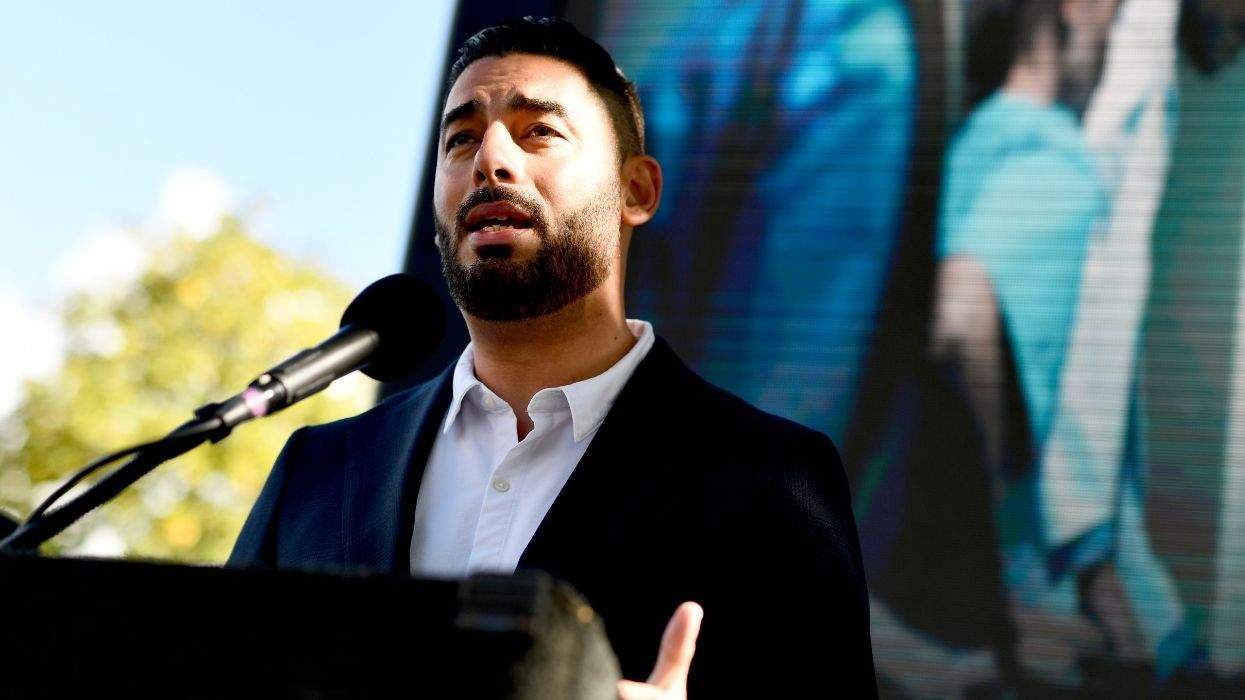
The controversy centers on a seven-page document circulated by the campaign of Ammar Campa-Najjar, a Democrat and Navy veteran who has previously run for Congress and for mayor and is now seeking the party’s nomination in the newly drawn 48th Congressional District. He’s facing Marni von Wilpert, a bisexual San Diego City Councilmember, in the primary.
The Advocate obtained the memo. In a section focused on Palm Springs, recently added to the district, the memo describes the city as “a critical constituency made up of reliable Democratic voters,” but argues that “neither Will Rollins, Christy Holstege, nor Lisa Middleton won their elections to higher office due to their inability to reach voters beyond Palm Springs.” It then adds: “Marni von Wilpert, as her record will show, is a candidate in the same vein, who will fail to win over Latinos and veterans, who are the true swing voters in this district.”
Related: This bisexual San Diego City Council member is fighting to replace Darrell Issa in Congress
LGBTQ+ leaders say the phrasing reads less like a neutral assessment than a familiar argument in which identity is recast as liability. Palm Springs is one of California’s most visible LGBTQ+ political communities, and the three candidates named are all members of the LGBTQ+ community. Rollins is an out gay former federal prosecutor who ran for Congress; Holstege is an out lesbian former mayor of Palm Springs who ran for the state assembly; and Middleton, who is transgender, is also a former Palm Springs mayor who ran for state Senate.
In an interview with The Advocate on Tuesday, von Wilpert said the memo was “heartbreaking” to read, particularly because it grouped together candidates she has supported, including Middleton and Rollins, and suggested they, and she, could not win because they are LGBTQ+.
She said that at a time when LGBTQ+ rights are under attack nationally, “the last thing we need in a Democratic primary is this kind of divisive rhetoric that questions whether LGBTQ+ candidates are worthy and can win or connect with broad communities.” She said the argument reminded her of attacks she faced in her 2020 city council race, when a Republican opponent questioned her qualifications, including that she hadn’t given birth, and argued that voters are “sick and tired of seeing divisive, hateful rhetoric like this.
The Advocate contacted Campa-Najjar’s campaign for comment, but the campaign did not respond before publication.
After this story was published, Campa-Najjar’s campaign rejected the criticism and said the memo was being mischaracterized. In a statement, campaign manager Andi McNew, an Air Force veteran and a member of the LGBTQ+ community, said, “These attacks are baseless and desperate. The memo’s analysis was explicitly about electoral geography, with no mention of identity. We understand this is a competitive race, but we hope the conversation can return to what matters most: building the broadest possible coalition to beat Darrell Issa and flip the House in November.”
The campaign noted that the memo analyzed why several candidates fell short in prior bids for higher office and concluded that winning CA-48 requires building a coalition well beyond any single part of the district. It argues Campa-Najjar has a track record of delivering.
Campa-Najjar has cited endorsements from LGBTQ+ leaders, including Rep. Robert Garcia, the ranking member of the powerful House Oversight Committee, who represents California. “I’m proud to endorse Ammar Campa-Najjar for Congress,” Garcia said in a statement last week. “As a fellow Southern Californian, I’ve seen Ammar take on Darrell Issa in one of the country’s toughest districts on behalf of working families, immigrants, LGBTQ+ communities, and people struggling to get by.”
Garcia’s office did not immediately respond to The Advocate’s request for comment.
Ryan Darsey, president of San Diego Democrats for Equality, said that what makes the memo troubling is not just one line but the pattern it establishes. The document, he said, “lists multiple LGBTQ candidates and claims they failed because they couldn’t reach voters beyond Palm Springs. Then it says Marni is in the same vein.” The implication, he added, “is not subtle. The only common thread among those candidates is that they are all LGBTQ.” Darsey called the language “offensive” and said that if Democrats start treating LGBTQ+ identity as a weakness, “we haven’t learned anything,” arguing that leadership should mean “uplifting our whole coalition, not narrowing it.”
He said he would expect that kind of framing in a Republican primary, “maybe in Alabama,” but not in a Democratic congressional race in California.
Rep. Mark Takano of California, the ranking member of the House Committee on Veterans’ Affairs and one of the first out gay members of Congress, echoed that view in a statement included in a von Wilpert campaign press release.
“When I ran for Congress, I heard the same anti-LGBTQ attacks — and I proved them wrong,” Takano, who chairs the Congressional Equality Caucus, said. “Our party wins when we build real coalitions rooted in respect and shared values, not when we echo the kind of divisive rhetoric that voters have grown tired of hearing. Democrats won’t defeat Republicans by sounding like them.”
Middleton also criticized the memo’s framing in a statement included in the release.
“This is the time for unifying the Democratic Party and our country,” she said. “You cannot unify our party or our country by disqualifying any American from candidacy for public office.”
The dispute is unfolding in a newly drawn district spanning parts of San Diego and Riverside counties that Democrats view as a must-win in a closely divided House.
Asked about Campa-Najjar’s past campaigns, von Wilpert said Campa-Najjar has “lost every campaign he’s ever run” and argued that the memo’s language sends “a signal to a group of people that is offensive and homophobic,” adding that “words have power and they have an impact.”
Editor's note: This story has been updated with a statement from the Campa-Najjar campaign.