'%3E%3Cpath d='M16.3574 35.6519H12.9537L15.0491 18.8873L16.3574 35.6519ZM30.4229 54.0093L22.309 0.994385H7.91795L0 54.0093H10.6634L11.5802 46.3855H17.4014L17.9914 54.0093H30.4229Z' fill='%23971B20'/%3E%3Cpath d='M48.2073 41.8813C48.2073 43.4049 47.4892 44.0011 46.1144 44.0011H43.7595V11.0687H46.1144C47.4892 11.0687 48.2073 11.6636 48.2073 13.1885V41.8813ZM59.5273 43.6695V11.3326C59.5273 3.71323 53.5729 0.994385 47.8157 0.994385H31.7213V54.0093H47.8157C53.5729 54.0093 59.5273 51.29 59.5273 43.6695Z' fill='%23971B20'/%3E%3Cpath d='M90.183 0.994385H78.6039L75.0711 30.6157L71.9955 0.994385H59.4346L69.2474 54.0093H80.373L90.183 0.994385Z' fill='%23971B20'/%3E%3Cpath d='M107.063 42.3448C107.063 43.7359 105.951 44.5974 104.643 44.5974C103.269 44.5974 102.157 43.7359 102.157 42.3448V12.658C102.157 11.2676 103.269 10.4058 104.643 10.4058C105.951 10.4058 107.063 11.2676 107.063 12.658V42.3448ZM119.233 43.2723V11.7312C119.233 6.36384 112.952 -3.8147e-06 104.643 -3.8147e-06C96.2667 -3.8147e-06 89.9867 6.36384 89.9867 11.7312V43.2723C89.9867 48.6393 96.2667 55 104.643 55C112.952 55 119.233 48.6393 119.233 43.2723Z' fill='%23971B20'/%3E%3Cpath d='M150.976 43.9349V33.7309H139.069V42.3448C139.069 43.7359 137.957 44.5974 136.582 44.5974C135.076 44.5974 133.964 43.7359 133.964 42.3448V12.658C133.964 11.2676 135.076 10.4058 136.582 10.4058C137.957 10.4058 139.069 11.2676 139.069 12.658V21.2723H150.976V11.0687C150.976 5.70107 145.283 -3.8147e-06 136.582 -3.8147e-06C127.75 -3.8147e-06 121.796 5.70107 121.796 11.0687V43.9349C121.796 49.3022 127.75 55 136.582 55C145.283 55 150.976 49.3022 150.976 43.9349Z' fill='%23971B20'/%3E%3Cpath d='M167.478 35.6519H164.076L166.17 18.8873L167.478 35.6519ZM181.544 54.0093L173.432 0.994385H159.037L151.123 54.0093H161.785L162.704 46.3855H168.523L169.114 54.0093H181.544Z' fill='%23971B20'/%3E%3Cpath d='M205.412 10.4058V0.994385H177.081V10.4058H185.392V54.0093H197.428V10.4058H205.412Z' fill='%23971B20'/%3E%3Cpath d='M230.002 54.0093V43.9349H218.914V31.8746H226.635V21.8028H218.914V10.4058H230.002V0.994385H206.875V54.0093H230.002Z' fill='%23971B20'/%3E%3C/g%3E%3Cdefs%3E%3CclipPath id='clip0_260_7080'%3E%3Crect width='230' height='55' fill='white'/%3E%3C/clipPath%3E%3C/defs%3E%3C/svg%3E)
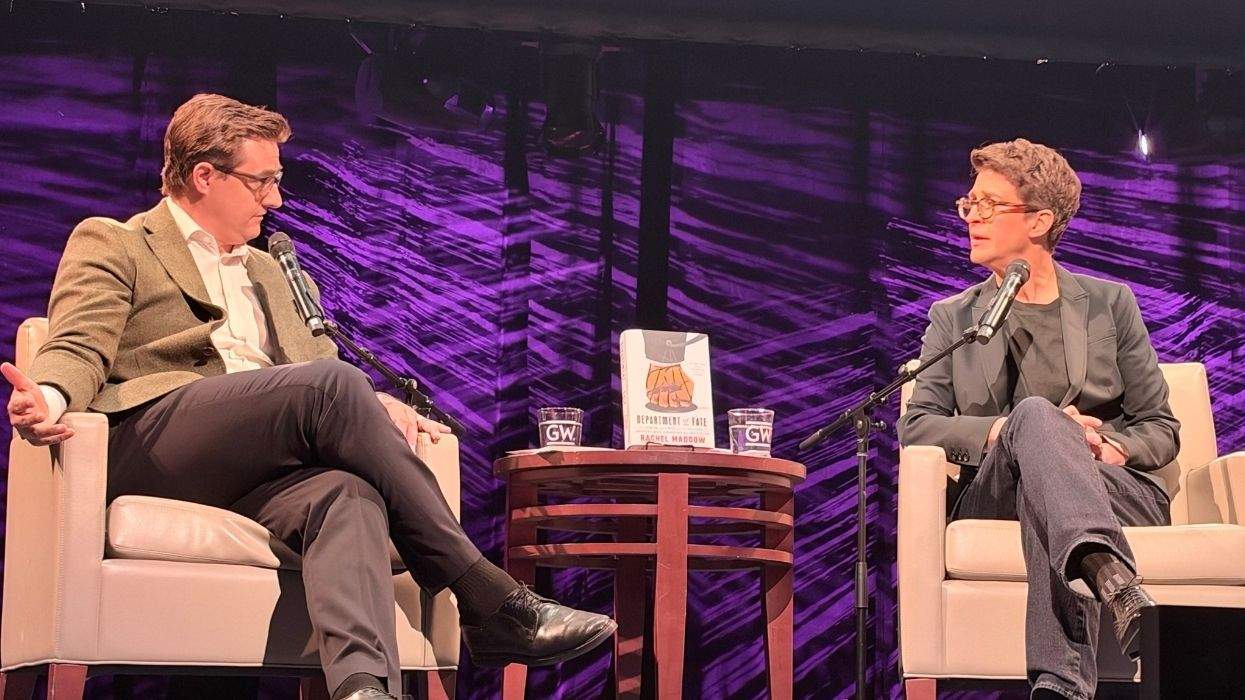
You could tell before Rachel Maddow even walked onstage Sunday evening that the sold-out crowd at George Washington University’s Lisner Auditorium in Washington, D.C., was having a very good week.
Democrats had just delivered a historic midterm drubbing to Republicans, winning control of both chambers of Congress. The audience was practically buzzing. University President Ellen Granberg noticed.
“What a spectacular crowd,” she said. “Y’all are feeling good. I wonder why.”
But one of the night’s biggest ovations wasn’t for an election winner.
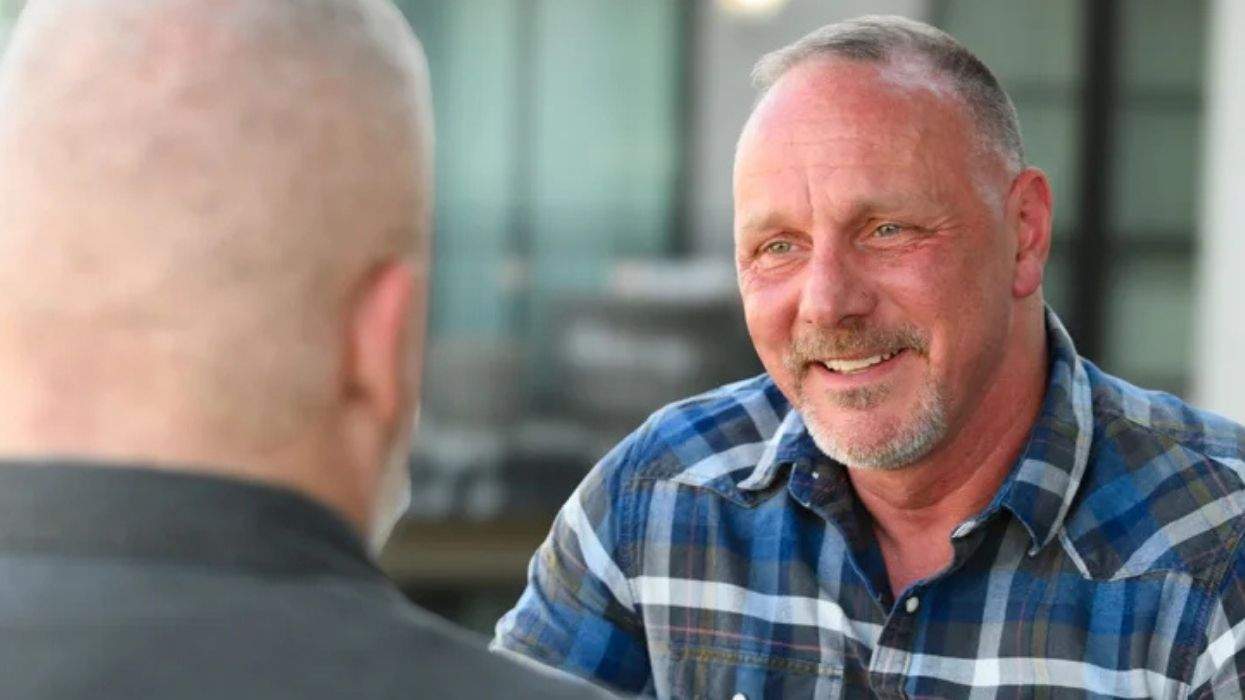
It came when Maddow, appearing with fellow MS NOW host Chris Hayes, recognized David Hearn, a former Olympic canoeist prosecuted by the Trump administration for allegedly damaging the Lincoln Memorial Reflecting Pool.
Hearn faced a felony charge after touching a loose piece of the pool’s lining. Prosecutors later acknowledged evidence that a flawed renovation, rather than vandalism, caused the damage. D.C. Superior Court Judge Todd Edelman permanently dismissed the case in October.
Hearn stood when Maddow called his name. Then the audience rose with him and gave him a standing ovation.
It was an unexpected illustration of the question running through Maddow’s latest book: What happens when ordinary Americans find themselves confronting the power of their own government?
Three weeks earlier, in an exclusive interview with The Advocate, Maddow offered a devastating assessment of the institution that prosecuted Hearn.
“It’s essentially dead and will need to be refounded from the ground up, which is what this book is about,” she says of the Justice Department.
Her new book, Department of Fate: The Promise, the Power, and the Collapse of America’s Most Consequential Institution, arrives Tuesday. The Advocate received one of a limited number of advance print copies.
Related: Rachel Maddow sees Americans’ active resistance as key to overcoming Donald Trump’s strongman game
The remarkable Americans Maddow wants us to remember
Congress established the Justice Department in 1870, as the federal government struggled to enforce Reconstruction’s constitutional guarantees.
In South Carolina, the Ku Klux Klan was terrorizing Black communities. One victim was Jim Williams, a Black political organizer murdered in 1871.
Attorney General Amos Akerman, himself a former slaveholder, pursued the Klansmen responsible for the violence.
What makes Akerman extraordinary to Maddow is that he insisted on respecting the constitutional rights of the people he prosecuted.
“Due process is not a favor,” Maddow said Sunday. “Due process is not something that you grant people because you like them.”
At Lisner, she read from a letter Akerman wrote to his young son as his career was threatened by political interests.
“Ask what is right, not what is popular,” Akerman advised. “When you have ascertained the right, try to make it popular, but cleave to it popular or not.”
Maddow said those words have given her strength this year.
Among the young men observing Akerman’s prosecutions was Louis Post, a stenographer who recorded testimony. Nearly 50 years later, Post found himself working at the Labor Department as federal authorities rounded up immigrants and suspected radicals during the Palmer Raids.
Post had learned what constitutional enforcement looked like under Akerman. Now he watched the Justice Department abandon those principles.
He used his relatively modest authority over deportation proceedings to challenge the government’s actions, ultimately stopping thousands of removals.
The book is hardly an uncomplicated celebration of federal law enforcement. Maddow also recounts how Attorney General Richard Olney used federal authority against striking railroad workers during the Pullman strike while resisting action against powerful railroad interests.
The Justice Department, she shows, has been capable of extraordinary justice and extraordinary abuse.
“The reason I keep doing history, the reason I keep doing this in my work is because I fall in love with previous generations of Americans who got this stuff right,” Maddow said Sunday.
Related: Rachel Maddow on standing up to government lies and her Walter Cronkite Award
The most important story in America isn’t Trump
In a June 2025 interview with The Advocate, Maddow identified the public’s response to Trump’s presidency as the country’s most consequential political development.
“The character of the opposition to Trump is the most important story in the country,” she said then.
Has that changed?
“My assessment of that has not changed,” she says in the October interview.
What fascinates her is that ordinary Americans have continued organizing and protesting even as institutions with far greater influence have, in her assessment, accommodated the administration.
“I’m much less interested in what he’s trying than the way the American people are acting to restrain him,” she says.
That theme runs through her work. Her podcast Ultra and 2023 book Prequel examined American fascist movements. Burn Order explored Japanese American incarceration. Her documentary Kill. Bury. Print. follows Oklahoma journalists who faced threats after investigating local officials.
Related: Rachel Maddow on Modern-Day Extremism, American Democracy, and Her New Book, ‘Prequel’
What happens when the government becomes the threat?
The Advocate raised the case of Andry Hernández Romero, the gay Venezuelan makeup artist deported to El Salvador’s CECOT prison.
Maddow’s reporting helped bring his ordeal to national attention. The Advocate subsequently interviewed him about his imprisonment and efforts to rebuild his life in Spain.
“In any democracy, in any constitutional republic, the places where constitutional protections are weakest tend to grow,” Maddow warns.
Her concern is that practices normalized against immigrants can eventually spread to other Americans.
She sees another dangerous reversal of the department’s founding purpose in the administration’s treatment of transgender people.
The Justice Department has investigated hospitals providing gender-affirming care and sought patient records. Hospitals have suspended care for transgender minors despite those treatments remaining legal under state law. Transgender service members are also challenging federal restrictions on military service in court.
“The Justice Department has completely abandoned the idea that you would pursue the defense of constitutional rights for disfavored minorities and instead is just trying to make itself as much of a weapon for Trump as it possibly can,” Maddow says.
For Maddow, restoring the department’s mission means ending what she describes as the government’s practice of “hunting transgender people and hunting immigrants and persecuting the president’s perceived political enemies.”
From presidential loyalty to public accountability
The book’s final chapters examine William Barr’s second tenure as attorney general, including his handling of former special counsel Robert Mueller’s investigation and politically sensitive prosecutions.
Maddow argues that Barr demonstrated how the department’s enormous discretion could serve a president’s political interests.
She expected that pattern to intensify during Trump’s second term. She says the department has also been hollowed out while Homeland Security has assumed a more aggressive enforcement role.
“I think that the investigation is the punishment,” she says, discussing cases involving perceived Trump adversaries.
On Sunday, Maddow explicitly called for Attorney General Todd Blanche’s impeachment, citing his interview with convicted Jeffrey Epstein accomplice Ghislaine Maxwell.
“I mean, Todd Blanche should be impeached,” she said, emphasizing that she was speaking “not as a news anchor, but as the author of a new book about the Department of Justice.”
But Maddow wants more than leadership changes. Her book outlines proposals including barring a president’s former personal lawyers and campaign workers from serving in the Justice Department, setting stricter professional qualifications for its leaders and requiring two-thirds Senate support for its political appointees.
She also proposes giving federal judges greater influence over selecting U.S. attorneys in their districts, including possible veto power over appointments. The aim is to make independence and professional experience more consequential than loyalty to the president.
Accountability would also have to outlast an official’s tenure. Maddow calls for giving the department’s inspector general more resources and the power to compel testimony from former officials. She points to Barr as an example of why that authority matters and argues that leaving office should not mean leaving questions about one’s conduct unanswered.
Her proposals would give the watchdog a stronger role in ensuring that recommended reforms are implemented and misconduct leads to consequences.
“I don’t think it needs to be rebuilt,” she said Sunday. “I think it needs to be refounded.”
The people Maddow still trusts
After the midterms, Maddow was especially encouraged by Americans’ participation in the election, including among Black, Latino, and young voters.
But winning an election, she suggested, was only the beginning.
“There will come a day when your country will need you,” she told the audience. It’s the lesson she takes from Akerman, Post and countless people whose names history nearly forgot.
“I think that when you find instances of unlikely David versus Goliath resistance actually paying off and Goliath falling, it is usually because David has friends,” she tells The Advocate.
While her faith in institutions has diminished, her faith in ordinary Americans hasn’t.
“I trust the people more than our institutions a lot,” she says.