'%3E%3Cpath d='M16.3574 35.6519H12.9537L15.0491 18.8873L16.3574 35.6519ZM30.4229 54.0093L22.309 0.994385H7.91795L0 54.0093H10.6634L11.5802 46.3855H17.4014L17.9914 54.0093H30.4229Z' fill='%23971B20'/%3E%3Cpath d='M48.2073 41.8813C48.2073 43.4049 47.4892 44.0011 46.1144 44.0011H43.7595V11.0687H46.1144C47.4892 11.0687 48.2073 11.6636 48.2073 13.1885V41.8813ZM59.5273 43.6695V11.3326C59.5273 3.71323 53.5729 0.994385 47.8157 0.994385H31.7213V54.0093H47.8157C53.5729 54.0093 59.5273 51.29 59.5273 43.6695Z' fill='%23971B20'/%3E%3Cpath d='M90.183 0.994385H78.6039L75.0711 30.6157L71.9955 0.994385H59.4346L69.2474 54.0093H80.373L90.183 0.994385Z' fill='%23971B20'/%3E%3Cpath d='M107.063 42.3448C107.063 43.7359 105.951 44.5974 104.643 44.5974C103.269 44.5974 102.157 43.7359 102.157 42.3448V12.658C102.157 11.2676 103.269 10.4058 104.643 10.4058C105.951 10.4058 107.063 11.2676 107.063 12.658V42.3448ZM119.233 43.2723V11.7312C119.233 6.36384 112.952 -3.8147e-06 104.643 -3.8147e-06C96.2667 -3.8147e-06 89.9867 6.36384 89.9867 11.7312V43.2723C89.9867 48.6393 96.2667 55 104.643 55C112.952 55 119.233 48.6393 119.233 43.2723Z' fill='%23971B20'/%3E%3Cpath d='M150.976 43.9349V33.7309H139.069V42.3448C139.069 43.7359 137.957 44.5974 136.582 44.5974C135.076 44.5974 133.964 43.7359 133.964 42.3448V12.658C133.964 11.2676 135.076 10.4058 136.582 10.4058C137.957 10.4058 139.069 11.2676 139.069 12.658V21.2723H150.976V11.0687C150.976 5.70107 145.283 -3.8147e-06 136.582 -3.8147e-06C127.75 -3.8147e-06 121.796 5.70107 121.796 11.0687V43.9349C121.796 49.3022 127.75 55 136.582 55C145.283 55 150.976 49.3022 150.976 43.9349Z' fill='%23971B20'/%3E%3Cpath d='M167.478 35.6519H164.076L166.17 18.8873L167.478 35.6519ZM181.544 54.0093L173.432 0.994385H159.037L151.123 54.0093H161.785L162.704 46.3855H168.523L169.114 54.0093H181.544Z' fill='%23971B20'/%3E%3Cpath d='M205.412 10.4058V0.994385H177.081V10.4058H185.392V54.0093H197.428V10.4058H205.412Z' fill='%23971B20'/%3E%3Cpath d='M230.002 54.0093V43.9349H218.914V31.8746H226.635V21.8028H218.914V10.4058H230.002V0.994385H206.875V54.0093H230.002Z' fill='%23971B20'/%3E%3C/g%3E%3Cdefs%3E%3CclipPath id='clip0_260_7080'%3E%3Crect width='230' height='55' fill='white'/%3E%3C/clipPath%3E%3C/defs%3E%3C/svg%3E)
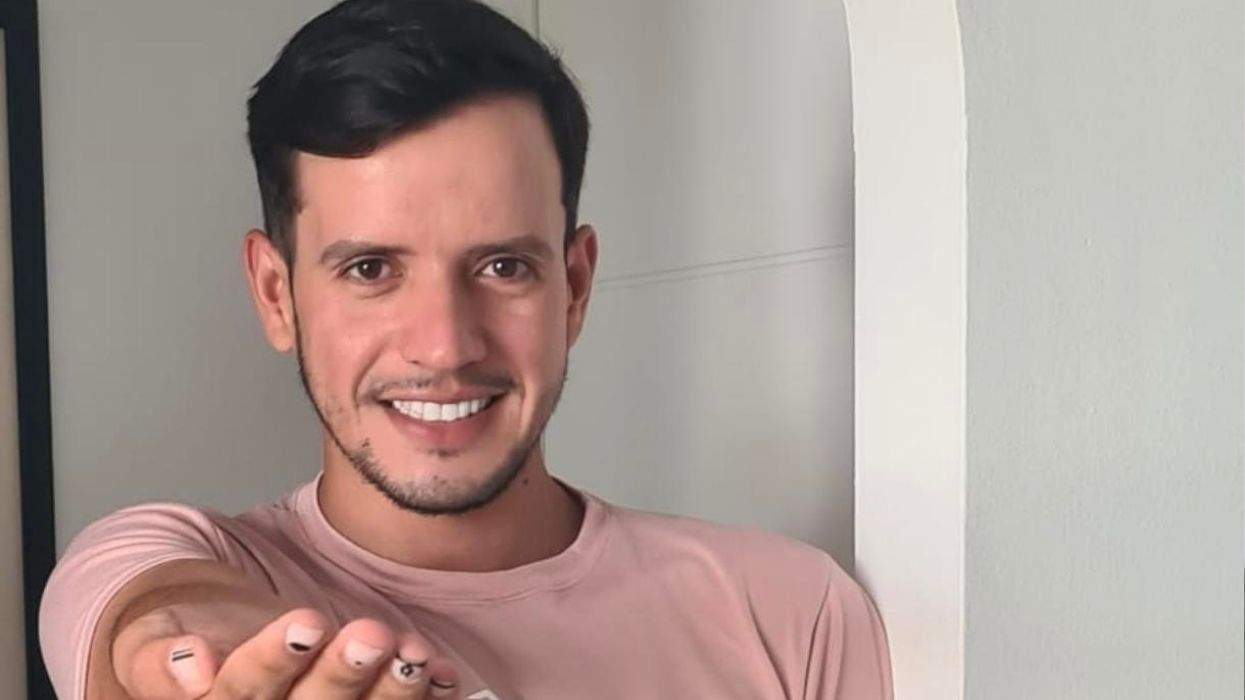
There are two words Andry Hernández Romero still struggles to hear.
"Requisa."
"Conteo."
Search. Count.
Nearly a year after he emerged from El Salvador's notorious CECOT prison, where he was deported after the Trump administration accused him of gang affiliation, allegations he has consistently denied, those words can still send a jolt through his body.
"If I'm walking down the street and I see a police officer carrying handcuffs or a baton," he told The Advocate, "it affects me."
Speaking through a Spanish-language interpreter during a recent video interview from Spain, Hernández Romero described a life that is safer than it was a year ago, but not yet free. The gay Venezuelan makeup artist is no longer locked inside one of the world's most infamous prisons. He is no longer wondering whether he will ever see the outside world again. But freedom, he says, remains incomplete.
Related: Inside the movement that freed gay makeup artist Andry Hernández Romero from a hellhole
Finding safety after torture
Hernández Romero became one of the most recognizable faces of the Trump administration's use of the Alien Enemies Act against Venezuelan migrants. In March 2025, he was among hundreds of Venezuelan men sent to El Salvador's Terrorism Confinement Center, known as CECOT, despite never being charged with a crime in the United States. Advocates and attorneys argued that officials relied on deeply flawed evidence, including tattoos, to label men as gang members.
His asylum application in Spain is still pending. He is not yet working. He has no stable income. And the trauma of what happened to him continues to shape nearly every day of his life. "I'm in a safe place," he said. "But this bitter experience isn't going to disappear overnight."
For LGBTQ+ Americans, Hernández Romero became more than an immigration case. He was an out gay asylum seeker who said he fled persecution in Venezuela only to find himself at the center of one of the Trump administration's most controversial and dystopian immigration actions.
Hernández Romero entered the United States through the CBP One program in 2024, seeking asylum. He was detained and later accused by federal officials of being affiliated with the Venezuelan gang Tren de Aragua, allegations he has consistently denied.
His case drew international attention after advocates and attorneys argued that tattoos were improperly used as evidence of gang affiliation. Hernández Romero's tattoos include crowns above the words "mom" and "dad," which he has long said honor his parents rather than any criminal organization.
In March 2025, he was among hundreds of Venezuelan men deported to El Salvador's Terrorism Confinement Center, known as CECOT, under the Trump administration's invocation of the Alien Enemies Act. He spent 125 days there before being released as part of a prisoner exchange that returned more than 250 Venezuelans to their home country.
Months later, Hernández Romero and several other former detainees filed legal claims against the Department of Homeland Security, alleging they were wrongfully deported and subjected to abuse. Today, however, Hernández Romero is focused less on his own story than on the people he left behind.
Related: Andry Hernández Romero, gay asylum seeker disappeared by Trump, part of prisoner swap
The prison that never fully lets go
Every day, Hernández Romero said, his phone fills with messages from former detainees and their families. The prison may be behind him, but it follows him through text messages, voice notes, and desperate appeals from people still searching for answers.
"People see a smile. They see strength. They see resilience," Hernández Romero said. "But sometimes I'm human. Sometimes I break down."
The smile that appeared on protest signs and spread across social media became a symbol of survival. But Hernández Romero said the public image often masks a far more complicated reality.
"A social network shows what a person wants to show," he said. What followers do not see, he said, are the difficult days, the uncertainty, and the lingering emotional weight of everything that happened.
Many of the messages he receives come from mothers. Others come from men who shared cells with him inside CECOT. "I receive messages every day from my companions and from their mothers," he said. "They ask for advice. They ask for help. They ask for visibility."
Related: Andry Hernández Romero explains how he survived CECOT after the U.S. government disappeared him
Speaking for the 252
Many of those conversations are no longer about what happened inside CECOT. They are about what came afterward. Some former detainees are trying to rebuild their lives. Others remain trapped in legal uncertainty, struggling with trauma, stigma, and the challenge of proving they were never gang members in the first place. Hernández Romero says he feels an obligation to keep telling their stories because many lack the public platform he now has.
People often assume the men are moving on because they are no longer imprisoned, he said. "They think, 'He's overcoming it. He's safe now. He's out of the country.' But they don't know the damage people carry inside."
He frequently speaks about the 252 Venezuelan men who were imprisoned alongside him, many of whom remain largely unknown outside their families and legal teams. Others, he said, still in detention centers, have no voice and need public attention.
"There are many innocent people in prisons today who do not have the opportunity to raise their voices," he said. "There are people being judged unfairly. I know because that was my case."
Carrying those stories has reshaped Hernández Romero's life. What began as a fight to clear his own name has evolved into a broader campaign on behalf of immigrants, asylum seekers, and former detainees who believe they were wrongly swept into the same system.
"I've been carrying out an activism campaign in support of immigrants and children because of everything that is happening today in the United States," he said.
Related: Andry Hernández Romero on surviving CECOT: 'They told us we would die there'
Tattoos are not evidence
One theme he repeated was the danger of reducing people to assumptions.
Tattoos are not evidence. “I want the world to know that being Venezuelan is not a crime,” Hernández Romero previously told The Advocate. Now, that message still holds.
The idea became a rallying cry among detainees inside CECOT, he said. "The Trump administration judged us for having roses, watches, compasses, or tattoos," he said. "A tattoo is not solid proof that someone is a criminal."
What did the government see, he asked, that justified sending a professional makeup artist to one of the world's most feared prisons despite his insistence that he had no criminal record and no gang affiliation?
Then he answered it himself. "The only weapon Andry Hernández has in his hands is a lipstick and a makeup brush,” he said.
Related: Gay asylum seeker Andry Hernández Romero remains in danger, advocates warn
Beyond CECOT
For Hernández Romero, that principle extends beyond the Venezuelan men deported to CECOT. It also shapes how he thinks about LGBTQ+ immigrants currently navigating the U.S. detention system. "The LGBTQ+ community right now has many people in detention centers who are being treated unfairly," he said.
Hernández Romero described knowing of a same-sex couple in immigration detention and expressed concern about one partner, who he said is living with HIV. He said he does not know whether the individual is receiving adequate medication or medical care.
The Advocate has reported on several LGBTQ+ asylum seekers held in immigration detention. Among them were a couple from Iran, who had been slated to be deported back to the country where their attorneys argued they would face certain punishment, if not death, for being gay. Those men were recently released and have reunited in Massachusetts, their attorney told The Advocate.
For Hernández Romero, the issue is part of a larger principle.
"I believe every person's human rights should be respected," he said. "No matter their sexual orientation, political beliefs, skin color, or where they come from."
He says many former detainees continue to struggle with psychological wounds that are invisible to the public.
"There were so many beatings, so many days of torture," he said. Even now, he said, ordinary encounters can trigger memories of incarceration. The sight of uniforms, handcuffs, or police equipment can transport him back to the routines that governed daily life inside CECOT. "You end up developing a fear of security agents." Those experiences have shaped his broader views on immigration detention.
While reserving his harshest criticism for CECOT, Hernández Romero also described troubling experiences inside U.S. immigration detention. At the Otay Mesa facility in California, where he was held before being eventually sent to El Salvador, he said some officials treated migrants differently based on nationality.
He recalled seeing Haitians, Cubans, and Venezuelans subjected to unequal treatment. "Why should nationality be the principal factor in determining how an immigrant is treated?" he asked. Yet he resisted broad characterizations.
Not everyone treated him badly, he said. Some staff members showed compassion. "I don't want to generalize," he said. Instead, he argues for reforms rooted in individualized review, accountability, and due process.
Building a Future
For now, he is waiting for his asylum case to be resolved. He hopes to return to work as a makeup artist and fashion designer and eventually build a life in Los Angeles, a city he speaks about not as a dream but as a home.
"The final destination for Andry is Los Angeles, California," he said.
Hernández Romero hopes to share those ideas directly with political leaders, including former Vice President Kamala Harris, one day. The proposal itself is still taking shape. But the principle behind it is straightforward: evaluate people individually, respect their humanity, and judge them based on evidence rather than assumptions.
Related: Deported gay makeup artist cried for mother in prison, photojournalist says
The Country He Still Believes In
Hernández Romero also reflected on the support he received from Americans during his detention.
His disappearance prompted an extraordinary campaign by advocates, lawyers, journalists, elected officials, and ordinary citizens who refused to let his name fade from public view. When asked what he would say to those supporters now, he expressed gratitude.
"I never imagined my name, my image, my story would be so influential in the United States," he said. "I never thought a large part of the American community would identify with the problem we were facing."
Then he offered a thought that captures the complicated relationship he still has with the country that both imprisoned and inspired him.
"By nationality, I'm Venezuelan," he said. "But in my heart, I'm American."