'%3E%3Cpath d='M16.3574 35.6519H12.9537L15.0491 18.8873L16.3574 35.6519ZM30.4229 54.0093L22.309 0.994385H7.91795L0 54.0093H10.6634L11.5802 46.3855H17.4014L17.9914 54.0093H30.4229Z' fill='%23971B20'/%3E%3Cpath d='M48.2073 41.8813C48.2073 43.4049 47.4892 44.0011 46.1144 44.0011H43.7595V11.0687H46.1144C47.4892 11.0687 48.2073 11.6636 48.2073 13.1885V41.8813ZM59.5273 43.6695V11.3326C59.5273 3.71323 53.5729 0.994385 47.8157 0.994385H31.7213V54.0093H47.8157C53.5729 54.0093 59.5273 51.29 59.5273 43.6695Z' fill='%23971B20'/%3E%3Cpath d='M90.183 0.994385H78.6039L75.0711 30.6157L71.9955 0.994385H59.4346L69.2474 54.0093H80.373L90.183 0.994385Z' fill='%23971B20'/%3E%3Cpath d='M107.063 42.3448C107.063 43.7359 105.951 44.5974 104.643 44.5974C103.269 44.5974 102.157 43.7359 102.157 42.3448V12.658C102.157 11.2676 103.269 10.4058 104.643 10.4058C105.951 10.4058 107.063 11.2676 107.063 12.658V42.3448ZM119.233 43.2723V11.7312C119.233 6.36384 112.952 -3.8147e-06 104.643 -3.8147e-06C96.2667 -3.8147e-06 89.9867 6.36384 89.9867 11.7312V43.2723C89.9867 48.6393 96.2667 55 104.643 55C112.952 55 119.233 48.6393 119.233 43.2723Z' fill='%23971B20'/%3E%3Cpath d='M150.976 43.9349V33.7309H139.069V42.3448C139.069 43.7359 137.957 44.5974 136.582 44.5974C135.076 44.5974 133.964 43.7359 133.964 42.3448V12.658C133.964 11.2676 135.076 10.4058 136.582 10.4058C137.957 10.4058 139.069 11.2676 139.069 12.658V21.2723H150.976V11.0687C150.976 5.70107 145.283 -3.8147e-06 136.582 -3.8147e-06C127.75 -3.8147e-06 121.796 5.70107 121.796 11.0687V43.9349C121.796 49.3022 127.75 55 136.582 55C145.283 55 150.976 49.3022 150.976 43.9349Z' fill='%23971B20'/%3E%3Cpath d='M167.478 35.6519H164.076L166.17 18.8873L167.478 35.6519ZM181.544 54.0093L173.432 0.994385H159.037L151.123 54.0093H161.785L162.704 46.3855H168.523L169.114 54.0093H181.544Z' fill='%23971B20'/%3E%3Cpath d='M205.412 10.4058V0.994385H177.081V10.4058H185.392V54.0093H197.428V10.4058H205.412Z' fill='%23971B20'/%3E%3Cpath d='M230.002 54.0093V43.9349H218.914V31.8746H226.635V21.8028H218.914V10.4058H230.002V0.994385H206.875V54.0093H230.002Z' fill='%23971B20'/%3E%3C/g%3E%3Cdefs%3E%3CclipPath id='clip0_260_7080'%3E%3Crect width='230' height='55' fill='white'/%3E%3C/clipPath%3E%3C/defs%3E%3C/svg%3E)

This story was originally reported by Candice Norwood of The 19th. Meet Candice and read more of their reporting on gender, politics and policy.
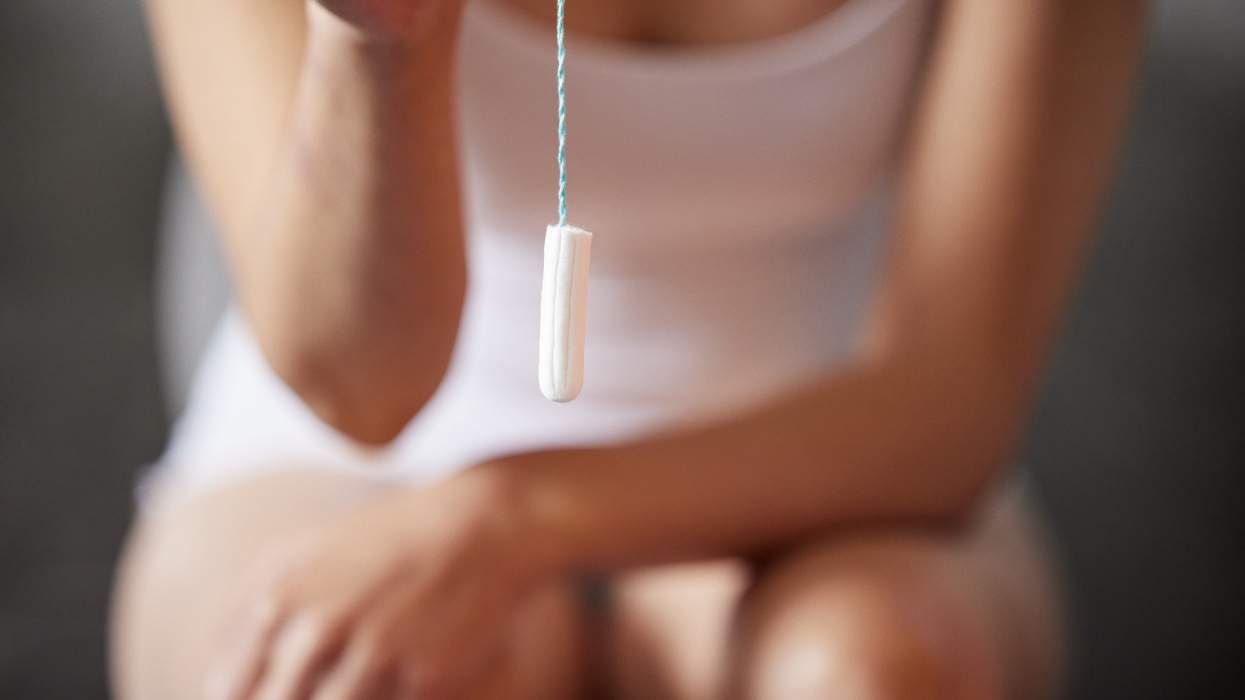
The tampons were stacked and bound together with a rubber band. The incarcerated people at the Patrick O'Daniel Unit — a women’s prison in Central Texas — referred to these bundles as “dynamite sticks.”
Behind bars, these household items could be a liability. People on their periods might beg their peers for tampons or even take them. Correctional officers might write someone up for having more than the 12 tampons permitted per month, which was the practice until the state removed those limits in 2019. The punishments for those violations could range from losing phone or visitation privileges, to fines to solitary confinement.
Jennifer Toon would hide her dynamite sticks behind the bookshelves of the prison library where she worked. “I saw girls get written up because they're hoarding. Like, they're stashing in their cubicle,” said Toon, who was incarcerated twice over two decades and last released in 2018.
But the prison commissary at that time could barely keep extra tampons in stock, she said — and that was assuming people had the money to afford them. To guard against this low supply, Toon and others at the prison would collect a personal stash and tuck them into nooks and crannies so they wouldn’t face consequences. Any infractions on their record could affect something as significant as their eligibility for parole.
“Who wants to get a major case over having extra tampons? And that sounds really ridiculous to people on the outside, but I mean, that would happen,” said Toon, who is now the executive director of Lioness Justice Impacted Women's Alliance, an advocacy nonprofit in Austin, Texas.
The system was a vicious cycle, and in many cases it felt like a trap. Across the country, incarcerated women, trans and nonbinary people are punished for having periods, according to a new analysis published by the Prison Policy Initiative (PPI), in partnership with researcher Miriam Vishniac, the founder and director of the Prison Flow Project, a database focused on access to menstrual products in U.S. prisons.
While prison disciplinary policies do not cite periods directly, the PPI report identified at least six types of prison policies used to punish menstruating people: These include rules concerning damage of prison property, personal hygiene requirements, contraband restrictions, “feigning” illness and being absent from an assigned location.
For example, in Texas, where Toon was incarcerated, “any item possessed in excess of the amounts authorized,” could be considered contraband and punished as a “level 2” offense, which is the second most severe offense category in the state’s disciplinary rulebook. This can result in a loss of good conduct credits that go toward eligibility for parole, educational or work opportunities and other benefits.
Stories from people inside underscore a larger culture of control and dehumanization that incarcerated people endure, Toon and Vishniac said. It also reflects how little attention is given to the health needs of women and trans people in the criminal legal system. Prisons and jails are largely designed with cisgender men in mind, given that they make up about 90 percent of the country’s incarcerated population.
Formerly incarcerated people like Toon have reported male correctional staff and supervisors being oblivious to how menstruation works. They don’t appear to understand, for example, why women might go through more toilet paper than incarcerated cisgender men, or that the quality among different menstrual products varies.
“I knew I needed the tampons because the pads that we were issued were just terrible,” Toon said. “They're going to fall apart in your panties.”
People using standard store-bought products outside of prison will typically go through three to six tampons or menstrual pads each day during a period, which can last for seven days. But the menstrual pads provided in prisons were “not much more useful than a panty liner,” said Stacy Burnett, 50, who was incarcerated for three stretches of time in New York before her release in 2019. During Burnett’s time inside, each person received two packs of 12 pads as well as about 8 tampons per month. The tampons were better for flow control, Burnett said, but could only handle lighter flow days and would still require using a pad as a backup.
“The quality of products provided or available for purchase is usually extremely poor — so poor that they do not fulfill their intended function,” said Vishniac, who completed her dissertation at the University of Edinburgh on the topic. “People have to use six pads at a time to prevent leakage, but they have strict limits on how many they are allowed.”
As a result of the limited access to period products and the poor quality, menstruating people have several options:
- Bleed freely through their uniforms — and risk being written up for poor hygiene or damaging prison property
- Hoard and hide as many tampons as they could find (or purchase from the commissary) — and risk being written up for contraband
- Barter and trade tampons with other incarcerated people — and risk being written up for improper exchange of property
- Make their own tampons out of whatever they could get their hands on: toilet paper, dirty rags, fabric torn from a t-shirt or filling from their mattresses — and risk both an infection and being written up for misuse of prison property
- Use their tampons and pads for multiple days — and risk an infection like Toxic Shock Syndrome. Many guidelines recommend that menstrual products are changed every 4 to 6 hours.
Or, they could “beg like dogs” for more period products, Vishniac said. “It was never as simple as asking for a product and getting it, because employees are trained to question every request incarcerated people make,” she said.
For Nathan Osborne, asking prison staff for period products opened the door to being mocked and degraded. Osborne, a 65-year-old transgender man, first became incarcerated in California in 1981 and was released from custody three months ago. He had a complicated relationship with menstruating as a man and often felt shame.
It didn’t help that when he requested menstrual products, “You would get the look; you would get, ‘Oh, men don’t have periods, why do you need a tampon?” Osborne said. That humiliation took a toll, so he started making his own tampons by tightly wadding up tissue paper and inserting it inside himself. Plenty of others did this, he said, but one day he was caught during a strip search.
“[The wad of paper] stuck out a little bit. I didn't have it all the way in,” he said. “So they took me and had me strapped down and had the doctor go up in me and pull it out, because they were trying to say that it was narcotics.”
Osborne said the doctor warned him that doing this again could cause an infection and sent him on his way. He felt violated by the experience, but he also left with a lingering question: What other choice did he have?
Oftentimes, the most damaging punishment behind bars isn’t being officially written up or losing privileges. It’s the demeaning comments from prison staff. Vishniac said all staff do not participate in this culture of shame, but the ones who do instill a sense of fear that ripples through women’s correctional units.
Like Osborne, Toon experienced strip searches while imprisoned before 2018. She remembers one day when she was scheduled to leave the prison to attend a conference for peer health educators, incarcerated women assigned to teach others in prison about sexual violence prevention, HIV/AIDS awareness and other health-related topics. Getting to attend the conference was “a treat,” Toon said. It was something she was looking forward to.
But in order to leave the prison, she had to be strip searched. Toon knew the routine: She and the other incarcerated women shuffled into the tiny room known as the “strip shack” near the back gate of the prison and began to undress. Typically this process can require the removal of clothing, underwear, as well as any pads or tampons. To avoid having to remove her tampon in front of 20 people, Toon said she learned a trick to clip the tampon string short enough so the staff could not tell. But this time, a woman staffer noticed the extra unwrapped tampon that fell out of Toon’s pocket.
“I know you have a tampon in there.” — “there” being Toon’s vagina.
“I want to see it,” Toon recalled the woman officer saying.
“You're not going anywhere until I see it.”
“So here I am, in front of 20 women, I squat down and I had to get in it,” Toon recalled. “I had to reach all the way in there and get that little string and I pulled it out.”
Droplets of blood fell to the floor as Toon pulled out her second-day tampon. The woman officer “looked at me with so much disgust,” Toon said. Toon looked over at her friend, Janet, who had tears running down her face.
Some cities and states are trying to make a shift in this culture. In response to questions from The 19th, a spokeswoman with the Texas Department of Criminal Justice said the culture Toon described “would be inaccurate to the state of TDCJ today.” In 2019, the department started providing unlimited access to menstrual products, according to the TDCJ spokeswoman. The department also “completed a large educational campaign,” concerning menstrual health care in women’s facilities, she said, and hired a consultant to work with the agency to improve female services and programming.
New York, Maryland, Alabama and Colorado have passed legislation requiring that people in state prisons receive menstrual products for free, though implementation and enforcement have been inconsistent. At least 14 states have passed a Dignity of Incarcerated Women Act aimed at improving certain conditions, including the quality and accessibility of period products.
But Vishniac emphasized that a singular law is simply a Band-Aid that does not address the root of the larger prison culture.
“I think some of the bigger changes that are really necessary — the oversight, the accountability, the transparency — those require us to grapple a bit more with a system that we have a really hard time questioning,” Vishniac said. “If we really, truly want to make sure that nobody is bleeding on themselves or punished for bleeding on themselves, we have to also understand that this stigmatization, and mass incarceration and warehousing people is part of that.”