'%3E%3Cpath d='M16.3574 35.6519H12.9537L15.0491 18.8873L16.3574 35.6519ZM30.4229 54.0093L22.309 0.994385H7.91795L0 54.0093H10.6634L11.5802 46.3855H17.4014L17.9914 54.0093H30.4229Z' fill='%23971B20'/%3E%3Cpath d='M48.2073 41.8813C48.2073 43.4049 47.4892 44.0011 46.1144 44.0011H43.7595V11.0687H46.1144C47.4892 11.0687 48.2073 11.6636 48.2073 13.1885V41.8813ZM59.5273 43.6695V11.3326C59.5273 3.71323 53.5729 0.994385 47.8157 0.994385H31.7213V54.0093H47.8157C53.5729 54.0093 59.5273 51.29 59.5273 43.6695Z' fill='%23971B20'/%3E%3Cpath d='M90.183 0.994385H78.6039L75.0711 30.6157L71.9955 0.994385H59.4346L69.2474 54.0093H80.373L90.183 0.994385Z' fill='%23971B20'/%3E%3Cpath d='M107.063 42.3448C107.063 43.7359 105.951 44.5974 104.643 44.5974C103.269 44.5974 102.157 43.7359 102.157 42.3448V12.658C102.157 11.2676 103.269 10.4058 104.643 10.4058C105.951 10.4058 107.063 11.2676 107.063 12.658V42.3448ZM119.233 43.2723V11.7312C119.233 6.36384 112.952 -3.8147e-06 104.643 -3.8147e-06C96.2667 -3.8147e-06 89.9867 6.36384 89.9867 11.7312V43.2723C89.9867 48.6393 96.2667 55 104.643 55C112.952 55 119.233 48.6393 119.233 43.2723Z' fill='%23971B20'/%3E%3Cpath d='M150.976 43.9349V33.7309H139.069V42.3448C139.069 43.7359 137.957 44.5974 136.582 44.5974C135.076 44.5974 133.964 43.7359 133.964 42.3448V12.658C133.964 11.2676 135.076 10.4058 136.582 10.4058C137.957 10.4058 139.069 11.2676 139.069 12.658V21.2723H150.976V11.0687C150.976 5.70107 145.283 -3.8147e-06 136.582 -3.8147e-06C127.75 -3.8147e-06 121.796 5.70107 121.796 11.0687V43.9349C121.796 49.3022 127.75 55 136.582 55C145.283 55 150.976 49.3022 150.976 43.9349Z' fill='%23971B20'/%3E%3Cpath d='M167.478 35.6519H164.076L166.17 18.8873L167.478 35.6519ZM181.544 54.0093L173.432 0.994385H159.037L151.123 54.0093H161.785L162.704 46.3855H168.523L169.114 54.0093H181.544Z' fill='%23971B20'/%3E%3Cpath d='M205.412 10.4058V0.994385H177.081V10.4058H185.392V54.0093H197.428V10.4058H205.412Z' fill='%23971B20'/%3E%3Cpath d='M230.002 54.0093V43.9349H218.914V31.8746H226.635V21.8028H218.914V10.4058H230.002V0.994385H206.875V54.0093H230.002Z' fill='%23971B20'/%3E%3C/g%3E%3Cdefs%3E%3CclipPath id='clip0_260_7080'%3E%3Crect width='230' height='55' fill='white'/%3E%3C/clipPath%3E%3C/defs%3E%3C/svg%3E)


From candlelight vigils to White House performances, gay men’s choruses have charted an extraordinary journey over the past half-century. It’s a series of stories tied together by community, activism, art, and resilience. Born out of a need for visibility and healing, they’ve become cultural institutions, blending music with unapologetic queerness and social justice.
The story begins in 1978 in San Francisco, when activist-musician Jon Reed Sims founded the San Francisco Gay Men’s Chorus to march in the city’s Gay Freedom Day Parade. It was the first chorus to include the word “gay” in its name. But a few months later, tragedy struck. In November 1978, following the assassinations of Supervisor Harvey Milk and Mayor George Moscone, the chorus took to the steps of City Hall to perform Mendelssohn’s “Thou, Lord, Our Refuge” at a candlelight vigil.
Inspired by San Francisco’s example, other choruses formed in the following years. Los Angeles launched its gay men’s chorus in 1979. New York City followed in 1980 and Washington, D.C., in 1981. In fact, Washington’s chorus owes its origins to a straight ally.
“The San Francisco chorus toured to D.C. and sang at the Kennedy Center in May or June of 1981,” explains Michael Hughes, a longtime member of the Gay Men’s Chorus of Washington, D.C. “It was the first time a gay arts group performed there. A woman named Marsha Pearson was so moved, she said, ‘We need this in D.C.’ She and her sister handed out flyers at Pride and around Dupont Circle. The first meeting of what became GMCW was on June 28, 1981.”
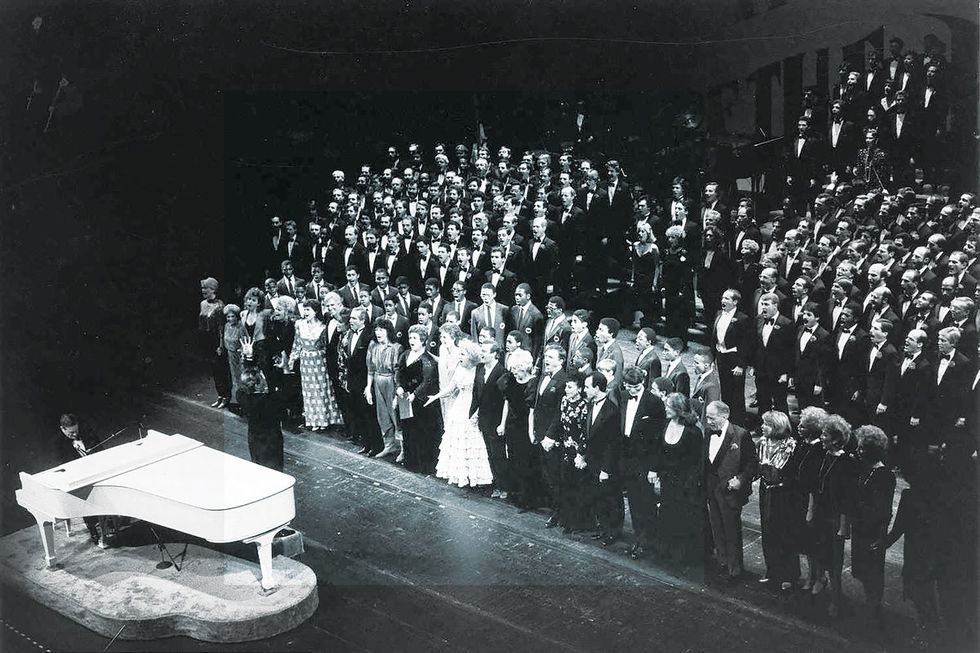 NYCGMC performs in Best of the Best, the first celebrity AIDS fundraiser, at the Metropolitan Opera House in New York City in 1985.courtesy nyc gay men’s chorus
Soon, the Gay and Lesbian Association of Choruses formed to connect these ensembles. Its inaugural 1983 festival in New York drew over 650 singers from 11 choruses and established a national movement.
The AIDS crisis of the 1980s and early ’90s devastated the gay community and deeply impacted the choruses.
“There’s a video from San Francisco that still gives me chills,” Hughes recalls. “About 150 singers are onstage. And as the song goes on, they turn their backs to the audience. They were representing members who died. At the end, only four or five are left facing forward. It’s heartbreaking. It’s powerful.”
“In GMCW, we lost around 100 members,” Hughes continues. “We sang at countless memorials. We even started the tradition of releasing balloons during services.”
In those darkest years, choruses became sanctuaries, offering grief-stricken communities a place to mourn and persevere together. They also reclaimed space in the classical canon, championed queer composers, and transformed music into political witness.
From Carnegie Hall to international tours, gay men’s choruses brought artistry and advocacy to elite stages. The New York City Gay Men’s Chorus made history with its 1981 Carnegie Hall debut, and the Gay Men’s Chorus of Los Angeles performed for Presidents Clinton and Obama.
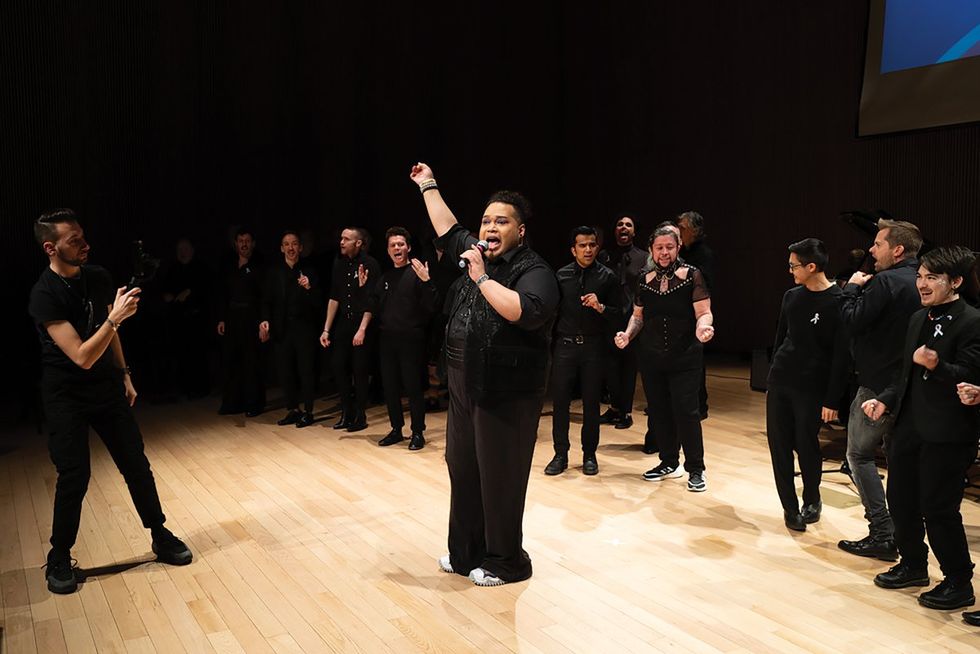 A member of NYC’s Gay Men’s Chorus belts it out on stage.courtesy nyc gay men’s chorus
Even in D.C., the chorus was attuned to the moment. “We were literally onstage, probably during a Christmas concert, when the military ban was rescinded,” Hughes remembers. “We didn’t plan it, but the whole room erupted. It was amazing.”
For years, the movement celebrated milestone after milestone: the overturning of sodomy laws, the repeal of “don’t ask, don’t tell,” the Supreme Court’s Obergefell v. Hodges decision that took marriage equality nationwide. But Hughes notes that the current climate is more challenging.
“Because of all the moves against the LGBTQ+ community by the Trump administration, I would say this is the most difficult period since I’ve been in the chorus,” he says. “After so many victories, we’re now facing real setbacks.”
While rooted in gay men’s experiences, today’s choruses reflect evolving queer communities and identities. “It’s not just gay men anymore,” Hughes says. “We have straight women. We have quite a few trans and nonbinary members. We’re building a space for all.”
Across the country, choruses now work with schools, offer educational outreach, and commission new works that center LGBTQ+ history and identity. San Francisco’s RHYTHM (Reaching Youth Through Music) program, for example, brings inclusive music to Bay Area students.
GALA choruses today include hundreds of groups across the U.S. and abroad, each carrying forward the legacy of those early pioneers. From a single vigil in San Francisco to global stages, gay men’s choruses have proven that music is more than performance. It includes protest, pride, and perseverance.
“They sang us through the worst of the AIDS crisis,” Hughes reflects. “They sang us through joy. And now they’re singing us through another fight.”
This article is part of The Advocate's Sept/Oct 2025 issue, now on newsstands. Support queer media and subscribe — or download the issue through Apple News, Zinio, Nook, or PressReader.