'%3E%3Cpath d='M16.3574 35.6519H12.9537L15.0491 18.8873L16.3574 35.6519ZM30.4229 54.0093L22.309 0.994385H7.91795L0 54.0093H10.6634L11.5802 46.3855H17.4014L17.9914 54.0093H30.4229Z' fill='%23971B20'/%3E%3Cpath d='M48.2073 41.8813C48.2073 43.4049 47.4892 44.0011 46.1144 44.0011H43.7595V11.0687H46.1144C47.4892 11.0687 48.2073 11.6636 48.2073 13.1885V41.8813ZM59.5273 43.6695V11.3326C59.5273 3.71323 53.5729 0.994385 47.8157 0.994385H31.7213V54.0093H47.8157C53.5729 54.0093 59.5273 51.29 59.5273 43.6695Z' fill='%23971B20'/%3E%3Cpath d='M90.183 0.994385H78.6039L75.0711 30.6157L71.9955 0.994385H59.4346L69.2474 54.0093H80.373L90.183 0.994385Z' fill='%23971B20'/%3E%3Cpath d='M107.063 42.3448C107.063 43.7359 105.951 44.5974 104.643 44.5974C103.269 44.5974 102.157 43.7359 102.157 42.3448V12.658C102.157 11.2676 103.269 10.4058 104.643 10.4058C105.951 10.4058 107.063 11.2676 107.063 12.658V42.3448ZM119.233 43.2723V11.7312C119.233 6.36384 112.952 -3.8147e-06 104.643 -3.8147e-06C96.2667 -3.8147e-06 89.9867 6.36384 89.9867 11.7312V43.2723C89.9867 48.6393 96.2667 55 104.643 55C112.952 55 119.233 48.6393 119.233 43.2723Z' fill='%23971B20'/%3E%3Cpath d='M150.976 43.9349V33.7309H139.069V42.3448C139.069 43.7359 137.957 44.5974 136.582 44.5974C135.076 44.5974 133.964 43.7359 133.964 42.3448V12.658C133.964 11.2676 135.076 10.4058 136.582 10.4058C137.957 10.4058 139.069 11.2676 139.069 12.658V21.2723H150.976V11.0687C150.976 5.70107 145.283 -3.8147e-06 136.582 -3.8147e-06C127.75 -3.8147e-06 121.796 5.70107 121.796 11.0687V43.9349C121.796 49.3022 127.75 55 136.582 55C145.283 55 150.976 49.3022 150.976 43.9349Z' fill='%23971B20'/%3E%3Cpath d='M167.478 35.6519H164.076L166.17 18.8873L167.478 35.6519ZM181.544 54.0093L173.432 0.994385H159.037L151.123 54.0093H161.785L162.704 46.3855H168.523L169.114 54.0093H181.544Z' fill='%23971B20'/%3E%3Cpath d='M205.412 10.4058V0.994385H177.081V10.4058H185.392V54.0093H197.428V10.4058H205.412Z' fill='%23971B20'/%3E%3Cpath d='M230.002 54.0093V43.9349H218.914V31.8746H226.635V21.8028H218.914V10.4058H230.002V0.994385H206.875V54.0093H230.002Z' fill='%23971B20'/%3E%3C/g%3E%3Cdefs%3E%3CclipPath id='clip0_260_7080'%3E%3Crect width='230' height='55' fill='white'/%3E%3C/clipPath%3E%3C/defs%3E%3C/svg%3E)

Curtis Clemons has lived in Northern Kentucky his entire life.
The 36-year-old said he's loved Covington since he was a kid. Growing up 45 minutes away in Williamstown, he looked forward to weekends "in the city" with his family.
Clemons, now a resident and a local realtor, said he usually felt safe in Covington when he interacted with local law enforcement until he learned of a police officer in Covington named Doug Ullrich.
"The interactions I've seen on the news and reported about Officer Ullrich, but also the interactions officers have had on the Roebling Bridge last summer," Clemons said. "There was unjust violence toward citizens on the bridge."
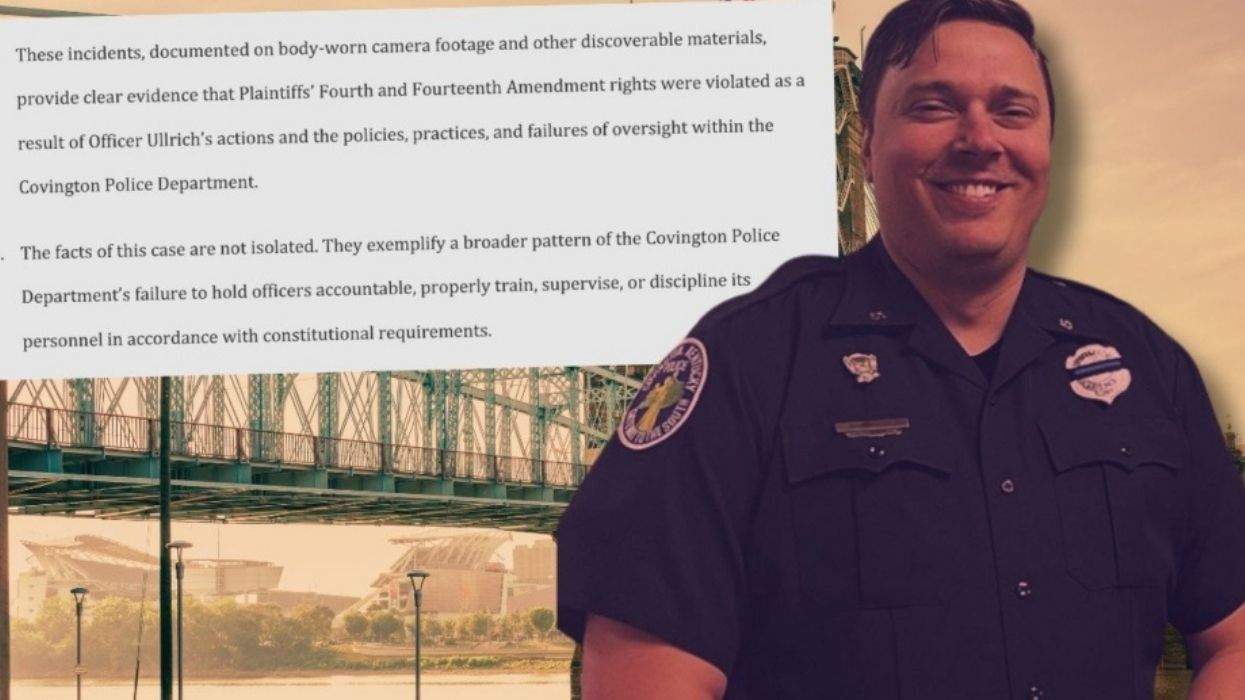
Clemons was one of several members of the Covington LGBTQ+ community that spoke with Queer Kentucky who were concerned with Ullrich, the number of lawsuits filed against him and what they see is a lack of action by the city and the Covington Police Department.
Ullrich is a training specialist and the department's LGBTQ+ Liaison Officer. On the Covington Police Department website, it describes the LGTBQ+ Liaison Officer mission, "To build communication between the LGBTQ+ community and (the department)," by "developing trust and understanding." Clemons, and other members of the LGTBQ+ Community interviewed by Queer Kentucky, believe the department is failing in that mission.
Ullrich made news in early 2025 when dashcam video of his October 2024 arrest of Damien Conner became public. Conner, an LGBTQ+ Black man, was pulled out of his car by Ullrich and another officer after they cut his seat belt. According to the complaint, Ullrich said he smelled marijuana in Conner's vehicle after he began removing him from the vehicle.
Conner was held overnight, but wasn't charged when he was released the next morning.
In March 2025, he filed a federal lawsuit against the Covington Police Department and Ullrich for violating his civil rights. It's one of nine lawsuits filed in federal court against Ullrich since 2021.
Clemons said the lawsuits against Ullrich and the handling of protestors on the Roebling Bridge last year, who were rallying against the detention of Ayiman Soliman by ICE, have put him in a position where he's afraid of interactions with the police department.
"It has eroded any trust that I might have had," Clemons said.
Ullrich has been the department's LGBTQ+ Liaison since 2023. In May 2025, Queer Kentucky published a profile on Ullrich, including excerpts from his 300-page personnel file.
Ullrich’s personnel file showed praise for his work involving traffic stops and drug enforcement. It also showed concerns from other officers and supervisors, including a 2014 group chat conversation with other officers, where Ullrich said, “I violate every policy,” in response to another officer discussing the time he tased a suspect who posed no threat and was running away.
Another member of the chat wrote, “…if u r ever the defendant in a federal case, it could come back to haunt…just my piece of advice, been there, done that, it was not fun.”
Nine lawsuits since 2021
Despite being sued nine times in federal court, Ullrich hasn't been found liable in the three cases that have been decided. One of those cases is before the Sixth Circuit Appellate Court.
"When one officer repeatedly appears in these cases, it naturally leads people to ask whether supervisory oversight and accountability mechanisms are working the way they should and if anyone truly cares," said Elise Sebastian, who does volunteer work in the city.
In 2021, Jeffrey Cundiff sued Ullrich and the department after he was given a body cavity search during a traffic stop. Ullrich won partially on summary judgment in March 2024.
In a suit filed in 2021, Anthony Wynn claimed he was assaulted by Ullrich and other officers over the course of three arrests. Wynn sued Ullrich, the police department and 50 officers. Ullrich and some other defendants were dropped from the suit after the judge partially dismissed portions of the case on statute of limitations grounds. The Eastern Kentucky District ruled in favor of the defendants last year. The Sixth Circuit affirmed the ruling in April.
Ashley Ferrerias filed a civil suit in 2024 after she claimed she was physically and sexually assaulted, and had her First Amendment rights violated after she was knocked off her crutches and arrested when questioning why her boyfriend was pulled over. Her case was appealed after the court found in Ullrich's favor in February. Ferreiras is also awaiting an appeal on her criminal conviction in the case related to her civil filing.
Eight days after the Ferrerias case was decided in Eastern Kentucky District Court, Ullrich was sued in February by Covington residents Stephen Weier and Brandon Greenlee for allegedly conducting a warrantless vehicle search, false arrest and unlawful detainment during a March 2025 traffic stop. Weier accused Ullrich of sexual assault while being searched.
Despite the court deciding in Ullrich's favor in the Ferrerias case (the judge ruled that Ferrerias's convictions in Kenton County Court wiped out her claims of having her civil rights violated), Clemons said it hasn't assuaged his worries about the department.
"If the suits are still being filed then it's clear there's still a problem at the Covington Police Department," Clemons said. "Ullrich may just be a symptom of those issues. Mayor Ron Washington, I think he was the highest or one of the highest-ranking African American police officers in the state of Kentucky, even though he's retired," Clemons said. "I would love to see him say something."
In a response to Queer Kentucky, the City of Covington sent the following statement:
"Because some cases remain pending, the Covington Police Department and the City are limited in what we can comment on publicly.
"That said, the rulings issued so far show that the actions taken by the City's police officers were professional, lawful, and within established operating procedures.
"The Covington Police Department is committed to professional policing, accountability, and ensuring that officers carry out their duties responsibly while protecting the people and visitors of Covington.
"The City will continue to let the legal process play out while remaining focused on serving the community and upholding the standards expected of the police department."
A Dangerous and Confusing Message
"Liaison roles exist to build trust with communities that historically have had complicated and often harmful interactions with law enforcement," said Elise Sebastian. "When the officer assigned to build that trust is simultaneously facing repeated allegations of excessive force, it sends a dangerous and confusing message. This creates a credibility problem."
Sebastian lives outside Covington with her wife. She's frequently in the city for LGBTQ+ events and first heard of Ullrich when his arrest of Conner made local news.
"After the news reports, I started paying closer attention to the department's response," Sebastian said. "What stood out to me wasn't just the lawsuits themselves, but the pattern. When one officer appears in that many cases, people are going to ask questions about oversight and accountability."
Dr. Chelsea Elsmere, a psychologist specializing in LGBTQ+ health concerns, said instances of discrimination can lead to members of a marginalized group losing trust in institutions and feeling they aren't safe where they live. That can lead to adverse mental and physical health effects, Elsmere said. Ullrich's status as LGBTQ+ Liaison and the allegations of excessive force could pose a mental health issue.
"It's a big problem if you can't trust who is supposed to be protecting you," Elsmere said. "There is so much fear in our world today; people need to feel secure in their own spaces.
"This is called 'minority stress theory;' and is particularly relevant to police interactions," Elsmere said. "LGBTQ+ individuals are likely to have a baseline of low trust in police and be reluctant to seek help from them. Documented incidents that bring safety into question aren't going to help this problem, nor is a lack of transparency/accountability from the department in response."
Sebastian said the situation has caused her to make fewer trips to Covington.
"Trust is fragile, especially between law enforcement and LGBTQ+ communities that historically have experienced discrimination or over-policing," Sebastian said. "When the officer assigned to be a bridge to that community is repeatedly named in civil rights lawsuits, it undermines the purpose of that bridge."
Questions about Use Of Force Policy
While Ullrich won the Ferrerias case, depositions reveal that there may be inconsistencies in the department's use of force policy.
Ullrich and Officer Anthony Fritsch were sued in federal civil court by Ferreiras in 2023 after she alleged officers assaulted her in front of her house. The incident began when officers, including Ullrich, had pulled over her boyfriend in front of her home for a broken taillight.
According to her complaint, she came down to the sidewalk on crutches, and officers pulled the crutches away from her. She filed the suit claiming she was unlawfully charged and arrested, and accused the officers of "physical and sexual assault."
Ferreiras was found guilty of charges related to the incident. Like her civil suit, that case is before an appeals court.
During the August 2025 deposition, Officer Anthony Fritsch was asked by attorney Justin Whitaker if he was trained on the department's use of force policy.
"No one specifically trained us on use of force policy," Fritsch said. "We were expected to read it and understand it."
Ullrich, a department training officer, said this wasn't the case when questioned by attorney Whitaker.
During the deposition, Ullrich didn't say whether he was in charge of training Fritsch on use of force policy. But it has caused community members to question whether the department is taking the policy seriously, especially with the training officer being sued eight times.
Community members: Department needs to address concerns
Elsmere said if more cases against Ulrich continue to be filed, the city's police department would be in a bind, not only with the LGBTQ+ community, but anyone who feels the department isn't being responsive to major issues.
"Each new case deepens the rift," Elsmere said. "Though Ulrich's interest in serving as LGBTQ+ liaison may come with good intent, the incidents in question have had damaging impact. It is undeniable that these events have undermined relations between the community and (the Covington) police department as a whole. That's quite contradictory to the very concept of a liaison."
As long as the department remains quiet, Sebastian, who does regular volunteer work in Covington, said she doesn't believe the department is taking Ullrich or the community's concerns seriously.
"The public understands that policing is difficult work," Sebastian said. "What people struggle with is when a pattern emerges and the response from leadership appears quiet or procedural. That is when trust erodes."
After the Roebling Bridge Protest, the department suspended one officer for a month and recommended he receive additional training. Sebastian said this is a similar moment and requires similar action.
"This is a moment for the city and the police department to demonstrate that ethical standards and public trust actually matter," Sebastian said.
Tracy Kisenda, who is suing Ullrich, is awaiting his criminal trial in June. Kisenda is facing charges of assaulting officers and disrupting governmental operations. He said those charges are false, according to his civil complaint, filed in 2025.
This article first appeared on Queer Kentucky | Kentucky's Only LGBTQ+ Newsroom and is republished here under a Creative Comons Attribution-NoDerivatives 4.0 International License.