'%3E%3Cpath d='M16.3574 35.6519H12.9537L15.0491 18.8873L16.3574 35.6519ZM30.4229 54.0093L22.309 0.994385H7.91795L0 54.0093H10.6634L11.5802 46.3855H17.4014L17.9914 54.0093H30.4229Z' fill='%23971B20'/%3E%3Cpath d='M48.2073 41.8813C48.2073 43.4049 47.4892 44.0011 46.1144 44.0011H43.7595V11.0687H46.1144C47.4892 11.0687 48.2073 11.6636 48.2073 13.1885V41.8813ZM59.5273 43.6695V11.3326C59.5273 3.71323 53.5729 0.994385 47.8157 0.994385H31.7213V54.0093H47.8157C53.5729 54.0093 59.5273 51.29 59.5273 43.6695Z' fill='%23971B20'/%3E%3Cpath d='M90.183 0.994385H78.6039L75.0711 30.6157L71.9955 0.994385H59.4346L69.2474 54.0093H80.373L90.183 0.994385Z' fill='%23971B20'/%3E%3Cpath d='M107.063 42.3448C107.063 43.7359 105.951 44.5974 104.643 44.5974C103.269 44.5974 102.157 43.7359 102.157 42.3448V12.658C102.157 11.2676 103.269 10.4058 104.643 10.4058C105.951 10.4058 107.063 11.2676 107.063 12.658V42.3448ZM119.233 43.2723V11.7312C119.233 6.36384 112.952 -3.8147e-06 104.643 -3.8147e-06C96.2667 -3.8147e-06 89.9867 6.36384 89.9867 11.7312V43.2723C89.9867 48.6393 96.2667 55 104.643 55C112.952 55 119.233 48.6393 119.233 43.2723Z' fill='%23971B20'/%3E%3Cpath d='M150.976 43.9349V33.7309H139.069V42.3448C139.069 43.7359 137.957 44.5974 136.582 44.5974C135.076 44.5974 133.964 43.7359 133.964 42.3448V12.658C133.964 11.2676 135.076 10.4058 136.582 10.4058C137.957 10.4058 139.069 11.2676 139.069 12.658V21.2723H150.976V11.0687C150.976 5.70107 145.283 -3.8147e-06 136.582 -3.8147e-06C127.75 -3.8147e-06 121.796 5.70107 121.796 11.0687V43.9349C121.796 49.3022 127.75 55 136.582 55C145.283 55 150.976 49.3022 150.976 43.9349Z' fill='%23971B20'/%3E%3Cpath d='M167.478 35.6519H164.076L166.17 18.8873L167.478 35.6519ZM181.544 54.0093L173.432 0.994385H159.037L151.123 54.0093H161.785L162.704 46.3855H168.523L169.114 54.0093H181.544Z' fill='%23971B20'/%3E%3Cpath d='M205.412 10.4058V0.994385H177.081V10.4058H185.392V54.0093H197.428V10.4058H205.412Z' fill='%23971B20'/%3E%3Cpath d='M230.002 54.0093V43.9349H218.914V31.8746H226.635V21.8028H218.914V10.4058H230.002V0.994385H206.875V54.0093H230.002Z' fill='%23971B20'/%3E%3C/g%3E%3Cdefs%3E%3CclipPath id='clip0_260_7080'%3E%3Crect width='230' height='55' fill='white'/%3E%3C/clipPath%3E%3C/defs%3E%3C/svg%3E)

Dolly Parton, the country music legend whose singular songwriting, towering hair and rhinestone-studded wit made her an American institution, died August 25 at 80.
Across a career spanning nearly six decades, Parton wrote an estimated 3,000 songs, sold more than 100 million records and gave the world classics including “Jolene,” “Coat of Many Colors,” “9 to 5” and “I Will Always Love You.”
Dolly Parton is an American icon.

For generations of LGBTQ+ fans, however, Parton was more than an entertainer. She returned their devotion. She championed marriage equality, rejected religious judgment of queer people, defended transgender Americans and embraced drag culture.
Here are some of the moments that cemented Parton’s legacy as an LGBTQ+ icon.
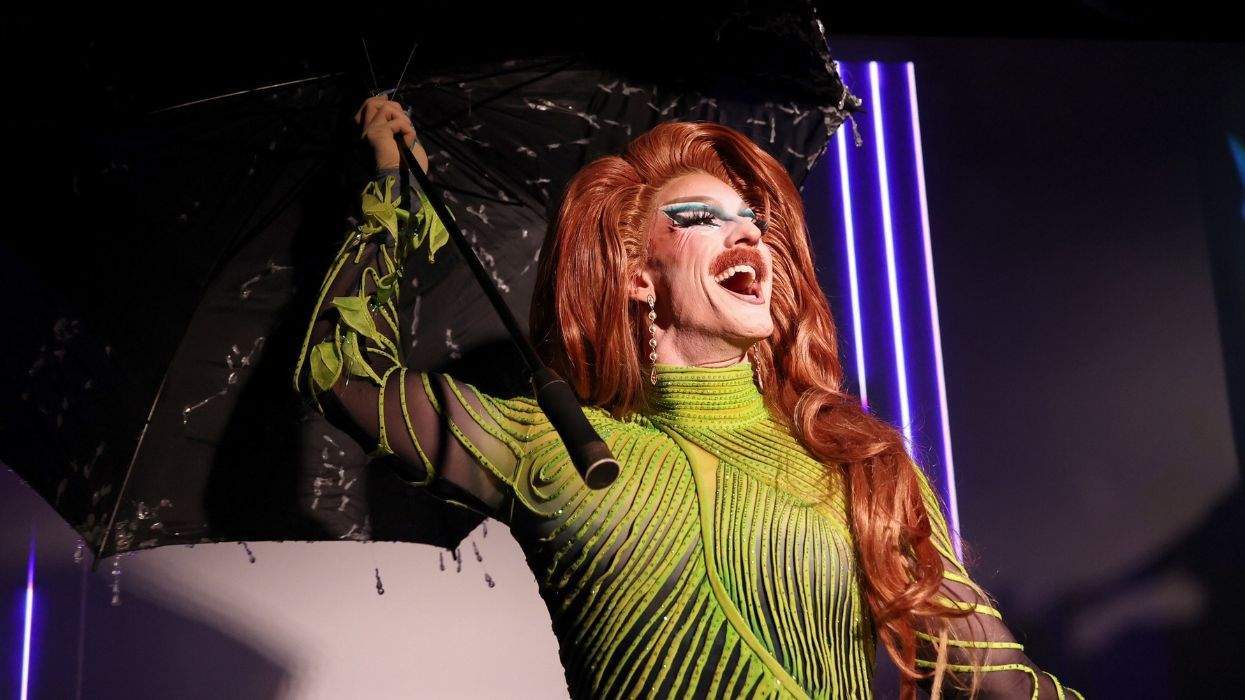
Dolly loved drag

Parton knew that imitation could be the sincerest — and funniest — form of flattery.
She once secretly entered a Dolly Parton look-alike contest on Santa Monica Boulevard in West Hollywood, competing against drag performers dressed as the country star. Even after exaggerating the famous Dolly look, the real Parton lost.
“I didn’t win,” she recalled during a Good Morning America interview. “I didn’t even come in close, I don’t think.”
Dolly rejected religious judgment of LGBTQ+ people

Parton’s Christian faith was central to her life, but she refused to use it as a weapon against LGBTQ+ people.
Speaking about her queer fans and Dollywood in a 2014 Billboard interview, Parton turned the language of religious condemnation back on those deploying it.
“If people want to pass judgment, they’re already sinning,” she said, adding, “I try to love everybody.”
Dolly sang about LGBTQ+ people belonging in families

Parton included gay people in her expansive definition of family long before country music became even moderately welcoming to LGBTQ+ artists and audiences.
Her 1991 album, Eagle When She Flies, included “Family,” a song acknowledging that relatives can be gay, struggling or otherwise unlike one another. Its ultimate message was that “not a one is turned away when it’s family.”
The language reflected its era, but its embrace was unmistakable: LGBTQ+ people belonged.
Dolly made clear that all families were welcome at Dollywood

In 2011, a lesbian visitor to Dollywood’s Splash Country said an employee forced her to turn a marriage equality T-shirt inside out.
Parton responded publicly and apologized for the treatment the woman experienced.
“Everyone knows of my personal support of the gay and lesbian community,” Parton said. She emphasized that Dollywood welcomed all kinds of families and promised to investigate what happened.
Dolly supported women in power, including Hillary.

Parton did not merely tolerate her queer fan base. She celebrated it.
“I have a huge gay following, and I’m proud of them,” she told The New York Times in 2016. "Sometimes some of them look more like me than I do."
Plus, she supported then-rumored presidential candidate Hillary Clinton.
"Hillary might make as good a president as anybody ever has... I personally think a woman would do a great job. I think Hillary's very qualified," Parton said, adding. "I'll certainly be behind her."
Dolly helped bring a transgender story to the screen

Parton wrote "Travelin’ Thru“ for Transamerica, the 2005 film about a transgender woman traveling across the country with the son she had only recently learned existed.
The film’s casting of cisgender actor Felicity Huffman in the central role would later draw criticism, but Parton’s song became an anthem about transformation, uncertainty and finding the courage to continue forward.
“Travelin’ Thru” earned Parton an Academy Award nomination for best original song. She performed it during the 2006 Oscars, bringing a song written for a transgender story to one of the world’s largest stages.
Dolly opposed restrictions targeting transgender people

When North Carolina’s anti-transgender “bathroom bill” became a national controversy in 2016, Parton responded with compassion — and characteristic humor.
“I think everybody should be treated with respect,” she said on CNN. “I hope that everybody gets a chance to be who and what they are.”
She then brushed aside the manufactured panic surrounding public restrooms by joking that when she needed to go, she would use whichever bathroom was available.
Dolly stood up for marriage equality

Parton publicly supported marriage equality years before the U.S. Supreme Court made it the law of the land.
She later voiced support for same-sex couples fighting for the freedom to marry in Australia, opening with a characteristically Dolly joke: “Why can’t they be as miserable as us heterosexuals in their marriages?”
Her serious message was equally direct.
“I think love is love and we have no control over that,” Parton said. “I think people should be allowed to marry.”
Dolly put a gay love story at the heart of her Netflix series

Dolly Parton attends the 58th Academy of Country Music Awards at The Ford Center at The Star on May 11, 2023 in Frisco, Texas.
Axelle/Bauer-Griffin/FilmMagic
In 2019, Parton used her Netflix anthology series, Dolly Parton’s Heartstrings, to tell a distinctly queer family story.
The episode “Two Doors Down” centered on a gay couple, played by Andy Mientus and Michael J. Willett, navigating family secrets and rejection during a New Year’s Eve wedding. Some viewers reportedly walked out of a screening at Dollywood after learning the two men were romantically involved.
Parton stood behind the story.
“It’s important that I touched on everything that all families go through,” she said. “Everyone has gays in their family.”
In 2020, “Two Doors Down” won the GLAAD Media Award for outstanding individual episode in a series without a regular LGBTQ+ character.
Dolly defended transgender people as Tennessee attacked their rights

Dolly Parton discusses their new book "Run, Rose, Run: A Novel" co-written with James Patterson at "Dollyverse Powered By Blockchain Creative Labs on Eluv.io" during the 2022 SXSW Conference And Festival at ACL Live at The Moody Theater on March 18, 2022 in Austin, Texas.
Rick Kern/FilmMagic
In 2023, Parton was asked about a wave of anti-transgender laws enacted in her home state of Tennessee, including a ban on gender-affirming health care for minors.
Parton, who generally resisted partisan political debates, said the issue was about the lives and dignity of people she knew and loved. She noted that transgender, gay and lesbian people were among her relatives and employees.
“I just want everybody to be treated good,” Parton told The Hollywood Reporter. “They cannot help that any more than I can help being Dolly Parton.”
She said she had witnessed the pain LGBTQ+ people experienced when they were targeted and rejected. Parton’s conclusion drew upon the Christian faith she repeatedly invoked in defense of queer people: Judgment belonged to God, she said, and everyone was one of God’s children.