'%3E%3Cpath d='M16.3574 35.6519H12.9537L15.0491 18.8873L16.3574 35.6519ZM30.4229 54.0093L22.309 0.994385H7.91795L0 54.0093H10.6634L11.5802 46.3855H17.4014L17.9914 54.0093H30.4229Z' fill='%23971B20'/%3E%3Cpath d='M48.2073 41.8813C48.2073 43.4049 47.4892 44.0011 46.1144 44.0011H43.7595V11.0687H46.1144C47.4892 11.0687 48.2073 11.6636 48.2073 13.1885V41.8813ZM59.5273 43.6695V11.3326C59.5273 3.71323 53.5729 0.994385 47.8157 0.994385H31.7213V54.0093H47.8157C53.5729 54.0093 59.5273 51.29 59.5273 43.6695Z' fill='%23971B20'/%3E%3Cpath d='M90.183 0.994385H78.6039L75.0711 30.6157L71.9955 0.994385H59.4346L69.2474 54.0093H80.373L90.183 0.994385Z' fill='%23971B20'/%3E%3Cpath d='M107.063 42.3448C107.063 43.7359 105.951 44.5974 104.643 44.5974C103.269 44.5974 102.157 43.7359 102.157 42.3448V12.658C102.157 11.2676 103.269 10.4058 104.643 10.4058C105.951 10.4058 107.063 11.2676 107.063 12.658V42.3448ZM119.233 43.2723V11.7312C119.233 6.36384 112.952 -3.8147e-06 104.643 -3.8147e-06C96.2667 -3.8147e-06 89.9867 6.36384 89.9867 11.7312V43.2723C89.9867 48.6393 96.2667 55 104.643 55C112.952 55 119.233 48.6393 119.233 43.2723Z' fill='%23971B20'/%3E%3Cpath d='M150.976 43.9349V33.7309H139.069V42.3448C139.069 43.7359 137.957 44.5974 136.582 44.5974C135.076 44.5974 133.964 43.7359 133.964 42.3448V12.658C133.964 11.2676 135.076 10.4058 136.582 10.4058C137.957 10.4058 139.069 11.2676 139.069 12.658V21.2723H150.976V11.0687C150.976 5.70107 145.283 -3.8147e-06 136.582 -3.8147e-06C127.75 -3.8147e-06 121.796 5.70107 121.796 11.0687V43.9349C121.796 49.3022 127.75 55 136.582 55C145.283 55 150.976 49.3022 150.976 43.9349Z' fill='%23971B20'/%3E%3Cpath d='M167.478 35.6519H164.076L166.17 18.8873L167.478 35.6519ZM181.544 54.0093L173.432 0.994385H159.037L151.123 54.0093H161.785L162.704 46.3855H168.523L169.114 54.0093H181.544Z' fill='%23971B20'/%3E%3Cpath d='M205.412 10.4058V0.994385H177.081V10.4058H185.392V54.0093H197.428V10.4058H205.412Z' fill='%23971B20'/%3E%3Cpath d='M230.002 54.0093V43.9349H218.914V31.8746H226.635V21.8028H218.914V10.4058H230.002V0.994385H206.875V54.0093H230.002Z' fill='%23971B20'/%3E%3C/g%3E%3Cdefs%3E%3CclipPath id='clip0_260_7080'%3E%3Crect width='230' height='55' fill='white'/%3E%3C/clipPath%3E%3C/defs%3E%3C/svg%3E)
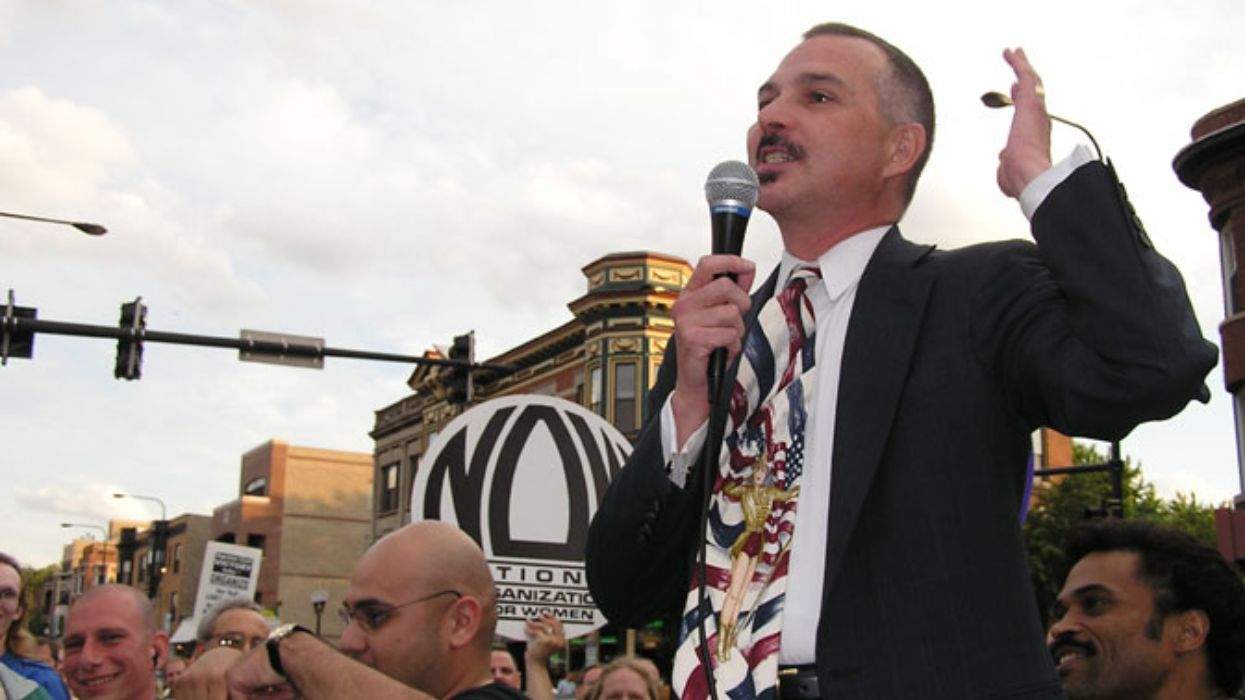

Chicago has lost a giant of LGBTQ+ activism.
Rick Garcia, who was involved in almost every advance in LGBTQ+ rights in Chicago, Cook County, and Illinois during his lifetime, died January 12 at age 69. He had been through a series of illnesses and surgeries, and the official cause of death was heart failure, said Richard Streetman, his friend, caregiver, and family spokesman. Streetman and several other friends spoke to The Advocate about the late activist.
Garcia worked to pass LGBTQ-inclusive civil rights laws at the city, county, and state levels, and then for civil unions and marriage equality.
Related: Change Comes From the Middle of the Countrythe Middle of the Country
A native of St. Louis, he was an organizer for the United Farm Workers while he was in college, then moved to Washington, D.C., to join New Ways Ministry, which advocates for LGBTQ+ equality within the Roman Catholic Church. He had come out as gay while still in St. Louis, confronting a Catholic priest who was speaking on the “sin” of homosexuality. Local TV stations were covering the priest’s appearance at St. Louis City Hall, so Garcia ended up coming out to his family and the whole viewing area.
On a vacation to Chicago in 1986, he joined the effort for a gay rights ordinance, and he ended up staying in the city. Working with an organization called the Gay and Lesbian Town Meeting, he and others persuaded the City Council to pass the ordinance in 1988. He and three other activists were key to the effort and became known as the “Gang of Four” — Garcia, Laurie Dittman, Art Johnston, and Jon-Henri Damski. One of Garcia’s strategies was to have nuns urge council members to support the ordinance, showing politicians they wouldn’t offend Catholics by doing so. Gender identity was added to the ordinance later.
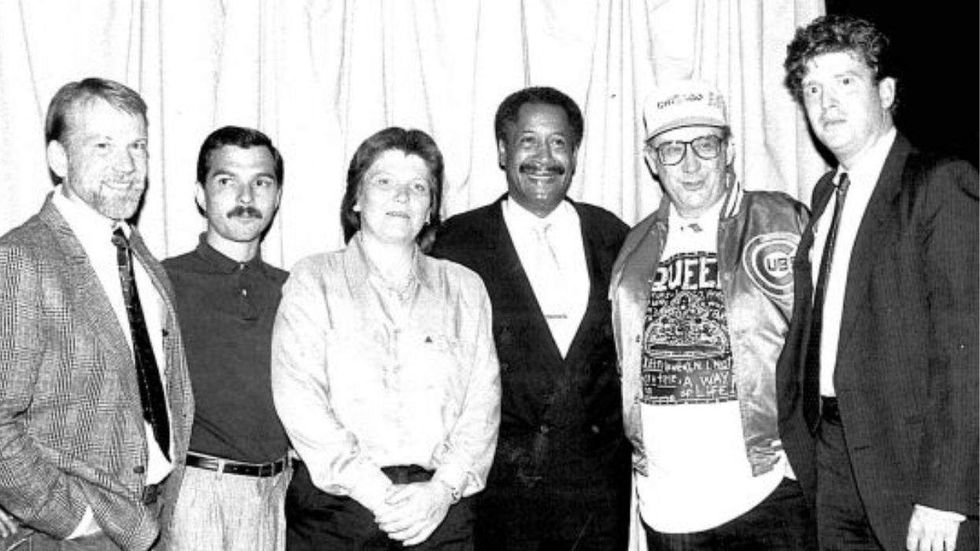 From left: Art Johnston, Rick Garcia, Laurie Dittman, Chicago Mayor Eugene Sawyer, Jon-Henri Damski, and Jon Simmons, Sawyer's liaison to the gay community, when the Chicago gay rights ordinance passed in 1988Windy City Times Archives
Garcia cofounded the Illinois Federation for Human Rights in 1992 to take the fight beyond Chicago and was its first executive director. “He had a brilliant political and tactician mind and was fearless in his pursuit of justice,” Ellen Meyers, another cofounder, longtime activist, and close friend, told The Advocate.
Cook County passed a gay rights law in 1993, adding protections against anti-transgender discrimination in 2002, and the state of Illinois approved a fully inclusive law in 2005, which went into effect the following year. “Garcia remained a fierce transgender ally, refusing to support the Illinois Human Rights Act ... unless it included explicit protections based on gender identity (another battle he won),” Windy City Times managing editor Jake Wittich wrote on Facebook. “Garcia was fiery and unapologetic, shaping so many of the LGBTQ+ protections we have today in Chicago and Illinois.” The Windy City Times obit of Garcia is here.
“He would not support the bill without explicit inclusion,” Jim Bennett, director of the Illinois Department of Human Rights, said in a statement. “As a result, Illinois became one of the first states in the nation to clearly and fully protect transgender, nonbinary and gender-nonconforming individuals from discrimination.”
Garcia’s fieriness sometimes got him into fights. He could be “vicious” toward anti-LGBTQ+ people and also toward fellow LGBTQ+ activists and allies if he felt they weren’t doing the right thing, Streetman said. “Rick had a way of confronting his friends even in brutal fashion” but still “letting you know he cared for you deeply,” according to Streetman.
“Like a number of gay men I've known in my life, Rick could be ... a lot,” said Victoria Noe, an author who has worked for AIDS service organizations in Chicago. “He was brilliant and ornery, and I never wanted to get on his bad side (I think I accomplished that). Like Jon-Henri Damski, he seemed to be at every HIV or LGBT event back in the late ’80s and ’90s, unless the organizers were really pissed at him. I didn't always approve of his tactics, but I knew he was almost always smarter than I was.”
“I am so sad to hear about the passing of Rick Garcia,” said Illinois State Rep. Kelly Cassidy. “Yes, he’s my constituent, but honestly so much more than that. Over the decades, we’ve worked together, we’ve fought with and for each other, we’ve laughed, danced, cried, primal screamed, and mourned together. His passing leaves a hole for sure, but his legacy of care for our community will live on.” Cassidy is preparing a memorial resolution.
The Illinois Federation for Human Rights was renamed Equality Illinois in 2000, and Garcia remained executive director. He later became political director. He and the group parted ways in December 2010, shortly after Illinois legislators approved a civil unions bill. Gov. Pat Quinn signed the bill into law in January 2011, and it went into effect in July of that year.
After Equality Illinois, Garcia joined the Civil Rights Agenda, where he worked for marriage equality. At a rally in January 2013 in Chicago, he delivered this message to lawmakers: “Get the job done, get the lead out, do it,” as the city's CBS affiliate reported at the time. The marriage equality bill cleared the legislature in November 2013, and Quinn signed it into law the same month.
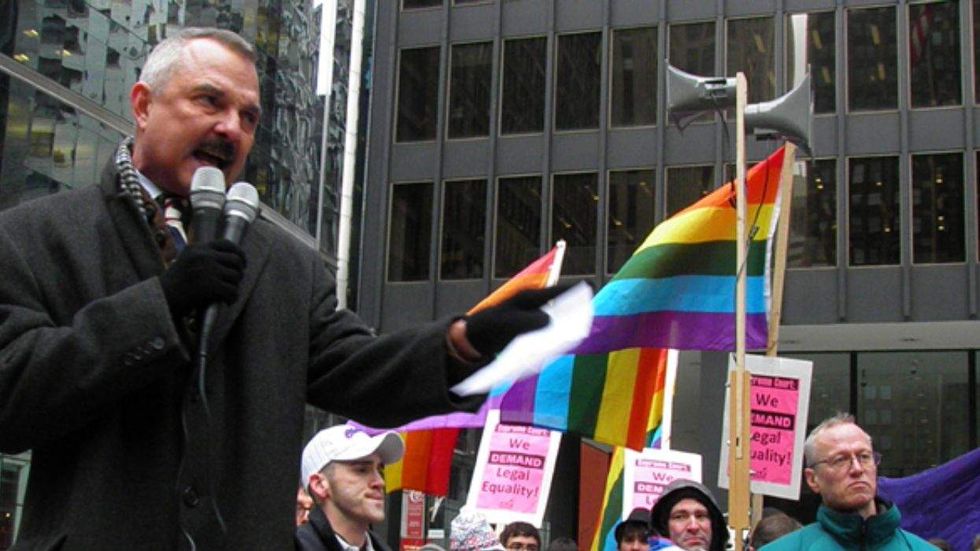 Rick Garcia at a marriage equality rally in Chicago in 2013Windy City Times Archives
“This is a great day for Illinois and for the rest of the country,” Garcia said when legislators passed the bill. “Fairness, decency, and equality were affirmed by our legislature. Same-gender couples will have the same state benefits as their heterosexual counterparts.”
He knew how to work a crowd and get media attention, Streetman noted. “There’s been so many times in my years of working and friendship with Rick Garcia that an event would happen unexpectedly and he’d be called upon to speak extemporaneously. … He always captured the moment.”
After the Civil Rights Agenda, Garcia worked in the Cook County Sheriff’s Office and the Illinois Secretary of State’s Office. He ran for a post on the Metropolitan Water Reclamation District board in 2022 but lost.
There was more to Garcia than his political work, his friends said. “In his younger years, he could do an absolutely smashing Audrey Hepburn in drag, sometimes wearing a bright pink bobbed wig,” Meyers recalled. “He was devoted to his longtime partner, Ernie [Hunsperger], who died a few years ago. He was also an amazing cook. Ernie would always send him recipes he had found for Rick to make.” Hunsperger, who worked in public relations and retail, died in 2020.
Garcia could mix politics and fun as well, Streetman said. After the U.S. Supreme Court’s Lawrence v. Texas decision in 2003, just a few days before Pride weekend, Equality Illinois decided to make its Pride parade float a tribute to the ruling, which struck down sodomy laws nationwide. Garcia, Streetman, and four others dressed as female Supreme Court justices to ride atop the float. “We were swinging gavels … we also had these big Marge Simpson wigs,” Streetman recalled. They had a sign that said “Thank you, Supremes,” and played a song by those other Supremes, “You Keep Me Hangin’ On.” It includes a lyric appropriate to the occasion —“Set me free, why don’t cha, baby?” Equality Illinois won best float that year.
There was also his devotion to Catholicism, even when he disagreed with the church. “Rick was an encyclopedia of Roman Catholicism,” Meyers said. “He could tell what order a nun was by the habit she wore. As a brother in the order Brothers for a Christian Community, he was very committed to social justice. Whenever I was with him and we had to enter someplace through a metal detector, he would always first take out of his pockets his rosary to put through the metal detector.”
“Rick studied theology, and he was very learned in his faith traditions,” Streetman said. “Even to the end, he had very specific beliefs. … He had a deeply held, thoroughly studied and researched view of Catholicism.”
Both Garcia and Equality Illinois have been inducted into the Chicago LGBT Hall of Fame, the only city-sanctioned institution of its kind in the U.S. Upon Garcia’s death, Equality Illinois released statements from several of its leaders.
“The fight for LGBTQ+ equality has always been carried forward by leaders who knew when to push hard and when to build bridges and Rick Garcia was one of those leaders,” said Art Johnston, part of the “Gang of Four,” an Equality Illinois cofounder, and owner of Sidetrack, a popular Chicago LGBTQ+ bar. “He was a fierce advocate in a pivotal era of our movement, unafraid to throw punches when our community was under attack and equally committed to coalition-building and lasting change.”
Related: A Love Story That Birthed an Iconic Gay Bar and a Lifetime of Activism
“Rick Garcia was instrumental in advancing protections for LGBTQ+ people in Illinois, including his critical role in the effort to add sexual orientation and gender identity to the Illinois Human Rights Act in 2006, as well as helping lay the early groundwork for marriage equality in our state,” said Myles Brady Davis, director of communications for Equality Illinois. “His leadership helped shape Equality Illinois and the broader movement for decades. We honor Rick’s legacy by continuing the work he believed in so deeply and by ensuring that the torch he carried continues to light the way forward.”
“Rick Garcia was a founding leader of Equality Illinois whose courage and conviction helped shape the rights LGBTQ+ people have today across our state,” said CEO Channyn Lynne Parker. “His visionary leadership helped secure Chicago’s landmark antidiscrimination ordinance, and his legacy lives on in the laws he helped pass and the countless lives impacted by his work. … As a transgender woman of color now entrusted to lead this organization, I am proud to walk in the footsteps of a man of color who fought for trans lives and trans rights long before such advocacy was widely embraced. I owe him a profound debt of gratitude and a continued commitment to carry that work forward with integrity.”
There will be a visitation at 10 a.m. Saturday at St. Mary’s of the Lake in Chicago, followed by a funeral mass at 11 a.m.