'%3E%3Cpath d='M16.3574 35.6519H12.9537L15.0491 18.8873L16.3574 35.6519ZM30.4229 54.0093L22.309 0.994385H7.91795L0 54.0093H10.6634L11.5802 46.3855H17.4014L17.9914 54.0093H30.4229Z' fill='%23971B20'/%3E%3Cpath d='M48.2073 41.8813C48.2073 43.4049 47.4892 44.0011 46.1144 44.0011H43.7595V11.0687H46.1144C47.4892 11.0687 48.2073 11.6636 48.2073 13.1885V41.8813ZM59.5273 43.6695V11.3326C59.5273 3.71323 53.5729 0.994385 47.8157 0.994385H31.7213V54.0093H47.8157C53.5729 54.0093 59.5273 51.29 59.5273 43.6695Z' fill='%23971B20'/%3E%3Cpath d='M90.183 0.994385H78.6039L75.0711 30.6157L71.9955 0.994385H59.4346L69.2474 54.0093H80.373L90.183 0.994385Z' fill='%23971B20'/%3E%3Cpath d='M107.063 42.3448C107.063 43.7359 105.951 44.5974 104.643 44.5974C103.269 44.5974 102.157 43.7359 102.157 42.3448V12.658C102.157 11.2676 103.269 10.4058 104.643 10.4058C105.951 10.4058 107.063 11.2676 107.063 12.658V42.3448ZM119.233 43.2723V11.7312C119.233 6.36384 112.952 -3.8147e-06 104.643 -3.8147e-06C96.2667 -3.8147e-06 89.9867 6.36384 89.9867 11.7312V43.2723C89.9867 48.6393 96.2667 55 104.643 55C112.952 55 119.233 48.6393 119.233 43.2723Z' fill='%23971B20'/%3E%3Cpath d='M150.976 43.9349V33.7309H139.069V42.3448C139.069 43.7359 137.957 44.5974 136.582 44.5974C135.076 44.5974 133.964 43.7359 133.964 42.3448V12.658C133.964 11.2676 135.076 10.4058 136.582 10.4058C137.957 10.4058 139.069 11.2676 139.069 12.658V21.2723H150.976V11.0687C150.976 5.70107 145.283 -3.8147e-06 136.582 -3.8147e-06C127.75 -3.8147e-06 121.796 5.70107 121.796 11.0687V43.9349C121.796 49.3022 127.75 55 136.582 55C145.283 55 150.976 49.3022 150.976 43.9349Z' fill='%23971B20'/%3E%3Cpath d='M167.478 35.6519H164.076L166.17 18.8873L167.478 35.6519ZM181.544 54.0093L173.432 0.994385H159.037L151.123 54.0093H161.785L162.704 46.3855H168.523L169.114 54.0093H181.544Z' fill='%23971B20'/%3E%3Cpath d='M205.412 10.4058V0.994385H177.081V10.4058H185.392V54.0093H197.428V10.4058H205.412Z' fill='%23971B20'/%3E%3Cpath d='M230.002 54.0093V43.9349H218.914V31.8746H226.635V21.8028H218.914V10.4058H230.002V0.994385H206.875V54.0093H230.002Z' fill='%23971B20'/%3E%3C/g%3E%3Cdefs%3E%3CclipPath id='clip0_260_7080'%3E%3Crect width='230' height='55' fill='white'/%3E%3C/clipPath%3E%3C/defs%3E%3C/svg%3E)
Every afternoon, when Saoirse Stone gets home from her job as a teacher in Florida, she performs a small ritual.
Keep up with the latest in LGBTQ+ news and politics. Sign up for The Advocate's email newsletter.
She changes out of the clothes she wore to school. She sets aside the bag that holds her lesson plans. She places everything she will need for the next day near the door, then tries to stop thinking about the classroom. It is, she says, the only way to keep herself intact.
“You have to have a clear division,” Stone, who is transgender, told The Advocate in an interview. “I change clothes immediately. I set my work stuff down. And then I don’t touch it. I don’t look at it. I don’t think about it.” For the rest of the evening, she tries to inhabit the life that feels real — the one she shares with her wife, Dani, in Orlando. The one where she reads books, plays tabletop games with friends, and occasionally loses herself in the sprawling universe of X-Men comics.
Related: Florida Senate pushes ahead with 'don't say gay at work' bill after seemingly brushing it aside
Related: Florida Republican lawmaker proposes law erasing transgender identities
But the next morning, the other version of her life begins again.
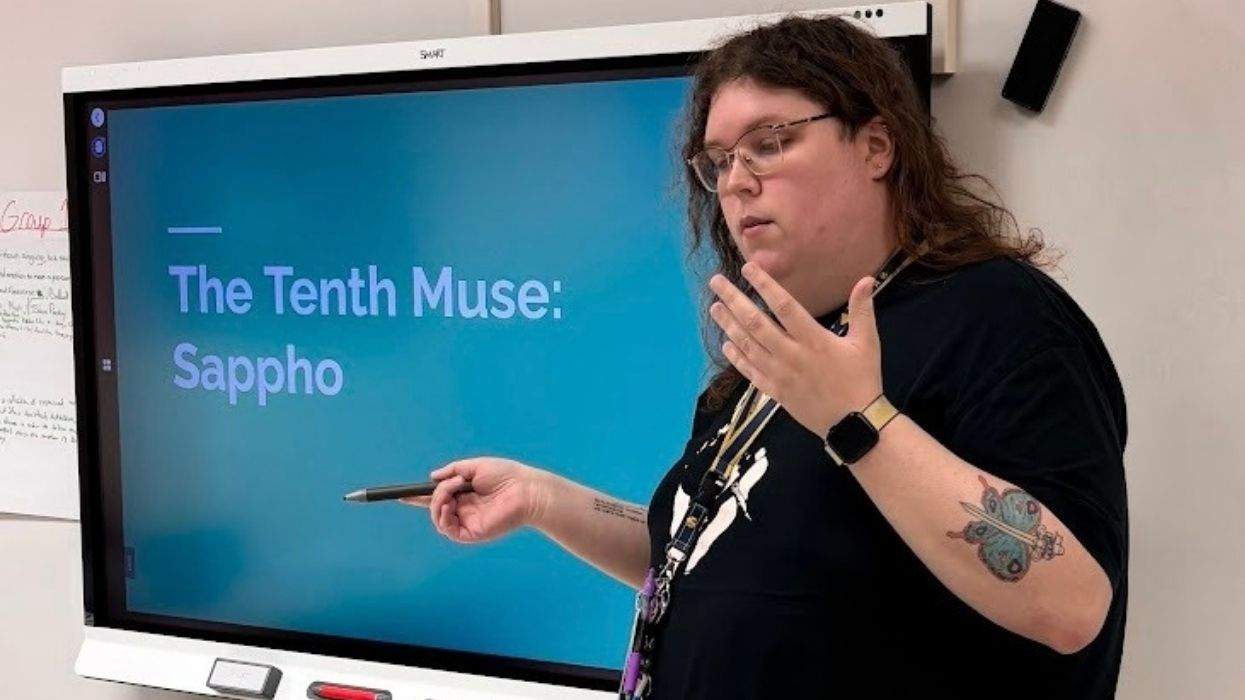
 Saoirse Stone and her wife are leaving Florida and moving to Maryland because of the hostile climate for transgender people in the state.Saoirse Stone
Stone is a high school English teacher in Orlando. She teaches 11th-grade English, AP Seminar, AP Research, and Cambridge General Paper, an advanced writing and critical thinking course in the Cambridge Advanced International Certificate of Education program, a college prep curriculum developed by the University of Cambridge and widely offered in Florida public schools.
She also coaches the school’s eSports team.
“I love teaching,” she said. “There is something really wonderful about helping students realize literature and language are powerful things.” For years, she believed that staying in the classroom, even under difficult circumstances, mattered.
Her hope, she said, was that simply existing as herself in front of students might mean something to teenagers quietly trying to understand their own lives. “My hope was just the fact that I’m there,” she said. “Even if I can’t say everything I want to say, even if I can’t do everything I want to do, I’m here, I’m alive, I’m happy.”
Now she is preparing to leave.
Stone, who is 32, says she began transitioning in 2022. At the time, she planned to come out publicly at work the following spring.
Then the political climate in Florida shifted dramatically.
Related: Florida House Passes Bill Extending 'Don't Say Gay' Law
Related: Florida is allowed to restrict transgender health care, appeals court rules
In 2022, Gov. Ron DeSantis signed the Parental Rights in Education law, widely known by critics as the “don’t say gay” law. Initially, it restricted classroom instruction on sexual orientation and gender identity in early grades. Subsequent rules expanded the restrictions across grade levels unless the material is considered age-appropriate or part of state standards.
Another Florida statute governs the use of pronouns and personal titles in public schools. The law states that sex is “an immutable biological trait” and says it is “false to ascribe to a person a pronoun that does not correspond to such person’s sex.” It also says that a public school employee “may not provide to a student his or her preferred personal title or pronouns” if they do not correspond with that person’s sex assigned at birth.
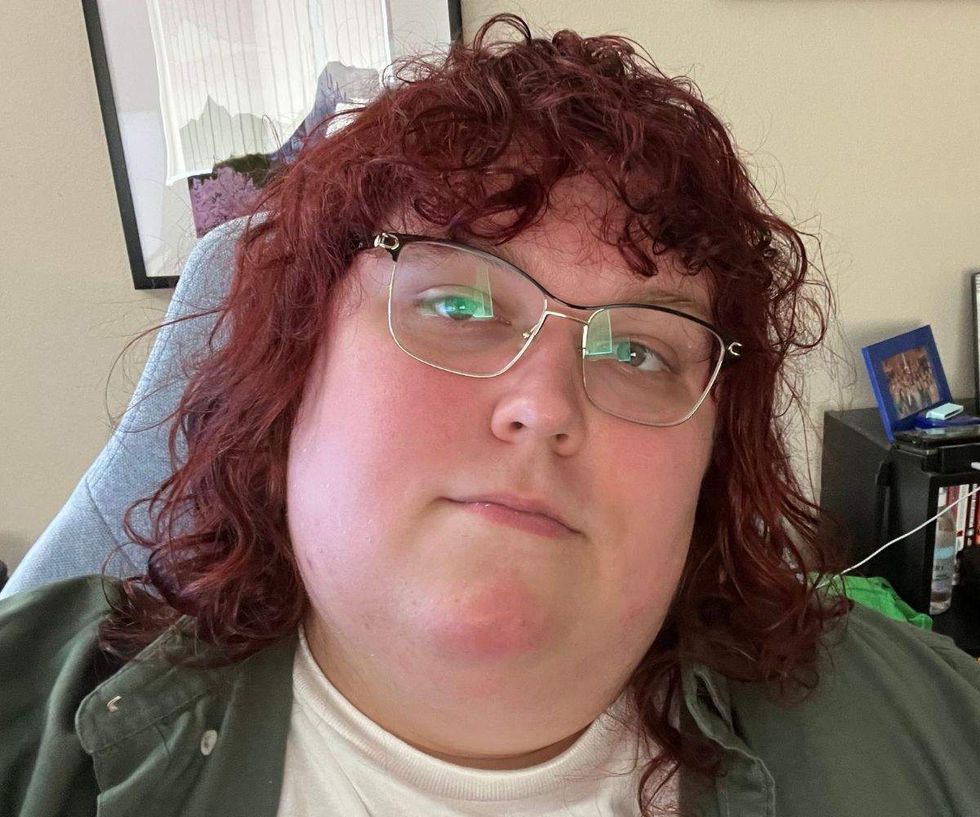 Saoirse Stone says that she she gets home she sheds her daytime persona and becomes a whole person until she returns to work the next day.Saoirse Stone
For Stone, the legal language translates into something far more personal. Before she became a teacher, Stone studied the law. She attended law school in Virginia and completed her degree, but she never pursued a career as an attorney. Instead, she found herself drawn to education, first through tutoring and academic support work, and eventually through the classroom.
Teaching, she said, offered something the legal profession did not.
“In law school, a lot of what you’re doing is theoretical,” she said. “Teaching is immediate. You can see the effect of what you do right in front of you.”
Related: Fact-check: Is Florida's 'Don't Say Gay' Bill About Sex Ed & Sex Acts?
After graduating, she returned to Florida, where she had grown up, and entered the profession she now says she still loves despite everything that has changed around it.
Now, though, the laws she once studied as a student have become the rules governing her daily life in the classroom.
She says she cannot discuss being transgender with her students. She cannot provide pronouns that match her gender identity. And when students refer to her incorrectly, whether accidentally or deliberately, she says she must let it pass.
“I cannot provide pronouns other than the ones that correspond with the gender I was assigned at birth,” she said. “If I do that, I could have my teaching certificate revoked.”
Some of the misgendering is accidental.
Sometimes, she says, it isn’t. “Sometimes kids get wise [and figure out that I’m trans] and they do it intentionally,” she said. “And there is nothing that can be done.” Sometimes the moment is as small as a word or a laugh.
But Stone cannot respond. “I can’t even speak up for myself,” she said. “I can’t defend myself.”
The compromise she arrived at was linguistic. If she could not use “Ms.” and would not use “Mr.,” she would use neither. Because of her coaching gig, she figured out an alternative. “What they can’t do under the law as they’ve created it is mandate that I describe myself as ‘mister,’” she said. “So I refuse. I became a coach.”
The solution works — mostly.
Stone says that her school serves a large Hispanic student population, where students often default to calling teachers Mr. or Miss. When it happens, she gently reminds them of her preference to be called coach. But the boundaries of what she can say are always present.
“I’m constantly having to self-police everything I say,” she said. “Is this going to be the thing that gets me on Fox News and gets my teaching certificate revoked?”
Stone said what frightens her most is not simply the possibility of discipline, but the sense that she might have little protection if it were to happen. “If I do something that somebody decides violates the law, I don’t believe I’ll get due process,” she said. In the current political environment, she added, she believes officials who would ultimately judge her case are already predisposed against people like her.
“There is so much hostility toward trans people from the conservatives who are in power right now,” she said. “I don’t think I’d be treated fairly.” The constraints she describes come at a time when Florida is struggling to staff classrooms. The irony is that Florida schools need teachers like her.
A recent Florida Department of Education report identifying high-demand teaching areas shows that thousands of English courses statewide are taught by instructors who are not certified in the subject. English remains one of several fields where districts struggle to staff classrooms with qualified teachers.
Stone is exactly the kind of teacher the state says it needs: experienced, credentialed, and teaching multiple advanced courses.
Orange County Public Schools said the restrictions Stone describes stem from state law rather than district decisions.
Michael Ollendorff, administrator of media relations for the district, said questions about the policies should be directed to the Florida Department of Education because the concerns are “directly connected to state law, not district policy.”
“The Orange County School District is required, as a matter of state law, to follow all state laws and State Board of Education rules,” Ollendorff said.
At the same time, the district’s official school board observance calendar still includes several LGBTQ-related commemorations. The 2025–26 list designates October as LGBTQ+ Awareness and History Month, June as Pride Month, and June 12 as Pulse Remembrance Day, honoring the victims of the 2016 nightclub shooting in Orlando.
The Florida Department of Education did not respond to The Advocate’s request for comment. A request for comment sent to Gov. Ron DeSantis’s office also went unanswered.
For Stone, the pressure has not been only emotional. It has also been financial. Orlando’s housing market has surged in recent years. Rent and utilities now consume more than half of her monthly income, she said. “For the past six months,” she said, “probably 60 percent of my diet has been cheap rice, whatever vegetables are on sale, and as a treat, discount Spam.”
Her wife, who works in health care, struggled to find stable work for a time. They’ve started a GoFundMe page to help defray some of the moving costs they anticipate having. The couple began to consider leaving Florida for Maryland as the most plausible destination.
Her wife has family there. Since Stone attended law school in nearby Virginia, she still has friends across the Mid-Atlantic. Maryland, under Democratic Gov. Wes Moore, also has statewide nondiscrimination protections covering gender identity.
But leaving Florida feels like an amputation, she said. Stone was born in the state. She grew up in Lake Wales. “This is my home,” she said. “All but three years of my life have been spent in this state.”
Her plan is to move this summer when the school year ends and the couple’s lease expires. She hopes to continue teaching.
She knows that starting over will not be easy, but she said that anything is better than the idea of continuing to be forced into the closet after having already come out. “I have done my absolute best to build something for myself here,” she said. “Respect. Credibility.” For now, she continues to teach in the classroom she plans to leave.
Each morning, she walks in knowing that the stripped-down version of the self-described “butch dyke” people get to see on most days is only part of the truth.
Each afternoon, she goes home and tries to become whole again.