'%3E%3Cpath d='M16.3574 35.6519H12.9537L15.0491 18.8873L16.3574 35.6519ZM30.4229 54.0093L22.309 0.994385H7.91795L0 54.0093H10.6634L11.5802 46.3855H17.4014L17.9914 54.0093H30.4229Z' fill='%23971B20'/%3E%3Cpath d='M48.2073 41.8813C48.2073 43.4049 47.4892 44.0011 46.1144 44.0011H43.7595V11.0687H46.1144C47.4892 11.0687 48.2073 11.6636 48.2073 13.1885V41.8813ZM59.5273 43.6695V11.3326C59.5273 3.71323 53.5729 0.994385 47.8157 0.994385H31.7213V54.0093H47.8157C53.5729 54.0093 59.5273 51.29 59.5273 43.6695Z' fill='%23971B20'/%3E%3Cpath d='M90.183 0.994385H78.6039L75.0711 30.6157L71.9955 0.994385H59.4346L69.2474 54.0093H80.373L90.183 0.994385Z' fill='%23971B20'/%3E%3Cpath d='M107.063 42.3448C107.063 43.7359 105.951 44.5974 104.643 44.5974C103.269 44.5974 102.157 43.7359 102.157 42.3448V12.658C102.157 11.2676 103.269 10.4058 104.643 10.4058C105.951 10.4058 107.063 11.2676 107.063 12.658V42.3448ZM119.233 43.2723V11.7312C119.233 6.36384 112.952 -3.8147e-06 104.643 -3.8147e-06C96.2667 -3.8147e-06 89.9867 6.36384 89.9867 11.7312V43.2723C89.9867 48.6393 96.2667 55 104.643 55C112.952 55 119.233 48.6393 119.233 43.2723Z' fill='%23971B20'/%3E%3Cpath d='M150.976 43.9349V33.7309H139.069V42.3448C139.069 43.7359 137.957 44.5974 136.582 44.5974C135.076 44.5974 133.964 43.7359 133.964 42.3448V12.658C133.964 11.2676 135.076 10.4058 136.582 10.4058C137.957 10.4058 139.069 11.2676 139.069 12.658V21.2723H150.976V11.0687C150.976 5.70107 145.283 -3.8147e-06 136.582 -3.8147e-06C127.75 -3.8147e-06 121.796 5.70107 121.796 11.0687V43.9349C121.796 49.3022 127.75 55 136.582 55C145.283 55 150.976 49.3022 150.976 43.9349Z' fill='%23971B20'/%3E%3Cpath d='M167.478 35.6519H164.076L166.17 18.8873L167.478 35.6519ZM181.544 54.0093L173.432 0.994385H159.037L151.123 54.0093H161.785L162.704 46.3855H168.523L169.114 54.0093H181.544Z' fill='%23971B20'/%3E%3Cpath d='M205.412 10.4058V0.994385H177.081V10.4058H185.392V54.0093H197.428V10.4058H205.412Z' fill='%23971B20'/%3E%3Cpath d='M230.002 54.0093V43.9349H218.914V31.8746H226.635V21.8028H218.914V10.4058H230.002V0.994385H206.875V54.0093H230.002Z' fill='%23971B20'/%3E%3C/g%3E%3Cdefs%3E%3CclipPath id='clip0_260_7080'%3E%3Crect width='230' height='55' fill='white'/%3E%3C/clipPath%3E%3C/defs%3E%3C/svg%3E)

Another day in America and another person killed by ICE. Today in Maine, a 26-year-old Colombian man who reportedly had work authorization and a young family was on his way to work when he encountered federal agents and was fatally shot.
"We didn't cross the border, the border crossed us" is a saying I heard all the time growing up in New Mexico. I love it because it puts me in my place. I'm a white American. My family wasn't here first. We tend to talk about immigrants as though they're interrupting our story, when in reality, this country has always been made of people living here long before it was America. Somewhere along the way we started acting as we had always been here, and the decision of who deserved to stay was ours.
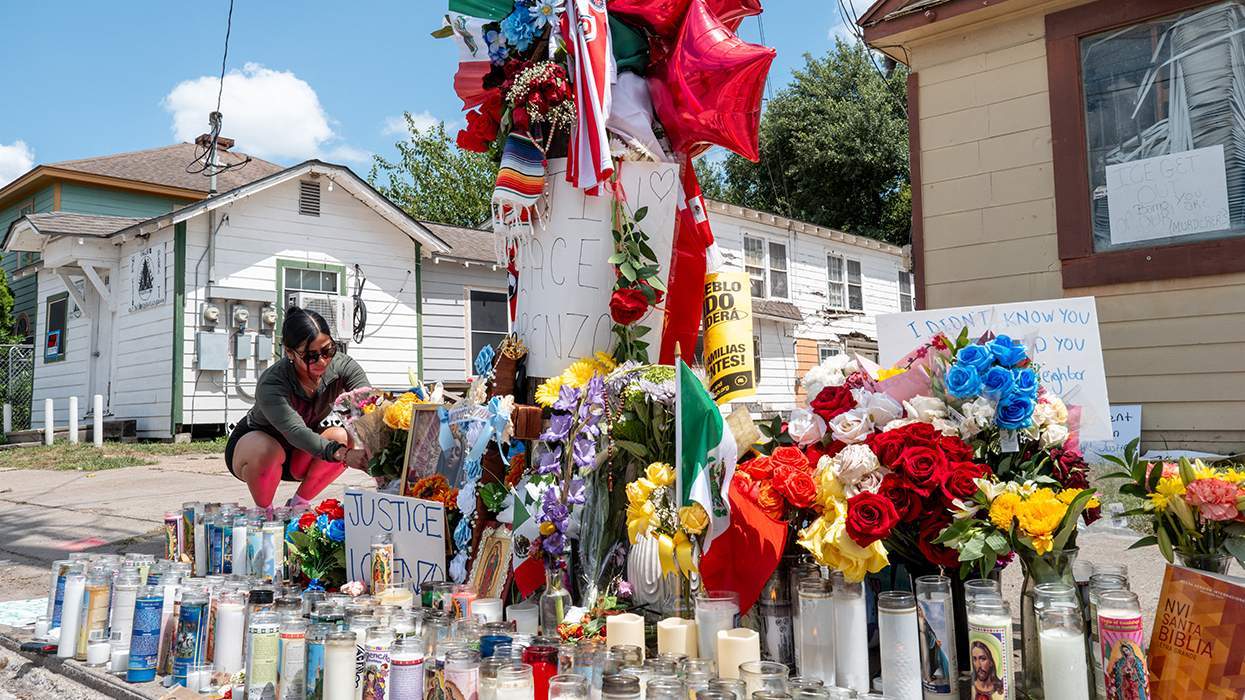
The ICE killing in Maine happened just days after Lorenzo Salgado-Araujo's fatal shooting by an ICE agent in Houston. Whatever investigators conclude about the Maine encounter, two fatal shootings involving ICE agents within days of each other should force a national reckoning over the growing use of deadly force in immigration enforcement. They join at least 21 people who have already died in ICE custody this year, the latest in a growing series of tragedies that are becoming frighteningly familiar: another family trying to understand how an encounter with the federal government became a death sentence.
This is who we are now. When Renee Nicole Good was killed by a federal immigration agent earlier this year, the public was told that an investigation would follow. Months later, the agent who shot her remains employed by ICE, reportedly reassigned rather than removed, while her family continues living with that loss. Accountability that is endlessly deferred becomes accountability denied.
For generations, this country marketed itself as a promise more than a place, asking people to overcome oceans, deserts, dictatorships, wars, famine, and impossible odds because we are a nation where hard work could become dignity, where children could succeed, and where freedom was measured by possibility. Our country did not merely welcome that story; it exported it. It built movies around it, wrote songs about it, carved it into speeches, and held it up as proof that this imperfect republic could nevertheless become home to anyone willing to believe in it. There is no greater national tragedy than the fact that the same country that spent generations inviting the world to build a life here has become increasingly comfortable killing people for pursuing that same dream.
That dream for many now feels like a prison. Immigration databases have expanded alongside facial recognition systems, license plate readers, commercial data brokers, biometric records, social media monitoring, men wearing Meta glasses to secretly record women, artificial intelligence capable of sorting through enormous quantities of information, and increasingly sophisticated data-sharing agreements between agencies that once operated independently. This is now a surveillance state, and if that phrase makes people uncomfortable, perhaps we should spend less time questioning the language and more time questioning how comfortable we have become in surrendering our privacy, our autonomy, our freedom, and the very independence America never stops congratulating itself for defending.
We live with cameras on our front doors, congratulate ourselves for helping find a lost dog or catch a porch pirate, and rarely ask what else those cameras are recording and who has access to those recordings. We have become so accustomed to constant surveillance that we market it as peace of mind, even as the same technologies are deeply intertwined with policing, immigration enforcement, and the expanding ability of the state to know far more about our private lives than any free society should ever consider normal. We have convinced ourselves this is the price of safety rather than the slow erosion of liberty.
Immigration is the most visible proving ground, but it is hardly the only one. After Dobbs, the Supreme Court decision that overturned Roe v. Wade, prosecutors and investigators increasingly turned to search histories, text messages, location information, and data collected by apps as potential evidence in abortion-related investigations. States have compiled information about transgender residents through health care reporting requirements and changes to identity documents. Journalists, doctors, librarians, nonprofit organizations, and civil society groups have found themselves operating in environments where information that once felt private now feels merely stored until someone decides it can be weaponized. None of these developments arise from the same source, and that is precisely what has made them so easy to miss. Immigration enforcement is presented as distinct from transgender health care, reproductive rights as separate from campus protest, national security as unrelated to public education, and artificial intelligence as merely another technological innovation. Yet the government expands its capacity to identify, document, categorize, locate, and ultimately act upon people's lives in ways that would have seemed extraordinary only a decade ago.
Governments typically don’t declare themselves police states. They spend years laying the foundation by expanding databases, normalizing surveillance, building infrastructure, testing the boundaries of public tolerance, and reassuring everyone that each individual step is too limited to threaten anyone who is not under suspicion. By the time the architecture is complete, the declaration becomes unnecessary. Actions speak louder than words, and the actions unfolding across this country are screaming that we are actively living in a surveillance state powerful enough to identify people, locate them, reconstruct their lives, map their relationships, predict their movements, and decide, with increasing efficiency, who belongs, who should be watched, who should be detained, and who should be removed or killed.
A remarkable political achievement of this moment has been convincing every community that it is fighting a separate battle. Immigrants are encouraged to believe their struggle belongs only to immigrants; transgender Americans are told their rights exist apart from reproductive freedom; protesters are told they have little in common with asylum seekers; and journalists are encouraged to view attacks on higher education as something fundamentally different from attacks on the press. This administration benefits enormously from that fragmentation because isolated communities are easier to suppress than united ones. Once governments acquire the ability to collect more information, they rarely choose to collect less. Once artificial intelligence makes sorting through millions of records faster, cheaper, and more comprehensive, the central question is how broadly they will be applied.
Salgado Araujo's death is much larger than a single immigration story. This moment demands something braver than sympathy for the latest family devastated by murder dressed up as immigration enforcement. It demands solidarity among communities that have too often been encouraged to believe they occupy different universes, because the infrastructure now used to identify, locate, and track immigrants is built from many of the same assumptions that make it easier to investigate abortion seekers, catalogue transgender people, monitor political activism, and assemble astonishingly detailed portraits of ordinary citizens from the digital residue of everyday life. For too long we have allowed ourselves to believe these are separate conversations simply because the people being targeted are them, not us. And while the mainstream media crowned AI as the second coming last year, the infrastructure has grown remarkably more expansive, more sophisticated, and more capable.
America has appeared to lose humanity. Spend five minutes reading the comments beneath almost any story about someone killed by ICE, and you will find people insisting they deserved it. We are dismantling the American Dream, replacing the mythology of a nation built by people seeking freedom with detention centers, surveillance networks, databases, and families wondering how the country that promised them a future became the place where that future ended. If America is still exceptional, it should be because we remain capable of correcting its course before this new normal becomes what we leave behind.
Josh Ackley is a political strategist and the frontman of the queerpunk band The Dead Betties. @momdarkness
Opinion is dedicated to featuring a wide range of inspiring personal stories and impactful opinions from the LGBTQ+ community and its allies. Visit Advocate.com/submit to learn more about submission guidelines. We welcome your thoughts and feedback on any of our stories. Email us at voices@equalpride.com. Views expressed in Voices stories are those of the guest writers, columnists, and editors, and do not directly represent the views of The Advocate or our parent company, equalpride.