'%3E%3Cpath d='M16.3574 35.6519H12.9537L15.0491 18.8873L16.3574 35.6519ZM30.4229 54.0093L22.309 0.994385H7.91795L0 54.0093H10.6634L11.5802 46.3855H17.4014L17.9914 54.0093H30.4229Z' fill='%23971B20'/%3E%3Cpath d='M48.2073 41.8813C48.2073 43.4049 47.4892 44.0011 46.1144 44.0011H43.7595V11.0687H46.1144C47.4892 11.0687 48.2073 11.6636 48.2073 13.1885V41.8813ZM59.5273 43.6695V11.3326C59.5273 3.71323 53.5729 0.994385 47.8157 0.994385H31.7213V54.0093H47.8157C53.5729 54.0093 59.5273 51.29 59.5273 43.6695Z' fill='%23971B20'/%3E%3Cpath d='M90.183 0.994385H78.6039L75.0711 30.6157L71.9955 0.994385H59.4346L69.2474 54.0093H80.373L90.183 0.994385Z' fill='%23971B20'/%3E%3Cpath d='M107.063 42.3448C107.063 43.7359 105.951 44.5974 104.643 44.5974C103.269 44.5974 102.157 43.7359 102.157 42.3448V12.658C102.157 11.2676 103.269 10.4058 104.643 10.4058C105.951 10.4058 107.063 11.2676 107.063 12.658V42.3448ZM119.233 43.2723V11.7312C119.233 6.36384 112.952 -3.8147e-06 104.643 -3.8147e-06C96.2667 -3.8147e-06 89.9867 6.36384 89.9867 11.7312V43.2723C89.9867 48.6393 96.2667 55 104.643 55C112.952 55 119.233 48.6393 119.233 43.2723Z' fill='%23971B20'/%3E%3Cpath d='M150.976 43.9349V33.7309H139.069V42.3448C139.069 43.7359 137.957 44.5974 136.582 44.5974C135.076 44.5974 133.964 43.7359 133.964 42.3448V12.658C133.964 11.2676 135.076 10.4058 136.582 10.4058C137.957 10.4058 139.069 11.2676 139.069 12.658V21.2723H150.976V11.0687C150.976 5.70107 145.283 -3.8147e-06 136.582 -3.8147e-06C127.75 -3.8147e-06 121.796 5.70107 121.796 11.0687V43.9349C121.796 49.3022 127.75 55 136.582 55C145.283 55 150.976 49.3022 150.976 43.9349Z' fill='%23971B20'/%3E%3Cpath d='M167.478 35.6519H164.076L166.17 18.8873L167.478 35.6519ZM181.544 54.0093L173.432 0.994385H159.037L151.123 54.0093H161.785L162.704 46.3855H168.523L169.114 54.0093H181.544Z' fill='%23971B20'/%3E%3Cpath d='M205.412 10.4058V0.994385H177.081V10.4058H185.392V54.0093H197.428V10.4058H205.412Z' fill='%23971B20'/%3E%3Cpath d='M230.002 54.0093V43.9349H218.914V31.8746H226.635V21.8028H218.914V10.4058H230.002V0.994385H206.875V54.0093H230.002Z' fill='%23971B20'/%3E%3C/g%3E%3Cdefs%3E%3CclipPath id='clip0_260_7080'%3E%3Crect width='230' height='55' fill='white'/%3E%3C/clipPath%3E%3C/defs%3E%3C/svg%3E)
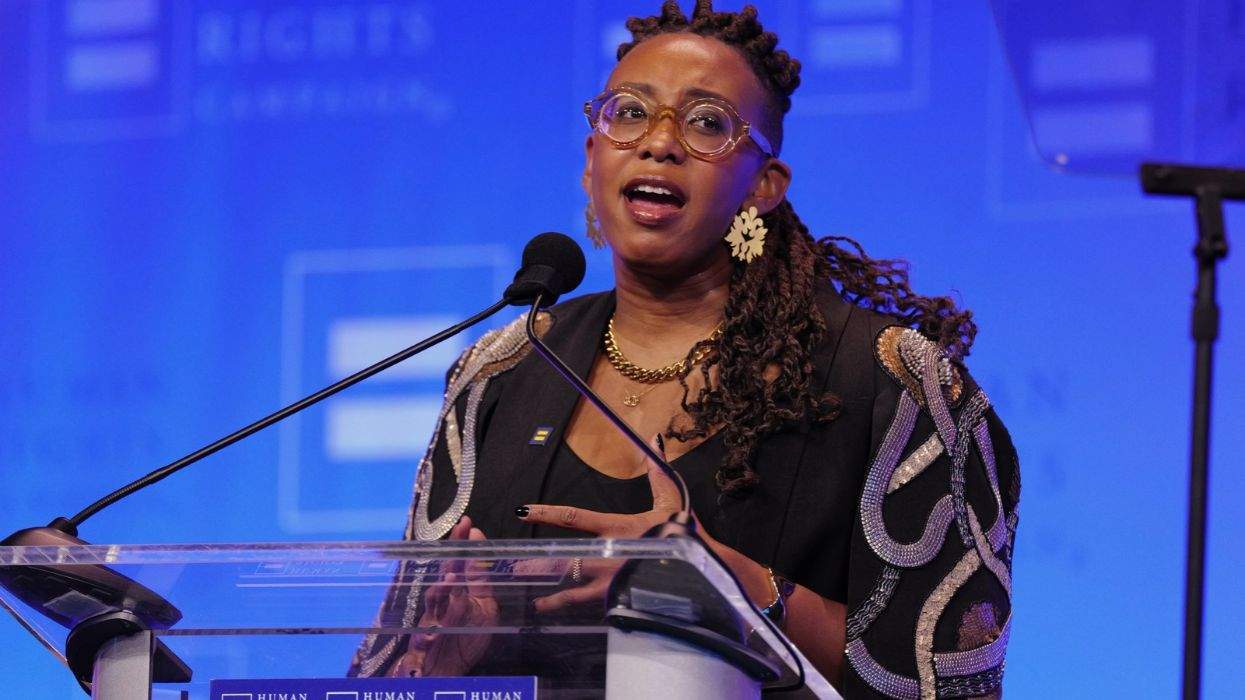
For Democrats hoping to make Republican attacks disappear by adopting their own anti-transgender messaging, Kelley Robinson believes that they are giving up too much for a political benefit that may never arrive.
“My honest answer is you’re doing too much and getting too little,” the Human Rights Campaign president told The Advocate during a roundtable breakfast conversation with reporters Monday at the organization’s headquarters in Washington, D.C. “You don’t have to sacrifice any member of our community to win in these races, to have a message that resonates with voters.”
The dispute centers on how Democrats should answer Republican campaign ads portraying support for transgender people, particularly their participation in school sports and access to gender-affirming care, as evidence that candidates are out of step with voters. Some Democrats have responded by emphasizing their own support for restrictions. Robinson argues that doing so gives LGBTQ+ voters less reason to support them without ending the Republican attacks.
Related: Gretchen Whitmer, ‘a Midwest lesbian’s mom,’ has a message for Democrats waffling on LGBTQ+ rights
With roughly a month until the midterm elections, Robinson laid out a strategy that places LGBTQ+ voters at the center of competitive races and challenges Democrats to recognize the electoral cost of alienating them. HRC, she said, has made a $15 million investment, its largest for a midterm election, and is concentrating its resources on candidates who will defend the community.
That support comes with conditions.
“We are not the Democratic Party. We do not endorse every Democrat,” Robinson said. “We endorse folks who are with us on the issues and where we think that there’s a margin that we can make a difference and win.”
Her warning arrives amid a debate over how Democrats should respond to Republican campaigns targeting transgender people. For Robinson, the question is also whether candidates understand who they are asking to put them in office, including voters whose concerns about paying the bills are inseparable from their ability to keep a job, protect their families, and live without discrimination.
Related: Gretchen Whitmer to Democrats questioning their support for trans rights: ‘I’ve never wavered’
Ohio illustrates the choices HRC is making. Robinson said the organization is investing in Sherrod Brown’s Senate campaign while declining to support Democratic gubernatorial candidate Amy Acton or U.S. Rep. Marcy Kaptur at this time.
Kaptur has used a campaign ad to highlight her vote with Republicans against what she calls “transgender ideology” in schools and to oppose transgender girls’ participation in girls’ sports. Acton has also faced criticism from LGBTQ+ advocates over her positions on transgender issues.
Robinson drew distinctions among the three, praising Brown’s response to anti-trans attacks, describing Acton as a physician with a supportive history who had become tangled in her messaging, and criticizing Kaptur on both policy and rhetoric.
Pressed on whether HRC should more forcefully denounce Democrats adopting anti-trans positions, Robinson pointed to her public statements that candidates cannot be anti-trans and pro-equality. Then she made clear how much more attention she intended to give Kaptur.
“I’m not wasting my time,” Robinson said of the Ohio congresswoman.
“So we’re spending our energy and resources on the champions that we think can be the difference makers,” she added.
The immediate danger for candidates adopting anti-trans messages, she argued, is that they could weaken the coalition they need in a close election. A voter treated as expendable in a campaign ad may be harder to persuade to turn out.
Robinson said some candidates have explained their decisions to HRC by saying they wanted the attacks against them to stop.
“The ads are not going to stop,” she said. “This is not a well-intentioned or good-faith political debate that they’re trying to engage with you on. This is a scare tactic because they don’t have answers to the concerns of voters.”
Related: These 8 Democrats voted for the Republican national ‘Don’t Say Trans’ bill passed by the House
HRC’s advice is to answer the attack, state the candidate’s values, and move to the issues constituents want addressed. Robinson described that approach as a correction to the Democratic response in 2024, when she said Vice President Kamala Harris’s campaign’s reluctance to engage allowed heavily financed attacks to go unanswered.
“However, when your opposition is pouring hundreds of millions of dollars into a lie, you have to address it,” Robinson said. “That to me was the core failure of 2024: the lack of direct response.”
She sees improvement this cycle, describing Democrats as more willing to affirm transgender people’s humanity and confront attacks head on. But the remaining defections carry consequences for people already watching governments debate their access to ordinary public life.
New findings released Tuesday by the HRC Foundation help explain that urgency. Among registered LGBTQ+ voters responding to its 2026 Annual LGBTQ+ Community Survey, 87 percent said they definitely planned to vote in the midterms, and another 7.5 percent said they probably would.
Nearly three-quarters of respondents (73.7 percent) selected civil rights and equal protections as one of their top three voting priorities. That category encompassed protections for LGBTQ+ people, people of color, women, people of faith, and others.
Economic stability, inflation, and the cost of living followed at 35.9 percent, ahead of government accountability and corruption at 32.5 percent, the foundation said. More than half of respondents said they were struggling or just getting by financially, and 47.2 percent said they were worse off than two years earlier.
Robinson argues that the economic and civil rights findings belong in the same conversation.
“If I can be fired from my job for being gay, that’s impacting affordability, that’s impacting economics,” she said. “If your kid is gay, it has generational impact on your family.”
The survey also recorded widespread concern about the durability of existing protections. Ninety-two percent of respondents worried the U.S. Supreme Court could undermine federal workplace discrimination protections, and 85 percent expressed concern about marriage equality, according to HRC.
Robinson said those fears inform the agenda beyond Election Day. She called for stronger state nondiscrimination laws and passage of the Equality Act, alongside military nondiscrimination protections, HIV funding, and permanent support for specialized LGBTQ+ youth crisis services through 988.
“We have to figure out a way to make our rights more durable than they currently are,” she said.
Robinson also directed some of her scrutiny inward. Building support for transgender people, she said, requires sustained conversations with people who have questions and a willingness to explain lives that political advertising often reduces to a threat.
“If I’m honest, there was a point in the movement where we said, ‘It’s not our job to educate you.’ That turned out to not be the case,” she said.
“The storytelling, the connecting with people, the working with folks through their questions that feel hard to ask, that’s actually part of movement building.”
For now, Robinson is looking to November for evidence that defending LGBTQ+ people can help candidates win. She wants the results to shape how the next Congress governs and how the next field of presidential candidates approaches the community.
“I hope that the headline coming out of November 4th is that equality voters won and anti-trans ads lost,” she said.